
Best Online English Courses for Kids in Japan (2026): 7 Platforms Compared

Your third-grade daughter keeps asking, “What color do you like?” at dinner—a phrase she learned in English class at school. You’re delighted, but also a little worried: “Will she really be able to speak English someday?” Everyday moments like this often prompt parents to start looking for online English lessons for their children.
Since the 2020 school year, Japanese elementary schools have provided 35 hours of “Foreign Language Activities” per year for third and fourth graders, and 70 hours of “Foreign Language” as a formal subject for fifth and sixth graders. Children certainly have more opportunities to encounter English. Still, 35 hours a year amounts to less than one class period a week. In a class of around 30 students, each child has very little time to speak English. According to the Ministry of Education, Culture, Sports, Science and Technology’s FY2024 Survey on the Implementation of English Education, only 52.4% of ninth graders had reached the equivalent of CEFR A1 or higher. There simply isn’t enough time to turn English children have heard at school into English they can produce themselves.
Online English lessons for children in Japan have become an established way to fill that gap at home. But the right service looks very different for a four-year-old who wants to keep learning through play, a fifth grader who also wants to review school units, and a junior high school student considering international exams. For this article, we compared seven services available to learners in Japan using the same criteria: Flalingo Kids, with its age-specific curricula and consistent teachers; GLOBAL CROWN, with lessons on fixed days; budget-friendly DMM Eikaiwa; Hatchlink Junior, with grade-specific programs; game-based Novakid; QQEnglish Kids, with full-time teachers; and Kimini, part of the Gakken Group. All prices are shown in Japanese yen (¥).
The Bottom Line
Our top overall pick is Flalingo Kids. It combines age-specific curricula, teachers trained in education, a system that makes it easy to stay with the same teacher, and a FLAI report after every lesson. Native-speaking teachers are also available at no extra charge. If you want to build a routine with fixed lesson days and times, consider GLOBAL CROWN. For an affordable starting point, try DMM Eikaiwa or QQEnglish Kids. Hatchlink Junior is an option for grade-based learning, while Novakid suits young children who want a fun, game-based introduction.
Contents
- Our Evaluation Criteria
- Comparison Table: Seven Online English Services for Children in Japan
- Is Elementary School English Enough? What to Add at Home
- #1 Flalingo Kids
- #2 GLOBAL CROWN
- #3 DMM Eikaiwa
- #4 Hatchlink Junior
- #5 Novakid
- #6 QQEnglish Kids
- #7 Kimini
- Which Combination Fits Our Family?
- Frequently Asked Questions
- References
Our Evaluation Criteria
When choosing online English lessons for adults, focusing on the number of teachers or low prices will generally serve you reasonably well. For children, things are different. Can they stay seated in front of a screen for 25 minutes? Will they feel intimidated by the teacher? How much insight can parents get into the lessons? These factors determine whether children keep going. We therefore added one Japan-specific criterion to six child-focused criteria. The seventh criterion, shown in orange, assesses how well lessons connect with English classes at school.
Comparison Table: Seven Online English Services for Children in Japan
The rightmost column shows indicative prices published on each provider's official website. Prices vary considerably depending on lesson frequency, subscription length, and course, so see the “Pricing” section for each service for details. The “Connection to School English” column summarizes the seventh criterion, which we added specifically for Japan.
Prices last checked: November 2026. Promotions change frequently, so check each provider’s official website and contact its support team before signing up.
Is Elementary School English Enough? What to Supplement at Home
Since the new elementary school curriculum guidelines were fully implemented, English has become a standard part of elementary education.
- Grades 3–4: Foreign language activities (35 hours per year). Children become familiar with the sounds of English through songs and games, with no grades assigned.
- Grades 5–6: Foreign language as a formal subject (70 hours per year). Reading and writing are introduced, and students receive report-card grades.
- Students cover approximately 600–700 words over these four years of elementary school.
- From junior high school onward, the policy is to conduct English classes primarily in English.
School lessons provide a good introduction to listening to English and imitating what students hear. What tends to be missing is time for each child to speak in their own words. With most speaking activities involving the whole class or scripted conversations in pairs, opportunities for one-on-one interaction with the teacher are inevitably limited. In the EF English Proficiency Index (EF EPI) 2025, Japan ranked 96th out of 123 countries and regions, with 18–25-year-olds scoring lowest among the age groups. These results suggest that the generation with the most recent experience of English classes still faces challenges with speaking.
This speaking time is what online English lessons at home should provide. As a guide, look for these three features:
- Weekly one-on-one conversations with the same teacher
- Age-appropriate lesson lengths and activities (songs and movement for preschoolers, with some reading and writing for older elementary students)
- Opportunities to actually use expressions learned at school during lessons
For English phrases you can use together at home, see 25 Simple Everyday Phrases for Speaking English with Your Child.
#1 Flalingo Kids: Age-Specific Curricula and a Familiar Teacher
Flalingo Kids offers 25-minute one-to-one online English lessons for children from age 3 through to secondary school. Teachers are hired after an interview, a demo lesson and an assessment of their teaching skills, and only 1 in 73 applicants gets through. Those who teach children have training in education, and many hold qualifications such as KidsTEFL or TESOL. Native-speaking teachers are available on every plan at no extra cost.
We ranked it first because it adapts its teaching approach to each age group. The curriculum is tailored to children's ages, and lessons are taught by teachers experienced in working with that age group.
- Ages 3–5: Children become familiar with the sounds of English through play, using songs, rhythms, movement, colorful pictures, and short stories. Reading and writing are not expected yet.
- Ages 6–8: Short tasks and games help children learn to take part in simple exchanges.
- Ages 9–12: Alongside conversation, children develop vocabulary, grammar, reading, and writing skills step by step. They can also review or get ahead on topics covered in their school English classes.
- Ages 13 and up: Goal-focused conversation, expressions, and exam preparation.
Parents can decide which direction their child's learning should take. If your child is still young and you simply want them to enjoy English, choose a teacher who focuses on play. If you want them to keep up with school lessons, choose a teacher skilled at reinforcing school English. A system called Smart Matching recommends compatible teachers based on 18 factors, including goals, level, availability, and the teacher's personality. The likelihood of being able to stay with the same teacher throughout your plan is over 90%. For shy children, seeing the same familiar face on screen every week can be deeply reassuring. Lessons are conducted in English, but you may also be able to find a teacher who speaks Japanese.
Lessons use age-based Smart Personalized Books. The series starts with three "Nia & Leo: Little Explorers" books for pre-schoolers and continues through Starter and Levels 1 to 6. Every unit for children has a game version, which the teacher opens during the lesson so children can search the picture, listen and guess. For ages 11–14, “The Loop” series provides content that leads toward A2 Key for Schools and B1 Preliminary for Schools. For help choosing an age-appropriate course, see our comparison articles for ages 7–9 and ages 10–12.
Secondary school students aiming for international exams can also prepare for IELTS or TOEFL. They can practise with exam teachers on the IELTS preparation course and the TOEFL preparation course, and take level checks and practice tests on Flalingo Exams. For detailed advice on choosing a course for ages 13 and up, see The 7 Best Online English Courses for Teens.
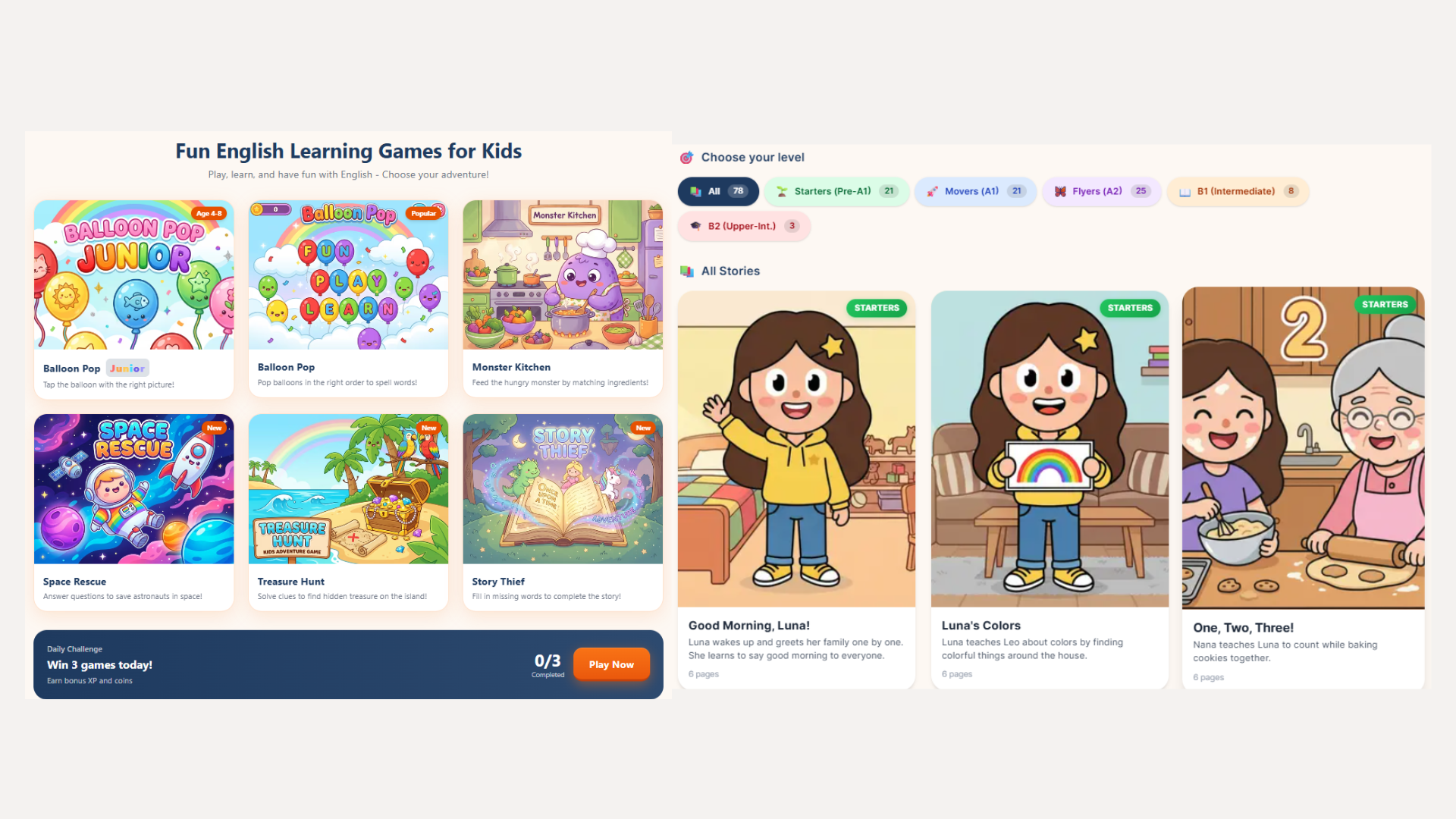
English doesn't have to stop on days without a lesson. Flalingo Stories has 165 English stories for ages 4 to 12, sorted by levels such as Starters, Movers and Flyers. Flalingo Games offers word and spelling games for ages 4 to 13, and children can play some of them with friends. For ways to enjoy the stories, see Free English Stories.
Learn more about how FLAI works in What Is FLAI, and how it differs from other children's services in Flalingo Kids vs Novakid.
Key Features
- 25-minute, one-on-one live lessons
- Age-appropriate curricula for ages 3–5, 6–8, 9–12, and 13 and up
- Teachers trained in pedagogy (only 1 in 73 applicants is hired)
- Native-speaking teachers available on every plan
- Smart Matching uses 18 criteria to recommend compatible teachers, making it easier to stay with the same teacher
- Age-specific Smart Personalized Books (Nia & Leo series and The Loop series)
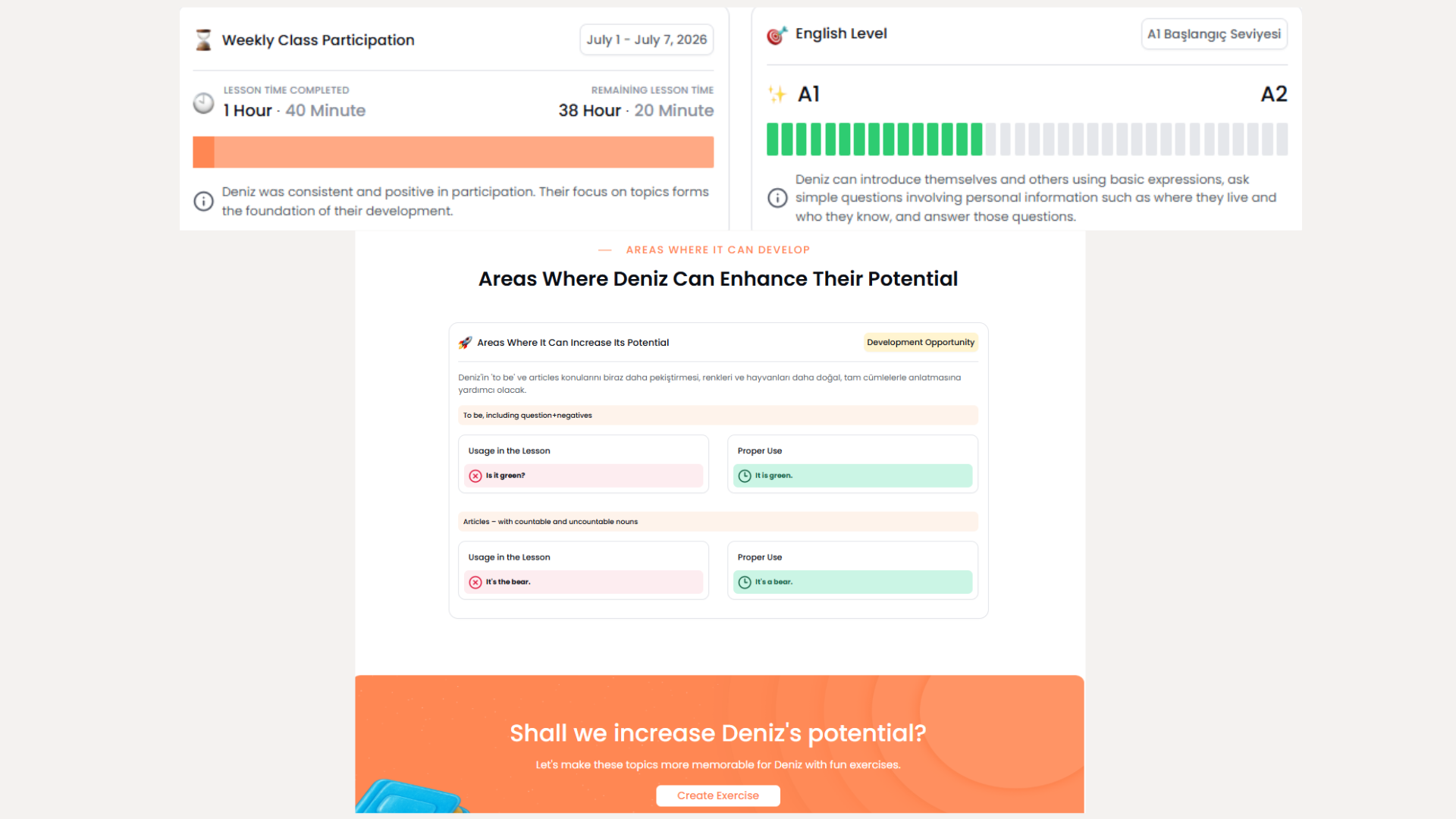
- FLAI reports after every lesson and weekly parent reports
- Personalized review exercises based on mistakes
- Parents can view lesson recordings at any time
- 24-hour live support and messaging with teachers
- Flalingo Stories (165 stories) and Flalingo Games
- IELTS and TOEFL preparation for middle and high school students
- Free children's level assessment and free trial lesson
Pricing
There are two plans for children, 6 months and 12 months, both with 25-minute lessons. Native-speaking teachers, Smart Personalized Books, FLAI reports, 24-hour support and access to lesson recordings come with both, and the 12-month plan adds group lessons. With one lesson a week, the figures look like this. Current prices are on the Flalingo Kids pricing page.
- An additional 20% discount for a second sibling on all plans
- Free trial lesson: 25 minutes, no credit card required
- Full refund within 30 days, for any reason
- No automatic renewal when the plan ends
The cost per lesson is higher than that of budget services in Japan. That difference covers age-specific learning materials, continuity with the same teacher, reports after every lesson, and native-speaking teachers. If you are unsure which plan suits you, Flalingo Kids Pricing and Plans breaks down the options by learning goal.
Prices last checked: November 2026.
Recommended For
- Children aged 3–6 learning English for the first time, whose families want them to develop a love of English through play
- Elementary school students who want to review or get ahead in their school English lessons at home
- Shy children who feel more comfortable speaking with the same teacher each week
- Middle and high school students aiming to take international exams such as IELTS or TOEFL
- Parents who want to follow their child's progress through reports, even if they are not confident in English
- Budget: From ¥4,014 per month on the 12-month plan (one 25-minute lesson per week)
Parent Reviews
Flalingo has a rating of 4.9 out of 5 from 710 Google reviews (as of November 2026). Here are two reviews from parents whose children take lessons.
#2 GLOBAL CROWN: Build a Routine with Fixed Lesson Times and an App
GLOBAL CROWN is an online English conversation service for children, with enrollment open from age three. It is designed for preschoolers through elementary school students, and enrolled students can continue after graduating from elementary school. Teachers are selected through a process with a 10% acceptance rate, and a key feature of the service is that they speak both Japanese and English.
Each lesson lasts 20 minutes—a manageable length that helps even young children stay focused. What sets it apart from other services is its fixed weekly schedule. There is no need to book each lesson, and a feature automatically matches students with suitable teachers. For busy families, this helps prevent a week from slipping by because someone forgot to book.
The fees include both online lessons and the app. The app offers vocabulary and phrase games, AI pronunciation checks, and tests that let children advance to the next level when they pass, providing practice on days without lessons. Parents receive a record of each lesson and a monthly report, and online consultations are also available. However, the official website did not explain how the program connects with elementary school English classes. Some reviews also say that the level-up tests are graded strictly and that lessons repeat the same material.
Main Features
- 20-minute one-on-one lessons
- Enrollment from age three, mainly for preschoolers and elementary school students
- Teachers selected through a process with a 10% acceptance rate
- Fixed weekly lesson times with no booking required, plus automatic matching with suitable teachers
- App featuring vocabulary and phrase games, AI pronunciation checks, level-up tests, and badges
- Records of each lesson, monthly reports, and online consultations
- Up to 10 free lesson reschedulings per month
- Enrollment and learning materials fees: $0; free trial includes two lessons and selected app features
Pricing
Prices depend on how many online lessons you take (one to five a week) and how long the plan runs. All app features come with every plan.
- Monthly plan (change or cancel at any time): ¥11,500 for one lesson a week, ¥15,200 for two, ¥17,600 for three, ¥21,200 for four and ¥23,600 for five
- 12-month plan: from ¥9,800 for one lesson a week to ¥20,100 for five
- 24-month plan: from ¥9,200 for one lesson a week to ¥18,900 for five
- On the 12- and 24-month plans you still pay monthly. If you cancel early, you are charged the difference from the standard price for the months you've used
- Joining fee and materials fee: ¥0
- Free trial: 2 online lessons and some app features
The official website recommends two or more lessons a week. The price per lesson is ¥2,875 at one lesson a week and drops to ¥1,467 at five.
Pricing last checked: November 2026. Please check the pricing page on the official website for the latest rates.
Recommended For
- Children ages 3–8 who want to take short lessons regularly at a fixed time
- Dual-income families with little time to manage weekly bookings
- Families who want their children to engage with English through an app on days without lessons
- Budget: from ¥9,200 per month (24-month plan, once a week)
Parent Reviews
GLOBAL CROWN has a rating of 3.37 out of 5 based on 31 reviews on Minhyo (as of November 2026). Here is one positive review and one critical review.
#3 DMM Eikaiwa: Get Comfortable with English at an Affordable Price
DMM Eikaiwa is best known as a service for adults, but it also offers learning materials and teachers for children. It provides free access to over 270 learning materials tailored to preschool, elementary, and junior high school students. Its “Find Teachers for Kids” feature lets you narrow down your search to teachers who are good at teaching children. Each lesson lasts 25 minutes, and bookings are available around the clock.
There is no separate plan for children; they use the same plans as adults. The Standard plan offers teachers from more than 116 countries, and families who want native speakers from countries such as the US or the UK switch to the Plus Native plan. Eight lessons a month start at ¥4,880, which makes it an easy way in for families who first want to see whether online lessons suit their child.
The trade-off is that parents are responsible for choosing the curriculum and teachers. There is no system for assigning a regular teacher, so if you want to continue with the same person, you'll need to find a teacher you like and book them each time. Keep in mind that popular teachers' slots tend to fill up quickly. We could not find any information on the official website about progress reports for children.
Key Features
- 25-minute one-on-one lessons, available 24/7
- Over 270 free learning materials for preschool, elementary, and junior high school students
- Search feature for teachers who teach children
- Standard Plan (teachers from over 116 countries) and Plus Native Plan
- Plans ranging from eight lessons a month to daily lessons
- Seven-day free trial with unlimited lessons
Pricing
- Standard plan: ¥4,880 for 8 lessons a month, ¥6,980 for one lesson a day
- Plus Native plan: ¥12,980 for 8 lessons a month, ¥22,880 for one lesson a day
- Free trial: 7 days of unlimited lessons
When we checked in November 2026, the site was showing a first-month price at a quarter of the usual rate (¥1,220 for 8 lessons a month or ¥1,745 for one lesson a day on the Standard plan). To get the offer, the same plan has to renew automatically once after the paid plan begins.
Pricing last checked: November 2026. For current prices and promotions, see the pricing plans on the official website.
Best Suited For
- Children new to online English lessons who want an affordable way to try them
- Children with busy extracurricular schedules who need flexible lesson times
- Families who don't mind choosing teachers and materials together
- Budget: From ¥4,880 per month (eight lessons)
Parent Reviews
On Minhyo's “Online English Lessons for Children” page, DMM Eikaiwa has a rating of 2.89 out of 5 based on four reviews (as of November 2026). The two reviews featured below were posted in 2017, so prices and systems may have changed since then.
#4 Hatchlink Junior: Three Courses Tailored to School Level
Hatchlink Junior is an online English conversation service exclusively for children, from preschoolers through junior high school students. Most instructors hold teaching licenses, and some also have qualifications such as TESOL or TEFL. Only 5% of applicants are hired after a document screening, two interviews, and a demonstration lesson. Before teaching their first class, instructors complete 30 hours of on-the-job training and 50 hours of practical training.
There are three courses to choose from based on your child's age and goals. The Basic course is for all ages and lets students choose their preferred materials and work at their own pace. The Preschool (Developing an English-Speaking Mind) course uses an age-based curriculum for children ages 3–6, with the aim of making learning English fun. The Elementary and Junior High School (Aligned with the New National Curriculum Guidelines) course follows school English curricula and suits children who want to do well in their school classes. This course also offers Eiken test preparation.
Booking is flexible: simply check instructors' schedules and choose an available time. Same-day bookings can be made up to one hour before a lesson, and cancellations are accepted up to two hours beforehand. Lessons can be rescheduled within the same month. Families with two or more children will also appreciate being able to share lessons among siblings and family members. One reviewer said that after requesting help with answering in full sentences, the teacher patiently worked with their child on this.
Key Features
- A service exclusively for children, from preschool through junior high school
- Most instructors hold teaching licenses (5% hiring rate, 30 hours of on-the-job training, and 50 hours of practical training)
- Three courses: Basic, Preschool (Developing an English-Speaking Mind), and Elementary and Junior High School (Aligned with the New National Curriculum Guidelines)
- Monthly plans with 4–30 lessons, plus a points-based option for additional lessons
- Same-day booking up to one hour before a lesson, cancellation up to two hours before, and rescheduling within the same month
- Lesson sharing among siblings and family members
- Lessons held on Zoom
- Two free trial lessons
Pricing
- Basic course: ¥3,800 for 4 lessons a month, ¥5,500 for 8, ¥7,900 for 12, ¥10,500 for 16, ¥12,900 for 20, ¥14,300 for 24 and ¥16,100 for 30
- Pre-school (English brain development) and Primary and junior high (aligned with the new Course of Study) courses: ¥4,100 for 4 lessons a month, ¥6,400 for 8, ¥9,300 for 12, ¥12,300 for 16, ¥15,200 for 20, ¥17,200 for 24 and ¥20,000 for 30
- For more lessons, a points course can be added to a monthly plan
- Payment: credit card (charged automatically each month) or bank transfer for three months or more
- Pausing or cancelling: let them know at least 7 days before the payment date
- Free trial: 2 lessons
Pricing last checked: November 2026. For current prices, please check the pricing page on the official website.
Recommended For
- Elementary and junior high school students who want to review material in line with their school English classes
- Children ages 3–6 learning English for the first time
- Families who want siblings to share a plan
- Budget: From ¥3,800 per month (Basic course, 4 lessons/month)
Parent Reviews
Hatchlink Junior has a rating of 3.05 out of 5 on Minpyo, based on six reviews as of November 2026. With so few reviews available, we recommend taking the free trial to get a feel for the lessons yourself. Here are two reviews.
#5 Novakid: Fun Learning in a World of Games
Novakid is an online English school for children aged 4 to 15. One-to-one lessons last 25 minutes, and classes are split by age. Novakid has more than 3,900 qualified teachers and says only 1 in 11 applicants gets through its ten-step hiring process.
The curriculum follows CEFR levels Pre-A1 through B1, with each level building on the last. Its standout feature is gamification. Children choose their own avatars and earn stars and certificates for completing homework. For children around ages 4–6, the fun of collecting these rewards provides motivation to attend lessons each week. Parents can manage lessons through a dedicated account and receive teacher feedback and a lesson recording after every session.
The pricing is harder to read. The official website shows "from ¥17,800 a month", but the price changes with lesson frequency, teacher category and course length, and there's no full price list. As one of the reviews below points out, native-speaking teachers need a higher plan. There's no regular-teacher system either; you choose and book teachers yourself.
Key Features
- 25-minute one-on-one lessons (ages 4–15, organized by age)
- More than 3,900 qualified teachers (one in 11 applicants hired)
- Curriculum covering CEFR Pre-A1–B1
- Game elements such as avatars, stars, and certificates
- Parent account, teacher feedback, and recordings of every lesson
- 45-minute speaking groups
- Free trial lesson (no credit card required)
- 14-day money-back guarantee
Pricing
- Shown on the official website: from ¥17,800 a month
- The price depends on lesson frequency, teacher category and course length; longer courses cost less per lesson
- Discounts for long courses, seasonal promotions and two or more siblings (rates not published)
- Two to three lessons a week recommended
- 14-day money-back guarantee; after that, refunds are calculated on the lessons already taken
- Free trial lesson (no credit card required)
Pricing last checked: November 2026. For exact pricing based on your child’s lesson frequency, check the official pricing page and contact support.
Best Suited For
- Children aged 4–9 who are motivated by games and rewards
- Families who can set aside regular time slots two to three times a week
- Parents who want to watch recordings of every lesson
- Budget: from ¥17,800 per month
Parent Reviews
Novakid has a Trustpilot rating of 4.3 out of 5, based on 2,603 reviews (as of November 2026). Here are two reviews from parents in Japan.
#6 QQ Kids (QQEnglish Kids): Full-Time Teachers and a Nine-Year Curriculum
QQ Kids is an online English conversation service for children run by QQEnglish. It is available for ages 3 and up. All instructors are full-time employees and are required to obtain TESOL, an internationally recognized qualification for teaching English. Rather than working part-time from home, they teach from dedicated offices, helping ensure stable connections without household noise.
The curriculum spans nine years and six levels. It begins with a “shower of sounds” and ultimately aims to help children express themselves in their own words. Materials include English for Little Ones for ages 3 through the early elementary grades, the core Smart Kids series, Reading for Kids for reading practice, and Time to Read for junior and senior high school students. Children progress from phonics and pronunciation fundamentals to English grammar. Curricula for proficiency tests, including EIKEN interview preparation, are also available.
The monitoring features offer reassurance for parents. You can watch lessons remotely in real time and review recordings afterward. Detailed feedback is provided after every lesson. Pricing uses a points system, with the number of points required varying by instructor, from 40 points for new instructors to 120 points for experienced ones. Some reviewers noted differences in how instructors interact with students and said that the booking screen showed many new instructors.
Main features
- 25-minute one-on-one lessons, available 24 hours a day
- For ages 3 and up
- All instructors are full-time employees with TESOL qualifications and teach from dedicated offices
- Nine-year, six-level curriculum (English for Little Ones, Smart Kids, Reading for Kids, Time to Read)
- Phonics, pronunciation, English grammar, and topic-based conversation
- Real-time monitoring, lesson recordings, and feedback after every lesson
- Points system (40–120 points depending on the instructor), with unused points shareable among family members
- Two free trial lessons (the first includes a level assessment)
Pricing
- 4 lessons a month: ¥3,280 (¥820 per lesson)
- 8 lessons a month: ¥6,180 (¥773 per lesson)
- 16 lessons a month: ¥9,680 (¥605 per lesson)
- Lesson counts assume a 50-point teacher. The points needed vary by teacher, from 40 for new teachers to 120 for experienced ones
- Joining fee, annual fee and cancellation fee: ¥0
- Payment by credit card (Visa, Mastercard, JCB) via PayPal
- The plan is a subscription and renews automatically until you cancel
- Free trial: 2 lessons (the first is a level check). You are not signed up to a paid plan automatically afterwards
When we checked in November 2026, new members could get their first month for ¥9 (with a minimum of two months; the standard price applies from the second month).
Pricing last checked: November 2026. Please check the pricing page on the official website for the latest rates.
Recommended for
- Children from age 3 through junior high school who want to build their skills step by step using a structured set of materials
- Families who want to monitor young children's lessons remotely
- Families looking for an affordable start with four lessons a month
- Budget: From ¥3,280 per month (four lessons)
Parent reviews
On Minhyo, QQEnglish, including QQ Kids, has a rating of 2.80 out of 5 based on 26 reviews (as of November 2026). Here are two reviews that include comments about children's lessons.
#7 Kimini English (Kimini): Gakken Group learning materials, starting in early childhood
Kimini English is an online English lesson service operated by the Gakken Group. It caters to a wide range of learners, from children to adults, with over 110 courses organized by goal and level. For children, it offers an introductory English course for preschoolers, while its courses for school students are based on Japan's national curriculum guidelines. It has also been adopted by more than 200 educational institutions across Japan.
Each lesson lasts 25 minutes and is available from 6:00 a.m. to midnight Japan time. There are over 2,000 teachers, whom you can search for by age and interests. The most popular plan, Standard Plus, includes one lesson a day, a monthly speaking test, AI conversation practice (Kimini AI), and skill-specific training. EIKEN preparation courses cover Grade 5 through Grade Pre-1, including the second-stage interview tests.
Keep in mind that available lesson times and courses vary by plan. The lower-priced Weekday plan is available only from 9:00 a.m. to 4:00 p.m. on weekdays, leaving very little overlap with the hours after elementary school children get home. For children, Standard Plus or the eight-lessons-per-month plan, both with broader availability, are more practical options. Also note that the free trial automatically converts to a paid plan when it ends.
Key Features
- 25-minute one-on-one lessons (6:00 a.m. to midnight Japan time, depending on the plan)
- Operated by the Gakken Group, with over 110 courses
- Introductory English courses for preschoolers and courses for school students based on national curriculum guidelines
- Over 2,000 teachers, searchable by age and interests
- Speaking tests (once a month with Standard Plus)
- Kimini AI and skill-specific training (Plus plans)
- Adopted by over 200 educational institutions across Japan
- Free trial (10 days for Standard Plus and Weekday; 3 days for the eight-lessons-per-month plan)
Pricing
- Standard Plus: ¥7,480 a month (one lesson a day, 6am to midnight, all courses)
- 8 lessons a month: ¥4,840 a month (6am to midnight, some restrictions)
- Weekday: ¥4,840 a month (one lesson each weekday, 9am to 4pm, some restrictions)
- Single lesson ticket (Filipino teachers): ¥605 with a plan, ¥1,210 without
- Free trial: 10 days on Standard Plus and Weekday, 3 days on the 8-lesson plan
- From 10 to 16 November 2026, Standard Plus is half price for three months (¥3,740 a month, tax included)
- Renews automatically; cancel through the dedicated form by the day before renewal
Pricing last checked: November 2026. Please check the pricing page on the official website for current rates.
Recommended For
- Families who want to introduce English during the preschool years using Gakken learning materials
- Elementary and junior high school students who want courses connected to their school English lessons
- Children who have time to take lessons every day
- Budget: From ¥4,840 per month (eight lessons per month)
Parent Reviews
Kimini English has a rating of 2.77 out of 5 based on 10 reviews on Minhyo (as of November 2026). Here are two reviews, including feedback from a parent taking lessons alongside their child.
Which combination is right for our family?
Rather than asking which service is best, think about which combination of features addresses your child's challenges. This makes it easier to avoid choosing the wrong service. Here are some common situations.
- Shy and slow to speak up: one-to-one lessons with the same teacher every week, plus age-based materials that start with play. Flalingo Kids is built around both.
- Too busy to manage bookings: GLOBAL CROWN, with its fixed day and time.
- Worried about keeping up with English at primary school: Flalingo Kids, which can follow school English, the primary and junior high course at Hatchlink Junior, or Kimini's courses for school students.
- Want to try it cheaply first: QQ Kids, Hatchlink Junior or DMM Eikaiwa, all starting at around ¥3,000 to ¥5,000 a month.
- A young child who tries harder when there's a game: Novakid, or Flalingo Kids with its game-version units and Flalingo Games.
- Want to keep going into junior high, with international exams in view: Flalingo Kids, which runs all the way to IELTS and TOEFL.
Whichever service you choose, have your child take the same level assessment before starting and again after three months, then compare the results. If there is no change, the service may not be right for your child at this stage. Our service is no exception.
In our evaluation, we placed the greatest weight on relationships that help children feel comfortable speaking and systems that keep parents informed. We ranked Flalingo Kids first for its combination of age-specific curricula, the same teacher each week, FLAI reports after every lesson, and native English-speaking teachers at no extra charge.
If you're also looking for English conversation lessons for yourself, take a look at Best Online English Courses in Japan (2026): 7 Platforms Compared.
Book a free trial lesson for your child
لدينا محتوى آخر قد يجذب اهتمامك

Best Online English Courses for Kids in Brazil (2026): 7 Platforms Compared
اقرأ المزيد
English Education for Ages 4–5: Not a Lesson for Your Child, but an English Playtime!
اقرأ المزيد

I'm Bright. I am a British-Nigerian English teacher with seven years of experience. I create engaging and tailored lessons that build confidence and fluency to support students to achieve their goals. My aim is to unlock the potential of students from different cultures, making the learning process both efficient and enjoyable.
الإنجليزية مع فلالينجو

تعلم الإنجليزية مع فلالينجو يعني التقدم من خلال نظام ذكي يعمل بشكل متكامل.