
Best 8 Online English Courses for Kids Ages 10–12
Something shifts around age ten. The child who used to repeat flashcard words happily starts rolling their eyes at cartoon-based lessons. They want to talk about real things. Music, gaming, sports, science, and they want to be taken seriously when they do it.
This is also the age when speaking anxiety either breaks or solidifies. A 10-year-old who has studied English for years but never felt safe enough to speak will carry that silence into secondary school and beyond. Stephen Krashen’s Affective Filter hypothesis makes this mechanism clear. When a learner feels anxious, embarrassed, or judged, a psychological barrier rises and blocks the very input they need to acquire language. Preteens, who are acutely aware of how they sound and deeply sensitive to peer comparison, have this filter running high almost by default.
The right English course for a 10-to-12-year-old does not simply deliver grammar drills. It lowers that filter. It pairs the child with a teacher who actually knows their interests. It provides evidence of progress so the child can see themselves improving. And it does all of this within a structured curriculum, because unstructured conversation alone does not produce fluency at this level.
We analysed eight platforms against the criteria that matter most for this age group. We included live-teacher platforms, app-based tools, marketplace models, and institutional options to give parents a clear view of what each approach actually delivers for a preteen learner.
Six criteria shaped the ranking. Each one reflects a specific challenge that this group face as language learners:
- Speaking confidence design: Does the platform actively reduce performance anxiety and encourage production?
- Teacher continuity: Can the child build a relationship with one teacher over weeks and months?
- Curriculum depth: Is there a structured path from A2 to B1 and beyond, or just conversation?
- Interest alignment: Does the platform match teachers or content to the child’s actual interests?
- Progress visibility: Can the child and parent see measurable improvement after each lesson?
- Value and transparency: Clear pricing, refund terms, no hidden renewals.
A note on methodology: Every child is different. A competitive 12-year-old preparing for a Cambridge exam needs a different setup than a shy 10-year-old who freezes when asked to speak. This guide is built around what works for most learners in this age range.
Table of Content
- Quick Comparison Table
- #1 — Flalingo Kids: Best Overall for Ages 10–12
- #2 — 51Talk
- #3 — Cambly Kids
- #4 — Preply Kids
- #5 — Lingoda
- #6 — Babbel
- #7 — italki Kids
- #8 — British Council Online
- Oxford Discover and Teens curriculum with CEFR-aligned progression from A2 through B1+
- 25-minute or 50-minute one-to-one lessons designed around preteen attention spans and engagement patterns
- 100% native English teachers with verified pedagogical credentials and child-teaching experience
- Rigorous teacher selection: only 1 in 73 applicants accepted
- Smart Match algorithm analysing 18 data points, including interests like music, technology, sports, and science
- Fixed teacher model with 90%+ same-teacher booking rate
- FLAI AI Coach is generating accuracy, fluency, and lexical resource reports after every lesson
- FLAI Speaking: personalised AI conversation practice based on the child’s real errors
- Flomework adaptive homework engine with four exercise formats targeting specific weaknesses
- Lesson recordings for self-review and long-term progress tracking
- demo.flalingo.com for pressure-free AI speaking practice anytime
- Free level assessment at start.flalingo.com before parents commit
- 30-day unconditional refund policy, no automatic subscription renewal
- FLAI child safety monitoring across all sessions
- High-frequency model: 3 to 5 lessons per week at an affordable price point
- Gamified classroom interface designed for younger and preteen learners
- CEFR-aligned proprietary curriculum with structured progression
- Lesson recordings available for parent review
- Large teacher pool with flexible scheduling across time zones
- AI-based teacher recommendation system for initial matching
- Native-speaker tutors from the US, UK, Canada, and Australia
- Flexible on-demand scheduling with short-notice availability
- Conversation-focused lesson approach
- Session recordings available for review
- Large tutor pool across different accents and personalities
- 42,000+ English tutors across 155 countries
- Detailed tutor profiles with verified reviews and video introductions
- AI Lesson Insights for personalised between-lesson feedback
- Flexible 25- or 50-minute lesson options
- Full parent control over teacher selection and scheduling
- CEFR-aligned curriculum with structured level progression
- Group classes and private one-to-one lessons
- Certified native-level teachers
- Sprint challenges for intensive learning periods
- Progress dashboard with level tracking
- Structured grammar and vocabulary courses with clear progression
- Speech recognition for basic pronunciation practice
- Short daily lessons designed to be independent study
- No scheduling required; works on the child’s own timetable
- Subscription at a fraction of live-lesson costs
- Marketplace with thousands of English teachers across every price point
- Full parent control over teacher selection, content, and scheduling
- Community and professional tutor tiers with verified reviews
- Consistent weekly booking available once a tutor is selected
- British Council-certified teachers following the institutional curriculum
- CEFR-aligned progression with the Cambridge exam preparation pathway
- Structured skills-based lessons covering grammar, reading, writing, and speaking
- Global institutional recognition
- Progress reports through the British Council system
Quick Comparison Table
#1 — Flalingo Kids: Best Overall for Ages 10–12
Flalingo Kids approaches the 10-to-12 age group differently from most platforms. Where many services simply extend their younger-child lessons upward, Flalingo has built a distinct experience for preteens. The Oxford Discover and Teens curriculum drives the academic structure, covering global topics that actually interest kids this age. These are not watered-down adult lessons or inflated children’s material. They sit exactly where a 10-to-12-year-old’s curiosity lives.
The platform’s Smart Match algorithm plays a critical role at this age. It does not randomly assign teachers. It analyses 18 data points, including the child’s interests, preferred communication style, and learning pace, then matches them with a teacher who shares genuine common ground.
Every lesson generates an FLAI report, an AI-powered analysis that goes beyond a simple attendance note. After each session, the child sees concrete data: “You improved fluency 12% this week” or “You used 5 new B1-level phrases correctly.” To a 10-year-old who doubts their progress, that kind of feedback is transformative.
Flalingo’s FLAI Speaking module extends practice beyond live lessons. It generates personalised speaking exercises based on the child’s actual mistakes from their most recent session. The child can practise pronunciation, rehearse sentence structures, and build confidence in a pressure-free AI environment before bringing those skills back to their next live lesson with their teacher.
The fixed-teacher model is especially important at this age. Preteens are building a sense of identity, and they respond to mentorship differently than younger children do. A teacher who remembers what a child said last week, who asks about their school project, who notices when their confidence grows, creates a learning relationship that no rotating-tutor model can replicate. Flalingo maintains a same-teacher booking rate above 90%, and the platform’s scheduling system actively prioritises continuity.
Lesson recordings are available for both parents and children. For a child, the ability to watch their own progress over time is a powerful motivator. Hearing how they sounded two months ago compared to today makes improvement tangible in a way that report cards and test scores do not.
Parents also receive a separate FLAI summary, showing what was covered, which skills were practised, and three recommended actions for the week. For parents who cannot sit in on every session, this closes the visibility gap entirely.
Key Features
Price
Packages run approximately $40 to $130 per month, depending on lesson frequency and package length. A trial lesson is available. There is no auto-renewal, so your plan does not roll over unless you actively choose to continue.
Prices last checked: May 2026. Always verify current packages on the platform’s website before purchasing.
Best For
Parents who want their chlid to move beyond passive English comprehension and start speaking with confidence. The combination of Smart Match (interest-based teacher pairing), FLAI Speaking (measurable fluency data), and Oxford Discover curriculum makes Flalingo the strongest option for preteens who know some English but freeze when asked to produce it. Particularly well suited to children approaching secondary school who need to bridge the gap between classroom English and real spoken fluency.
#2 — 51Talk
51Talk’s pitch for this age group is frequency. The platform’s pricing structure makes it realistic for a 10-to-12-year-old to take English lessons three to five times a week, something that most premium platforms price out of reach. Repetition builds fluency faster than infrequent high-quality sessions, and 51Talk leans into this logic fully.
Teachers on 51Talk are primarily Filipino ESL educators who hold TEFL certifications and undergo structured training. They are proficient, professional, and experienced with young learners. However, they are not native English speakers. To children whose phonemic foundations are largely set, this matters less than it would for a 4-year-old. But it still matters to accent modelling and natural intonation at the intermediate level.
The platform follows a CEFR-aligned proprietary curriculum and uses a gamified classroom interface that works well for keeping preteens engaged. Lesson recordings are available to parent review, and teacher-written progress notes are provided periodically.
Key Features
Price
Approximately $40 to $100 per month, depending on lesson frequency and package length. This is the most affordable live-teacher option in this comparison for families who want multiple weekly lessons.
Prices last checked: May 2026. Always verify current packages on the platform’s website before purchasing.
Best For
Families who prioritise exposure frequency above all else, or who want to pair an affordable daily-practice platform with a more structured weekend lesson elsewhere. Also suits preteens who need volume of speaking practice to build confidence before worrying about accent precision.
What People Are Saying?
User reviews can provide valuable insights when assessing online language learning platforms, though they should be interpreted carefully.
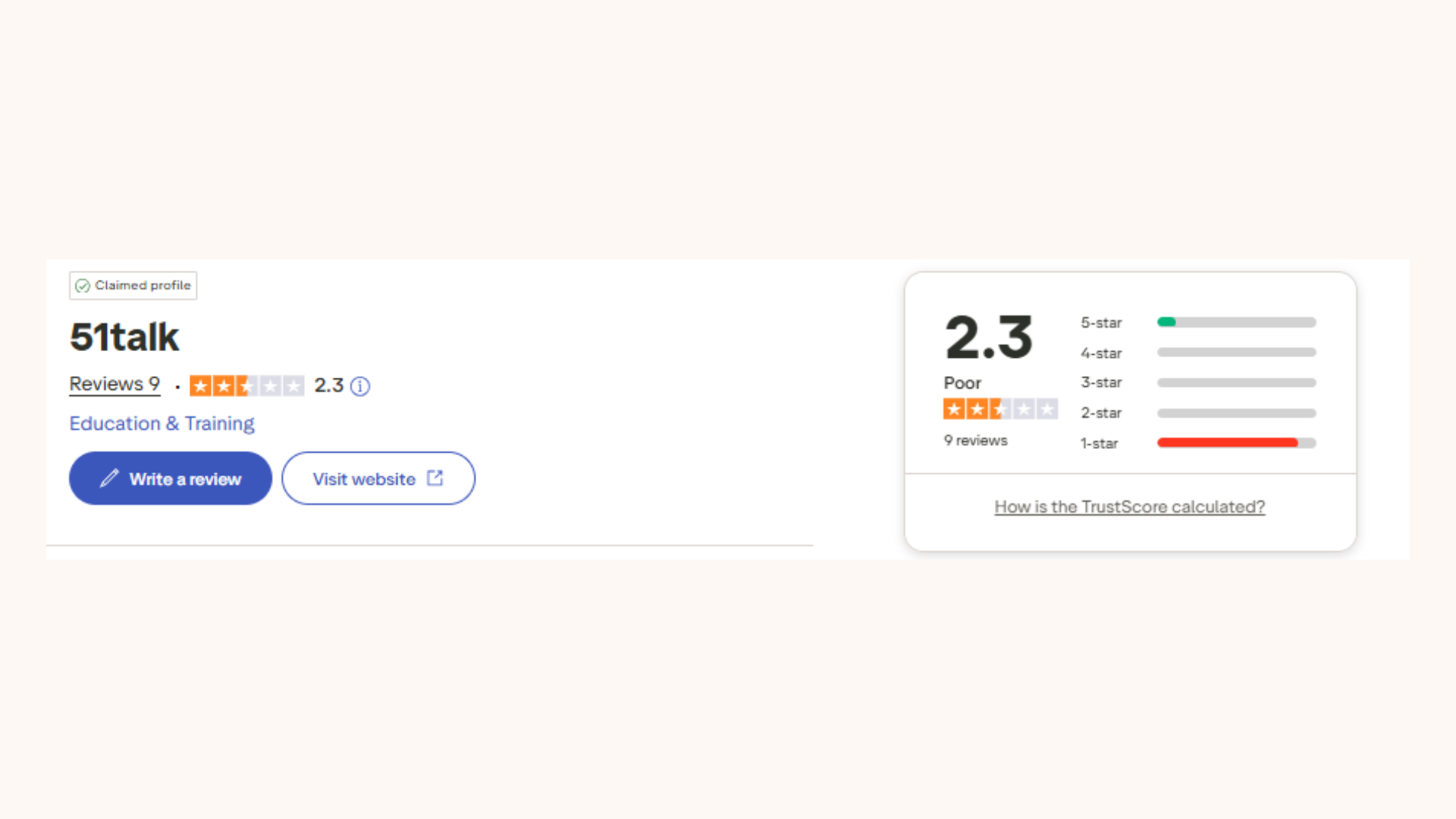
At the moment, 51Talk holds a 2.3 rating on Trustpilot based on just 9 reviews. Given the limited number of responses, the rating alone may not yet provide a fully dependable picture of the platform’s overall quality. If you would like to explore the feedback yourself, you can read the reviews here: 51Talk Trustpilot
#3 — Cambly Kids
Cambly Kids connects children with native English-speaking tutors through video calls, emphasising free conversation over rigid lesson plans. Children who already have a foundation in English and need real speaking practice with native speakers can use the platform for genuine accent exposure across American, British, Australian, and Canadian varieties.
The scheduling model is highly flexible, with tutors often available on short notice. This suits families with unpredictable routines. However, Cambly Kids does not enforce standardised pedagogical training. Some tutors are certified teachers with years of classroom experience; others are enthusiastic native speakers without formal teaching backgrounds.
Teacher continuity is possible if parents actively rebook the same tutor each week, but the platform does not guarantee availability or prioritise continuity in its system design. There is no AI-driven progress reporting, and post-lesson feedback depends entirely on the individual tutor.
Key Features
Price
Approximately $99 to $199 per month, depending on lesson frequency and package tier. This positions Cambly Kids at the higher end of the range while offering less structural consistency than top-ranked alternatives.
Prices last checked: May 2026. Always verify current packages on the platform’s website before purchasing.
Best For
Families looking for supplemental native-speaker conversation practice alongside a more structured primary platform. Works well for preteens who already have good grammar foundations and need to build listening flexibility and natural conversational flow.
#4 — Preply Kids
Preply is a global tutoring marketplace where parents search, compare, and book English teachers based on profiles, video introductions, and verified student reviews. The platform offers a massive tutor pool spanning over 42,000 English teachers across 155 countries, giving families more choice than any closed-marketplace alternative.
Parents who know exactly what they want in a teacher can filter by certification, accent, specialisation, price, and availability. Once a strong tutor is found, consistent weekly booking is straightforward, and Preply’s AI Lesson Insights tool provides personalised feedback between sessions.
The trade-off is that Preply sets no central curriculum. Lesson quality, structure, and progression depend entirely on the individual tutor. Parents who are willing to invest time upfront in vetting and trial lessons can find outstanding teachers at competitive prices. Parents who want a ready-made system may find the setup process demanding.
Key Features
Price
Approximately $40 to $250+ per month, depending entirely on the tutor selected and lesson frequency. Community tutors sit at the lower end; certified professionals with strong track records cost more.
Prices last checked: May 2026. Always verify current packages on the platform’s website before purchasing.
Best For
Parents who want maximum flexibility and are willing to invest time in finding and vetting individual tutors with specific preteen English experience. A strong option for families who already know what teaching approach works.
#5 — Lingoda
Lingoda is a Berlin-based online language school offering structured English courses aligned with CEFR standards. The platform provides both group classes and private one-to-one lessons, all taught by certified native-level teachers. To European families familiar with the CEFR framework, Lingoda offers a recognisable progression path.
Lingoda’s group class option can be a double-edged feature. Some preteens thrive in small-group environments where peer interaction adds energy and variety. Others, particularly those with speaking anxiety, find the presence of other learners inhibiting. The platform does not offer a dedicated children’s programme, which means preteens are typically placed in classes designed for a broader age range.
Teacher continuity is limited by design. Lingoda uses a rotating teacher model, which means the child meets a different instructor for most sessions. While each teacher follows the same structured curriculum, the lack of a consistent relationship can slow trust-building for preteens.
Key Features
Price
Approximately $80 to $220 per month, depending on group vs. private format and lesson frequency. Group classes sit at the lower end.
Prices last checked: May 2026. Always verify current packages on the platform’s website before purchasing.
Best For
European families who value CEFR-mapped progression and want the option of small-group classes. Suits confident, outgoing preteens who enjoy learning alongside peers.
#6 — Babbel
Babbel occupies a completely different space in this comparison. There is no live teacher. Babbel is an app-based self-study platform built around structured grammar and vocabulary courses, speech recognition exercises, and short daily practice sessions. It works as a supplement, never as a primary English learning solution.
What Babbel does well is grammar scaffolding. The courses are clearly structured, professionally produced, and broken into manageable units that a preteen can work through independently. The speech recognition feature provides basic pronunciation feedback, though it does not match the depth of a live teacher’s correction.
What Babbel does not do is teach children to speak in conversation. There is no live interaction, no real-time error correction, no conversational pressure. A 10-year-old who uses Babbel alone will build grammar knowledge and passive vocabulary, but will not develop the spoken fluency or confidence that live interaction produces. Parents who want both should pair Babbel with a live-teacher platform.
Key Features
Price
Approximately $8 to $13 per month. By far the lowest cost in this comparison, reflecting its nature as an app-based supplement rather than a live instruction platform.
Prices last checked: May 2026. Always verify current packages on the platform’s website before purchasing.
Best For
Preteens who need structured grammar reinforcement alongside a live-teacher platform. Not a standalone solution for spoken fluency.
#7 — italki Kids
italki operates as a language tutor marketplace where parents browse thousands of teachers, compare profiles and reviews, and book lessons independently. The platform sets no curriculum requirements; each tutor determines their own teaching approach. This gives italki the widest price range and the most diverse teacher pool in this comparison.
italki requires more effort up front than curated platforms. Finding a tutor with genuine preteen teaching experience takes research. Reading reviews, watching introduction videos, and booking trial lessons are part of the process. But to families willing to invest that time, italki can surface high-quality tutors at price points that closed-marketplace platforms cannot match.
Once a strong tutor is found, continuity is entirely in the parents’ hands. There is no algorithm to help, but there is also no system preventing you from booking the same person every week. Progress reporting depends on the individual tutor; italki itself does not generate lesson analytics.
Key Features
Price
Approximately $40 to $250+ per month, depending on the tutors selected and booking frequency. Community tutors are at the low end; certified professionals with proven track records are at the higher end.
Prices last checked: May 2026. Always verify current packages on the platform’s website before purchasing.
Best For
Budget-conscious families willing to invest time in finding the right tutor, or parents who want full control over lesson content and teaching style for their preteen.
#8 — British Council Online
The British Council is one of the most recognised names in English language education worldwide. Its online teen programme offers structured courses taught by British Council-certified teachers, following the organisation’s proprietary curriculum. Families who value institutional credibility and want a certification pathway that carries weight in academic contexts, this brand recognition is a genuine advantage.
The British Council’s approach is more academic than most platforms in this comparison. Lessons are structured around grammar, reading, writing, and speaking skills in a formal framework. This can be excellent for preteens preparing for Cambridge exams or building toward formal English certifications. It can also feel rigid to children who respond better to conversational, interest-driven learning.
Progress reporting is provided through the British Council’s own systems, though it lacks the real-time AI analysis that newer platforms offer. Teacher continuity varies depending on the specific programme and location. Pricing sits at the higher end, reflecting the institutional brand and certification value.
Key Features
Price
Approximately $70 to $152 per month, depending on programme type, lesson format, and frequency. Pricing reflects the institutional brand and certification pathway rather than per-feature value.
Prices last checked: May 2026. Always verify current packages on the platform’s website before purchasing.
Best For
Families who want English learning tied to a formal certification pathway (Cambridge YLE, KET, PET) and value institutional brand recognition. Best suited for academically oriented preteens who are preparing for secondary school entrance exams or international school applications.
If there is one thing this comparison makes clear, it is that 10-to-12 is the age when speaking anxiety either breaks or hardens. Every platform on this list handles that challenge differently. Some focus on frequency, betting that sheer volume of practice will override hesitation. Some offer flexibility, giving parents full control over teacher selection. Some provide institutional credibility and exam pathways.
The platforms that scored highest share specific traits: they pair children with teachers who share their interests, they provide measurable evidence of progress, and they maintain teacher continuity so the child builds a genuine relationship rather than performing for a new stranger each week.
Looking for options for older kids? We’ve also reviewed and ranked the top online English learning programs for teenagers.
Frequently Asked Questions
My child has studied English for years but still won’t speak. Is that normal at age 10–12?
Yes, and it is one of the most common challenges at this age. Krashen’s Affective Filter research shows that anxiety and self-consciousness block language production even when comprehension is strong. The solution is not more grammar drills. It is a safe, consistent environment with a teacher the child trusts. Interest-based teacher matching and fixed teacher continuity are the two design features that address this most directly.
How many lessons per week should a 10–12-year-old take?
Two to three live lessons per week is the most effective range for most preteens. This frequency is high enough to build retention and momentum, but low enough to avoid burnout. Children who are preparing for specific exams may benefit from additional sessions during preparation periods.
Does it matter whether the teacher is a native speaker at this age?
It matters less than at ages 3 to 6, when phonemic foundations are still forming. By age 10, most children’s core pronunciation patterns are established. However, native-speaker exposure still adds value for natural intonation, idiomatic language, and cultural fluency. The more important factor at this age is whether the teacher has pedagogical training and experience with preteens specifically.
Should I sit in on my child’s online English lessons?
For 10-to-12-year-olds, sitting in is usually counterproductive. Preteens are highly aware of being observed, and a watching parent often increases the performance pressure that inhibits speaking. A better approach is to use a platform that provides structured post-lesson reporting, so you can see exactly what was covered and how your child performed without disrupting the session itself.
Can an app replace live English lessons for preteens?
No. Apps build grammar knowledge and passive vocabulary effectively, but they do not produce spoken fluency. Spoken language develops through live interaction where the learner must produce language under real-time conversational pressure. Apps work best as supplements to a live-teacher platform, reinforcing grammar and vocabulary between sessions.
What CEFR level should a 10–12-year-old be at?
This varies depending on when and how intensively the child started learning English. Many 10-to-12-year-olds who have had regular English exposure sit somewhere between A2 and B1. The transition from A2 (basic user) to B1 (independent user) is often the most impactful threshold, as B1 is where a child can start having real, unscripted conversations. Platforms with CEFR-aligned curricula make this progression visible and measurable.
Other content that may interest you


As an ESL educator of 5+ years, I am a guide for students and parents. I simplify complex English topics and online course selection for you. My goal is to help you turn learning from a stressful task into an enjoyable adventure.
English with Flalingo

Learning English with Flalingo means progressing with an intelligent system that works in an integrated manner.