
What Is FLAI? Discover the Power of AI for Learning English
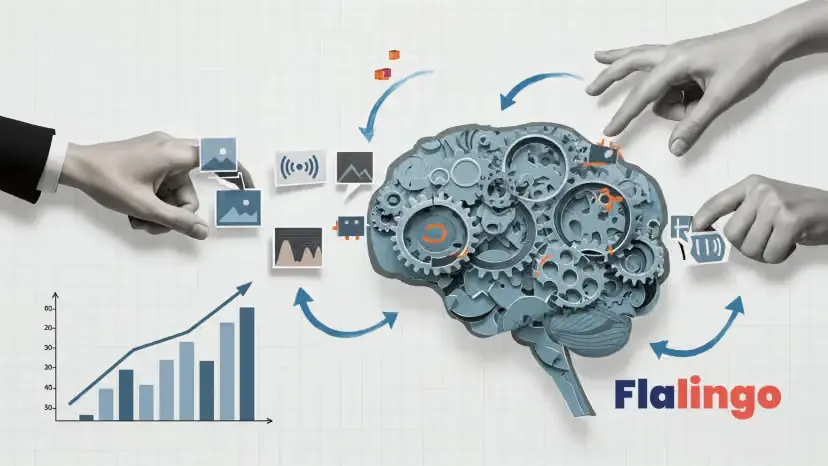
Picture yourself as an English teacher: you teach eight one-hour lessons a day. Throughout each lesson, you're mentally keeping track of how much your student is talking, which words they're using, and where their pronunciation slips up. This is exactly where FLAI (Foreign Language AI Analyzer) comes in — it uses AI to analyze the conversations that happen during your lessons, helping you follow your student's progress in far more detail.
Then, once the lesson ends, the real work begins: you have to put together a detailed evaluation report for every student. "How many new words did the student learn today? Was their speaking pace right? Did they get enough practice?" You spend roughly 15 to 20 minutes trying to answer these questions from memory and typing it all into a Word document.
Eight lessons a day adds up to more than two hours of evaluation work every single day. But what if there were a system that automated this entire process, gave you objective data, and freed up your time to simply focus on teaching?
The language-learning industry has gone digital fast over the past few years. Lessons over Zoom, interactive apps, and online platforms are now the norm. But despite this digital shift, evaluating lessons has largely remained a manual, time-consuming, and subjective process. This is exactly where a new generation of AI-powered analysis systems steps in.
Table of Contents
The Problem: The Burden of Manual Lesson Evaluations
One of the biggest operational challenges facing today's language-learning platforms is measuring and evaluating lesson quality consistently. Traditional evaluation methods fall short in several ways:
1. Time Cost
On average, a teacher spends 15 to 20 minutes evaluating a single lesson. For a teacher running 6 to 8 lessons a day, that's an extra 2 to 3 hours of work every day. From a platform's perspective, a company running 1,000 lessons a month is burning through 250 to 300 hours of human effort on evaluation alone. That drives up both teacher workload and costs.
A simple visualization of evaluation workload at the teacher and platform level.
Manual evaluations create 2–3 hours of extra workload per day for a single teacher; scaled up to a platform running 1,000 lessons, this climbs to 250–300 hours, adding up to a serious operational cost.
2. Subjectivity and Consistency Issues
Human evaluations are subjective by nature. One teacher might say a student "spoke well," while another would judge the exact same performance completely differently. A teacher's mood, fatigue level, or personal standards on any given day directly shape the evaluation. This inconsistency becomes a serious quality-control problem, especially for platforms working with multiple teachers.
3. Lack of Detailed Metrics
Traditional evaluations tend to rely on general impressions: "spoke well," "made a grammar mistake," "seemed shy." But none of that translates into concrete, measurable data. Critical details — exactly how many words the student used, what the speaking ratio looked like, which words they picked up — simply get lost. There's no real metric base to support data-driven decisions.
General impressions are quick, but they aren't measurable — and that makes them a poor basis for decisions and progress tracking. The metric-based approach on the right gives both teacher and student clear, actionable direction through concrete data like word count, speaking ratio, and new vocabulary.
4. Scalability Problem
At a small scale — say, a platform working with 5 to 10 teachers — manual evaluation might be manageable. But as the platform grows and the number of teachers climbs to 50, 100, or 500, keeping up with quality control becomes next to impossible. There simply aren't enough resources to manually review every lesson from every teacher.
5. Delayed Feedback
It usually takes a teacher one to two days to prepare an evaluation report and get it to the student. That delay breaks the student's learning momentum. By the time the feedback arrives, the mistakes they made or the words they learned during the lesson have already started to fade from memory — which cuts into how effectively they learn.
6. Lack of Data Analytics
With manual systems, tracking a student's progress over time is genuinely hard. Getting a concrete progress metric — like "they were using 150 words three months ago, and now they're using 420" — would mean manually combing through and comparing every single report. In practice, nobody does that, so valuable insights just slip away.
Word Usage – 3-Month Progress
Seeing this kind of growth consistently is hard with manual tracking. With automatic metric tracking, progress like 150 → 220 → 310 → 420 is visualized instantly, and development decisions are backed by real data.
Bottom line: the traditional evaluation system has become a bottleneck — one that wears teachers out, holds back platform growth, and falls short of giving students the experience they deserve.
FLAI: The AI-Powered Solution
FLAI (Foreign Language AI Analyzer) is an AI-powered, automated lesson-analysis system built to solve every problem outlined above. It takes the audio recordings of live language lessons, analyzes them with advanced AI technology, and produces detailed, objective, instantly accessible reports for teachers, students, and platform managers alike.
How Does FLAI Work?
FLAI's process runs through four main stages:
1. Lesson Recording and Data Collection
Every lesson that takes place on the platform — whether on Zoom, Google Meet, or a similar tool — is recorded automatically, either as an audio file or a video. FLAI then automatically pulls in these recordings and adds them to its processing queue.
2. AI-Powered Transcription
FLAI uses advanced transcription services such as the Gladia API to turn audio recordings into text. But unlike an ordinary transcription tool, FLAI actively applies "diarization" — speaker separation.
That means it can pinpoint exactly who said what, and when, during the lesson. The system produces a clearly separated transcript, something like: "Speaker 1: Hello, how are you?" and "Speaker 2: I'm fine, thank you."
3. In-Depth Analysis and Metric Generation
Once the transcript is ready, this is where FLAI really shows its strength. It analyzes the dialogue using large language models such as OpenAI's GPT-4, extracting detailed information that answers questions like:
- Which speaker is the teacher, and which is the student?
- How many words did the student use in total?
- How many of those words are unique?
- Which new words were taught?
- What is the student's speaking speed (words per minute)?
- What is the speaking ratio (e.g., 60% student, 40% teacher)?
- What language levels (A1–C2) does the lesson correspond to?
- What is the difficulty distribution of the words used?
On top of that, FLAI also carries out the following additional analyses:
- Dictionary Integration: definitions and example sentences for newly learned words
- Synonyms: alternative words for the ones the student learned
- Speech Pauses: moments where the student hesitates
- Language-Mixing Detection: how often the student switches to their native language
Speaking Ratio – Student vs. Teacher
This chart illustrates the speaking-balance indicator generated from FLAI's transcript analysis. The same approach can be used to visualize other metrics too, such as word difficulty distribution or language-use ratios.
4. Automatic Report Generation
Once all the analysis is complete, FLAI generates a structured report in JSON format. This report includes:
- For the teacher: insights they can use to prepare for the next lesson
- For the student: metrics to track their own progress
- For the platform manager: data to evaluate lesson quality and teacher performance
...and it's ready just seconds after the lesson ends.
FLAI's Core Features
Every lesson is automatically converted to text with speakers separated out. No human intervention required.
Measures the student/teacher speaking balance and compares it to the ideal 60% / 40% split, triggering an automatic alert if the teacher talks 95%+ of the time.
Lists total and unique word counts, the most frequently used words, and newly learned vocabulary.
Classifies words by CEFR level (A1–C2) and checks whether they match the student's level.
Measures words per minute and pauses; a very low pace may point to a lack of confidence, while a very high pace can hurt comprehensibility.
Detects the languages used in the lesson and the share of each (e.g., English/Turkish).
Automatic content safety (via the OpenAI Moderation API) is active for children's lessons.
All lessons are archived, with progress shown in weekly, monthly, and yearly charts.
What FLAI Can't Do: The Limits of AI-Powered Lesson Analysis
FLAI analyzes lesson recordings to provide teachers and students with measurable data. But because it's an AI-powered analysis system, the results it produces depend on the quality of the audio recording and how accurately the system can interpret it.
Transcription Isn't Always Perfect
FLAI's language analysis starts with converting the lesson recording into text. When audio quality is poor, when speakers talk over each other, or when certain words aren't clearly audible, transcription errors can creep in. Those errors can, in turn, affect downstream metrics such as word count, speaking ratio, or language use.
Analysis Performance Can Vary in Noisy Environments
Background noise, microphone quality, connection-related audio distortion, or several people talking at once can all make audio analysis harder. A quiet, clear recording makes it much easier for the system to distinguish speakers and transcribe accurately.
Accent Analysis Has Its Limits Too
Different English accents and pronunciation styles can be more challenging for automated speech-analysis systems. Strong regional accents, unusual pronunciations, or low audio quality in particular can cause certain words to be misread.
For that reason, FLAI's pronunciation and speech analyses should be treated as data that helps build a picture of a student's overall performance — not as the final word. Rather than drawing firm conclusions about a student's pronunciation from a single metric or a single lesson, it's healthier to look at these results alongside trends over time and the teacher's own judgment.
Why FLAI?
There's no shortage of transcription and analysis tools on the market, but what sets FLAI apart is its pedagogical focus. FLAI doesn't just answer "who said what" — it digs deep enough to answer the far more meaningful question: "how effective was this lesson for learning?"
For example, a platform might have 100 lessons marked as "completed." But in how many of those did the student actually get enough chances to speak? In how many were level-appropriate words taught? In which one did the student go quiet out of boredom? FLAI can answer all of these questions with real data.
FLAI's Value Proposition: A Win for Everyone
FLAI delivers real value to all three key players in the language-learning ecosystem:
👨🏫 For Teachers
- Time Savings: Cuts manual evaluation time by 90%. Instead of spending 15 to 20 minutes per lesson, teachers spend just 2 to 3 minutes reviewing the FLAI report and adding any extra notes if needed.
- Data-Backed Insights: Instead of relying on guesswork, teachers can now judge student performance based on hard numbers — building clear action plans like: "The student learned 23 new words this lesson, but their speaking ratio was only 35%. I need to get them talking more next time."
- Professional Growth: Teachers can also see their own teaching style objectively, answering questions like "Am I giving my students enough room to talk?" with actual data instead of a hunch.
🎓 For Students
- Fast Feedback: Students can see their own performance the moment the lesson ends. This instant feedback boosts motivation and speeds up the learning loop.
- Clear Progress Tracking: Seeing concrete growth — "I used 180 unique words last week, and 220 this week!" — motivates students and strengthens their commitment to learning.
- A Personalized Learning Path: Students can clearly see where they're strong and where they need more work, and receive tailored suggestions like: "Your vocabulary is great — pick up your speaking pace a bit and you'll sound even more fluent."
🏢 For Platform Managers
- Lesson Quality Monitoring: Managers can automatically track the quality of every lesson, making it easy to spot which teachers consistently deliver high-quality lessons and which ones need improvement.
- Teacher Performance Evaluation: Managers can measure teacher performance with objective data, picking up insights like "Students speak 65% of the time in this teacher's lessons — great!" or "This teacher talks too much; they might need some coaching."
The bars show the student speaking ratio, and the red line marks the target threshold (60%). This visualization answers the question "Which teachers need coaching?" at a single glance.
- Scalable Analysis: The same level of quality control applies whether the platform is working with 10 teachers or 500. Since it doesn't rely on a manual system, it scales without limits.
- Higher ROI: Time saved translates directly into lower costs. Better lessons also boost student satisfaction, which brings down churn and increases lifetime value.
The New Standard in Language Learning
FLAI isn't just a tool — it represents a new standard for the language-learning industry. It's a model where AI doesn't replace the human teacher, but empowers them instead. Freed from repetitive tasks like evaluation, teachers can spend more time on what actually matters: teaching, inspiring, and connecting with their students.
Students, meanwhile, get a learning experience that's more transparent and data-driven than ever before. They can see their progress in clear metrics, understand what's working and what isn't, and take more informed steps on their learning journey.
Less evaluation workload → more time for actual teaching.
Instant, measurable feedback → higher motivation and engagement.
The bars represent an estimated impact percentage for each stakeholder; the figures are illustrative, meant to simplify the point.
From a platform's perspective, FLAI is a strategic investment — one that boosts operational efficiency, ensures quality control, and delivers a real competitive edge. Platforms still trying to compete with manual systems will fall behind on both scalability and quality.


My role as Product Manager at Flalingo is to create technology and data-driven solutions to common student problems. By analysing our users' feedback and learning data, I work to make language learning more efficient and measurable with innovative tools like FLAI. In these posts, I share what goes on in the kitchen of an educational platform and how technology can change your English learning journey.
English with Flalingo
Learning English with Flalingo means progressing with an intelligent system that works in an integrated manner.