
Flalingo Kids Reviews: What Parents Say About the Platform

One of the reviews below was written by a fifth grader. Three lessons a week, six months, and English marks he wanted the internet to know about. We couldn’t have written that if we tried, which is roughly the point of this page. Everything here was already published on Google by the families using Flalingo Kids.
Eleven reviews, word for word, each one linked back to where it was posted. Nothing tidied up. The mother whose daughter has over a thousand words after fourteen months and still cannot speak fluently is in here. So is the parent who wishes we taught German and had to go elsewhere for it. Our overall rating is 4.9 across 632 reviews, and on its own that number proves nothing to a parent deciding whether to spend money on a six-year-old.
What parents keep asking before they pay for anything is fairly consistent. Will the child want to do this at six in the evening on a Wednesday? What sits behind the games? Who is the teacher, and can we change them if it does not click? How much structure does a seven-year-old actually need? What will I see afterwards, given that I may not speak English myself? And the question that settles it: does any of this show up at home or at school? The reviews are grouped that way, and everything we say about how Flalingo Kids works sits directly under the review that raised it.
Getting a Child To Want The Lesson
While with adults, motivation is a decision, with a seven-year-old, it is a negotiation you can lose in the first four minutes.
Toygar’s sentence about the lesson becoming a pleasure rather than an obligation is the whole job for this age group. It starts with who is teaching. Teachers are tagged by specialisation, and child pedagogy is one of them, so a teacher who is excellent with a thirty-year-old preparing for a promotion never lands in front of a six-year-old on that basis alone. One in 73 applicants is accepted to Flalingo, and for the kids' roster we look for whether a teacher can hold a small child’s attention for twenty-five minutes without raising their voice or losing the thread.
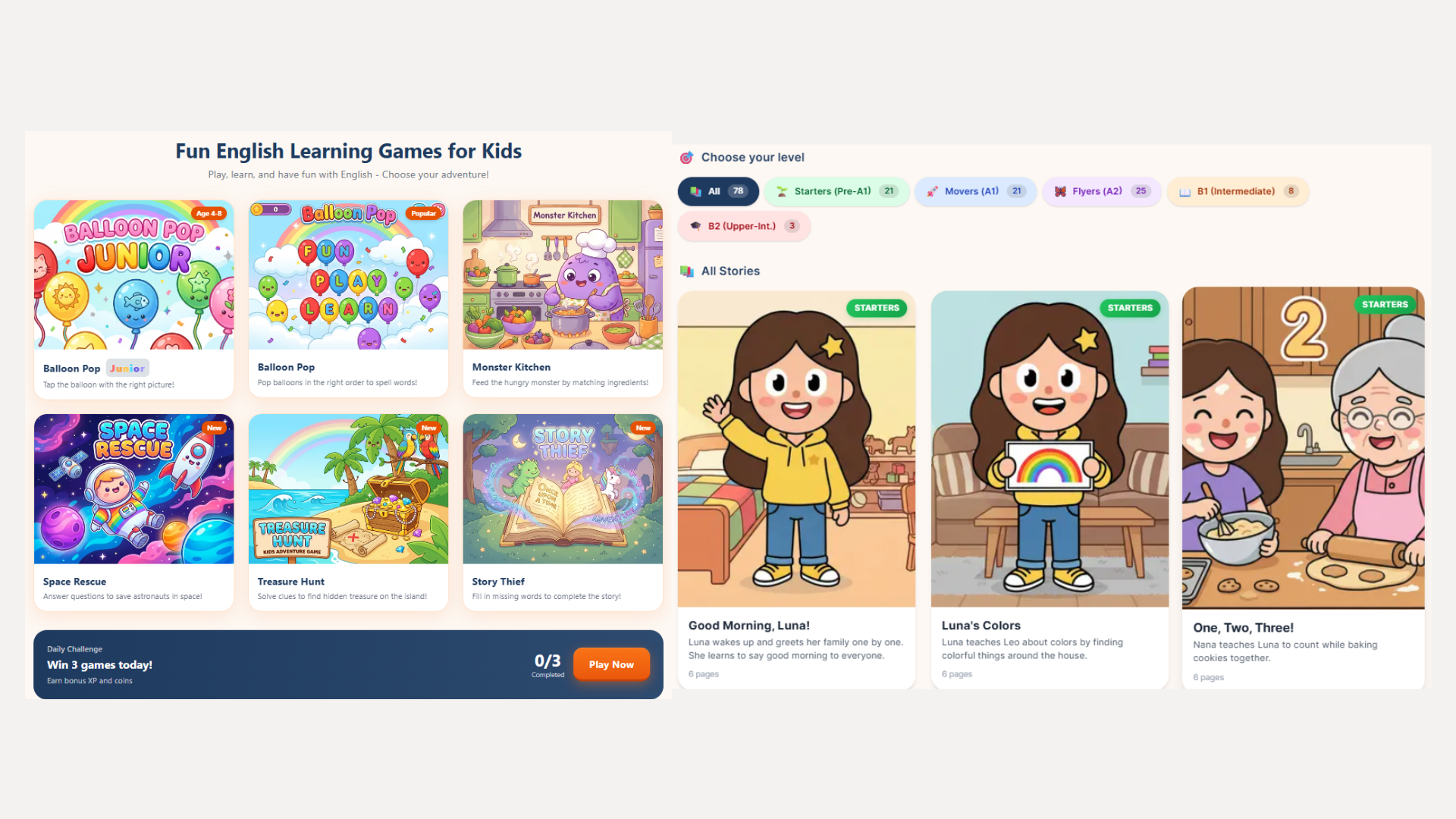
On games.flalingo.com, kids aged 4 to 13 play word games like Balloon Pop and Monster Kitchen, and stickers are earned through lesson attendance and quiz completion, then spent on album pages, avatar items or a streak freeze. There are daily and weekly caps on all of it, deliberately, because a child who is farming stickers is no longer learning English. Parents searching for the best courses for ages 3-6 are usually choosing between platforms that are entertaining and platforms that are serious. Şükrüye’s daughter had never taken an English lesson before, and she is progressing quickly because the lesson is fun.
How The Lesson Changes As The Kid Grows
A four-year-old and a fourteen-year-old aren’t doing the same lesson with different vocabulary. The 25 minutes are built differently, and the balance between play and study shifts with the age band.
- Ages 3 to 6: no book, no grammar, almost no sitting still. A picture cue, one short task, a song, a game to lock the word in, a quick repetition with the teacher, done. A child this age learns "jump" by jumping, and the teacher moves with them on camera.
- Ages 7 to 9: mini tasks with a sticker rhythm, word cards and short reading, a first attempt at speaking without a script, and a summary at the end. Games are still a big part of the lesson, but they now reinforce something specific rather than carry the whole session.
- Ages 10 to 12: reading and writing take more of the time, the Oxford course does more of the work, and play turns into quizzes and challenges the child wants to win.
- Ages 13 and up: targeted speaking, vocabulary sets, task-based communication (describe this, compare these, defend that), a short piece of writing, and closing feedback. Close to the adult lesson, with a teenager’s topics.
The skeleton stays the same at every age. Attend the lesson, look at what the report flagged, do a short practice, speak again. What changes is how much of that is disguised as a game.
What Sits Behind The Games
The books, songs and activity booklets Ebru mentions are Oxford University Press Family and Friends, the same course used in classrooms worldwide. It carries a phonics programme, songs, projects and a defined progression from Pre-A1 upward, which matters more than it sounds cause a child who learns forty words with no sequence behind them has forty words. A child moving through a real syllabus has a level. Those levels follow the CEFR scale, so when a report says A1, it means what a school or an exam board means by A1.
Reading works the same way. On stories.flalingo.com, there are 78 interactive Luna stories, banded by Cambridge Young Learners levels: Starters (Pre-A1), Movers (A1), Flyers (A2), and then B1 and B2 for older children. A six-year-old starts at "Good Morning, Luna!" and a twelve-year-old ends up reading about honesty and time management. This is also the honest answer to the Flalingo vs Novakid question. Both programmes are built on the CEFR, and that comparison is fair. What differs is what fills the frame, such as the Oxford University Press course material, a story library banded to Cambridge levels, and a certified teacher as standard rather than a paid upgrade.
The Teacher, and Being Allowed To Change Your Mind
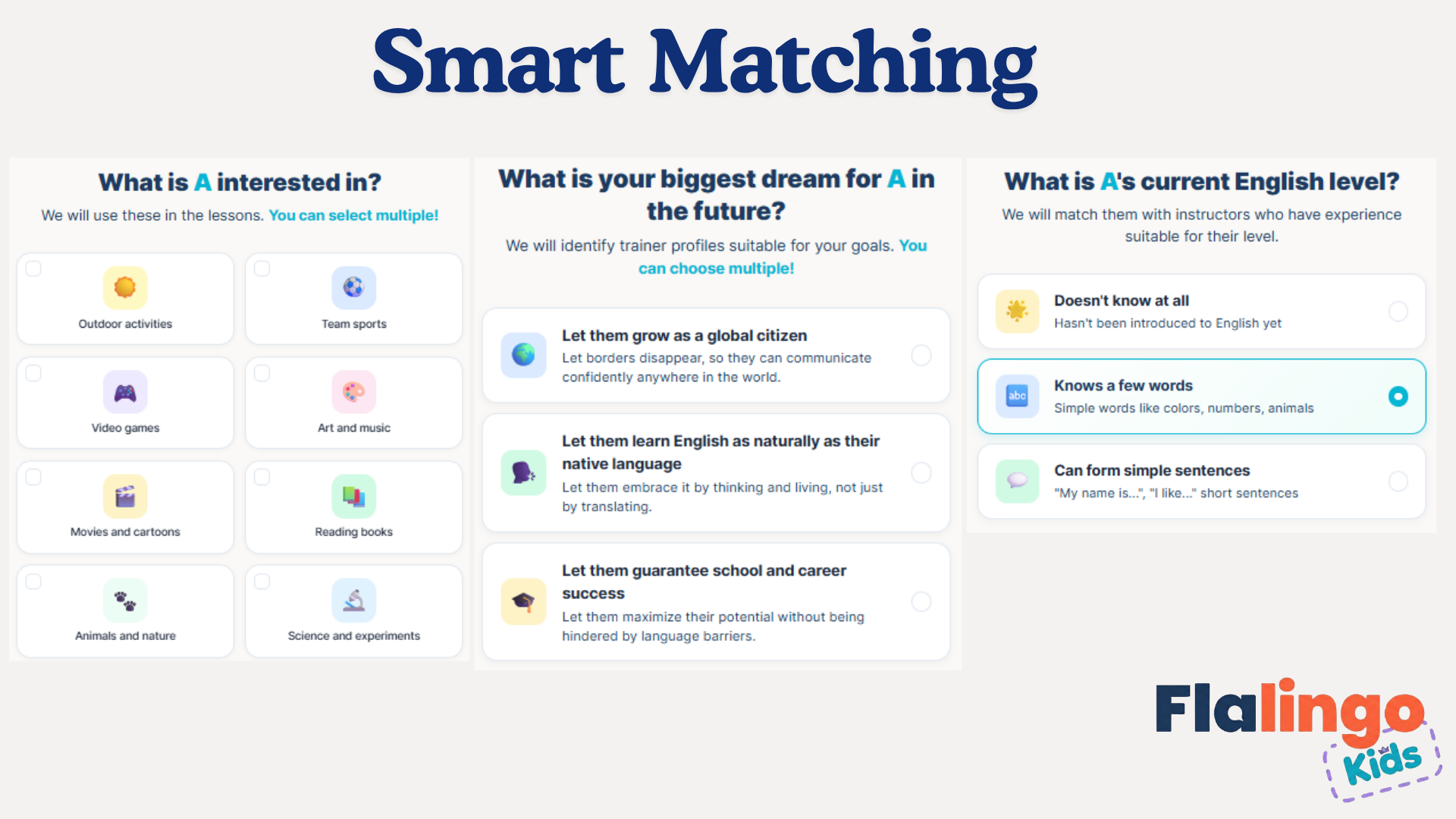
Esma is running two teachers for two children, which is exactly what the system is supposed to allow. Smart Matching takes what you tell us at sign-up (the child’s age and level, the hours that fit around school, the goal, the kind of teacher the child responds to) and returns a shortlist of 22 to 30 matched teachers rather than the whole roster. You try a few, and you keep the one who works. And once you have found them, teacher continuity is built into the scheduling. A family that wants the same teacher again finds them more than 90% of the time, so a shy child isn’t restarting the relationship every week.
This is the crux of Flalingo vs Cambly Kids. Native fluency isn’t a teaching qualification. Our teachers hold teaching certification and pass a pedagogical assessment before they meet a child, and they keep being measured afterwards on satisfaction, attendance and the objective data FLAI produces from each lesson. Teachers who fall below standard leave the platform. Seda credits her teacher’s patience and individual support, and that isn’t a personality bonus we got lucky with. It is what we hire for.
Structure or No Structure: Course Mode and Relax Mode
Emre runs his seven-year-old in Relax Mode, no grammar, and he is right to. Course Mode gives you the Oxford book, the sequence and the homework, and it suits a child who is preparing for school exams or who has hit the age where structure stops feeling like a punishment. Relax Mode drops the book and keeps the conversation, which is usually the right call for a young beginner or for a child who freezes the moment a page appears on screen. You can switch, and plenty of families run Relax Mode for a term and then move into the course when the child asks for one.
Frequency is the other lever. Three lessons a week is what most of the parents here are doing, and it is where progress actually starts to compound. This is where the Flalingo Kids vs 51Talk trade-off becomes visible. Platforms built on very high frequency at a very low price usually pay for it somewhere, most often in who is standing in front of your child. We would rather sell you three lessons with a certified teacher than seven with an unvetted one. Emre thinks the price is fair and mentions what he was offered when he added a second child. We aren’t going to build a pricing promise out of one review, so ask what applies to your family before you subscribe.
The Weekly Report and The Video After Every Lesson
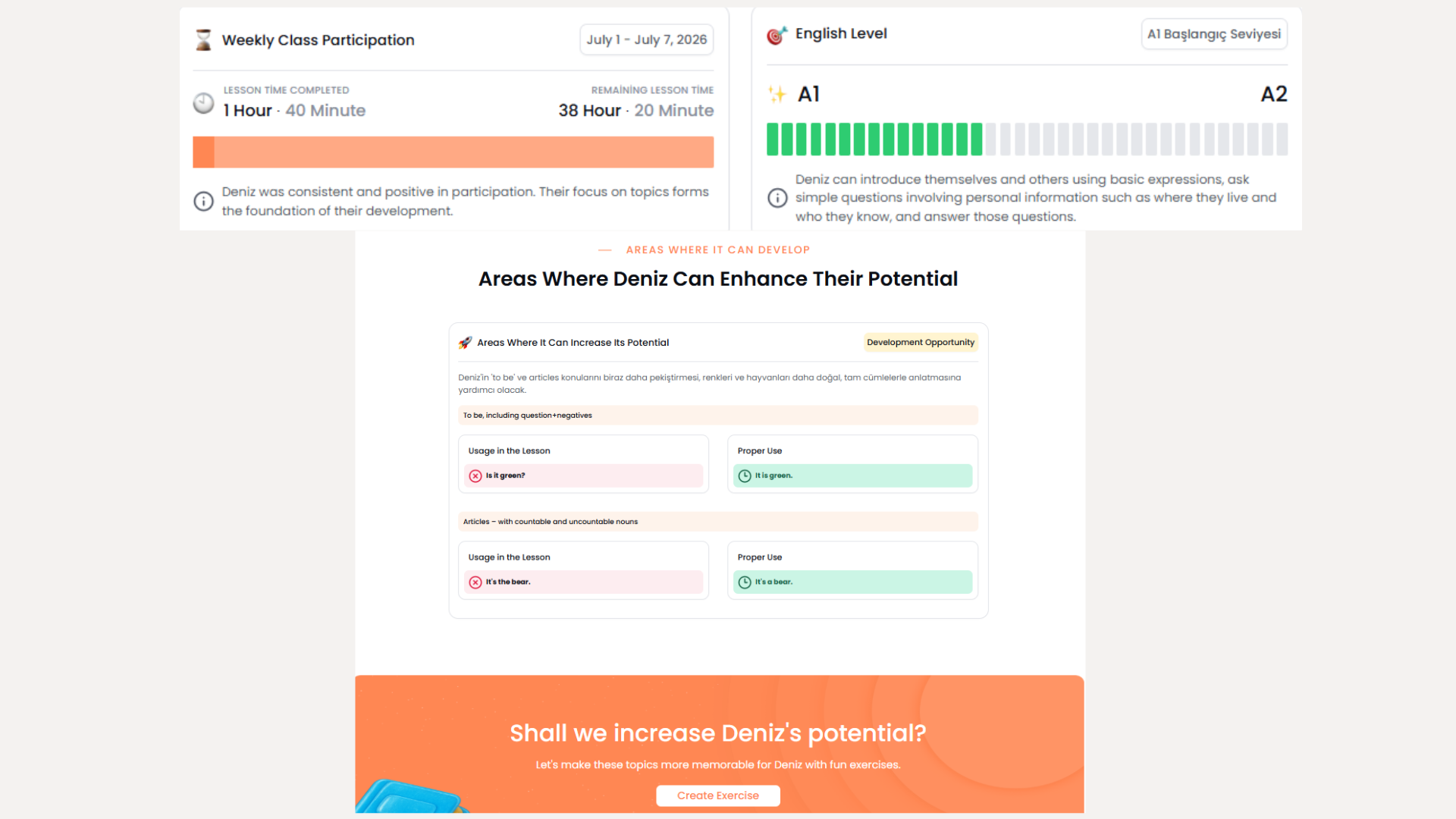
Haldun mentions two things that are worth separating. After each lesson, you can watch the recording and see where your child stands. The written report is weekly, and it is the one that most parents end up reading on a Sunday evening.
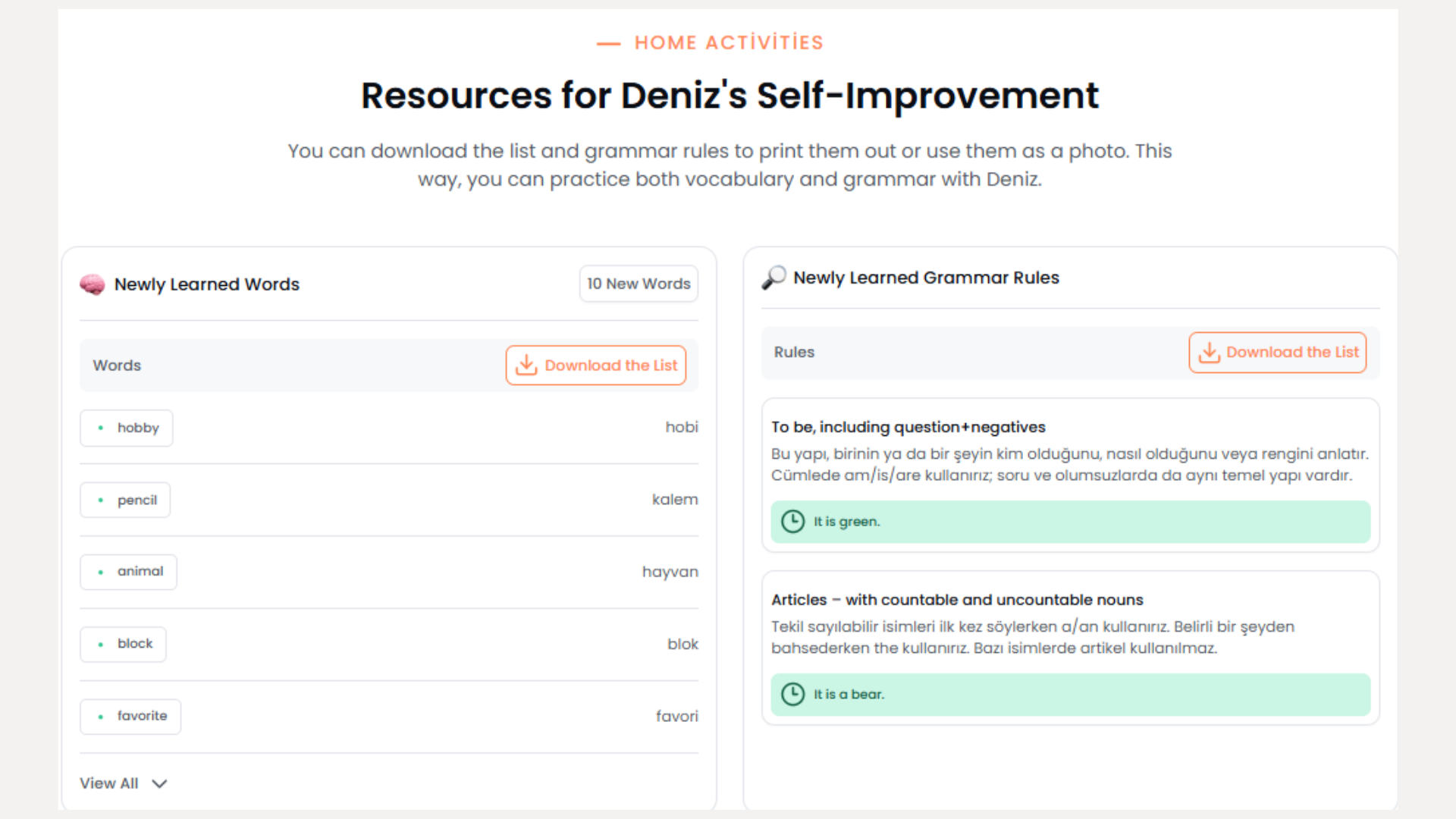
FLAI listens to the lessons, transcribes them and analyses what your child actually said, which structures they got wrong, how much they spoke, and how their vocabulary is spreading across CEFR levels. What comes back to you once a week is that analysis translated into a parent’s language rather than a linguist’s. What your child worked on. What got better. What still needs work. And a short list of free resources you can use at home before the next lesson, usually a Luna story at the right level, a game on the kids' platform, a song they already half know. You don’t need to speak English to read any of it, and you don’t need to sit in on the lesson to know what happened in it.
FLAI has a second job that parents rarely think to ask about. It reviews every lesson for content a child shouldn’t be exposed to, and anything it flags goes straight to our lesson quality specialists rather than sitting in a log. It is a quiet feature, and it is one of the reasons we can put a child in a room with an adult they have never met and be comfortable doing it.
Does Any Of It Show Up Outside The Lesson?
Leyla describes a boy who listened and didn’t participate and who now speaks English at home. That gap is normal, and it has a name: children build comprehension before they produce speech, and the silent stretch in between panics more parents than any other part of the process. It is also the stretch where families quit. Parents comparing the best courses for ages 7-9 should judge a platform on what happens in month four, not week two, which is why the FLAI report tracks how much a child spoke rather than only what they got right.
S Y’s daughter started speaking after four lessons, and we want to be careful with that number. Four lessons didn’t teach her English; she had four years of school English and no room to use it. What changed was that she was the only student in the room. Serdar, who wrote his own review, is the clearest case of the school overlap with three 25-minute lessons a week for six months, and his English marks roughly doubled. We don’t teach to the school curriculum, and we never claim to. It just turns out that a child who can hold a conversation tends to find the exam easier than a child who has memorised the unit.
What Parents Tell Us To Fix
Her main criticism is fair, and we can’t solve it. Flalingo teaches English and only English. There is no German, no French, no Spanish, and a parent who wants a second language has to go and find another platform, exactly as she did. We built the whole system, from the Oxford course to the FLAI analysis, around one language. That focus is a real cost to families like hers, and telling her it is a strength would be an insult to her time.
The second thing she says is the more useful one for parents still deciding. Fourteen months in, her daughter knows over a thousand words and understands most of what is said to her, and she still can’t speak perfectly. That is what fourteen months looks like at two or three lessons a week, and any platform promising you a fluent child in three months is selling you something. Our own planning assumes roughly two hours a week to move through a level in six to eight months. Comprehension arrives first, speech follows, and precision follows that.
One more thing worth noting, since she raised it, is that she was nervous about paying a foreign-registered company. Plenty of parents are, and the answer isn’t a paragraph of reassurance. Book a trial lesson, watch it, read the report that comes out of it, then decide.
Curious how your child would respond?
İlgini çekebilecek diğer içeriklerimiz

The AI Revolution in Online Teaching: How Flalingo's FLAI Makes You a Better Instructor
Devamını oku
The Most Interactive Form of English: Flalingo Group Lessons
Devamını oku
Joy Joel
My name is Joy. I am an online English teacher with five years of experience working with students of all ages. My teaching approach aims to build self-confidence and make the learning process productive through interactive, engaging and tailored support.
Flalingo ile İngilizce

Flalingo ile İngilizce öğrenmek, birbiriyle entegre çalışan akıllı bir sistemle ilerlemektir.