
Best 7 Online English Courses for Kids Ages 3–6

If you have ever watched a four-year-old switch between two languages on a playground, you already understand what neuroscientists have spent decades proving. The years between 3 and 6 are not just good for language learning. They are biologically privileged. Patricia Kuhl's research at the University of Washington shows that children in this window absorb phonemic distinctions that older learners will struggle with for the rest of their lives. Miss it, and the door does not close entirely. But it does narrow.
How you teach English to a 3-year-old matters more than whether you teach it at all. A bored toddler learns nothing. A toddler who meets a different teacher every week never builds the trust she needs to actually open her mouth and speak, and a toddler whose teacher was hired for their accent rather than their classroom skills ends up memorising vocabulary lists that vanish the moment the screen turns off.
We evaluated each platform across six factors that matter specifically for this age group. General ESL ranking criteria do not apply the same way when your learner is four years old.
- Teacher continuity: Does the child see the same teacher every lesson, or a new face each time?
- Pedagogical training: Are teachers trained in early-childhood education, or simply native speakers?
- Attention-span design: Are lessons structured around a 15-20 minute focus window?
- Curriculum quality: Is there a real CEFR or phonics-aligned syllabus behind the lessons?
- Parent visibility: Can parents see what their child actually learned after each session?
- Real-world usability: Billing transparency, refund terms, trial access.
We included platforms with very different models on purpose. App-based, marketplace, native-only, group classes. We wanted parents to see exactly why one approach suits their child better than another, not just which platform scored highest on a rubric.
Table of Contents
- Quick Comparison: 7 Best Online English Courses for Kids Ages 3–6
- #1 - Flalingo Kids: Best Overall for Ages 3-6
- #2 - Novakid
- #3 - 51Talk
- #4 - Lingokids
- #5 - Cambly Kids
- #6 - italki Kids
- #7 - LingoAce
- Oxford Kids curriculum with phonics, songs, and stories designed specifically for children aged 3–6
- 25-minute one-to-one lessons built around real preschool attention spans
- 100% native English teachers with verified pedagogical credentials
- Rigorous teacher selection process, with only 1 in 73 applicants accepted
- Fixed teacher model: the same teacher every lesson, every week
- 90%+ same-teacher booking rate, helping children build trust and speak with confidence
- FLAI AI Coach with real-time lesson analysis
- FLAI Parent Report sent after every session, showing what the child practised, which words came up, and how confident they sounded
- FLAI child safety monitoring, with all sessions reviewed for inappropriate content and immediate quality team alerts if any concern arises
- Pedagogical English games at games.flalingo.com, optimised for 15–20-minute attention windows
- Audio English stories at stories.flalingo.com for independent listening between lessons
- Free child-specific level assessment at start.flalingo.com before parents commit
- 30-day unconditional refund policy
- No automatic subscription renewal and no billing surprises
- CEFR-aligned syllabus calibrated for Pre-A1 through A2 young learners
- Gamified virtual classroom built specifically for children, vocabulary as quests, not flashcards
- Choice of native or near-native teachers across two pricing tiers
- Structured progress tracking with visible milestone markers
- Lesson recording for parent review
- Recognised across European markets with a large user base
- High-frequency model: 3-5 lessons per week is affordable for most families
- Gamified classroom interface built for young children
- Lesson recordings available for parents to review after class
- Large teacher pool: professionally trained Filipino ESL educators
- Structured scheduling system with flexible time slots
- Self-paced English learning games and songs for ages 2-8
- Professional voice acting with native-speaker narration
- Early-literacy content structured around phonics and vocabulary milestones
- No scheduling required: works on the child's own timetable
- Subscription model at a fraction of the live-lesson cost
- Native-speaker tutors from English-speaking countries worldwide
- On-demand scheduling: no fixed time slot required
- Large and varied tutor pool across different accents and personalities
- Sessions can be recorded for parent review
- Marketplace model: thousands of teachers across every price point and background
- Full control over teacher selection, booking, and lesson content
- Once a preferred teacher is found, consistent weekly booking is straightforward
- Often lower per-lesson cost than curated platforms at comparable quality levels
- Community and professional teacher ratings from other parents
- Multi-subject capability (English, Mandarin, Mathematics)
- Native-speaker teachers trained in Asian-market pedagogy
- Fixed teacher assignment with consistent continuity
- Polished classroom interface with strong production quality
- Structured progression with clear content milestones
Quick Comparison: 7 Best Online English Courses for Kids Ages 3–6
#1 - Flalingo Kids: Best Overall for Ages 3-6
Flalingo Kids is built around how preschool children actually learn, not how adults expect them to behave. Each lesson lasts 25 minutes. Long enough to create a real learning routine, but short enough to match the attention span of a 3 to 6-year-old. Children work with the same teacher every time, and that consistency is central to the experience. In early childhood, trust comes before participation. A child who feels safe is more likely to try new sounds, repeat words, and engage. A child who meets a new stranger every week is more likely to stay silent.
The programme follows the Oxford University Press Kids curriculum, with a strong focus on phonics, songs, visual storytelling, and age-appropriate vocabulary development. Lessons are structured, but never forced into an adult format. Every activity is designed for young learners who are still developing confidence, attention, and emotional readiness.
Flalingo Kids also sets a high standard for its teachers. All educators are native-level English speakers with formal training in early-childhood pedagogy. Many native-speaker platforms prioritise accent over teaching skill, while many qualified-teacher platforms compromise on language quality. Flalingo Kids insists on both. Teachers go through a rigorous selection process, with only 1 in 73 applicants accepted.
For parents, the FLAI Report provides a clear view of each lesson without requiring them to sit beside the child. After every 25-minute session, parents receive a structured summary showing what the child practised, which words were introduced, and how confident they sounded. This is especially valuable because many young children behave differently when they know a parent is watching.
The learning environment extends beyond live lessons. games.flalingo.com offers short, attention-friendly English games. stories.flalingo.com gives children bedtime listening practice in English. start.flalingo.com provides a free, child-friendly assessment before parents make any commitment.
Flalingo Kids is not simply a one-to-one English tutoring platform. It is a complete early-language learning environment designed around emotional safety, teacher continuity, native-level language input, and pedagogy that genuinely fits young children.
Key Features
Price
Packages run approximately $40-$130 per month, depending on lesson frequency and package length. A trial lesson is available. There is no auto-renewal, so your plan does not roll over unless you actively choose to continue.
Prices last checked: May 2026. Always verify current packages on the platform's website before purchasing.
Best For
Flalingo Kids is best for parents who want an Oxford-structured curriculum, clear post-lesson progress data, and the reassurance that their 3 to 6-year-old is learning with the same trusted teacher every week. It is a strong fit for families who want their child to actively speak English, not just recognise words passively. The fixed-teacher model is especially valuable for shy children or those who need time to warm up, because familiarity reduces anxiety and helps speech come more naturally. It also works well for parents who want visible progress without needing to observe every lesson themselves. After each session, the FLAI Parent Report gives a clear view of what was practised, which words came up, and how confidently the child participated.
#2 - Novakid
Novakid is a European-focused live English platform for children aged 4–12. The platform’s biggest strength is its gamified lesson design. Novakid has put serious effort into making the classroom feel more like a game than a traditional lesson, and young learners often respond well to that. The virtual-world format helps hold attention better than a plain video call, which can be useful for preschool and early-primary learners.
Lessons are CEFR-aligned from Pre-A1 upward, giving parents a clear sense of where their child is starting and what they are working toward. The teacher model is tiered. Native English-speaking teachers cost more, while near-native teachers, often qualified educators from Eastern Europe, are more affordable. The main trade-offs are teacher continuity and parent reporting. Novakid allows families to request the same teacher, but this is not guaranteed. Its post-lesson reporting is also less detailed than Flalingo’s FLAI Parent Report.
Key Features
Price
Approximately $80-$175 per month, varying by teacher tier and package length. Native-speaker packages sit at the higher end of the range. If the near-native tier is selected for cost reasons, that trade-off matters more at ages 3-6 than it would for older learners.
Prices last checked: May 2026. Always verify current packages on the platform's website before purchasing.
Best For
European families who want a curriculum they can point to, something that maps to CEFR levels and gives them benchmark language to use at parent-teacher conferences or in conversations with schools. Also good for children who respond well to game-style reward systems and find straightforward video-call formats a bit flat.
#3 - 51Talk
51Talk's core argument is straightforward. More lessons at a lower cost outperform fewer premium lessons over time. For children aged 3-6, where repetition is genuinely the mechanism by which language sticks, this logic is not wrong. A child who hears English five times a week will develop faster than a child who hears it once, even if the per-lesson quality is lower.
The caveat is real, though. 51Talk teachers are highly proficient, professionally trained ESL educators, and the platform model works well in terms of cost and coverage. But they are not native speakers. For older learners and adults, this is a reasonable trade. For 3-6 year-olds whose phoneme inventory is still forming, native-accent exposure matters in a way it simply does not later in life. While teacher quality is generally consistent, the continuity of seeing the same face every week is not a built-in feature.
For families on a genuine budget, or for those who want to add high-frequency English exposure on top of a more structured platform, 51Talk is a serious option. Just go in clear-eyed about what you are optimising for.
Key Features
Price
Approximately $40-$100 per month, depending on lesson frequency and package length. This is notably the most affordable live-teacher option in this comparison for families who want multiple lessons per week.
Prices last checked: May 2026. Always verify current packages on the platform's website before purchasing.
Best For
Families who prioritise exposure frequency above all else, or who are pairing this with a more structured platform and want affordable daily reinforcement. Also suits parents who are comfortable with non-native teachers and primarily want their child to build confidence speaking before worrying about phonemic precision.
What People Are Saying?
When evaluating online language learning platforms, user reviews can provide useful insights, but they should also be interpreted carefully.
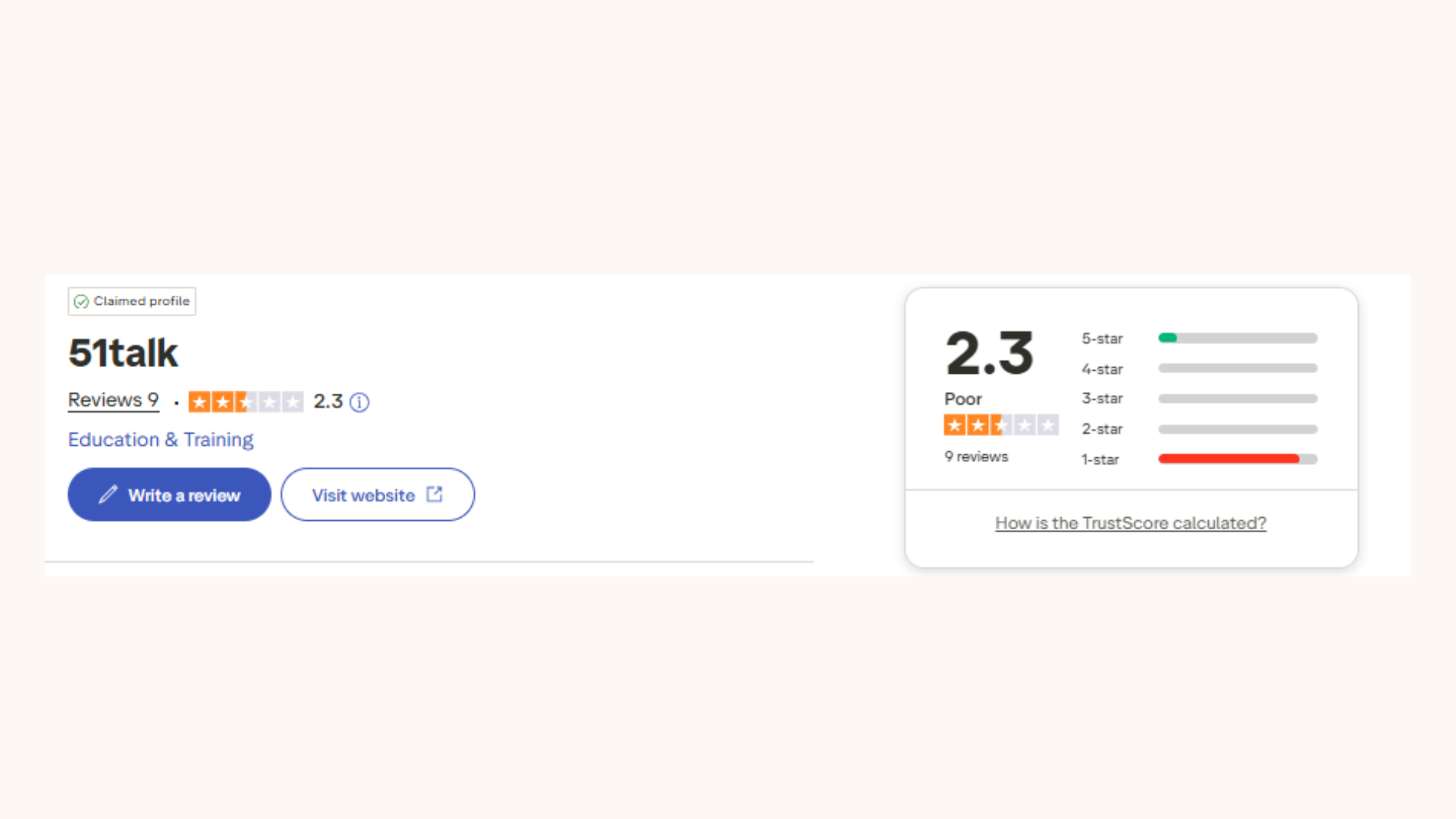
Although 51Talk has a 2.3 rating on Trustpilot, the score is currently based on only 9 reviews. Because the sample size is still very limited, we do not think it is possible to make a fair or reliable conclusion based solely on these reviews. If you would like, you can also review the comments yourself here: https://www.trustpilot.com/review/51talk.com
#4 - Lingokids
Lingokids sits in a different category from everything else on this list. There is no live teacher. Children work through games and songs at their own pace, narrated by professional voice actors, with content built around early-literacy milestones. For the right child in the right context, it works well.
The interface is genuinely delightful. The songs stick. The reward system is well-calibrated for preschool-age attention spans. A 3-year-old who gets a lot of rich adult interaction during the day, and who is ready for some structured independent screen time, will pick up real vocabulary here.
What Lingokids does not do is teach children to speak. There is no live conversation partner. There is no error correction in real time. There is no conversational pressure that forces a child to actually produce language. It builds passive vocabulary and listening comprehension, which are valuable. But spoken fluency requires a different kind of practice, one that only comes from talking to another person. Parents who want both should pair Lingokids with a live-teacher platform, not use it as a standalone solution.
Key Features
Price
Approximately $13.49 per month. By a significant margin, this is the lowest cost on the list. That price reflects what it is: a well-built vocabulary and listening app, not a live instruction platform.
Prices last checked: May 2026. Always verify current packages on the platform's website before purchasing.
Best For
Families already using a live-teacher platform who want to keep English present in the child's daily life without scheduling another lesson. Works especially well for children who are naturally drawn to games and need minimal encouragement to engage. Not the right choice as a primary English learning solution if spoken fluency is the goal.
#5 - Cambly Kids
Cambly Kids connects children with native English-speaking tutors via video call, with an emphasis on conversational practice over a formal, structured curriculum. The platform is well-regarded for the quality of its native speakers, many of whom are based in the United States, Canada, and the UK. Scheduling is highly flexible, often available within minutes of booking.
For online English classes for 3-year-olds through age 6, Cambly Kids works best as a conversation-focused supplement. The platform does not enforce a standardised pedagogical framework for this age group, which means lesson quality and structure vary considerably between tutors. Parents who want a predictable curriculum-based progression may find this model less reliable than Oxford-backed alternatives.
Key Features
Price
Approximately $99-$199 per month, depending on lesson frequency and package tier. This puts Cambly Kids at the higher end of the range while offering less structural consistency than the top-ranked platforms.
Prices last checked: May 2026. Always verify current packages on the platform's website before purchasing.
Best For
Families looking for supplemental native-speaker conversation practice on a flexible schedule, used alongside a curriculum-based platform for structural learning.
#6 - italki Kids
italki is a global language tutor marketplace where parents search, compare, and book English teachers for their children based on profiles, video introductions, and student reviews. The platform itself sets no curriculum standards; individual tutors determine their own lesson approach. This gives italki a wide price range and a genuinely diverse teacher pool, spanning professional educators, community tutors, and subject-matter specialists.
For parents researching how to teach English to toddlers online, italki requires more upfront effort than other platforms on this list. Finding a tutor with specific experience in the 3 to 6-year-old age group takes research. But for families who have the time to vet carefully, italki can surface high-quality, affordable options that a closed-marketplace platform cannot match.
Key Features
Price
$40-$250+ per month, depending entirely on the teachers you select and how frequently you book. The range is wide enough that italki can be the cheapest or one of the more expensive options on this list, depending on your choices. Community teachers sit at the lower end; professional certified teachers with strong track records cost more.
Prices last checked: May 2026. Always verify current packages on the platform's website before purchasing.
Best For
Parents who want maximum flexibility and are willing to invest time in finding and vetting individual tutors with specific early childhood English experience.
#7 - LingoAce
LingoAce is a Singapore-based multidisciplinary learning platform primarily serving children in the Asia-Pacific region. Alongside English, it offers Mandarin and Mathematics, positioning itself as a broader academic enrichment service. For English specifically, the platform uses a structured curriculum with certified teachers and incorporates storytelling and project-based elements into lessons.
For families in Singapore, Hong Kong, or broader ASEAN markets, LingoAce is a strong regional option with genuine curriculum depth. For European or North American families, accessibility and time zone coverage are more limited. There is no AI-powered parent reporting system comparable to FLAI, but LingoAce does provide post-lesson progress notes from teachers.
Key Features
Price
Approximately $80-$250 per month, depending on package and frequency. This sits in the mid-to-high range and reflects the structured, content-rich curriculum behind the lessons. Worth considering whether the multidisciplinary approach fits your child's current readiness before comparing this price to simpler live-lesson alternatives.
Prices last checked: May 2026. Always verify current packages on the platform's website before purchasing.
Best For
Families who want English to function as a gateway to broader learning rather than a subject studied in isolation. Particularly well suited to children who are already engaged with content topics in their home language and are ready to encounter them through English as well.
If there is one takeaway from this comparison, it is this: the platform matters less than four specific design choices. These are not opinions. They are grounded in decades of early-childhood language acquisition research, including Patricia Kuhl's critical period work, ACTFL young-learner standards, and Oxford University Press phonics research. Fixed teacher, native or near-native phonemic input, attention-span-aware design, phonics-based structured curriculum.
The platforms in this comparison deliver these four essentials in very different combinations. The right question for any parent is which combination fits what my child needs right now?
If you're researching online English courses for older kids as well, our guides for ages 7–9 and ages 10–12 offer educator-tested recommendations and rankings.
Frequently Asked Questions
At what age can a child realistically start online English lessons?
Most children are ready for short structured live lessons from age 3, as long as sessions run 20-25 minutes, the teacher is consistent, and the format is genuinely play-based. Younger than 3, app-based exposure and English audio stories tend to be more appropriate than live tutoring sessions.
How many lessons per week works best for a 3-6 year-old?
Two to three live lessons per week is the sweet spot for most preschoolers. Frequent enough to build routine and vocabulary retention, infrequent enough that it stays a positive experience. Higher-frequency models work for some children but can produce fatigue if the teacher-child relationship is not strong.
Does it have to be a native speaker at this age?
The critical period research is fairly clear on this: native or near-native input matters more between ages 3-6 than at any later stage of language learning. Children who receive primarily non-native pronunciation modelling in this window often need deliberate correction later. If the budget allows for a native teacher at this age, it is the higher-leverage choice.
Will my child actually speak, or just understand English?
This depends almost entirely on the format. Live lessons require the child to produce language. App-based platforms build comprehension but do not push production. If spoken fluency is the goal, a live-teacher format is not optional. It is the mechanism by which speaking actually develops.
Are 25-minute screen sessions too much for a toddler?
The American Academy of Pediatrics draws a meaningful distinction between passive screen time and interactive video communication. A 25-minute live lesson, two or three times per week, falls well within guidelines for the interactive category. The key is that someone is talking back, which is fundamentally different from watching a cartoon.
Should I sit in on lessons?
Most experienced early-childhood teachers will encourage you not to. A watching parent often becomes the performance audience, redirecting the child's attention away from the teacher. A better approach is a platform with structured post-lesson reporting, which gives parents visibility without pulling focus from the session itself.




As an ESL educator of 5+ years, I am a guide for students and parents. I simplify complex English topics and online course selection for you. My goal is to help you turn learning from a stressful task into an enjoyable adventure.
English with Flalingo

Learning English with Flalingo means progressing with an intelligent system that works in an integrated manner.