
Flalingo Kids vs 51Talk: Which Online English Platform Is Right for Your Child?
Choosing an online English platform for a child is a different decision from choosing one for yourself. A young learner needs more than good lessons. They need a teacher they look forward to seeing, material that feels closer to play than homework, and a way for you to see what is changing week to week. 51Talk and Flalingo Kids both promise all three, and both run live one-on-one lessons rather than pre-recorded videos or app drills. They just arrive at the goal from different directions.
51Talk is one of the largest names in online English for kids, with a global teacher pool and a model built around frequent, affordable practice. Flalingo Kids is a smaller, more curated program that pairs native English tutors with Oxford University Press supported material and an AI coach that reports to parents every week. This comparison looks at how each one works, what you actually pay, and which type of family each suits best, so you can match the platform to your child rather than the other way around.
Flalingo Kids vs 51Talk: At a Glance
How Does 51Talk Work?
51Talk has been teaching English online since 2011 and was the first company of its kind to list on the New York Stock Exchange in 2016. Today, it reports more than 10,000 teachers, learners in over 50 countries, and more than 100 million lessons delivered.
Lessons are one-on-one and run 25 minutes, a length that 51Talk ties to a young kid's natural attention span. The curriculum follows the CEFR framework and lines up with Cambridge Young Learners English and other Cambridge English Qualifications, so progress maps onto benchmarks parents recognise. Around each live session sits a Learn, Practice, Test, Support cycle: a short video preview before class, review exercises generated automatically afterwards, and a focused review lesson every fourth session.
The classroom itself is built to hold a child's attention. 51Talk's Air Class uses gamified materials, an animated learning companion, and warm-up activities that make a lesson feel closer to a game. Teachers come from the US, UK, Canada, Australia, the Philippines and beyond, and the company says only the top 3 per cent of applicants are accepted, with TESOL, TEFL or CELTA certification and at least a bachelor's degree required. Parents can filter teachers by style and reviews, try several, and keep a favourite.
Where 51Talk leans in hardest is frequency. Its pricing and short lesson format are designed so a kid can practice several times a week without the cost feeling heavy, and many families book three to five sessions weekly.
How Does Flalingo Kids Work?
Flalingo launched in 2018 and now says it works with more than 200,000 parents. Its kids' program, Flalingo Kids, is built around one idea, which it calls the Flalingo Method. Children fall in love with English through stories and games first, and structured progress grows out of that.
Lessons are live and one-on-one, offered in 25 or 50 minute formats, and grouped by age: preschool (3-6), early primary (6-8), upper primary (9-12), and teens (13+). Teaching material is supported by Oxford University Press, then wrapped in games and story content that keep younger kids moving through the harder parts.
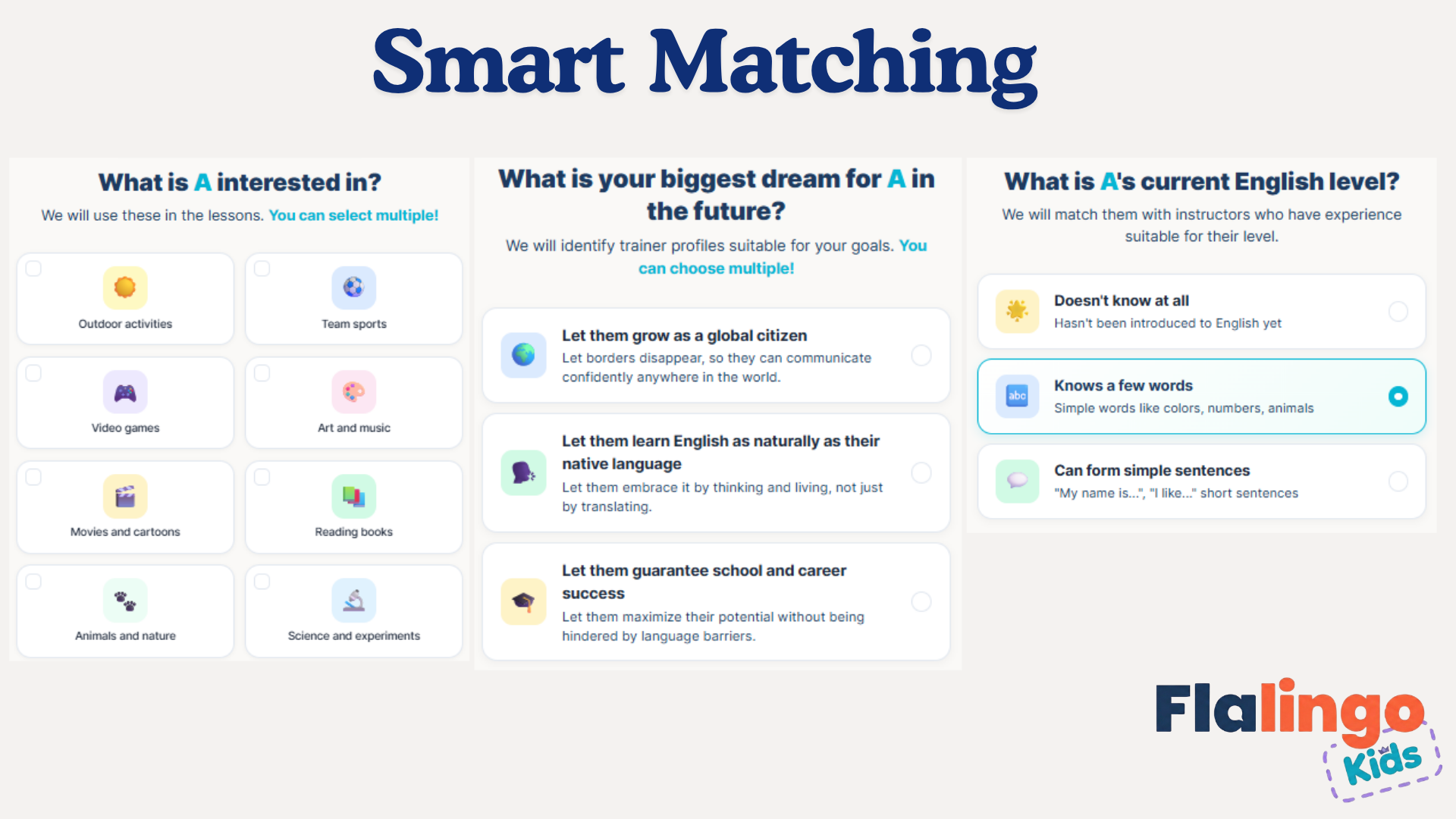
Two features shape the experience. The first is the Smart Matching algorithm, which pairs each kid with a tutor based on level, goals, schedule and personality instead of leaving parents to sift through a directory. The second is FLAI, an AI coach that reviews each lesson and sends parents a weekly report showing the words their child learned, the grammar they practised, and how they did in exercises. FLAI also screens lessons for anything that could put a kid at risk and alerts the quality team if it finds a problem, which gives the program a safety layer that many platforms leave to chance.
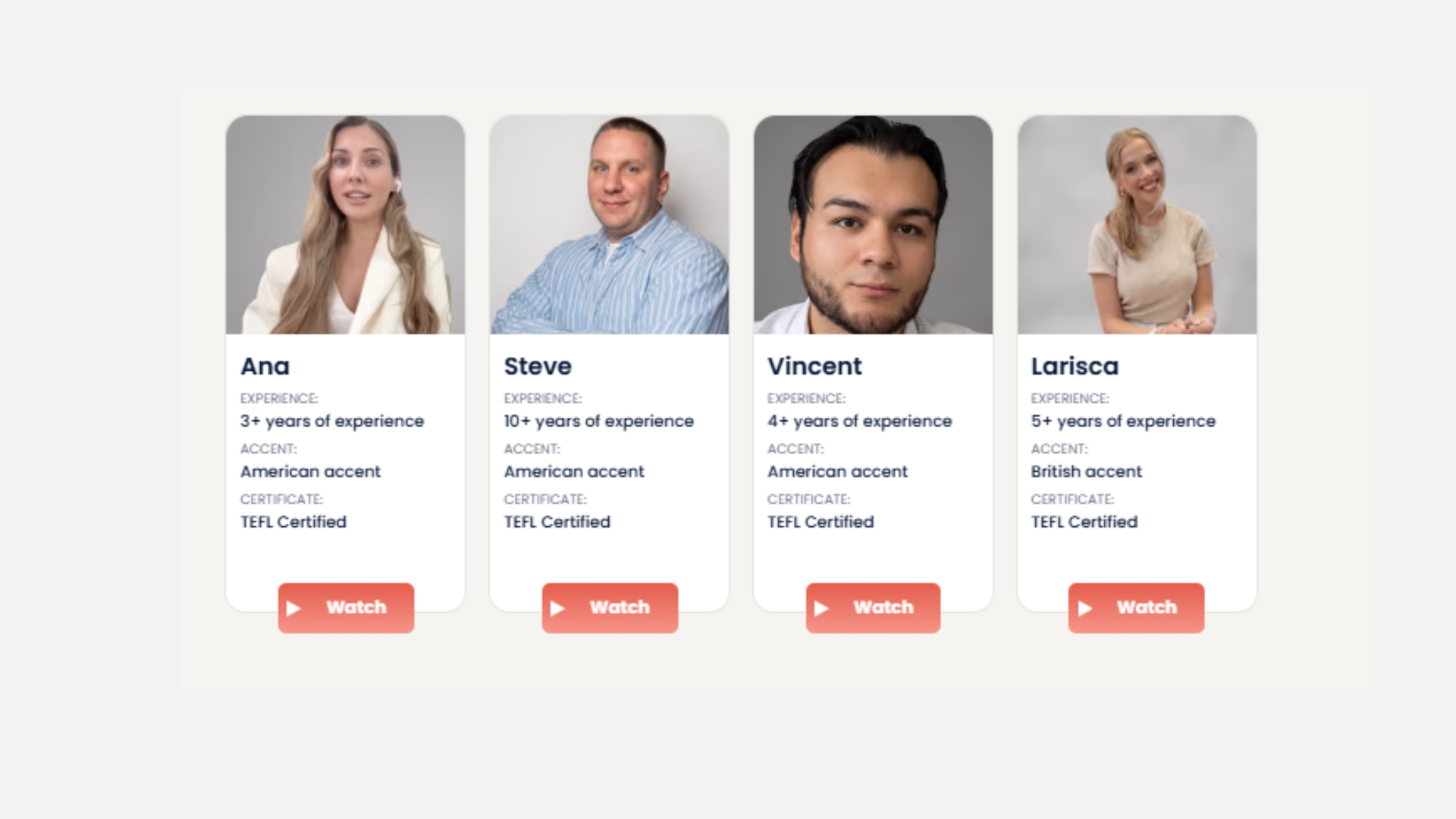
Teachers are native English tutors chosen through a multi-stage process. Flalingo says it accepts roughly one applicant in 73, after interviews, a sample lesson, and pedagogical and technical assessments, and it keeps checking quality after hire through student feedback and FLAI's own analysis.
Frequency vs Teacher Quality: The Core Trade-off
51Talk pours its energy into frequency: more sessions, lower cost, easy to repeat. Flalingo Kids spends its energy on the teacher in the room and on how closely a child is followed afterwards.
Frequency deserves real credit here. A kid who speaks English for 100 minutes across four short sessions a week gets more repetition, more comfort, and more room to recover from mistakes than one who sits through a single longer lesson. 51Talk's large teacher pool and low per-lesson cost exist precisely to make that rhythm affordable and easy to keep up.
What happens inside those minutes matters just as much. 51Talk calls its teachers native-level, and the pool really does mix native speakers from the US, UK and Canada with highly proficient non-native teachers, many from the Philippines, who hold internationally recognised certificates. Flalingo Kids narrows the field. It recruits native English tutors, screens far more heavily, and tags teachers by specialism, so a shy six-year-old and a confident ten-year-old preparing for secondary school are not handed the same lesson. It also guards teacher continuity from one week to the next, which counts for more with kids than with adults. For a young learner, trust and rhythm with one familiar adult can do as much for confidence as the lesson content itself.
It comes down to what you want more of. If the answer is practice, as much of it as you can sustain at the lowest cost, 51Talk's model fits. If the answer is a consistent, closely matched native teacher and a clear view of what your child is actually learning, that is the ground Flalingo Kids was built on.
Curriculum Depth Compared
Both platforms take structure seriously, and both anchor to the CEFR framework, so a kid on either one moves through recognisable levels rather than loose conversation.
51Talk uses a self-developed curriculum aligned with CEFR and Cambridge English Qualifications, supplemented with well-known readers such as Wonders and Reach Higher, plus graded reading and project tasks. Its levels run from a pre-level starter stage through to fluency, with clear vocabulary targets at each stage. The stated goal is education that is internationally benchmarked and results-measurable.
Flalingo Kids builds its curriculum on Oxford University Press young learners materials, the same publisher trusted in classrooms worldwide, then presents it through stories and games rather than a textbook. The difference between a lesson that feels like school and one that feels like play often decides whether they come back willingly. Parents comparing structured, CEFR-based programs may also want to see how Flalingo Kids compares with Novakid, another curriculum-led option, before deciding.
The practical difference is less about the publisher and more about tone. 51Talk's material is systematic and built with test readiness in mind. Flalingo Kids puts enjoyment first and keeps the structure underneath it. Either can carry a kid to the same level; what differs is which one your particular child keeps showing up for.
Progress Tracking and Parent Visibility
51Talk tracks progress through unit assessments at the end of each unit, longer level evaluations, and feedback reports teachers complete after lessons. It is a solid, familiar model that gives you diagnostic checkpoints and a general sense of whether your child is on track.
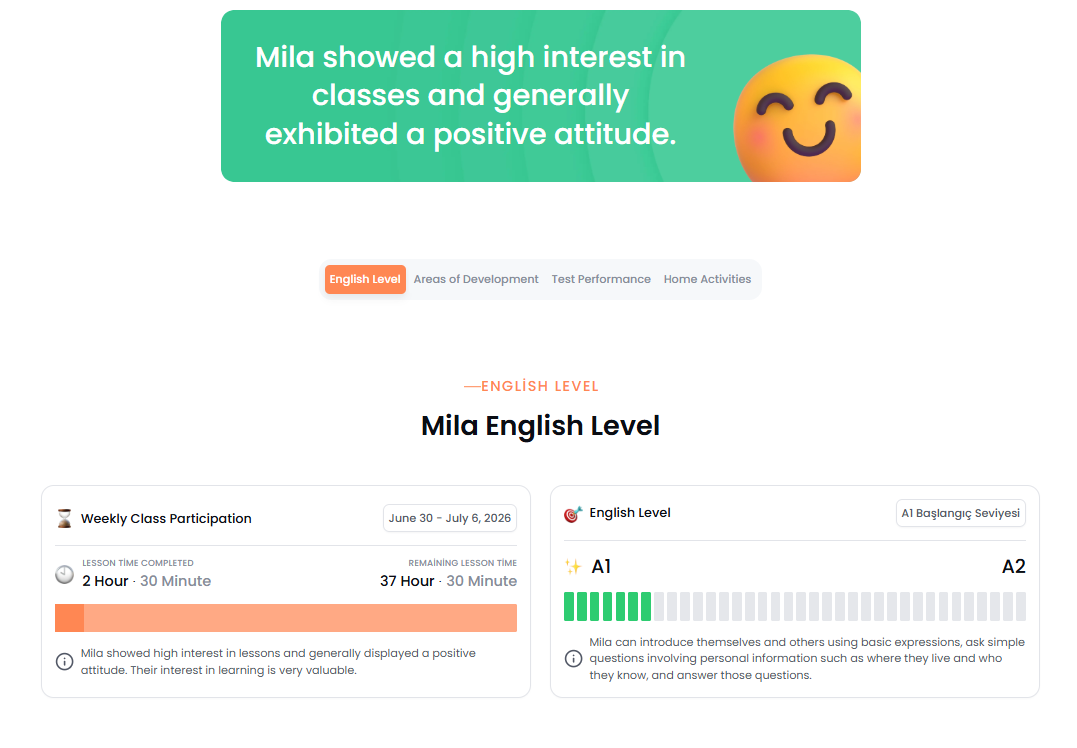
Flalingo Kids goes further with FLAI, which reports automatically every week. Instead of waiting for a unit to close, parents receive a summary showing the specific vocabulary a kid used, the grammar points they practised, and where they struggled in exercises. For a parent who does not speak much English, that detail reassures in a concrete way. You can see that this week your kid used three new past-tense verbs correctly, rather than trusting a single grade. Paired with the child-safety screening built into the same system, progress tracking becomes less a periodic report card and more a running commentary.
Flalingo Kids vs 51Talk: Pricing Compared
Prices on both platforms move with promotions, package length and region, so treat the figures below as a guide and confirm current rates before you commit. Both offer a trial, so you can test the fit cheaply first.
Figures are indicative and were last checked in July 2026. Always confirm current package prices on each platform before purchasing.
Who Is 51Talk Best For?
- ✔ Families who want maximum practice frequency at the lowest sustainable per-lesson cost.
- ✔ Parents who value a large, established, publicly listed company with constant teacher availability.
- ✔ Children who thrive on daily or near-daily repetition and gamified, high-energy sessions.
- ✔ Households comfortable with a global teacher pool that blends native and near-native speakers.
- ✔ Families in regions where 51Talk has strong local support.
Who Is Flalingo Kids Best For?
- ✔ Parents who specifically want native English tutors and will prioritise that over raw lesson count.
- ✔ Families who want detailed, weekly visibility into what their kid is actually learning, through FLAI.
- ✔ Kids who need the same familiar teacher each week to build confidence.
- ✔ Parents who value Oxford University Press-supported material delivered through stories and games rather than a textbook feel.
- ✔ Households that see built-in child-safety monitoring as a requirement rather than a bonus.
Parents still weighing several options may find it useful to read broader reviews of the best online English courses for ages 3-6, or the best online English courses for ages 7-9.
Flalingo Kids vs 51Talk: The Verdict
There is no single winner here, and any comparison that declares one is selling you something. 51Talk is an excellent choice if you believe, reasonably, that frequency wins: that the surest path to fluency for a child is short, cheap, near-daily practice, and that a large, dependable platform is worth more than a narrow one. Its track record, scale and affordability are real strengths, honestly earned.
Flalingo Kids makes a different bet. It argues that who teaches your kid, how consistently they show up, and how clearly you can follow the progress matter more than the raw number of sessions. Everything it does points the same way. A native tutor your kid keeps, a weekly FLAI report you can actually read, Oxford University Press material dressed up as play, and a quiet safety check running in the background.
If your child mainly needs volume and you want the lowest cost per session, start with 51Talk. If you want a closely matched native teacher, a curriculum your child actually enjoys, and a weekly window into exactly what they are learning, Flalingo Kids is the stronger fit. The best next step for either is the same, which is to book a trial, watch your kid's face during the lesson, and let that tell you more than any table can.
See the difference native, pedagogically-trained teachers make
Other content that may interest you

English Education for Ages 8–9: Why Is It So Important and How Should It Be?
Read More
Flalingo and Oxford Publications Collaboration In English Education
Read More
Flalingo Package Selection Guide: Which Plan Should You Choose?
Read More
Hi, I'm Glory. Teaching English is one of the most rewarding experiences of my life as I get to meet people from different cultures and help them express themselves with confidence. At Flalingo, I take care to create pleasant and relaxed teaching environments where students can speak without fear of making mistakes. My greatest happiness is witnessing the moments when my students realise that they are really making progress.
English with Flalingo

Learning English with Flalingo means progressing with an intelligent system that works in an integrated manner.