
Ir al contenido
Flalingo

Práctica de inglés

La pasiva en presente para B1 Preliminary: explica cómo se prepara un plato y escribe una ficha de receta

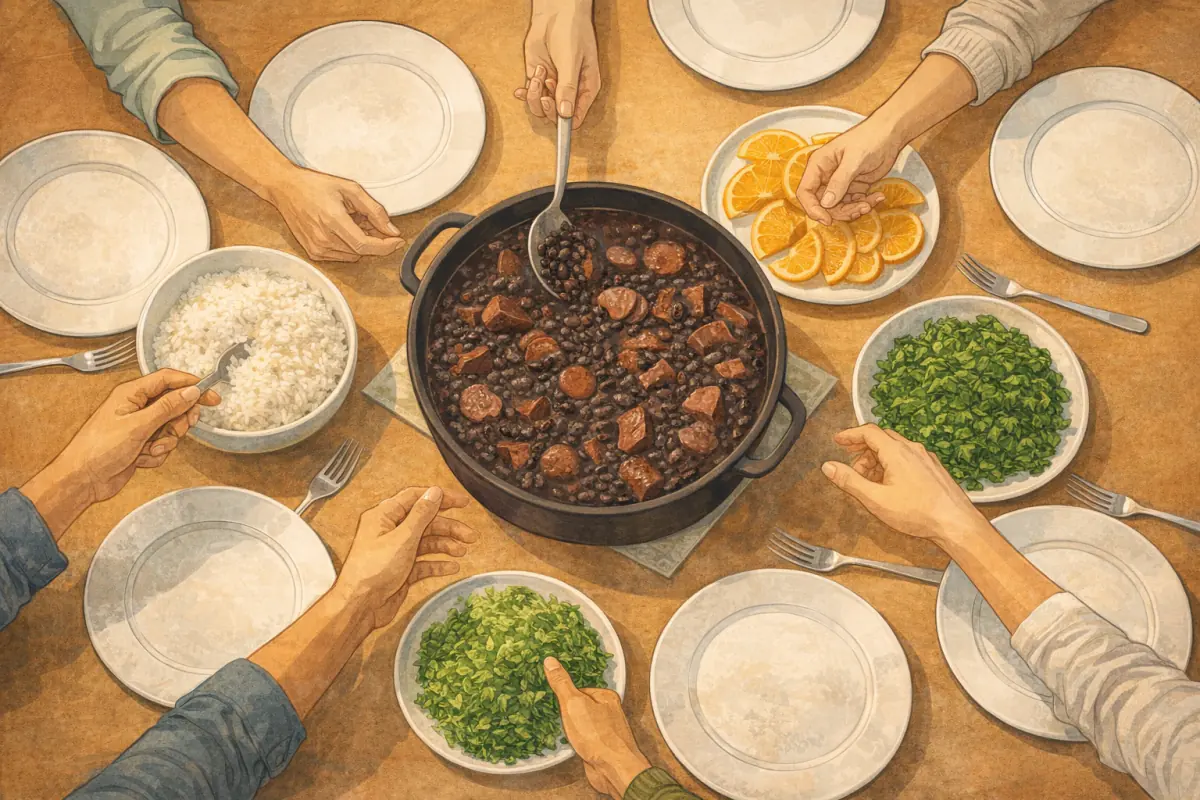
A Sunday lunch table seen from above: a pot of feijoada in the middle, with rice, orange slices, green vegetables and hands reaching for the food.

Cómo usan los adolescentes que preparan B1 Preliminary (B1) la pasiva en presente, a few, a little y plenty of, los verbos de cocina y las palabras de orden para explicar cómo se prepara un plato y escribir una ficha de receta de 80 palabras.

Para explicar cómo se prepara un plato, usa la pasiva en presente: is o are + participio, como en “The rice is boiled.” La comida va primero, porque importa más lo que le pasa que quién lo hace. Da las cantidades con a few, a little y plenty of, y ordena los pasos con First, Then, After that y Finally. Esas mismas palabras pequeñas rellenan muchos huecos de la Parte 6 de Reading de B1 Preliminary. Esta guía es para estudiantes de nivel intermedio (B1) de unos 12–16 años.

¿Para quién es este artículo?

  • Estudiantes que preparan B1 Preliminary o B1 Preliminary for Schools, de unos 12–16 años.
  • Sabes decir qué cocina tu familia, pero cuando explicas cómo se prepara un plato, todas las frases empiezan con “you” o “my mum”, o confundes a few y a little.
  • Para madres y padres: la próxima vez que cocines con tu hijo o hija, pídele que explique los pasos en inglés (“The onions are cut, then …”). Cuatro pasos con First, Then y Finally ya son media ficha de receta.
  • Demasiado pronto: si un correo corto de A2 Key todavía te cuesta, empieza por el artículo de A2 sobre un correo a un amigo que viene a quedarse en tu casa (enlace abajo).
  • Demasiado fácil: si ya explicas un proceso con la pasiva sin errores, pasa al ejercicio de emparejar de Reading de B1 Preliminary y al artículo de la Parte 2 de Writing sobre el uso de pantallas (enlaces abajo).

Abrir las páginas de muestra

Abrir las páginas de muestra

Tarjetas de vocabulario

mix

to put different foods together and move them round

The cabbage is mixed with a spicy sauce.

add

to put one more thing in with the others

Salt is added to the cabbage first.

serve

to give food to people at a meal

Feijoada is served with rice.

taste

to put a little food in your mouth to see if it is good

Hana's grandfather always tastes the sauce first.

Conversación

Kai So, Hana, how is kimchi made?

Hana First, the cabbage is cut into big pieces and salt is added.

Kai And then?

Hana Then it is left overnight. In the morning, the salt is washed off.

Kai What about the red sauce?

Hana The sauce is made with garlic, hot pepper and a little sugar. Then the cabbage is mixed with the sauce by my grandfather. He always does that part.

Hana Finally, the kimchi is put in big jars and kept somewhere cold.

Estructura de la frase

Write a recipe card for a family dish (about 80 words).

Lemon chicken with rice (for four people) Ingredients: four pieces of chicken, two lemons, a little oil, plenty of garlic, a few fresh herbs, rice, salt. Method: First, a little salt is added to the chicken. Then the garlic and lemon juice are mixed and poured over the chicken. After that, it is roasted in the oven for an hour. Meanwhile, the rice is boiled. Finally, everything is served with the fresh herbs on top. It's my favourite Sunday dish!

The model has 80 words. It has a name, ingredients with amounts (a little, plenty of, a few) and a method with passive verbs (is added, are mixed, is roasted, is boiled, is served) and order words (First, Then, After that, Finally).

  • Name: … (for … people)
  • Ingredients: a few …, a little …, plenty of …
  • First, … is / are …
  • Then …
  • After that, …
  • Finally, … is served with …

Más práctica

How is kimchi made?

Kai So, Hana, how is kimchi made?

Hana First, the cabbage is cut into big pieces and salt is added.

Kai And then?

Hana Then it is left overnight. In the morning, the salt is washed off.

Kai What about the red sauce?

Hana The sauce is made with garlic, hot pepper and a little sugar. Then the cabbage is mixed with the sauce by my grandfather. He always does that part.

Hana Finally, the kimchi is put in big jars and kept somewhere cold.

How is kimchi made?

The cabbage is cut and salt is added. Then everything is mixed with a spicy sauce.

Present simple passive: am / is / are + past participle (cut, added, made, mixed, kept). Use it when the food and the action are more important than the person. Add by + person only when it matters: The kimchi is mixed by my grandfather.

  • is cut
  • is added
  • is made
  • are mixed
  • are kept
  • is mixed by …

Lucas's recipe post

A Sunday lunch table seen from above: a pot of feijoada in the middle, with rice, orange slices, green vegetables and hands reaching for the food.

Our Sunday feijoada, by Lucas

Every Sunday, my family gets together for a big lunch, and the star of the table is always feijoada. It's a traditional Brazilian dish of black beans and meat. People say that every family in Brazil has its own recipe, and this is ours.

Our feijoada starts the night before: the black beans are washed and left in cold water. On Sunday morning, they are boiled slowly with the meat for about three hours. A few onions and plenty of garlic are fried in a little oil and then added to the pot. We don't add many herbs, because we want the beans to have the strongest flavour.

Feijoada is served with white rice, green vegetables and slices of orange. The orange isn't just there for its colour: its fresh, sour taste is perfect with the heavy beans.

My favourite part isn't the eating, though. It's the three hours in the kitchen, when everyone talks and laughs while the pot cooks. And every five minutes, someone asks when lunch is ready!

Want to try it? You'll need a big pot, a lot of time and some hungry friends.

On camera

What dish are you showing us today?

Hi, everyone! Today I'm showing you my family's lemon chicken. It's made every Sunday in our house. First, the chicken is covered in garlic and lemon, and then it's roasted. It smells delicious, and it tastes like home!

  • Hi, everyone! Today I'm showing you …
  • It's made …
  • First, … Then, …
  • It smells / tastes …
Aprende esta unidad
¿Cómo quieres aprender?

La pasiva en presente: is / are + participio

Usa la pasiva cuando importa más lo que le pasa a algo que quién lo hace: quien lee una receta quiere saber qué le pasa al arroz, no quién lo remueve. Usa is con una sola cosa o con un sustantivo incontable, y are con plurales.

En español las recetas usan mucho el “se”: “Se corta la cebolla.” En inglés eso es la pasiva, pero con el sujeto delante: “The onion is cut.” Las recetas también dan órdenes (“Cut the cabbage.”); para explicar cómo se prepara un plato, la pasiva suena natural.

  • Afirmativa: “The peppers are filled with rice.”
  • Negativa: “The fish isn’t fried. It’s grilled.”
  • Pregunta: “How is kimchi made?”
  • Participios irregulares: cut → cut, put → put, make → made, keep → kept, leave → left

Escúchalo: cómo se prepara un plato de familia

Dos estudiantes hablan del kimchi, un plato coreano picante hecho con col. Encuentra los siete verbos en pasiva. “By my grandfather” aparece porque la persona importa; en la última línea, dos verbos comparten un solo is.

Estudiante 1 So, Hana, how is kimchi made?

Estudiante 2 First, the cabbage is cut into big pieces and salt is added.

Estudiante 2 The sauce is made with garlic, hot pepper and a little sugar. Then the cabbage is mixed with the sauce by my grandfather. He always does that part.

Estudiante 2 Finally, the kimchi is put in big jars and kept somewhere cold.

Cantidades: a few, a little, plenty of, none

La palabra de cantidad tiene que encajar con el sustantivo: el inglés separa lo que se puede contar (eggs, onions) de lo que no (salt, oil, milk). Ojo: “un poco de sal” es “a little salt”, sin “of”.

  • “a few” + sustantivo en plural: “a few onions”, “a few spoonfuls of sugar”
  • “a little” + sustantivo incontable: “a little salt”
  • “plenty of” (más que suficiente) + los dos: “plenty of garlic”, “plenty of eggs”
  • “none” va solo y “no” va delante de un sustantivo: “How much sugar is left?” “None.”
  • Artículos: “a bowl” la primera vez, luego “the bowl”, y sin artículo para hablar en general: “Kimchi is made from cabbage.” En español dirías “el kimchi”, pero en inglés aquí no va “the”.

Verbos de cocina y los tres sonidos de -ed

Verbos útiles: boil (hervir), fry (freír), roast y bake (asar u hornear en el horno), grill (asar a la parrilla), stir (remover), slice (cortar en rodajas), mash (machacar) y pour (verter). La terminación -ed tiene tres sonidos; no la pronuncies siempre como una sílaba más:

  • /t/ después de sonidos como k, s, p, sh, ch y f: mixed, sliced, baked
  • /d/ después de casi todos los demás sonidos: served, poured, boiled
  • /ɪd/, una sílaba más, solo después de t o d: added, roasted

Escribe una ficha de receta de 80 palabras

Una ficha de receta no es una tarea de B1 Preliminary, pero entrena la gramática precisa y el orden claro. Escribe el nombre, los ingredientes con cantidades y la preparación, con cuatro verbos en pasiva, tres palabras de cantidad y cuatro palabras de orden. Nuestro modelo tiene unas 80 palabras; tú escribe sobre un plato de tu familia.

  • “Banana pancakes (for two people)” → nombre
  • “Ingredients: two ripe bananas, two eggs, a few spoonfuls of flour, a little milk, a little butter, plenty of honey.” → ingredientes con cantidades
  • “Method: First, the bananas are mashed with a fork. Then the eggs, flour and milk are added, and everything is mixed well.” → palabras de orden, tres pasivas
  • “After that, a little butter is heated in a pan, and small spoonfuls of the mixture are cooked for two minutes on each side.” → dos pasivas más
  • “Finally, the pancakes are served with plenty of honey on top.” → último paso
Aprende esta unidad a tu manera

Dónde te ayuda en B1 Preliminary

Palabras como fresh, spicy y herbs también te sirven en la Parte 2 de Speaking, cuando describes una foto durante un minuto aproximadamente.

La Parte 6 de Reading es un open cloze: un texto corto con seis huecos, y escribes una palabra en cada uno. Muchos huecos piden justo estas palabras pequeñas. Prueba con estos:

  • “The peppers ___ filled with rice and lamb.” → are
  • “You only need a ___ salt.” → little
  • “Use plenty ___ fresh herbs.” → of

Errores típicos y cómo corregirlos

Búscalos al revisar tu ficha (error a la izquierda, corrección a la derecha):

  • “The cabbage cut into pieces.” → “The cabbage is cut into pieces.” Y el sujeto va delante: no “Is added the salt.”
  • “Salt is add first.” → “Salt is added first.”
  • “The onions is fried.” → “The onions are fried.”
  • “The cabbage is cutted.” → “The cabbage is cut.”
  • “Add a few salt.” → “Add a little salt.”

Una rutina de práctica de 15 minutos

Con tres veces por semana basta:

  • 3 minutos: elige un plato de tu familia y apunta los ingredientes con cantidades.
  • 6 minutos: escribe cuatro o cinco pasos en pasiva con palabras de orden.
  • 3 minutos: revisa is / are, los participios y a few / a little.
  • 3 minutos: explica el plato en voz alta en 30 segundos y grábate.

Tu siguiente paso

Después, prueba el ejercicio de emparejar de Reading y un artículo de la Parte 2 de Writing (enlaces abajo), y también la pasiva en pasado: “This cake was first made by my grandmother.”

Preguntas frecuentes

¿Cómo se forma la pasiva en presente en inglés?

Con is o are + participio: “Salt is added.” En las preguntas, is o are va delante del sujeto: “How is it made?”

¿Qué diferencia hay entre a few y a little?

A few va con sustantivos en plural (a few eggs), y a little con incontables (a little milk). Sin a, few y little significan “pocos” y “poco”, con un sentido negativo.

¿Cuándo hace falta by en una frase pasiva?

Solo cuando la persona importa: “The sauce is mixed by my grandfather.” Normalmente se omite: “The bread is baked daily.”

Flalingo no está afiliado a Cambridge English, entidad que ofrece A2 Key y B1 Preliminary, ni cuenta con su respaldo.

Aprende esta unidad
¿Cómo quieres aprender?

¿Qué viene después?

Clases individuales con un profesor en vivo

En Flalingo, los adolescentes trabajan unidades como esta en clases individuales con un profesor en vivo, a su propio ritmo.

Reserva una clase de prueba gratis