
Ir al contenido
Flalingo

Práctica de inglés

Cómo describir tu casa en un correo en inglés a un amigo que viene a quedarse (A2 Key, parte 6)

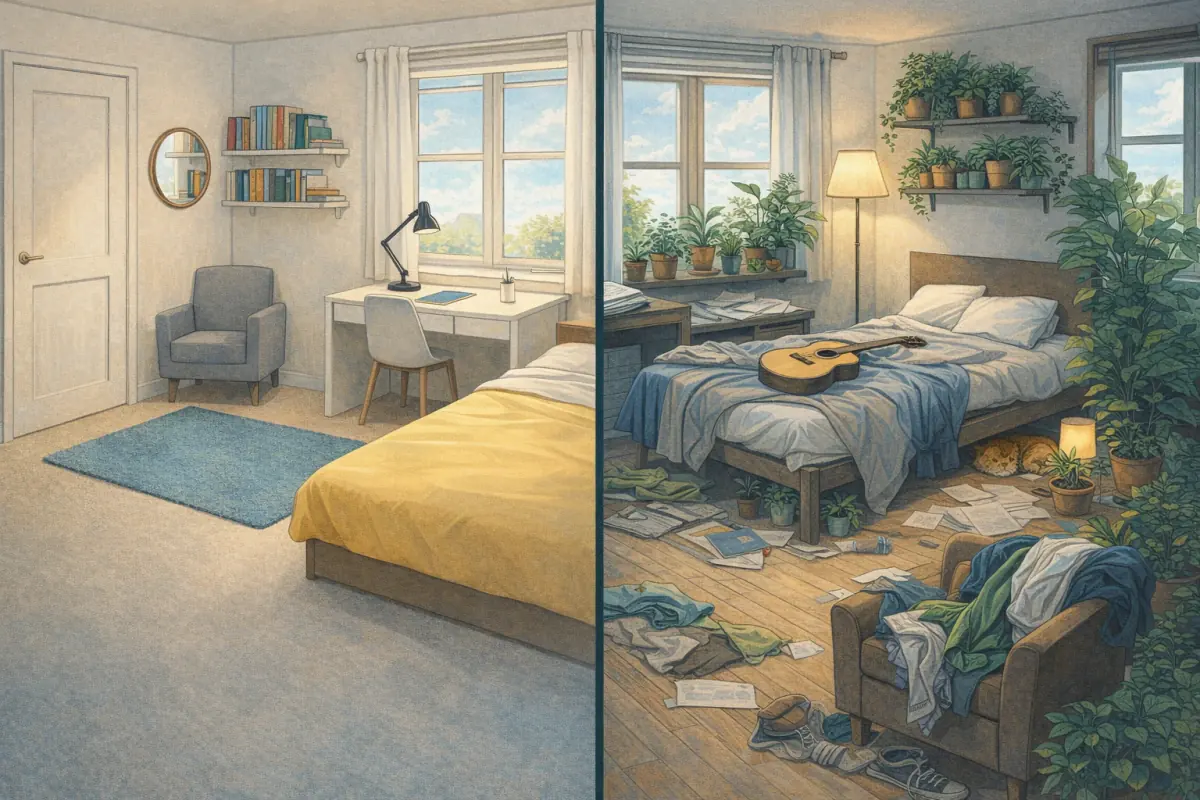
A tidy bedroom and an untidy bedroom side by side.

El correo de la parte 6 de A2 Key y A2 Key for Schools para un invitado: there is y there are, palabras de lugar como opposite y next to, dónde dormirá tu amigo, un correo modelo y errores típicos. Nivel A2, 11–15 años.

Un correo a un amigo que viene a quedarse en tu casa necesita tres cosas: una descripción corta de tu casa (“Our flat is small but comfortable.”), dónde va a dormir tu amigo (“You can sleep in my room.”) y algo para hacer juntos (“We can go swimming.”). Es el tipo de tarea que aparece en la parte 6 de la prueba de lectura y escritura (Reading and Writing) de A2 Key y A2 Key for Schools: 25 palabras o más, y con 30–50 es suficiente. Esta guía es para estudiantes de nivel A2 (elemental) de unos 11–15 años.

¿Para quién es este artículo?

  • Estudiantes de unos 11–15 años que preparan A2 Key o A2 Key for Schools.
  • Estudiantes que conocen palabras como “bedroom” y “kitchen”, pero confunden “there is” y “there are” u olvidan un punto del correo.
  • Para madres y padres: puedes ayudar sin un inglés avanzado; pide a tu hijo o hija que describa una habitación de casa en cinco frases y repasa con él o con ella las palabras de lugar.
  • Demasiado pronto: si escribir un correo corto todavía es nuevo para ti, empieza por la guía del correo para unirte a un club (saludos, despedidas y tres puntos).
  • Demasiado fácil: si escribes sin problema un correo de 100 palabras sobre tu casa, pasa a las tareas de escritura de B1 Preliminary.

Abrir las páginas de muestra

Abrir las páginas de muestra

Tarjetas de vocabulario

next to

very close, at the side of something

Zara's mirror is next to the door.

opposite

on the other side, looking at something

There's a park opposite Amara's flat.

between

in the middle of two things

Zara's carpet is between the bed and the desk.

behind

at the back of something

Theo's desk is behind the plants.

in front of

the other side from behind

Zara's desk is in front of the window.

Conversación

Theo Is that your room, Zara? There aren't any clothes on the floor!

Zara Of course not. Look, these are my books, and that's my mirror, next to the door.

Zara Where's your desk, Theo? I can't see it.

Theo It's there, behind those plants. There are some papers on it.

Zara And is there a lamp?

Theo Yes, there is. It's on the floor, next to the bed.

Zara Theo! You have to tidy up!

Theo Why? It's comfortable.

Estructura de la frase

Your English friend is coming to stay with you. Write an email to your friend. In your email: describe your house or flat; say where your friend will sleep; say what you can do there. Write 25 words or more.

Hi Sam, I can't wait to see you! Our flat is small but comfortable. There are two bedrooms and a big kitchen. You can sleep on the sofa in the living room. We can play basketball in the park opposite. See you soon! Alex

This model has 44 words and answers all three points.

  • 1 your home: There are ... / Our flat is ...
  • 2 where your friend will sleep: You can sleep ...
  • 3 what you can do: We can ...
  • 25 words or more

Más práctica

Amara's email

EFUA'S MESSAGE: Hi Amara! Tell me about your new flat. What's your room like? What can you do near your home?

AMARA'S EMAIL: Hi Efua, thanks for your message! Here's my room tour in words. Our flat is on the third floor of a tall building. It isn't very big, but it's comfortable. My brothers Kofi and Yaw share a bedroom, and I've got a small room next to the kitchen.

In my room, there's a bed under the window, a desk and some shelves for my books. There aren't any photos on my walls yet. Can you send me a photo of you?

There's a park opposite our flat. There's a basketball court there, and I play with my new friends every Saturday. Love, Amara

There is, there are

There's a ... / There is a ...

for one thing

There's a guitar on the bed.

There are some ...

for more than one thing

There are some books on the shelf.

There isn't a ... / There aren't any ...

for things that are not there

There aren't any plants in Zara's room.

Is there a ...? / Are there any ...?

for questions

Is there a mirror in your room? Yes, there is.

a / an

an before a, e, i, o, u sounds

a lamp, a desk, an armchair

this / these

for things near you

This is my desk. These are my books.

that / those

for things not near you

Those photos over there are from Mexico City.

Are there any plants in your room?

Yes, there are some plants on the shelf. / No, there aren't any plants.

Use some in positive sentences and any in negatives and questions.

  • There's a lamp.
  • There are some books.
  • There aren't any plants.
  • Is there a mirror?
  • Are there any photos?

Write your email

Your English friend is coming to stay with you. Write an email to your friend. In your email: describe your house or flat; say where your friend will sleep; say what you can do there. Write 25 words or more.

Hi Sam, I can't wait to see you! Our flat is small but comfortable. There are two bedrooms and a big kitchen. You can sleep on the sofa in the living room. We can play basketball in the park opposite. See you soon! Alex

This model has 44 words.

  • There are ...
  • You can sleep ...
  • We can ...
  • next to / opposite

Check your email

Point 1: my home

Did you describe your house or flat?

Our flat is small but comfortable.

Point 2: where you will sleep

Did you say where your friend will sleep?

You can sleep on the sofa.

Point 3: what we can do

Did you say what you can do there?

We can play basketball in the park.

Place words

Did you use a place word (next to, opposite, under, on)?

We can play basketball in the park opposite.

25 words or more

Count your words.

The model has 44 words.

Aprende esta unidad
¿Cómo quieres aprender?

Cómo es la tarea en el examen

En la parte 6 de la prueba de lectura y escritura de A2 Key y A2 Key for Schools, lees una situación con tres puntos y escribes 25 palabras o más. Esta es una tarea con el mismo estilo, preparada para esta guía:

  • “Your English friend Sam is coming to stay for the weekend. Write an email to Sam.”
  • “Describe your home.”
  • “Say where Sam will sleep.”
  • “Say what you can do together.”
  • “Write 25 words or more.”

Punto 1: describe tu casa con there is y there are

Empieza con una frase general y añade un detalle que le importe a un invitado. Usa “There’s” para una cosa y “There are” para más de una; usa “some” en frases afirmativas y “any” en la mayoría de las negativas y preguntas.

  • General: “We live in a flat on the third floor.”
  • Una cosa: “There’s a big kitchen.”
  • Más de una: “There are some shops near our building.”
  • Lo que no hay: “There isn’t a lift.” / “There aren’t any shops in our street.”

Palabras de lugar que aclaran la imagen

Aprende bien estas cinco, además de “in”, “on” y “under”. Ojo: cuando “enfrente de” significa al otro lado de la calle, en inglés es “opposite”, no “in front of”.

  • “next to”: “The bathroom is next to your room.”
  • “opposite” (frente a frente, a menudo al otro lado de la calle): “There’s a park opposite our flat.”
  • “between”: “The sofa is between the window and the door.”
  • “behind”: “There’s a garden behind the house.”
  • “in front of” (delante, cerca de la parte de delante): “There’s a bus stop in front of our building.”

Puntos 2 y 3: dónde dormirá tu amigo y qué hacer juntos

El punto de dormir es fácil de olvidar, porque es un plan, no una descripción. Ojo con la preposición: se duerme “in” una cama o una habitación, pero “on” un sofá o el suelo. En español las dos son “en”, por eso es fácil decir “in the sofa”.

Para la actividad, usa “can” + verbo, sin “to”. Muchas actividades llevan “go” + -ing: go swimming, go shopping.

  • “You can sleep in my room. I can sleep on the sofa.”
  • “We can play basketball in the park opposite.”
  • “We can go swimming. There’s a pool next to my school.”

Un correo modelo, línea a línea

Cada línea aparece con su función. El correo completo tiene unas 50 palabras.

  • “Hi Sam, I’m so happy you’re coming!” → saludo y un comienzo amistoso.
  • “We live in a small flat with two bedrooms and a balcony.” → punto 1: tu casa.
  • “You can sleep in my room, and I can sleep on the sofa.” → punto 2: dónde dormirá Sam.
  • “There’s a pool opposite our building, so we can go swimming.” → punto 3: qué hacer juntos.
  • “See you on Saturday! Deniz” → despedida y tu nombre.
Aprende esta unidad a tu manera

Describir una habitación en voz alta

Al hablar necesitas el mismo lenguaje. Aquí dos amigos, Zara y Theo, comparan sus habitaciones. Fíjate en “There are some”, “Is there a …? Yes, there is.”, “behind” y “next to”.

Zara Where's your desk, Theo? I can't see it.

Theo It's there, behind those plants. There are some papers on it.

Zara And is there a lamp?

Theo Yes, there is. It's on the floor, next to the bed.

Errores típicos y cómo corregirlos

Algunos vienen del español: “hay” sirve para una cosa y para varias, y de ahí sale “There is two bedrooms.”; y como “muebles” va en plural, aparece “furnitures”. Búscalos al revisar (antes de la flecha, el error; después, la corrección) y comprueba que dijiste dónde dormirá tu amigo.

  • “There is two bedrooms.” → “There are two bedrooms.”
  • “In my room is a desk.” → “There’s a desk in my room.”
  • “There aren’t some shops.” → “There aren’t any shops.”
  • “We have a lot of furnitures.” → “We have a lot of furniture.”
  • “You can sleep in the sofa.” → “You can sleep on the sofa.”

Tu rutina de examen de 10 minutos

Planea durante un minuto (casa, cama, actividad), escribe durante seis y revisa durante tres. Para practicar la expresión oral, describe una habitación de tu casa en cinco frases mientras alguien la dibuja.

  • “Your English cousin is coming to stay for a week. Write an email. Say what your bedroom is like, where your cousin can put their clothes and what you can do in your town. Write 25 words or more.”
  • Comprueba: ¿hay una frase para cada punto y una palabra de lugar?
  • Comprueba: ¿“There’s” para una cosa y “There are” para varias? ¿25 palabras o más y tu nombre?

Qué viene después

Después, practica mensajes cortos que hacen una sugerencia y dan un motivo con “because”. En B1 Preliminary, el correo crece hasta unas 100 palabras y responde a cuatro notas.

Preguntas frecuentes

¿Cuántas palabras debe tener el correo de la parte 6 de A2 Key?

Al menos 25; no hay límite máximo. Con 30–50 palabras es suficiente, y escribir más no suma puntos por sí solo.

¿Cuándo se usa “there is” y cuándo “there are”?

“There is” va delante de una sola cosa o de un sustantivo incontable (“There isn’t much furniture.”); “there are”, delante de más de una (“There are two bedrooms.”).

¿Qué diferencia hay entre “opposite” e “in front of”?

“Opposite” es frente a frente, al otro lado, a menudo cruzando la calle; “in front of” es delante de algo, cerca de su parte de delante. Se dice “opposite our flat”, no “opposite of our flat”.

Flalingo no está afiliado a Cambridge English, entidad que ofrece A2 Key y B1 Preliminary, ni cuenta con su respaldo.

Aprende esta unidad
¿Cómo quieres aprender?

¿Qué viene después?

Clases individuales con un profesor en vivo

En Flalingo, los adolescentes trabajan unidades como esta en clases individuales con un profesor en vivo, a su propio ritmo.

Reserva una clase de prueba gratis