

Ir al contenido
Flalingo

Práctica de inglés

¿Some, any, much o many? Una sugerencia corta en inglés sobre la comida del colegio (A2 Key, parte 6)

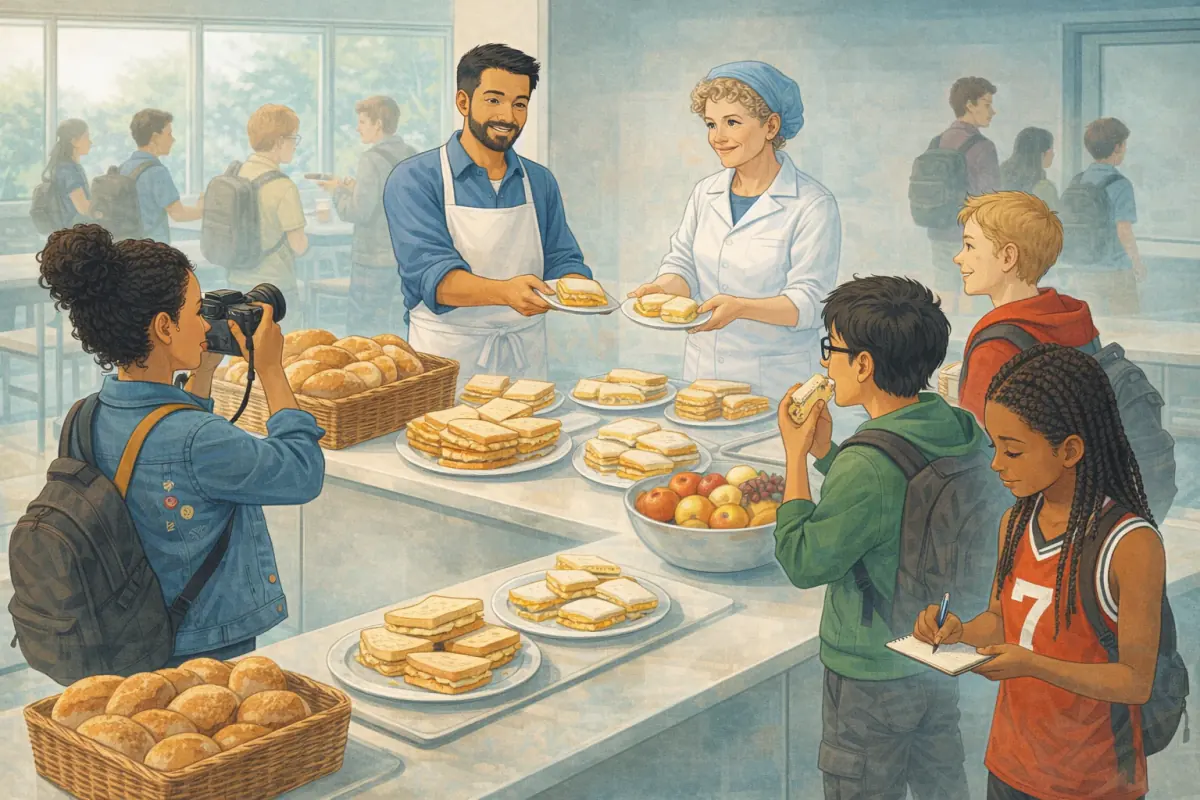
Bakery Friday: fresh bread, sandwiches and fruit in the canteen, with happy students.

Cómo escribir una sugerencia de 25–40 palabras para el comedor con “I think we should … because …” y usar bien some, any, much, many y las palabras de comida. A2 Key y A2 Key for Schools, de 11 a 15 años.

Una sugerencia corta sobre la comida del colegio necesita cuatro cosas: un saludo (“Dear Mr Ross,”), una idea clara (“I think we should have a fruit day.”), un motivo con “because” y tu nombre. Los errores típicos están en las palabras de comida: “some bread”, no “a bread”; “any” en frases negativas y preguntas; “much” con la leche y “many” con los huevos. Es una buena práctica para la parte 6 de la prueba de lectura y escritura (Reading and Writing) de A2 Key y A2 Key for Schools, donde escribes 25 palabras o más. Esta guía es para estudiantes de nivel A2 de unos 11–15 años.

¿Para quién es este artículo?

  • Estudiantes de unos 11–15 años que preparan A2 Key o A2 Key for Schools.
  • Quienes conocen las palabras de comida pero confunden “some” y “any”, o “much” y “many”, al escribir.
  • Para madres y padres: puedes ayudar sin un inglés avanzado; abre la nevera con tu hijo o hija y pídele tres frases con “some”, “any” y “a lot of”.
  • Demasiado pronto: si un correo corto todavía es nuevo para ti, empieza por la guía para describir tu casa en un correo a un amigo (A2 Key, parte 6).
  • Demasiado fácil: si ya puedes dar tu opinión en un artículo de 100 palabras, pasa a la guía B1 sobre un artículo equilibrado acerca del uso de pantallas.

Abrir las páginas de muestra

Abrir las páginas de muestra

Tarjetas de vocabulario

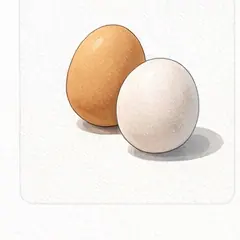
eggegg

a round food from a chicken; it has a hard outside

Mr Haddad needs a lot of eggs for his cakes.

milkmilk

a white drink from cows

Amara's brothers drink a lot of milk.

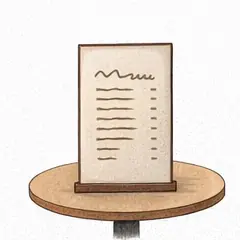
menumenu

a list of the food and drinks you can buy in a cafe or restaurant, with the prices

Look at the menu. How much is an egg sandwich?

Conversación

Examiner You will hear Amara talking to Mrs Dunn, the canteen manager, about food at school.

Amara Thank you for this interview, Mrs Dunn. Why isn't there any fresh bread in the canteen now?

Woman Some people think students don't like bread, but that isn't true. They love it! And the bakery near the school is still open. The problem is money. Fresh bread is too expensive for us now.

Amara How much money does the canteen have for each student's lunch?

Woman Two pounds. Last year it was three pounds. And a cheese sandwich with fresh bread costs us one pound fifty to make.

Amara So what do students buy now?

Woman We sell a lot of biscuits, but most students buy crisps. There's some fruit too, but not many students choose it.

Amara What would you like to sell?

Woman Not soup. Students don't eat much soup. And we've got salad already. I'd really like to sell cheese sandwiches with fresh bread again.

Amara Can The Loop help? We could ask the students what they want.

Woman Everyone wants bread, Amara! You don't need to ask them. Talk to a bakery first. Then talk to the head teacher.

Amara Good idea. First, I'll ask Zara's dad. He has a bakery!

Estructura de la frase

Write to the head teacher about a healthy food idea.

Dear Mr Bramley, Thanks for Bakery Friday! I think we should have a fruit day on Wednesdays. There isn't much fruit on the menu, and a lot of students want more, because it's healthy. Best wishes, Amara

Amara's message has 37 words. It says thank you, gives one idea, gives a reason and ends with her name.

  • Dear Mr Bramley,
  • I think we should …
  • because …
  • Best wishes,

Más práctica

The bakery list

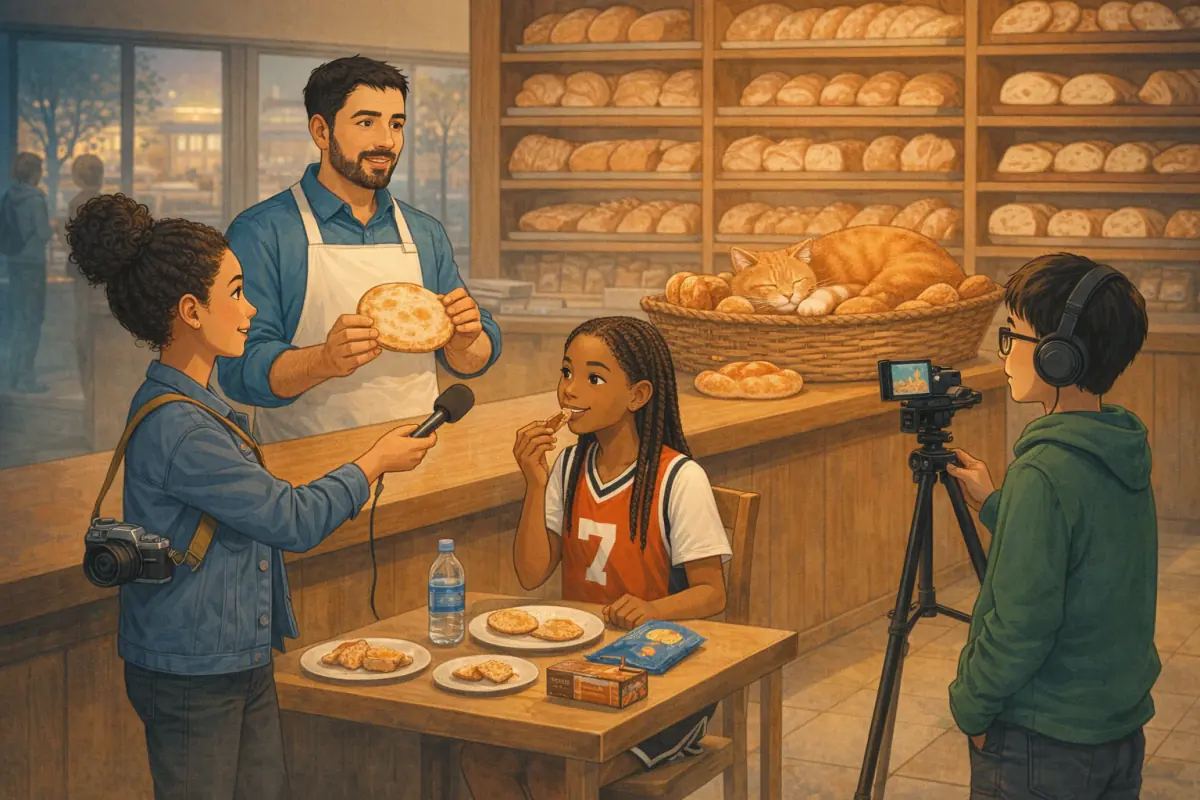
Zara interviews her dad at Haddad's Bakery while Kai films Amara's taste test. A cat is sleeping in the bread basket.

Zara Dad, how much bread do you make every day?

Mr Haddad A lot of bread! We start at four o'clock in the morning.

Zara How many eggs do you need?

Mr Haddad Not many for bread. But we need a lot of eggs for the cakes.

Zara Is there any sugar in our bread?

Mr Haddad Only a little. There's some salt and some butter, but there isn't much sugar.

Zara Are there any sandwiches for the taste test?

Mr Haddad Not yet. We haven't got any cheese! Can you buy some?

Is there any cheese?

No, there isn't any cheese, but there's some butter.

Use some in + sentences. Use any in – sentences and questions. We also use some when we ask for things: Can I have some milk?

Countable: a / an, many

  • an egg → some eggs
  • a sandwich → two sandwiches
  • How many eggs? Not many.

Uncountable: much, no a / an, no -s

  • some bread, some butter, some sugar
  • How much sugar? Not much.
  • NOT: a bread, two breads

some and any

  • + There's some salt. There are some eggs.
  • – There isn't any cheese. There aren't any sandwiches.
  • ? Is there any sugar? Are there any biscuits?

a lot of: countable and uncountable

  • a lot of eggs
  • a lot of bread

Say your idea

Bakery Friday: fresh bread, sandwiches and fruit in the canteen, with happy students.

Zara What's your idea for the canteen?

Amara I think we should have a fruit day, because fruit is healthy.

What's your idea for the canteen?

I think we should have a fruit day, because fruit is healthy.

Say your idea with I think we should … and give a reason with because.

Start and finish

  • Dear Mr Bramley,
  • Best wishes, + your name

Your idea

  • I think we should …
  • Could the canteen sell …?

Your reason

  • … because it's healthy / fresh / delicious.
  • There isn't any … now, and a lot of students want some.

Check your message

There isn't some fresh fruit on the menu.

There isn't any fresh fruit on the menu.

Use any in – sentences.

Check

  • some in + sentences: We want some fruit.
  • any in – sentences and questions: There isn't any salad.
  • no a / an or -s with bread, butter, fruit, milk
  • much + uncountable, many + countable
Aprende esta unidad
¿Cómo quieres aprender?

Qué hace una buena sugerencia

Una buena sugerencia es corta y educada: una idea y un motivo claro. En la parte 6 de Reading and Writing de A2 Key escribes un correo o una nota de 25 palabras o más que cubre tres puntos. Esta es una tarea nuestra en ese estilo:

  • “Your school wants ideas for the canteen. Write a message to your head teacher, Mr Ross.”
  • “Suggest one new food or drink.”
  • “Say why it is a good idea.”
  • “Say which day it could be on the menu.”
  • “Write 25 words or more.”

Expresiones para la idea y el motivo

Después de “should”, “could” y “can”, el verbo no lleva “to” ni “-s”. Las mismas expresiones te sirven en la parte 2 de la prueba oral (Speaking) de A2 Key, donde le cuentas a tu compañero o compañera qué te gusta y por qué.

  • Idea: “I think we should have a fruit day.”, “I think the canteen should sell soup.”
  • Pregunta educada: “Could the canteen sell fresh bread?”
  • Motivo: “because it’s healthy”, “because students love it”

Un mensaje modelo, línea a línea

Con el saludo y la despedida, esta respuesta tiene 38 palabras.

  • “Dear Mr Ross,” → saludo: “Dear”, el tratamiento y el apellido.
  • “I think the canteen should sell fruit salad.” → punto 1: una sola idea.
  • “There isn’t any fruit on the menu now, and a lot of students want some because it’s healthy.” → punto 2: el motivo, con “any”, “a lot of” y “some”.
  • “Could we have it on Mondays?” → punto 3: el día, como pregunta educada.
  • “Best wishes, Deniz” → despedida y tu nombre.

¿Contable o incontable? Palabras de comida con trampa

Los sustantivos contables tienen plural: an egg, two eggs. Los incontables no llevan “a/an” ni “-s”: “some bread”, no “a bread” ni “breads”. En español dices “un pan, dos panes”, así que este error es muy común; una barra de pan es “a loaf of bread” y una rebanada, “a slice of bread”. Para contar, pon delante una cantidad o un envase.

  • Contables: egg, sandwich, biscuit, apple, vegetable, snack
  • Incontables: bread, butter, cheese, milk, sugar, salt, water, juice, rice, pasta, fruit
  • Cantidades y envases: a piece of bread, a glass of milk, a bottle of water, a packet of crisps, a box of biscuits
  • “Fruit” suele ser incontable, aunque en español digas “frutas”: “some fruit”, “a piece of fruit”. Una manzana es “an apple”.
Aprende esta unidad a tu manera

Some, any, much, many y a lot of

Una pista: si en español dirías “mucho” o “mucha” en singular (mucho pan, mucha leche), en inglés suele ser “much”; si dirías “muchos” o “muchas” (muchos huevos), es “many”. Y nada de doble negación: “No hay nada de pan” es “There isn’t any bread.”, no “There isn’t no bread.” En la grabación de abajo, la responsable del comedor de un colegio contesta a una estudiante: fíjate en “not many students” (plural) y “much soup” (incontable).

  • “some” en frases afirmativas, ofrecimientos y peticiones: “There are some eggs.” “Can I have some milk?”
  • “any” en negativas y preguntas: “There isn’t any bread.” “Are there any biscuits?”
  • “much” con incontables, sobre todo en negativas y preguntas: “How much sugar?”
  • “many” con plurales: “How many eggs?” “Not many students eat soup.”
  • “a lot of” con los dos, sobre todo en afirmativas: “We eat a lot of bread.”, no “We eat much bread.”

Student So what do students buy now?

Canteen manager We sell a lot of biscuits, but most students buy crisps. There's some fruit too, but not many students choose it.

Student What would you like to sell?

Canteen manager Not soup. Students don't eat much soup. And we've got salad already. I'd really like to sell cheese sandwiches with fresh bread again.

Errores típicos y cómo corregirlos

Búscalos al terminar (el error antes de la flecha, la corrección después). Y no dejes el motivo solo, como “Because it’s cheap.”: únelo a tu idea.

  • “Can I have a bread?” → “Can I have some bread?”
  • “There isn’t some fruit on the menu.” → “There isn’t any fruit on the menu.”
  • “How many sugar do you want?” → “How much sugar do you want?”
  • “I think we should to sell soup.” → “I think we should sell soup.”
  • “because of it’s healthy” → “because it’s healthy”

Tu rutina de 10 minutos

Escribe esta tarea en 10 minutos: 2 para planificar, 6 para escribir y 2 para revisar.

  • “Your class is planning a healthy snack table. Write a note to your teacher, Ms Patel. Suggest one snack, say why and say one food the table shouldn’t have. Write 25 words or more.”
  • Revisión 1: ¿hay una idea, un motivo con “because” y el tercer punto?
  • Revisión 2: ¿usas “any” en las negativas y en las preguntas?
  • Revisión 3: ¿bread, milk y fruit van sin “a” y sin “-s”?

Qué viene después

Después pasas de la comida al deporte: describir un partido mientras se juega, en cinco frases. Hasta entonces, en cada comida di una frase sobre tu plato con “some”, “any” o “a lot of”.

Preguntas frecuentes

¿Qué diferencia hay entre “some” y “any”?

“Some” va en frases afirmativas, ofrecimientos y peticiones (“Can I have some milk?”); “any”, en negativas y en la mayoría de las preguntas (“There isn’t any bread.”).

¿“Bread” es contable o incontable?

Incontable: di “some bread”, nunca “a bread” ni “breads”. Para contarlo, di “a piece of bread” o “a slice of bread”.

¿Cuándo se usa “much” y cuándo “many”?

“Much” va con incontables (“How much milk?”) y “many” con plurales (“How many eggs?”). En frases afirmativas, “a lot of” suena más natural con los dos.

Flalingo no está afiliado a Cambridge English, entidad que ofrece A2 Key y B1 Preliminary, ni cuenta con su respaldo.

Aprende esta unidad
¿Cómo quieres aprender?

¿Qué viene después?

Clases individuales con un profesor en vivo

En Flalingo, los adolescentes trabajan unidades como esta en clases individuales con un profesor en vivo, a su propio ritmo.

Reserva una clase de prueba gratis