


Ir al contenido
Flalingo

Práctica de inglés

Cómo escribir una crónica corta de un partido en inglés como un comentarista: present simple y present continuous (nivel A2 Key)

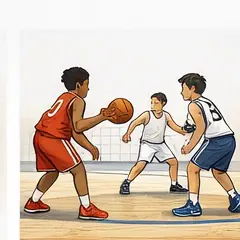
After the match: the team sit together and Coach Bell claps for them.

Una crónica de un partido en cinco frases en inglés: am/is/are + -ing para lo que está pasando, present simple para jugadas rápidas y costumbres, vocabulario deportivo, una crónica modelo y errores típicos. Nivel A2 Key, 11–15 años.

Una crónica corta de un partido funciona bien en cinco frases: cuándo y dónde, la primera jugada importante, el gran momento, el resultado y cómo termina. Escríbela en presente, como un comentarista: am/is/are + -ing para lo que está pasando alrededor (“The fans are singing.”), y present simple para las jugadas rápidas (“She throws the ball, and it goes in.”) y las costumbres (“We usually lose to them.”). Añade el resultado y al menos tres palabras de deporte. Esta guía es para estudiantes de nivel A2 (elemental) de unos 11–15 años, y para sus familias.

¿Para quién es este artículo?

  • Estudiantes de unos 11–15 años que preparan A2 Key o A2 Key for Schools, sobre todo si el deporte es el tema sobre el que más fácil te resulta escribir.
  • Estudiantes que conocen “I play” y “I’m playing”, pero los mezclan cuando escriben rápido.
  • Para madres y padres: no necesitas un inglés avanzado para revisar la crónica: cuenta cinco frases, busca el resultado y subraya cada is/are + -ing.
  • Demasiado pronto: si la -s de “she plays” y “he watches” todavía es nueva para ti, practica primero el present simple con rutinas diarias.
  • Demasiado fácil: si ya escribes crónicas más largas sin problema, pasa a tareas de B1, como debatir ideas con un compañero y llegar a un acuerdo sobre una.

Abrir las páginas de muestra

Abrir las páginas de muestra

Tarjetas de vocabulario

commentator

a person who talks about a match while it is happening, for people who can't see it

Kai is the commentator for the live stream.

matchmatch

a game between two teams or two players

Today is Amara's first big match.

fan

a person who loves a team, a sport or a singer

The fans are singing the team song.

throwthrow

to send something through the air with your hand

Throw the ball to Amara!

kickkick

to hit something with your foot

In football, you kick the ball.

Conversación

Narrator After Max's video, The Loop needs a new story, with no bread in it! Today it's Amara's first big basketball match.

Zara We're live! Hi, everyone. We're in the school sports hall, and the match is starting.

Theo Look at the fans. They're singing already!

Zara Kai, you're the commentator. What's happening?

Kai Amara is running down the court with the ball. She usually scores from there!

Theo Yes! Two points! Harbour Park are winning!

Kai And Coach Bell is shouting, 'Go, go, go!'

Zara Great! Now look at the camera, Kai. Say hello to everyone at home.

Kai Me? On camera? Er…

Estructura de la frase

What is Amara doing now?

She's running down the court. She usually scores from there!

Use am / is / are + -ing for now. Use play / plays for things you usually do.

Más práctica

The match report

After the match: the team sit together and Coach Bell claps for them.

Harbour Park lose by two points, but win a lot of fans

Friday is a big day in the school sports hall. It's the first home match of the year for our basketball team, and the hall is full. Northside are a strong team, and at half-time they're winning by ten points.

But Harbour Park don't stop. In the last ten minutes, Amara Mensah (number 7) scores twelve points. With one minute to go, the score is 38–38. Then a Northside player throws the ball from the middle of the court, and it goes in. The final score is 38–40.

'I'm very happy with my players,' says Coach Bell. 'They're fit, and they never stop running.'

The Loop shows the match in a live stream. For ten seconds, the commentator, Kai Morales, says nothing. Then Theo Lindqvist plays the team song on his guitar, and all the fans sing. More than 200 people watch the stream, and it gets 85 comments. That's our best number ever!

The team plays its next match in two weeks.

comment

words that people write under a video or a post on the internet

The live stream gets 85 comments.

report

a piece of writing that tells people what happens, for example in a match

Amara reads the match report in the school newspaper.

Your match report

After the match: the team sit together and Coach Bell claps for them.

Write about a match in five sentences.

Harbour Park 3, Northside 1 It's Saturday morning, and our football team is playing Northside at the sports centre. Northside score first, but our players don't stop running. In the second half, our number 9 scores two goals, and the fans are singing. The final score is Harbour Park 3, Northside 1. It's an exciting match, and the next one is in two weeks.

This report has five sentences and 64 words. It uses the present, like a commentator.

  • It's Saturday morning …
  • … score first
  • … is/are singing
  • The final score is …

Check your report

Look! The fans sing the team song.

Look! The fans are singing the team song.

Look! means now, so use are + -ing.

Check

  • now: am / is / are + -ing (The fans are singing.)
  • usually: play / plays (The team practises a lot.)
  • he / she / it: add -s (Amara scores.)
  • -ing spelling: swimming, running, riding
Aprende esta unidad
¿Cómo quieres aprender?

¿Ahora, normalmente o una jugada rápida?

Una crónica necesita las dos formas del presente. Am/is/are + -ing describe algo que está en marcha en este momento; palabras como “Look!” y “at the moment” apuntan a esta forma. El present simple describe costumbres; palabras como “usually” y “every week” apuntan a él. En español, el presente simple también sirve para lo que pasa ahora (“¡Mira, corre!”), así que es fácil escribir “Look! She runs.” en vez de “Look! She’s running.”

Los comentaristas también usan el present simple para acciones cortas que empiezan y terminan en un segundo: “She takes the ball, she runs, she scores!” Por eso, en una crónica, un verbo en present simple no siempre significa “normalmente”. Prueba: rápida y terminada, present simple; todavía en marcha, -ing.

  • Ahora: “Look! The fans are singing.” “Our goalkeeper isn’t moving!”
  • Normalmente: “The team practises twice a week.” “She usually scores from there.”
  • Jugada rápida: “Number 7 throws the ball, and it goes in.” “Hillview score first.”

Escucha: un partido del colegio en directo

Unos estudiantes graban un partido de baloncesto del colegio para una retransmisión en directo, y uno de ellos es el comentarista. Fíjate en las formas con -ing y en una costumbre (“usually scores”). Con el nombre de un equipo, el inglés británico usa a menudo “are”.

Zara We're live! Hi, everyone. We're in the school sports hall, and the match is starting.

Theo Look at the fans. They're singing already!

Zara Kai, you're the commentator. What's happening?

Kai Amara is running down the court with the ball. She usually scores from there!

Theo Yes! Two points! Harbour Park are winning!

Vocabulario deportivo: play, go o do, y el resultado

Usa al menos tres palabras de deporte que encajen con el tuyo.

  • “play” con deportes de pelota y juegos: play football, play tennis, play chess
  • “go” con actividades en -ing: go swimming, go sailing, go skateboarding
  • “do” con el ejercicio y el deporte en general: do exercise, do sport
  • Acciones y personas: throw, catch, kick, hit, jump; player, team, coach, fan, commentator
  • Resultados: win a match, beat a team, lose to a team, score a goal
  • El marcador: “The final score is 2–1.” (se dice “two–one”); 1–1 es “one all”; en el fútbol británico, el 0 suele decirse “nil”.

Una crónica modelo, frase a frase

Es un ejemplo nuestro: unas 75 palabras bajo un titular con el resultado. Cada frase tiene una función.

  • “Riverside 2, Hillview 1” → titular.
  • “It’s Saturday afternoon, and our school football team, Riverside, is playing Hillview in the town park.” → 1: cuándo, dónde, quién.
  • “Hillview score first, but our players are running hard and the fans are singing.” → 2: la primera jugada y la escena con -ing.
  • “In the second half, Mia kicks the ball from the middle of the pitch, and it’s a goal!” → 3: el gran momento.
  • “Ten minutes later, our number 4 scores another goal, and the final score is 2–1.” → 4: el resultado.
  • “We usually lose to Hillview, so everyone is very happy today.” → 5: el final, con una costumbre.
Aprende esta unidad a tu manera

Errores típicos y cómo corregirlos

Al terminar, revisa cada verbo (antes de la flecha, el error; después, la corrección). En español “ganar” sirve para el partido y para el rival (“les ganamos”); de ahí sale el error “We won Hillview.”

  • “Look! The fans sing.” → “Look! The fans are singing.”
  • “She running with the ball.” → “She is running with the ball.”
  • “My brother play tennis.” → “My brother plays tennis.”
  • “We play swimming on Sundays.” → “We go swimming on Sundays.”
  • “We won Hillview.” → “We beat Hillview.” (win con el partido; beat con el rival)
  • “The match is very excited.” → “The match is very exciting.” (el público está excited; el partido es exciting)
  • “runing”, “swiming” → “running”, “swimming”

Tu rutina de 15 minutos

Dos veces por semana, escribe sobre un partido que hayas jugado, visto o inventado.

  • Minutos 1–3: mira un minuto de cualquier partido y coméntalo en voz alta: “Now number 10 is running…”
  • Minutos 4–5: anota los equipos, el resultado y tres palabras de deporte.
  • Minutos 6–12: escribe cinco frases, cada una con su función.
  • Minutos 13–15: revisa el resultado, is/are + -ing para la escena y la -s con he, she e it.

Qué viene después

La prueba de lectura y escritura de A2 Key termina con una historia corta a partir de tres imágenes (35 palabras o más); contar un partido en pasos claros entrena esa misma habilidad. En la prueba oral puedes hablar de deportes y aficiones, así que usa -ing después de enjoy, love, hate y don’t mind: “I don’t mind playing chess, but I love swimming.”

Preguntas frecuentes

¿Cuál es la diferencia entre el present simple y el present continuous?

Am/is/are + -ing es para acciones en marcha ahora: “She’s running.” El present simple es para costumbres: “She runs every morning.” En una crónica en directo, también cuenta las jugadas rápidas.

¿Se dice play football o do football?

“Play football.” Usa play con deportes de pelota, go con actividades en -ing (go swimming) y do con el ejercicio o el deporte en general.

¿La crónica de un partido forma parte del examen A2 Key?

No. La escritura de A2 Key tiene un correo o una nota corta (25 palabras o más) y una historia a partir de imágenes (35 palabras o más). Una crónica de cinco frases es buena práctica para la historia.

Flalingo no está afiliado a Cambridge English, entidad que ofrece A2 Key y B1 Preliminary, ni cuenta con su respaldo.

Aprende esta unidad
¿Cómo quieres aprender?

¿Qué viene después?

Clases individuales con un profesor en vivo

En Flalingo, los adolescentes trabajan unidades como esta en clases individuales con un profesor en vivo, a su propio ritmo.

Reserva una clase de prueba gratis