
Best Online English Courses for Kids in Portugal (2026): 6 Options Compared
The vocabulary worksheet came home marked “Very Good”, the Year 4 test went well, and the English exercise book is full of colours, animals and days of the week. Then a cousin who lives in London calls on video, asks “How was school today?” and gets a shy smile in reply. Anyone looking for the best online English courses for children in Portugal knows this scene well. English has been compulsory from Year 3 since 2015/2016, with at least two hours a week (Decree-Law No. 176/2014). And the Essential Learning Outcomes for English published by the Directorate-General for Education in March 2026 set a target of A1.1 by the end of Year 4, meaning the beginning of A1 on the Common European Framework of Reference for Languages (CEFR).
Many families respond to this in the most Portuguese way possible: with explicações, the private tutoring sessions that fill so many afternoons. According to a study by the "la Caixa" Foundation's Social Observatory released in March 2026, one in five pupils aged 6 to 18 has private tutoring, and English is the third most popular subject after Maths and Portuguese. On average, families spend €126.40 a month per pupil. The catch is that a typical tutoring session prepares the next test, while what many children lack is minutes spent talking to someone who waits for an answer in English.
We therefore compared six options available in Portugal with two questions in mind: does the child actually speak during the lesson, and can the lesson keep pace with what is being taught at school? The options include one-to-one lessons with teachers used to working with children, a tutoring marketplace, a British institution with schools in Greater Lisbon, Porto and Coimbra, and an app without a teacher. All prices are listed in the same currency.
Short answer
Our top pick is Flalingo Kids: a regular teacher, a FLAI report after every lesson, room for school material and €5.76 per lesson on the 12-month plan. Novakid suits children who love games, Cambly Kids focuses on native speakers, Preply on choosing your own tutor, the British Council on group classes and Lingokids on the youngest learners.
Contents
- Our evaluation criteria
- Quick comparison of the best online English courses for children in Portugal
- English tutoring and schoolwork: what to look for
- #1 - Flalingo Kids
- #2 - Novakid
- #3 - Cambly Kids
- #4 - Preply
- #5 - British Council
- #6 - Lingokids
- Which combination suits your child?
- Frequently asked questions
- Sources
Our evaluation criteria
An eight-year-old does not say the lesson was boring. They simply stop wanting to turn on the computer. So we looked at what makes the difference in week six, rather than week one: whether there is a familiar face on the other side, whether the lesson was designed for their age and whether parents know what happened. We assessed all six options against the same seven questions, using what they publish on their pricing pages, in their subscription terms and in their help centres. The seventh criterion, shown in orange, comes from a very Portuguese habit: using tutoring to support school learning.
Quick comparison of the best online English courses for children in Portugal
The last column shows the lowest starting price we found on the official websites. Lesson length and class size vary considerably from one option to another, so the details are provided in each section. The second-to-last column summarises the Portugal-specific criterion: whether lessons can incorporate schoolwork.
Prices last checked: November 2026.
English tutoring and schoolwork: what to look for
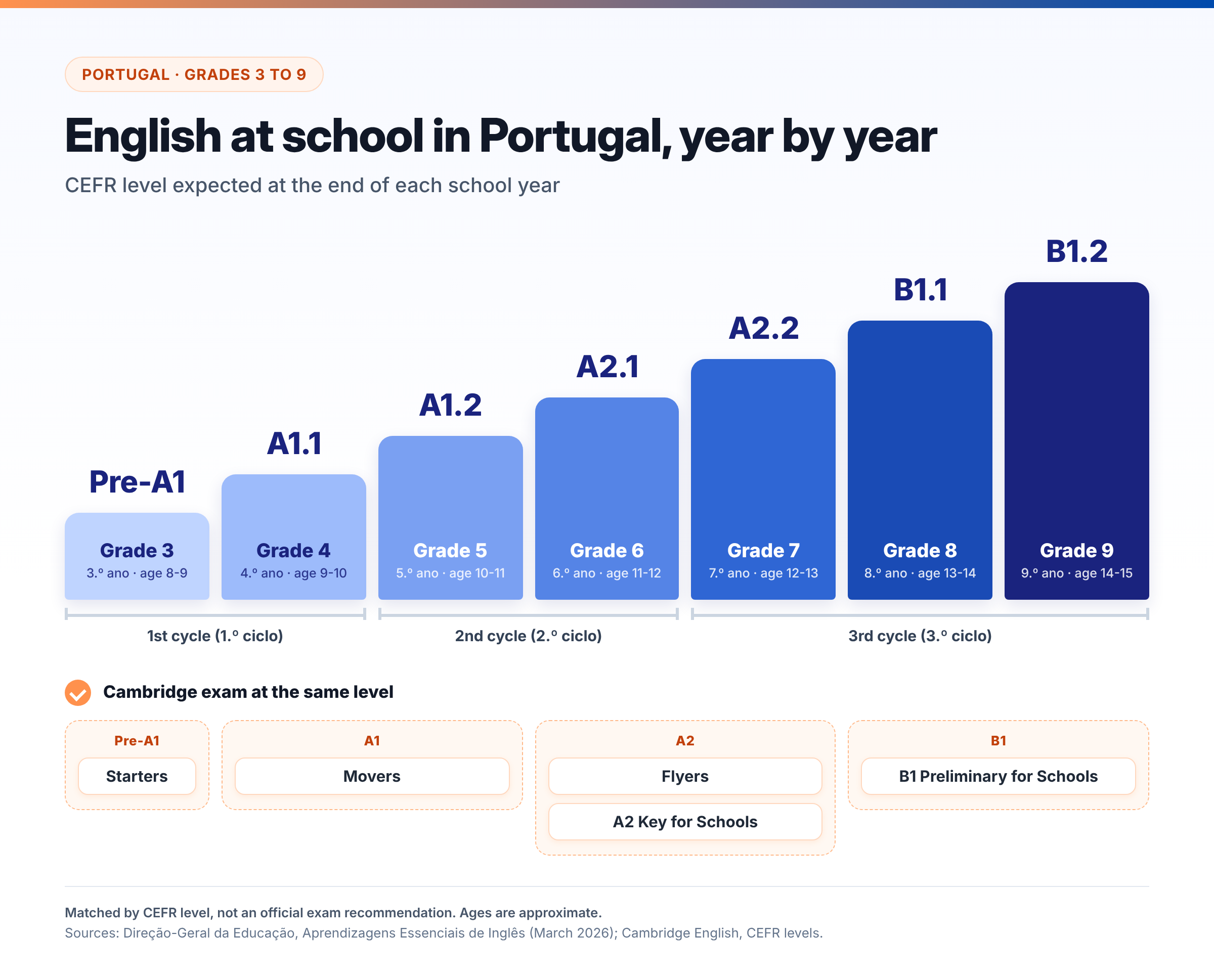
Before choosing, it helps to know what your child's school will expect each year. The Essential Learning Outcomes for English, revised by Portugal's Directorate-General for Education in March 2026, set a CEFR level for each school year (Year 3, Year 4):
- Year 3: pre-A1
- Year 4: A1.1
- Year 5: A1.2
- Year 6: A2.1
- Year 7: A2.2
- Year 8: B1.1
- Year 9: B1.2
For Year 3, the document itself states that pupils are not expected to reach A1, even partially, and recommends games, songs, stories and visual resources. Expectations rise quickly from the second cycle of basic education (Years 5–6) onwards. This is also where tutoring comes into play. According to the ”la Caixa” Foundation study, the two main reasons for getting tutoring in Portugal are difficulties with the subject (40.8%) and exam preparation (31.3%). The typical student spends 3.1 hours a week in tutoring, and more than half of sessions take place at tutoring centres.
An online English lesson can serve the same purpose without turning into a last-minute revision session before a test. To make sure it does, it is worth asking any platform three questions:
- Will the teacher work with the material being covered in class, whether that is a textbook page, the week's vocabulary list or the topic of an oral presentation?
- Does the platform have its own level-based learning path, so that the child makes progress even in weeks when there is no test?
- Do parents receive a record of what was covered that they can compare with school worksheets and tests?
Of the six options on this list, only Flalingo Kids and Preply answer yes to the first question. The difference lies in the other two. On Preply, the learning path and records depend on the tutor you choose. On Flalingo Kids, textbook material is incorporated into a lesson that already has a book, a level and a report behind it.
#1 - Flalingo Kids: a regular teacher, reports for parents and schoolwork in lessons
Flalingo Kids offers live one-to-one English lessons to children and teenagers aged 3 to 17, organised into four age groups (3-5, 6-8, 9-12 and 13+). Each lesson lasts 25 or 50 minutes. For preschool and the first years of primary school, the shorter version is the one to go for, with pictures, songs and games. The platform suggests two to three lessons a week and allows up to seven for families who want to speed things up.
To teach at Flalingo, a teacher needs a degree in English language teaching or in English language and literature, a teaching certificate, proven proficiency (IELTS 8 or TOEFL 100, or TEFL, TESOL or CELTA for native speakers) and two years of experience. After a live interview, a demo lesson and reference checks, only one in 73 applicants is accepted, according to the platform. Teachers who work with children also go through a background check and child protection training. Every plan gives access to teachers whose first language is English.
This is also where Flalingo Kids answers the Portugal criterion best. Because the teachers are pedagogically trained, they can work in parallel with the school curriculum. Send the teacher, through the platform's messaging, the textbook page the class is on, the week's vocabulary or the topic of an oral presentation, and they will use that material to get your child talking about it. School content comes into the conversation without the lesson turning into test tutoring, and the book pathway carries on. For older children, The Loop books lead to the Cambridge A2 Key and B1 Preliminary for Schools exams (our guide A2 Key or B1 Preliminary for Schools helps you pick the right level). For anyone already thinking about IELTS or TOEFL, say for studying abroad, FlalingoExams has mock exams marked by AI.
What puts Flalingo Kids in first place, though, is continuity. Smart Matching weighs 18 data points, including age, level, interests and the kind of teacher your child prefers (calmer or more energetic), and suggests 22 to 30 profiles. The chance of keeping the same teacher until the end of the plan is above 90%. For a shy child, this is often what gets them talking: by week three, they recognise the face on the screen and pick the conversation up where they left it. Switching teacher remains possible before any lesson, at no cost.
Parents can watch the lesson live, replay the recording later and receive a short video of the lesson every week on WhatsApp. A lesson can be cancelled up to eight hours before it starts. FLAI, Flalingo's artificial intelligence, also reviews every session for safety and alerts the quality team if any content raises concerns.
The lessons use the Smart Personalized Books, one continuous series. The Nia & Leo series starts with three Little Explorers books for preschool, moves through a starter level and six main levels, and The Loop series then continues from age 11 to 14. Every unit has a game version: the teacher opens it during the lesson, and the child searches, listens, guesses and colours in the same picture as the teacher. The drawing then becomes a sticker for the child's collection.
Between lessons, Flalingo Stories brings together 165 interactive stories for ages 4 to 12, organised by the Cambridge Starters, Movers and Flyers levels (we cover them in Free English stories for children). Flalingo Games has multiplayer games for ages 4 to 13. Both sites are entirely in English, which works in the child's favour here. And before the first lesson, the free placement test for children adapts its questions to your child's age and reading ability.
Key features
- Live one-to-one lessons lasting 25 or 50 minutes, up to 7 per week, for ages 3 to 17
- Teachers with degrees and training in education, background checks and child safeguarding training
- Smart Matching with 18 criteria and a selection of 22 to 30 teachers
- Learning alongside school: textbooks, weekly vocabulary, oral presentations
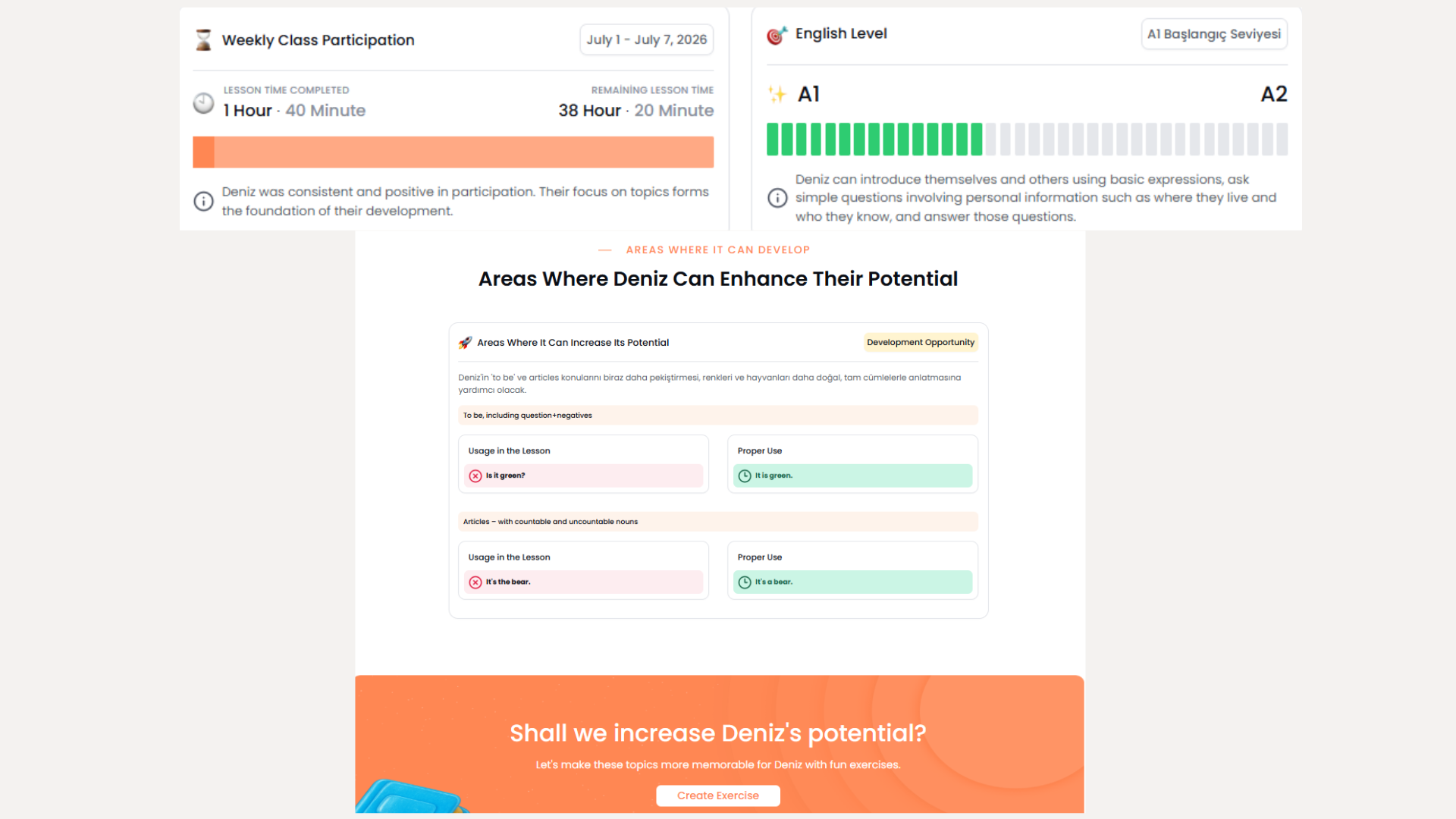
- FLAI report after every lesson and a weekly report for parents
- Personalised exercises created from the child's mistakes
- Lessons parents can watch live, unlimited recordings and a weekly video via WhatsApp
- Nia & Leo and The Loop books, up to B1 Preliminary for Schools
- AI safety analysis of lessons, with alerts to the quality team
- Free placement test for children
- 24-hour live support and messaging with the teacher
Price
There are two plans, which differ only in length and price per lesson. Both include native-speaker teachers, the Smart Personalized Books, FLAI reports, 24/7 support and unlimited access to recordings. The 12-month plan adds group lessons. With one lesson a week, the numbers look like this (full details on the Flalingo Kids pricing page):
- Second child: an extra 20% off, on every plan
- Free trial lesson of 25 minutes, with no card details or upfront payment
- Full refund within 30 days of the first lesson, no questions asked
- No automatic renewal at the end of the plan
Prices last checked: November 2026.
Who is it for?
- Children aged 3 to 17, especially those aged 5 to 12, who understand but do not feel confident enough to speak
- Families who want the same teacher throughout the year
- Parents who want to combine school material and conversation in the same lesson
- Students in years 5 to 9 preparing for A2 Key, B1 Preliminary for Schools or an oral presentation
- Budgets starting at €22.97 per month on the 12-month plan, with one lesson per week
Parents' reviews
On Google, Flalingo has a rating of 4.9 out of 5, with 710 reviews. The two comments below come from families whose daughters take lessons with Flalingo Kids. You can find more opinions in Flalingo Kids Reviews: What Parents Say.
#2 - Novakid: a world of games for ages 4 to 12
Novakid is an online English school just for children, with a website in European Portuguese. It takes children aged 4 to 15, with its core between 4 and 12. Each one-to-one lesson lasts 25 minutes and is taught entirely in English, and most children have two or three a week. The programme follows the CEFR from pre-A1 to B1, with a certificate at the end of each level.
Novakid advertises more than 3 900 certified teachers and says it accepts one in every 11 applicants after a ten-stage recruitment process. There are two categories of teachers: international teachers, who are not native speakers, and native speakers, who cost more. The platform does not guarantee a regular teacher, but you can book further lessons with a teacher your child likes. After every lesson, parents receive the teacher's feedback and a video of the session, and they can view the topics and levels completed in their parent account.
On the school side, Novakid follows its own programme, and we found no option for working with the Portuguese textbook. To get children speaking more, it adds 45-minute small-group conversation sessions with children from several countries to the one-to-one lessons. This works well with a confident child. A shy child tends to let the others do the talking. We compare the two approaches in Flalingo Kids vs Novakid.
Key features
- 25-minute individual lessons, entirely in English
- More than 3 900 certified international or native-speaking teachers
- CEFR-aligned curriculum, from pre-A1 to B1, with a certificate at each level
- Avatars, challenges, stars and rewards
- Teacher feedback and a video after each lesson, plus a parent account
- 45-minute group conversation lessons with children from several countries
- Free 25-minute trial lesson, no card required
Price
Novakid only publishes starting prices: from €9 per 25-minute lesson with international teachers and from €17 with native speakers. The 45-minute group conversation lessons start at $8 (about €7), with the first month free. The final price depends on subscription length, the number of lessons a week and current promotions, and longer subscriptions usually bring the price per lesson down. With two lessons a week with international teachers, budget for at least €78 a month or so.
- 10% discount for two siblings, with at least two lessons a week each
- Money-back guarantee: the pricing page says 14 days, the homepage says 45, so check before you pay
- Free 25-minute trial lesson
Prices last checked: November 2026.
Who is it for?
- Children aged 4 to 10 who are drawn to games and rewards
- Families who can commit to two or three fixed time slots per week
- Parents who do not need a direct link to the school curriculum
- A budget starting at around €78 per month for two lessons a week
Parent reviews
Novakid has a rating of 4.2 out of 5 on Trustpilot, with 2 605 reviews. The two reviews below are from parents. The first is very enthusiastic, while the second likes the teachers but makes two specific criticisms of the curriculum.
#3 - Cambly Kids: native-speaking tutors in 30-minute lessons
Cambly Kids is the children's offer from Cambly, the American platform known for conversations with native speakers. It is aimed at ages 4 to 15, in one-to-one lessons of 30 minutes. All tutors speak English as their first language, and the courses are organised by CEFR level, from A1 to C1. The site displays the kidSAFE seal. Plans range from two to seven lessons a week, paid monthly, quarterly or yearly.
It best suits a child who already has the basics and needs to loosen up when speaking. For a complete beginner who needs a rule explained slowly, the format can feel abrupt. On the Portugal criterion, Cambly Kids sits halfway. Nothing stops you asking the tutor to chat about the topic of the unit the class is covering, but the platform has no pathway designed to follow the school curriculum. We set the two approaches side by side in Flalingo Kids vs Cambly Kids.
You can choose a tutor and book them again from week to week. Lessons are recorded, and the videos are deleted twelve months after the account stops being used. There is no regular report for parents, however: to find out how your child is doing, you need to watch the recordings or ask them.
Key features
- 30-minute one-to-one lessons for ages 4 to 15
- Native-speaking tutors only
- Courses from A1 to C1 on the CEFR scale
- kidSAFE safety seal
- Every lesson recorded
- Plans with 2, 3, 5 or 7 lessons per week
- Free games and activities, no subscription needed
Price
Cambly publishes its prices for children in dollars, per 30-minute lesson, on the plan with two lessons a week. In euros, that comes to about €15.47 per lesson paid monthly, €10.00 paid quarterly (30% off) and €7.14 on the annual plan (50% off). With two lessons a week, expect to pay around €62 to €134 a month. The page doesn't show prices for the 3, 5 and 7-lesson plans.
- 30-minute trial lesson at a token price
- Annual plan renewed automatically every 12 months, cancellable at any time
- Full refund on the first plan if you ask within the first seven days
Prices last checked: November 2026.
Who is it for?
- Children aged 7 to 15 who know the basics and need more speaking practice
- Children who understand a lot but give one-word answers
- Families with changing schedules who prefer short lessons
- A budget of around €62 to €134 per month for two lessons a week
User reviews
Cambly has a rating of 2 out of 5 on Trustpilot, based on 256 reviews across all its services. Many negative reviews focus on refunds, automatic renewals and relationships with tutors rather than the lessons themselves. We did not find any recent parent reviews of Cambly Kids: the first review below is from an adult user, and the second is from a tutor on the platform.
#4 - Preply: a tutor of your choice for a specific need
Preply is a marketplace of independent tutors, not a school. Its page of English lessons for children lists more than 14,700 teachers, and each one sets their own price, schedule and method. The average is around €22 an hour with native speakers and €23 with non-native speakers, according to the platform itself. You filter by price, availability, country, specialism or languages spoken, and you read other families' reviews before booking. Lessons usually last 50 minutes, and the trial lesson 25 or 50. If the first tutor isn't right, you can try two more at no extra cost.
In the Portuguese context, Preply is the closest option to traditional private tutoring. You can look for a tutor who speaks Portuguese, works with your child's school textbook and prepares them for tests worksheet by worksheet. That freedom comes at a cost. There is no shared curriculum for children, and the teacher's background, method and way of talking to a child depend entirely on the person you choose. You are responsible for screening tutors, and if your child is under eight, it is best to stay nearby during the first few lessons.
The Lesson Insights tool uses AI to summarise each lesson, with vocabulary, grammar and review exercises. It only works if both the teacher and the pupil switch it on, and it transcribes the session audio to do so. We compare this model with a dedicated children's curriculum in Flalingo Kids vs Preply for Kids.
Key features
- More than 14 700 English teachers for children, with filters for price, schedule and languages spoken
- Portuguese-speaking teachers, helpful for beginners
- 50-minute lessons, with 25- or 50-minute trial lessons
- Free teacher replacement if the first one is not a good fit
- Subscription with your chosen teacher, with the option to pause
- Optional AI lesson summaries (Lesson Insights)
Price
Each tutor sets the price, and the average sits at around €22 to €23 an hour. The price filter runs from about €3 to more than €45 per lesson, with the most experienced native speakers at the top. Four lessons at €22 come to about €88 per 28-day cycle.
- Subscription renewed every 28 days, with a minimum of four lessons per cycle
- Pause for up to 20 days, once per cycle
- Cancel up to one day before the next charge
- Trial lesson of 25 or 50 minutes
Prices last checked: November 2026.
Who is it for?
- Children with a specific need: an end-of-term test, pronunciation or reading
- Families who want a tutor who can explain things in Portuguese during the first few weeks
- Parents willing to compare profiles and take two or three trial lessons
- A budget of around €88 per 28-day cycle, with four lessons at $25 per hour
User reviews
Preply has a rating of 4.4 out of 5 on Trustpilot, based on 25 979 reviews. The two reviews below were written in Portuguese and discuss customer support and teachers' punctuality.
#5 - British Council: schools in Lisbon, Porto and Coimbra, plus online classes
The British Council, the UK's organisation for cultural relations and education, runs English courses for ages 4 to 17 in Portugal. Most of them are face to face, in six schools: Lisbon (Telheiras/Lumiar), Miraflores, Odivelas/Ramada, Parede, Porto (Foz do Douro) and Coimbra. There are classes for preschool (Early Years, 4-5), Primary English (6-9), Lower Secondary (10-12) and Secondary (13-17), with annual enrolment and an entry price from €13 an hour.
The online offer starts at age 8. Primary Plus Online (8-9), Lower Secondary Online (10-12) and Secondary Plus Online (13-17) combine live lessons in small classes with self-study on a platform with games, reading and exercises. That adds up to three 50-minute teaching hours a week, in one session or in two sessions of an hour and a half, with a personal dashboard for tracking progress. For ages 13 to 17, there are also EnglishScore Tutors one-to-one lessons of 30 minutes that can be booked at any time, and a 30-hour online preparation course for Cambridge First (B2) and Advanced (C1), taught over Zoom.
Children aged 9 and over take a free level assessment before enrolling, and the British Council publishes a child protection policy. On the Portugal criterion, it follows its own programme and prepares children for Cambridge exams, with no link to school content. To compare it with other options for older children, see Best 7 online English courses for teenagers.
Key features
- Schools in Lisbon, Miraflores, Odivelas, Parede, Porto and Coimbra, for ages 4 to 17
- Online: Primary Plus (8–9), Lower Secondary (10–12) and Secondary Plus (13–17), with three teaching periods per week
- Independent study platform with games, reading materials and exercises
- 30-minute one-to-one EnglishScore Tutors lessons for ages 13 to 17
- Online preparation course for Cambridge First and Advanced (30 hours)
- Free level assessment from age 9
- Published child protection policy
Price
The British Council publishes its prices in euros.
- Face-to-face courses, per year: €1,120 for Early Years (4-5); €1,185, €1,483 or €1,578 for ages 6 to 17, depending on whether the timetable is off-peak, regular or peak
- Online courses, per year: €1,483, also payable in 3 or 9 instalments, plus a €60 enrolment fee
- Joining mid-year: you only pay for the remaining lessons
- EnglishScore Tutors (ages 13 to 17, 30 minutes): first session for €1, then €70 for 3 sessions, €180 for 10 and €345 for 20, which works out at €17.25 per session
- Cambridge exams: exam registration is booked and paid for separately
Prices last checked: November 2026.
Who is it for?
- Children who live near one of the six schools and enjoy working in a group
- Pupils aged 8 to 17 who want an online class with a fixed timetable
- Teenagers preparing for First, Advanced or another Cambridge exam
- Budget of €1,120 to €1,578 a year, or from €17.25 per half hour for one-to-one lessons
User reviews
We found no reviews on Trustpilot about the British Council's courses in Portugal. The organisation's general profile (www.britishcouncil.org) has a rating of 1.7 out of 5 from 120 reviews, is not managed by the British Council and brings together opinions from many countries, mainly about IELTS exams. The two reviews below are general and do not relate to the courses offered in Portugal or to children's courses.
General reviews of the British Council, not related to courses in Portugal or children's courses.
#6 - Lingokids: a game-based app for younger children, without a teacher
Lingokids is the only option in this comparison with no live lessons. Created in Madrid, it is an app designed for ages 2 to 8, with more than 4,000 games, songs and activities and no ads. English sits alongside maths, reading, science and music, with characters many children already know. The app works offline, and parents get progress reports and up to four child profiles.
In Portugal, this format raises a question the other options don't. The Portuguese Society of Neuropaediatrics recommends avoiding screens until age 3, except for video calls, and limiting children aged 4 to 6 to 30 minutes a day of quality content, with an adult alongside. From 7 to 11, the limit rises to one hour. An app designed from age 2 therefore calls for some discipline at home: playing together with the child, for short spells, rather than using it to fill the late afternoon.
The other limitation is speaking. The child listens, sometimes repeats and taps the screen, but nobody asks them a question or corrects a sentence they've said. Nor is there any link to what the child covers at school. Lingokids trains the ear and builds vocabulary, and conversation has to come from another format. For options with a teacher at this age, see Best 7 online English courses for kids aged 3 to 6.
Key features
- Over 4 000 games, songs and activities for ages 2 to 8
- English alongside maths, reading, science and music
- Progress reports and up to four child profiles
- Parental controls and offline use
- No ads
Price
On the Portuguese App Store, Lingokids costs €14.99 a month or €71.99 a year, which is about €6 a month. The annual Plus subscription costs €89.99. If you subscribe on a phone, you cancel in the app store settings, not inside Lingokids.
Prices last checked: November 2026.
Who is it for?
- Children aged 3 to 8, especially preschoolers, with an adult alongside until age 6
- Families looking for a first introduction to English, without fixed schedules
- Parents supplementing a live lesson with a little play on other days
- A budget of around €6 per month on the annual plan
Parent reviews
Lingokids has a rating of 4.7 out of 5 on Trustpilot (164 reviews) and 4.3 on the Portuguese App Store (around 6 500 reviews, November 2026). The two reviews below are from parents.
Which combination suits your child?
A ranked list does not tell you what your child needs this year. Start instead with what they are missing today:
- Needs speaking practice with the same teacher throughout the year, and you want to bring schoolwork and progress tracking together in one place: Flalingo Kids
- Is between 4 and 10 and only gets hooked when there are stars to earn: Novakid
- Already has the basics and needs to gain confidence speaking with native speakers: Cambly Kids
- Needs a tutor with a very specific profile, who speaks Portuguese or works through test preparation one worksheet at a time: Preply
- Enjoys group classes and lives near a British Council school, or is over 8 and wants an online group class with a fixed schedule: British Council
- Is under 6 and wants an introduction with no scheduled lessons: Lingokids
Before paying for anything, try a simple test. Let your child do the trial lesson alone and, afterwards, ask what they told the teacher. If they answer without being prompted, the format suits them. For days without a lesson, these 25 simple everyday sentences help keep English going at home without turning dinner into a lesson.
Flalingo Kids takes first place because it brings together what gets a child speaking throughout an entire school year: a teacher who stays with them, a coursebook progression from preschool to B1, and time in every lesson for the material on their next test.
If you also want to get back to learning English yourself, our comparison of the best online English courses in Portugal for adults reviews seven platforms, from one-to-one lessons to structured group courses.
A free trial lesson for your child

As an ESL educator of 5+ years, I am a guide for students and parents. I simplify complex English topics and online course selection for you. My goal is to help you turn learning from a stressful task into an enjoyable adventure.
English with Flalingo

Learning English with Flalingo means progressing with an intelligent system that works in an integrated manner.