
Best Online English Courses for Kids in France (2026): 7 Platforms Compared

If you're looking for the best online English classes for children in France, this scene probably sounds familiar. Your child sings “ Head, Shoulders, Knees and Toes ” flawlessly and recognises colours in a cartoon, then goes quiet as soon as someone asks them a question in English. A foreign language is compulsory from CP (the first year of primary school), usually English, for an hour and a half a week. Yet by the end of CM2 (the final year of primary school), only 56.3 % of pupils reach A1 level in listening comprehension, according to the DEPP's Cedre 2022 survey. By the end of troisième (the final year of lower secondary school), 61.9 % reach A2 level in listening. Speaking ability, however, is not measured.
Speaking time explains much of this gap. In a 45-minute lesson shared between the teacher and twenty-five pupils, each child gets a minute or two to speak, at best. Yet France's Ministry of Education states that “ speaking practice is a priority ” (education.gouv.fr). What an online class can add is precisely those minutes when a child has to respond to someone who is listening.
We therefore compared seven options available in France, looking first at how much time children actually spend speaking, whether they see the same person every week, and what parents know about the lesson. The selection ranges from live one-to-one lessons to a teacher-free app, alongside a tutoring marketplace, a British institution and an in-home tutoring network. All prices are given in euros.
Short answer
Our top pick is Flalingo Kids: a regular teacher, a FLAI report after every lesson and €5.75 per lesson on the 12-month plan. Novakid suits playful 4 to 12-year-olds, Cambly Kids focuses on native speakers, Preply on choice of tutor, the British Council on group learning, Lingokids on the very young and Acadomia on lessons at home.
Contents
- Our evaluation criteria
- Quick comparison of the best online English classes for children in France
- Speaking time: what children need most
- #1 - Flalingo Kids
- #2 - Novakid
- #3 - Cambly Kids
- #4 - Preply
- #5 - British Council
- #6 - Lingokids
- #7 - Acadomia
- Which combination is right for your child ?
- Frequently asked questions
- Sources
Our evaluation criteria
A children's English course can rarely be judged by the first lesson, when everyone is making an effort. The real test comes around week six : does your child look forward to logging in, do they see a familiar face, and do you know what they have learned ? We assessed all seven options against the same seven questions. The last one, in orange, targets French schoolchildren's weak point.
Quick comparison of the best online English classes for children in France
The last column shows the lowest starting price we found on the official websites. Lesson length, group size and commitment vary considerably from one offering to another, so the details are provided in each section.
Prices last checked : November 2026.
Speaking time: what children need most
Understanding and speaking do not develop at the same pace. A child may recognise hundreds of words yet remain silent because they have rarely had to put a sentence together with someone waiting for their answer. We therefore asked three questions about each offering :
- In a 25- or 30-minute lesson, how much time does the child spend speaking, and how much does the teacher ?
- Does the child see the same person from one week to the next ? A shy child will not open up to a stranger, nor will they speak English to them.
- What is left after the lesson : a record of what they said, words to review, an activity that gets them speaking again ?
The format has a major bearing on the answer. In a well-run private lesson, the child speaks half the time, sometimes more. In a small group of six, they share that time with five other children. With an app, they listen, repeat and tap the screen, but no one asks them questions. None of these formats is inherently bad, provided you do not expect an app to deliver what only an exchange with another person can offer.
#1 - Flalingo Kids : the same teacher every week, and visible progress
Flalingo Kids offers live, one-to-one English lessons for ages 3–17, divided into four age groups (3–5, 6–8, 9–12 and 13 and up). Lessons last 25 or 50 minutes. The shorter format is recommended for preschool and early elementary school children, using pictures, songs and games, and the platform recommends two to three lessons per week.
Teachers must have a degree in English teaching, a teaching certificate, proof of proficiency (IELTS 8 or TOEFL 100, or TEFL, TESOL or CELTA for native speakers) and two years of experience. According to the platform, one in 73 applicants is selected following an interview and a demonstration lesson. Those who teach children also undergo a background check and child safeguarding training. All plans include native-speaking teachers.
This teaching expertise is also useful for school English. Share the current lesson, a vocabulary list or a presentation your child has to give in class with the teacher, who will use it to get your child talking about that topic. Older children can prepare for an exam : The Loop books lead up to the Cambridge A2 Key and B1 Preliminary for Schools qualifications (see our B1 Preliminary for Schools guide), while high school students aiming for IELTS or TOEFL can find AI-scored practice exams on Flalingo Exams, an English-language website.
However, it is continuity that puts Flalingo Kids in first place. Smart Matching cross-references 18 pieces of information, including your child's interests and your preferred type of teacher—calmer or more energetic—then suggests 22 to 30 profiles. The likelihood of keeping the same teacher until the end of the plan exceeds 90 %. For a shy child, this is often what gets them talking, because by the third week they see a familiar face and pick up the conversation where they left off. Switching teachers remains free.
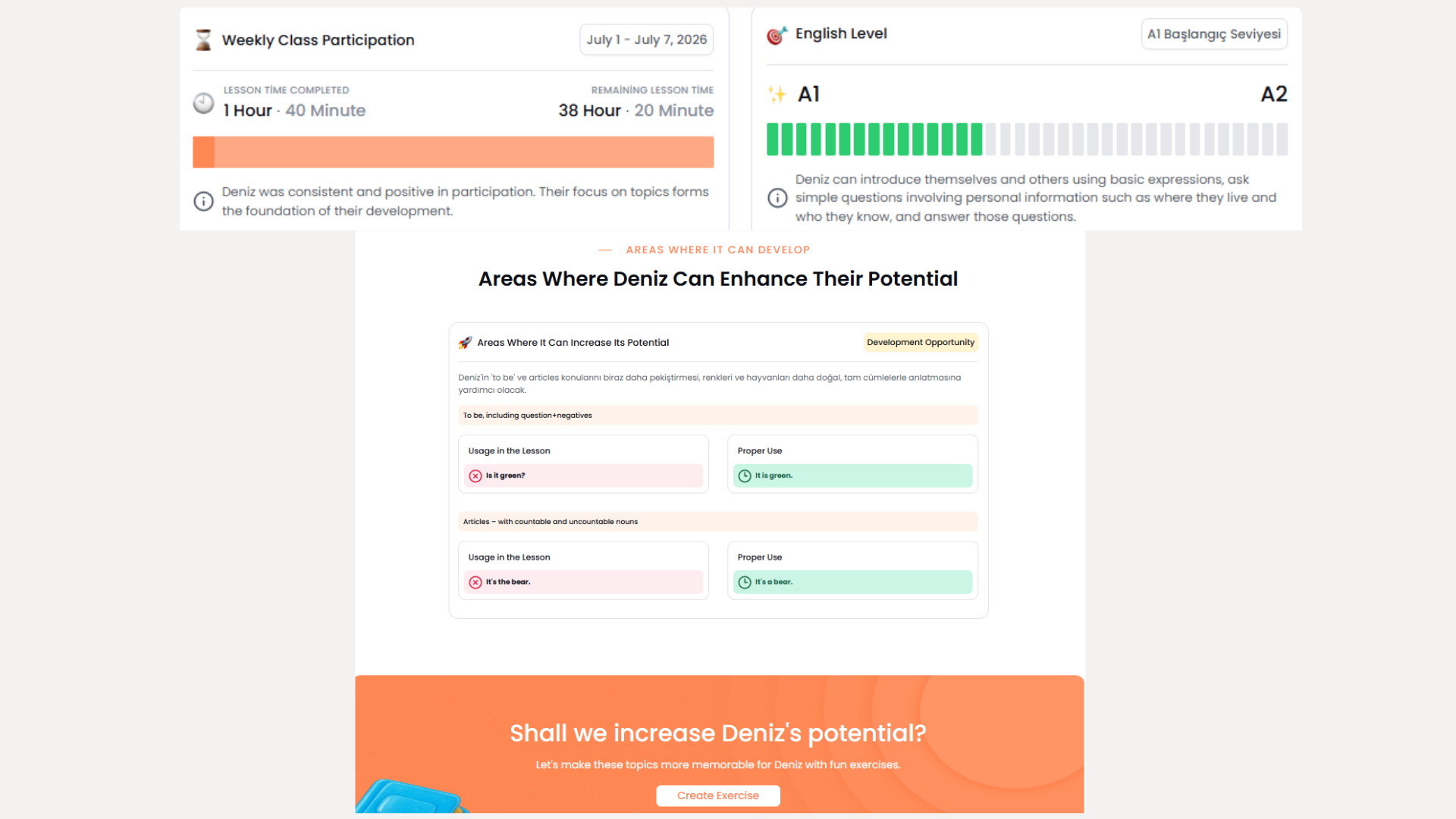
As a parent, you can watch the lesson live, replay the recording and receive a short video on WhatsApp each week. Lessons can be canceled up to eight hours before they start. FLAI, Flalingo's artificial intelligence, also analyzes each session for safety and alerts the quality team if there is a problem.
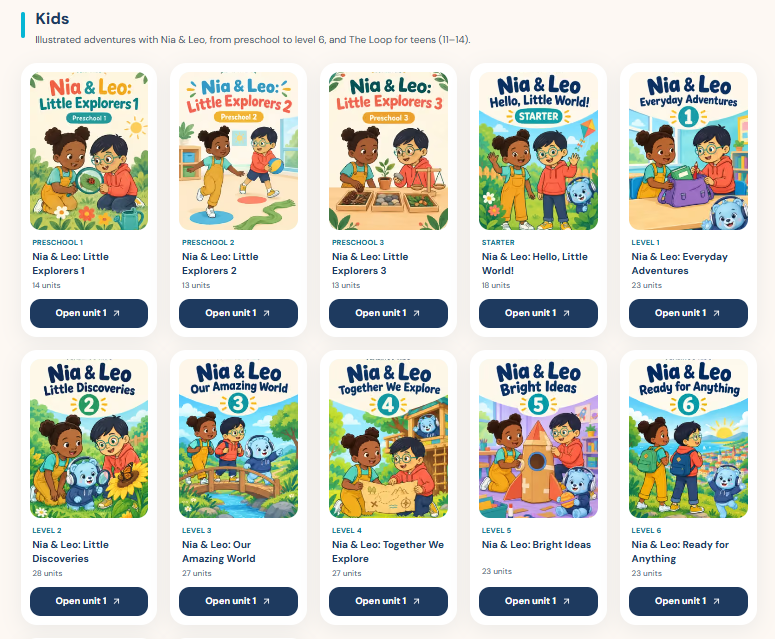
Lessons use Smart Personalized Materials for children : the Nia & Leo series, from preschool (three Little Explorers books) through level 6, followed by The Loop for ages 11–14. Each unit also comes in a game version. The teacher opens it during the lesson, and the child searches, listens and colors on the same picture as the teacher. Their drawing then becomes a sticker in their collection.
Between lessons, Flalingo Stories offers 165 interactive stories for ages 4–12, organized by Cambridge's Starters, Movers and Flyers levels, while Flalingo Games offers multiplayer games for ages 4–13, both in English. In the Parent Academy parents can find age-specific guides on screen time, bilingualism and motivation.
Key features
- Live, one-to-one lessons lasting 25 or 50 minutes, up to 7 per week, for ages 3–17
- Teachers trained in teaching methods and child safeguarding
- Smart Matching based on 18 criteria, with 22 to 30 suggested teachers
- FLAI report after every lesson, weekly report and personalized exercises
- Live lesson viewing, unlimited recordings and a weekly video on WhatsApp
- Nia & Leo and The Loop Smart Books, up to B1 Preliminary for Schools
- School English and exam preparation for older children
- Free placement test for children, tailored to their age and reading ability
- Support 24 hours a day and messaging with the teacher
Pricing
Both plans include native-speaking teachers, Smart Books, FLAI reports, support 24 hours a day and unlimited access to recordings. The 12-month plan also includes group lessons. With one lesson per week, the prices work out as follows (details on the Flalingo Kids pricing page) :
- Second child : an additional 20 % discount on all plans
- Free trial lesson lasting 25 minutes, with no credit card or upfront payment required
- Full refund within 30 days of the first lesson, no questions asked
- No automatic renewal at the end of the plan
Prices last checked : November 2026.
Who is it for ?
- Children aged 3 to 17, especially those aged 5 to 12, who understand English but lack the confidence to speak
- Families who want to keep the same teacher all year
- Parents who want to know what happens in lessons without attending them
- Middle school students preparing for A2 Key, B1 Preliminary for Schools or a presentation in English
- Prices start at €22.90 per month with the 12-month plan, with one lesson per week
Parent reviews
On Google, Flalingo has a rating of 4.9 out of 5 from 710 reviews. The two reviews below are from parents whose daughters take lessons with Flalingo Kids.
#2 - Novakid : a world of games for ages 4–12
Novakid is an online English school for children aged 4–15, with a French-language website and a WhatsApp number with the +33 country code. One-to-one lessons last 25 minutes and are taught entirely in English, with most children taking two or three per week. The curriculum follows the CEFR from Pre-A1 to B1, and children receive a certificate for each level completed.
Novakid reports having more than 3 900 certified teachers and accepting just one in 11 applicants through a ten-stage recruitment process. Standard teachers are non-native speakers, while Premium teachers are native speakers. Having the same teacher is not guaranteed, but you can rebook a teacher your child likes. After each lesson, parents receive feedback from the teacher and a video of the session.
The one-to-one lessons are complemented by 45-minute small-group conversation sessions organized by age. This is a good option for a confident child, but less so for a shy child who will happily let others do the talking. We compare the two approaches in Flalingo Kids vs Novakid.
Key features
- 25-minute one-to-one lessons, taught entirely in English
- More than 3 900 certified teachers, either native speakers (Premium) or non-native speakers (Standard)
- CEFR-aligned curriculum, from Pre-A1 to B1, with a certificate for each level
- Avatars, challenges, stars and rewards
- Teacher feedback and a video after every lesson, plus a parent app
- 45-minute group conversation sessions by age group (4–6, 7–9, 10–13)
- Free 25-minute trial lesson, no credit card required
Pricing
Novakid shows only a starting point: from €110 a month. The final amount depends on subscription length, the number of lessons per week, the teacher category and current promotions.
- Family discount : 5 % for two children, 10 % for three
- 14-day money-back guarantee
- One free month of group conversation sessions with the purchase of one-to-one lessons, according to the Novakid website
- Free 25-minute trial lesson
Prices last checked : November 2026.
Who is it for ?
- Children aged 4–10 who enjoy games and rewards
- Families who can set aside two or three fixed time slots per week
- Parents who keep track of their subscription renewal date
- Budget starting at €110 per month
Parent reviews
Novakid has a rating of 4.3 out of 5 on Trustpilot, with 2 588 reviews. Negative reviews mainly concern cancellations, renewals and sales calls. The two reviews below were written by parents in French.
#3 - Cambly Kids : native-speaking tutors, in 30-minute sessions
Cambly Kids is the children's offering from Cambly, an American platform known for conversations with native speakers. It caters to children aged 4–15 through 30-minute one-to-one lessons. All tutors are native English speakers, and many are graduates of American, British or Canadian universities. Lessons are organized by CEFR level, from A1 to C1, and the website displays the kidSAFE safety seal. Plans range from two to seven lessons per week, with monthly, quarterly or annual payment options.
Cambly Kids is best suited to a child who already knows the basics and needs to start speaking. For a complete beginner who needs rules explained, the format may feel a little abrupt. You can rebook the same tutor from one week to the next. Lessons are recorded, and the videos are deleted twelve months after the account is no longer used. However, there are no regular reports for parents. To find out how your child is doing, you need to watch the recordings or ask them.
Key features
- 30-minute one-to-one lessons for ages 4–15
- Native-speaking tutors only
- Lessons graded from A1 to C1 according to the CEFR
- kidSAFE safety certification
- Every lesson recorded
- Plans with 2, 3, 5 or 7 lessons per week
- Free games, quizzes and workbooks, with no subscription required
Pricing
Cambly lists its children's prices in dollars, per 30-minute session. Converted into euros, that comes to about €15.42 a session with monthly payment, €9.97 with quarterly payment (30% off) and €7.11 on the annual plan (50% off). With two lessons a week, expect roughly €62 to €134 a month. Part of these discounts comes from a current promotion.
- 30-minute trial lesson for a nominal fee
- Annual plan renews automatically every 12 months, and can be cancelled at any time
- Full refund of the first plan if requested within seven days
Prices last checked : November 2026.
Who is it for ?
- Children aged 7–15 who have basic English skills and need more speaking practice
- Children who understand a lot but give one-word answers
- Families with changing schedules who prefer short sessions
- A budget of around €62 to €134 per month for two lessons a week
User reviews
Cambly scores 2 out of 5 on Trustpilot, based on 264 reviews across all its offerings. Many negative reviews concern billing, renewals and customer support rather than the lessons. We did not find any recent parent reviews specifically about Cambly Kids : the two reviews below concern Cambly in general and were written by adults.
#4 - Preply : a teacher you choose for a specific need
Preply is not a school but a marketplace for independent teachers. The French version of the site lists more than 46 000 English teachers, each with their own rates, schedule and teaching method. You filter by price, availability or languages spoken, then read reviews from other families before booking. Lessons generally last 50 minutes, while trial lessons last 25 to 50 minutes. If the first teacher is not a good fit, you can try others at no extra cost.
For a child, this flexibility has its advantages : a French-speaking teacher who puts a beginner at ease, an English university student who loves conversation, or someone used to teaching very young children. The downside is the lack of a shared curriculum for children. Everything depends on the person you choose, and it is up to you to sort through the options. With a child under eight, stay nearby during the first few lessons.
The Lesson Insights tool uses AI to summarize lessons, but only if both the teacher and student have enabled it, and it transcribes the audio to do so. For other options aimed at younger children, see our ranking Best 7 Online English Courses for Kids Ages 3–6.
Key features
- More than 46 000 English teachers, with filters for price, schedule and languages spoken
- French-speaking teachers for beginners
- 50-minute lessons, with 25- to 50-minute trial lessons
- Free teacher replacement if the first one is not a good fit
- Subscription with your chosen teacher, with the option to pause
- Optional AI lesson summaries (Lesson Insights)
Pricing
Each tutor sets their own price. For English lessons aimed at children, Preply shows a range of €3 to €25 an hour, compared with an average of €16 an hour across all English lessons.
- Subscription renews every 28 days, with at least four lessons per cycle
- Pause for up to 20 days, once per cycle
- Cancel up to one day before the next payment
- Trial lesson of 25 or 50 minutes
Prices last checked : November 2026.
Who is it for ?
- Children with a specific need: pronunciation, reading, or preparing for a trip
- Families who want a tutor who can explain things in French at first
- Parents willing to compare several profiles and try two or three tutors
- Budget of €3 to €25 per hour, depending on the tutor
User reviews
Preply scores 4.4 out of 5 on Trustpilot, with 25.349 reviews. The first review below is from a mother; the second is from an adult learner.
#5 - British Council : in-person in Paris, online from age 11
The British Council, the UK's cultural and educational organization, offers English courses in France for ages 3–18. For younger children, everything takes place in person in Paris: Primary English welcomes children aged 6–10 across five levels, with a 2-hour lesson each week for 30 weeks at seven Paris centers, while the Learning Hub platform extends learning at home.
Online options start at age 11. Secondary English Online brings together secondary school students aged 11–18 in small groups of similar ability, from A1.1 to B2, on Tuesdays or Thursdays from 5:45 p.m. to 7:45 p.m., excluding school holidays. Students aged 13–17 can also take 30-minute private online lessons with EnglishScore Tutors, covering general English or IELTS preparation, bookable at any time.
Staff are trained in child safeguarding, and a free assessment takes place before enrollment. For more options for teenagers, see Best 7 Online English Courses for Teenagers.
Key features
- Primary English (ages 6–10) : five levels, 2 hours per week at a center in Paris
- Secondary English Online (ages 11–18) : six levels from A1.1 to B2, 2 hours per week
- 30-minute private online lessons for ages 13–17 (EnglishScore Tutors)
- Cambridge English exam and IELTS preparation
- Learning Hub platform with games, videos and stories
- In-person courses during school holidays
- Free level assessment
Pricing
The British Council publishes its prices in euros.
- Primary English and Secondary English online: €1,750 for 60 hours over the year, about €29 an hour, pro rata if you join mid-year
- Payment in one go, or by cheque in three instalments, subject to conditions
- Discounts that can't be combined: €100 in the online shop (code 26WEBSHOP100), €80 at the Paris-Invalides centre for a single payment, €150 for a second child, €50 loyalty discount
- Holiday courses: €799 for 30 hours
- EnglishScore Tutors (ages 13-17): €1 trial, then €70 for 3 sessions, €180 for 10 and €345 for 20, which works out at €17.25 per 30-minute session
Prices last checked : November 2026.
Who is it for ?
- Children aged 6–10 who live in Paris and enjoy working in groups
- Secondary school students who want regular online lessons with a fixed timetable
- Teenagers preparing for IELTS or a Cambridge exam
- Budget of €1,750 per year, or from €17.25 per half-hour private lesson
User reviews
The British Council's Trustpilot profile scores 1.8 out of 5, with 119 reviews. This profile is not managed by the organization and combines reviews from many countries, often about exams rather than children's courses. The two reviews below, originally in French, concern a school holiday course and distance learning. They are negative, and we quote them as written because they highlight real limitations of the group format.
#6 - Lingokids : a game-based app for young children, with no teacher
Lingokids is the only option in this comparison without live lessons. It combines English with maths, reading, science, art and music, featuring characters children already know from Disney, Blippi and Pocoyo. The app also works offline, and parents get progress reports and up to four child profiles.
In France, this format raises a concern that the others do not. The Ministry of Health advises against any screen exposure before age 3, including as background sound, and recommends only occasional use between ages 3 and 6, limited to high-quality educational content with an adult present (solidarites.gouv.fr). An app designed for children as young as 2 therefore calls for some discipline : play with your child for short periods, rather than handing it over to keep them occupied for the rest of the afternoon. And no one asks them questions or corrects their sentences. Lingokids develops listening skills without replacing conversation.
Key features
- Over 4 000 games, songs and activities for ages 2–8
- Over 650 learning objectives covering English, maths, science, art and music
- Disney, Blippi and Pocoyo characters
- Progress reports and up to four child profiles
- Parental controls and offline play
- Ad-free
Pricing
On the French App Store, Lingokids costs €14.99 a month or €71.99 a year, about €6 a month. The annual Plus subscription is €89.99. If you subscribe from a phone, you cancel in your app store settings, not in Lingokids.
Prices last checked : November 2026.
Who is it for ?
- Children aged 3 to 8, especially preschoolers, with an adult beside them before age 6
- Families looking for a first introduction to English without a fixed schedule
- Parents supplementing live lessons with a little play
- A budget of around €6 per month with the annual plan
Parent reviews
Lingokids scores 4.7 out of 5 on Trustpilot (164 reviews) and 4.3 on the French App Store. The two reviews below were written by parents.
#7 - Acadomia : a French tutoring network, at home, at a centre or online
Acadomia is a French network offering private and group lessons, reporting 110 centres, 22 000 teachers and 150 000 pupils per year (press kit, March 2026). It is primarily a school tutoring provider, with English lessons that follow what children are learning in class, from the first year of primary school through to the end of secondary school. Primary-level teachers hold at least a three-year university degree, take a test and undergo a teaching interview, and their suitability to work with children is checked annually.
For primary school English, private lessons last 1 to 2 hours per week and take place at home or by video, with no commitment. Weekly group lessons bring together a maximum of six pupils in the evenings, on Wednesdays or on Saturdays, at a centre or online. Holiday courses lasting at least 5 hours round out the offering, including a new English Club comprising five half-days. Some teachers use the Cambridge English method, and the network prepares pupils for Cambridge qualifications.
Progress is monitored by a dedicated adviser who holds regular reviews with the family, rather than through a report after every lesson. It all starts with a free, no-obligation assessment at your nearest centre.
Key features
- 110 centres in France, with lessons at home, at a centre or by video
- Private lessons lasting 1 to 2 hours per week, with no commitment
- Weekly group lessons lasting 1 hour or 1 hour 30 minutes, with a maximum of six pupils
- Holiday courses lasting at least 5 hours and an English Club course
- Primary-level teachers hold at least a three-year university degree, with annual background checks
- Dedicated adviser and regular progress reviews
- Free, no-obligation initial assessment
Pricing
Acadomia publishes indicative prices for 2026-2027, and the final price is set with the centre after the assessment.
- Online one-to-one lessons: from €20.50 per half hour at primary level
- One-to-one lessons at home: from €45.40 an hour at primary level
- Weekly group lessons: €69 to €114 a month online, €76 to €145 a month in a centre
- Holiday course: €122.50 for a 5-hour course
- Free initial assessment, no commitment
Home lessons qualify for a 50 % tax credit, with an immediate advance available, whereas online and group lessons do not.
Prices last checked : November 2026.
Who is it for ?
- Families who want a teacher at home or a centre nearby
- Children who concentrate better face to face than in front of a screen
- Lower secondary pupils preparing for a Cambridge qualification in a small group
- Budget from €69 per month for online group lessons, or $46 per hour for online private lessons
Parent reviews
Acadomia scores 4.4 out of 5 on Trustpilot, with 8 066 reviews across all subjects. Negative reviews mainly mention billing and administrative support. The two reviews below were written by parents and are not specifically about English.
Which combination suits your child ?
A ranking cannot tell you what your child needs this year. Instead, start with what they are missing right now :
- They need to speak, with the same teacher all year, and you want to see their progress in black and white : Flalingo Kids
- They are between 4 and 10 and get hooked whenever there are stars to earn : Novakid
- They know the basics and need to take the plunge with native speakers : Cambly Kids
- You are looking for a very specific teacher profile, whether French-speaking or specialised : Preply
- They enjoy learning in a group, and you live in Paris or they are over 11 : British Council
- They are under 6 and you want a first introduction with no scheduled sessions : Lingokids
- You want a teacher at home or a centre nearby : Acadomia
Before paying, try a simple test. Let your child take the trial lesson on their own, then ask them what they told the teacher. If they answer without prompting, the format suits them. For days without lessons, Tips for Families with Flalingo Kids suggests simple habits to build at home.
Flalingo Kids comes out on top because it brings together what keeps a child speaking over time : a teacher who stays with them, books that support them from nursery through lower secondary school, and parents kept informed every week.
And if you want to brush up on your own English, our comparison of the best online English courses in France reviews seven platforms for adults.
A free trial lesson for your child


I'm Bright. I am a British-Nigerian English teacher with seven years of experience. I create engaging and tailored lessons that build confidence and fluency to support students to achieve their goals. My aim is to unlock the potential of students from different cultures, making the learning process both efficient and enjoyable.
English with Flalingo
Learning English with Flalingo means progressing with an intelligent system that works in an integrated manner.