

انتقل إلى المحتوى
Flalingo

تدريبات على الإنجليزية

OET Reading Part A: كيف تجد إجابات دقيقة في أربعة نصوص قصيرة خلال 15 دقيقة وتنقلها كما هي

Two healthcare colleagues in uniform compare open blue folders at a desk; one points to a sheet of paper.

كيف تحلّ OET Reading Part A: تختار النص بحسب وظيفته، وتقرأ الصف الصحيح في الجدول، وتنقل الأرقام مع وحدتها وشرطها، وتميّز الموعد النهائي من وقت الحدث. للممرضين والأطباء من مستوى B2 فما فوق.

يعطيك OET Reading Part A أربعة نصوص قصيرة عن موضوع صحي واحد و20 سؤالًا في 15 دقيقة، فلا وقت لقراءة كل شيء بتمعّن. اختر النص الذي يؤدي الوظيفة التي يحتاجها السؤال، مستعينًا بالعناوين وطريقة التنسيق. ثم ابحث عن التفصيل واقرأ الجملة أو صف الجدول المحيط به فقط. انقل الإجابة كما هي، مع وحدتها وشرطها ووقتها. هذا الدليل موجّه إلى الممرضين والأطباء الذين يبلغ مستواهم في الإنجليزية فوق المتوسط (B2) على الأقل.

لمن هذا المقال؟

  • الممرضون والأطباء الذين يفهمون نصوص Part A لكن الوقت ينفد منهم قبل الأسئلة الأخيرة.
  • المتقدّمون الذين يخسرون درجات بسبب إجابات صحيحة تقريبًا: وحدة ناقصة، أو صف مجاور، أو كلمات منقولة من حول الفراغ.
  • المهنيون الذين يراجعون جداول المناوبات والمواعيد والسياسات في العمل ويريدون الوصول إلى التفصيل الدقيق بسرعة.
  • ما زال الوقت مبكرًا: إذا كان نص إنجليزي من صفحة واحدة لا يزال يأخذ منك وقتًا طويلًا، فارفع مستوى قراءتك العام إلى فوق المتوسط (B2) أولًا؛ ويساعدك دليل خطة الدراسة أدناه على تحديد هدف أسبوعي واحد.
  • سهل جدًا: إذا كنت تنهي Part A بثقة خلال 15 دقيقة، فانتقل إلى Part B وإعلانات الموظفين (الرابط أدناه).

افتح الصفحات النموذجية

افتح الصفحات النموذجية

بطاقات الكلمات

Personal · finding information

When did you last struggle to find a simple piece of information in a document or on a website? What made it hard?

Useful: ‘I was looking for…, but…’ · ‘The information was there, but it was hidden under…’ · ‘In the end, I had to…’

Personal · how you read

Do you usually read instructions from beginning to end, or scan for what you need? Has that ever caused a problem?

Useful: ‘I tend to skim until…’ · ‘I only read carefully when…’ · ‘Once, I missed… because…’

Professional practice · documents at work

Which document at your workplace do staff or patients most often misread? How would you improve it?

Useful: ‘The one that causes most confusion is…’ · ‘I’d move… so that…’ · ‘The heading should say…’

Big idea · reader and writer

When a reader misunderstands an important document, whose responsibility is it: the writer’s or the reader’s?

Useful: ‘I’d say the writer has more responsibility, because…’ · ‘That’s true up to a point, but…’ · ‘Both have a part to play:…’

مثال على المحادثة

How can you explain a useful checking habit?

I would underline the deadline label before copying the time, because the same notice also gives the later session time.

One possible formulation; other coherent and accurate responses are welcome.

تركيب الجملة

Copy the unit with the number

  • A number without its unit can change the meaning.
  • A notice says return within seven days. Recording seven without days leaves the time period incomplete.

Use the right condition

  • A general rule may have an exception.
  • Staff collect folders from reception; external visitors collect them from the training desk. The right place depends on who is collecting.

Answer the actual field

  • Avoid repeating words already printed around the gap.
  • Field: Send requests at least ___ before the session. Source: two working days. Copy two working days, not the whole sentence.

تدريبات إضافية

Read the information

Text A — Visitor-support desk: purpose

The visitor-support desk helps people understand practical arrangements at the clinic. Staff can explain where to wait, how to find a department and how to contact the appointment team. The desk does not make clinical decisions or change treatment plans. Questions about an individual’s care should be directed to the appropriate professional.

Text B — Finding the desk

From the main entrance, continue along the ground-floor corridor to the large noticeboard. The visitor-support desk is on the left immediately after the noticeboard, opposite the small meeting room. It is not beside the upstairs lift. Staff directing someone from the side entrance should first guide them towards the main entrance corridor.

Text C — Contacting the support team

For a routine practical enquiry, use the shared support inbox. Staff should include a callback number and a brief description of the information requested. Do not put detailed personal information in the subject line. For a same-day practical issue, telephone the support coordinator on the internal number shown in the staff directory.

Text D — Desk opening times

The desk is staffed from 09:00 to 12:00 and from 13:00 to 16:00 on weekdays. During the midday closure, written enquiries can still be left in the secure enquiry box next to the desk. The box is checked when the afternoon session begins. The desk is not staffed on weekends.

Practice context

  • Four reference extracts for staff at a community clinic. Read them as workplace information, not instructions for treating a patient.

Evidence questions

  • Which text explains the limits of what the service can do?
  • Which text would help a colleague direct a visitor from the main entrance?
  • Which text explains the communication channel for a same-day practical issue?

Read the information

Text A — Training folders

Training folders are prepared for registered participants. Internal staff collect them from reception; external visitors collect them from the training desk. Each folder contains the session outline and blank note pages. Participants who need a different print size should mention this when they register, so the correct version can be prepared.

Text B — Requests and changes

Requests for printed folders must reach the training team at least two working days before the session. Include the session title, date and number of participants. A change to the participant total after the deadline should be reported through the shared training inbox; staff should not assume that extra folders will already be available.

Text C — Borrowed learning resources

Reference folders borrowed for personal study should be returned within seven days. A borrower who needs more time may request an extension before the return date. The training team checks whether another person is waiting before confirming an extension. An unconfirmed request does not automatically change the original return date.

Text D — Returning a resource

Return borrowed reference folders to the labelled tray inside the training office. If the office is closed, use the secure return box beside its door. Do not leave borrowed material on a reception counter, where it may be mistaken for a new session pack. Staff check the return box each weekday morning.

Practice context

  • Four staff-training reference extracts from a training centre. Complete brief answers externally before looking at the supported choices.

Evidence questions

  • Where should an external visitor collect a prepared training folder?
  • How far in advance must a printed-folder request reach the team?
  • Where should a borrowed folder be placed when the training office is closed?

Read the information

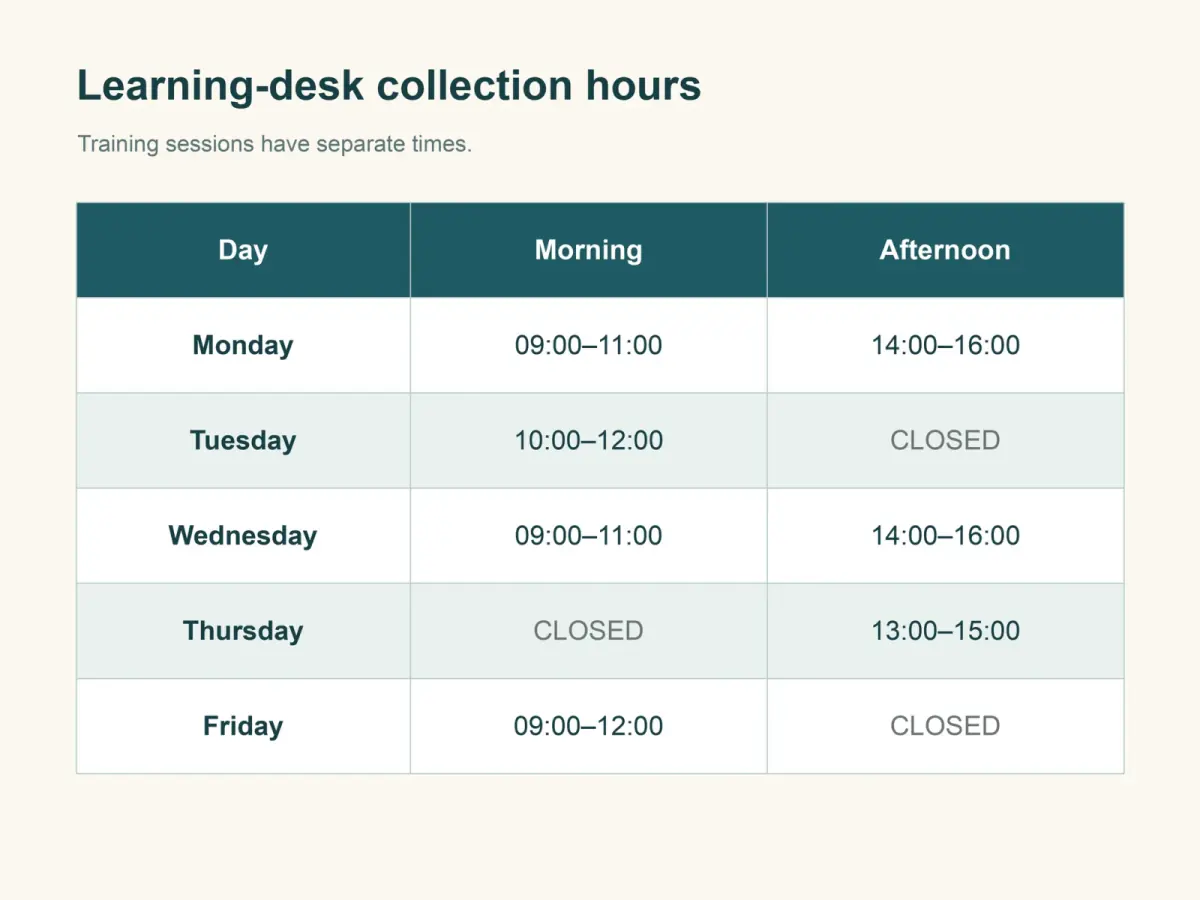
Collection timetable: Monday 09:00–11:00 and 14:00–16:00; Tuesday 10:00–12:00, afternoon closed; Wednesday 09:00–11:00 and 14:00–16:00; Thursday morning closed, 13:00–15:00; Friday 09:00–12:00, afternoon closed.

Text A — Collection service

The learning desk holds pre-booked session packs for staff. A collection is ready only after the organiser has confirmed the participant’s registration. The desk cannot confirm a place on a course. A staff member who has not received registration confirmation should contact the organiser rather than assume that a pack is waiting.

Text B — Learning-desk schedule

Monday: morning 09:00 to 11:00; afternoon 14:00 to 16:00.

Tuesday: morning 10:00 to 12:00; afternoon closed.

Wednesday: morning 09:00 to 11:00; afternoon 14:00 to 16:00.

Thursday: morning closed; afternoon 13:00 to 15:00.

Friday: morning 09:00 to 12:00; afternoon closed.

These are collection hours, not the times of the training sessions themselves.

Text C — Preparing a collection

Receive collection request, then check registration list. If registration is confirmed, prepare the named pack and send a collection message. If the name is not on the list, ask the organiser to check the registration. Do not prepare a pack or send a ready-to-collect message until the registration is confirmed.

Text D — Outside the listed hours

Staff who cannot attend during collection hours may ask the learning team to arrange an alternative. The team must confirm the arrangement before anyone leaves material elsewhere. A request alone is not confirmation. Session packs should not be left in public waiting areas or passed to an unknown person.

Practice context

  • Four reference extracts for a staff-learning desk. Text B is a compact schedule with labelled day rows; Text C is a written decision path.

Evidence questions

  • Which collection window is available on Thursday?
  • What happens next if a requested name is missing from the registration list?
  • What must happen before an alternative collection arrangement is used?

Read the information

Text A — Orientation visit

The centre runs a practical orientation visit for new volunteers. It introduces the reception area, staff-learning room and visitor-support point. The visit is about finding services and understanding whom to contact. It does not include clinical work or observation of patient consultations. Volunteers receive their individual duty information separately from their own coordinator.

Text B — Booking and deadline

The next orientation visit is on Friday 18 October at 14:00. A group organiser should submit the final number of visitors by 12:00 on Wednesday 16 October. Include a contact name and any practical access requests. Do not send detailed personal histories. The organiser receives a confirmation message once the group booking has been checked.

Text C — Arrival information

Confirmed groups meet at the side entrance beside the bicycle racks. Individual volunteers attending without a group meet at main reception. Both groups should arrive ten minutes before the stated start time. A person arriving late should contact the orientation coordinator rather than follow an unfamiliar group into another part of the building.

Text D — Changes after confirmation

An organiser who needs to change the group size should contact the orientation coordinator through the shared visits inbox. The coordinator checks whether the revised group can be accommodated and replies with confirmation or an alternative. The original arrangement remains in place until a change is confirmed. Please do not treat an unanswered message as agreement.

Practice context

  • Four reference extracts about a centre’s orientation visit. This is a shorter classroom retrieval task, not a full twenty-question Reading Part A paper.

Evidence questions

  • What is the deadline for a group organiser’s final visitor count?
  • Where should a confirmed group meet?
  • What is the status of the original arrangement while a requested change is unanswered?

Choose and justify with evidence

Text A — Visitor-support desk: purpose

The visitor-support desk helps people understand practical arrangements at the clinic. Staff can explain where to wait, how to find a department and how to contact the appointment team. The desk does not make clinical decisions or change treatment plans. Questions about an individual’s care should be directed to the appropriate professional.

Text B — Finding the desk

From the main entrance, continue along the ground-floor corridor to the large noticeboard. The visitor-support desk is on the left immediately after the noticeboard, opposite the small meeting room. It is not beside the upstairs lift. Staff directing someone from the side entrance should first guide them towards the main entrance corridor.

Text C — Contacting the support team

For a routine practical enquiry, use the shared support inbox. Staff should include a callback number and a brief description of the information requested. Do not put detailed personal information in the subject line. For a same-day practical issue, telephone the support coordinator on the internal number shown in the staff directory.

Text D — Desk opening times

The desk is staffed from 09:00 to 12:00 and from 13:00 to 16:00 on weekdays. During the midday closure, written enquiries can still be left in the secure enquiry box next to the desk. The box is checked when the afternoon session begins. The desk is not staffed on weekends.

  1. Which text explains the limits of what the service can do?

    اعرض الإجابة والشرح

    Text A

    Text A describes the desk’s practical role and says it does not make clinical decisions or change treatment plans.

  2. Which text would help a colleague direct a visitor from the main entrance?

    اعرض الإجابة والشرح

    Text B

    Text B gives the route and landmarks needed to find the desk.

  3. Which text explains the communication channel for a same-day practical issue?

    اعرض الإجابة والشرح

    Text C

    Text C distinguishes routine inbox enquiries from a same-day call to the coordinator.

Choose and justify with evidence

Text A — Training folders

Training folders are prepared for registered participants. Internal staff collect them from reception; external visitors collect them from the training desk. Each folder contains the session outline and blank note pages. Participants who need a different print size should mention this when they register, so the correct version can be prepared.

Text B — Requests and changes

Requests for printed folders must reach the training team at least two working days before the session. Include the session title, date and number of participants. A change to the participant total after the deadline should be reported through the shared training inbox; staff should not assume that extra folders will already be available.

Text C — Borrowed learning resources

Reference folders borrowed for personal study should be returned within seven days. A borrower who needs more time may request an extension before the return date. The training team checks whether another person is waiting before confirming an extension. An unconfirmed request does not automatically change the original return date.

Text D — Returning a resource

Return borrowed reference folders to the labelled tray inside the training office. If the office is closed, use the secure return box beside its door. Do not leave borrowed material on a reception counter, where it may be mistaken for a new session pack. Staff check the return box each weekday morning.

  1. Where should an external visitor collect a prepared training folder?

    اعرض الإجابة والشرح

    the training desk

    Text A distinguishes external visitors, who collect at the training desk, from internal staff at reception.

  2. How far in advance must a printed-folder request reach the team?

    اعرض الإجابة والشرح

    two working days

    Text B says at least two working days; calendar days and seven days refer to different or unsupported periods.

  3. Where should a borrowed folder be placed when the training office is closed?

    اعرض الإجابة والشرح

    the secure return box

    Text D specifies the secure return box beside the closed office door.

Choose and justify with evidence

Collection timetable: Monday 09:00–11:00 and 14:00–16:00; Tuesday 10:00–12:00, afternoon closed; Wednesday 09:00–11:00 and 14:00–16:00; Thursday morning closed, 13:00–15:00; Friday 09:00–12:00, afternoon closed.

Text A — Collection service

The learning desk holds pre-booked session packs for staff. A collection is ready only after the organiser has confirmed the participant’s registration. The desk cannot confirm a place on a course. A staff member who has not received registration confirmation should contact the organiser rather than assume that a pack is waiting.

Text B — Learning-desk schedule

Monday: morning 09:00 to 11:00; afternoon 14:00 to 16:00.

Tuesday: morning 10:00 to 12:00; afternoon closed.

Wednesday: morning 09:00 to 11:00; afternoon 14:00 to 16:00.

Thursday: morning closed; afternoon 13:00 to 15:00.

Friday: morning 09:00 to 12:00; afternoon closed.

These are collection hours, not the times of the training sessions themselves.

Text C — Preparing a collection

Receive collection request, then check registration list. If registration is confirmed, prepare the named pack and send a collection message. If the name is not on the list, ask the organiser to check the registration. Do not prepare a pack or send a ready-to-collect message until the registration is confirmed.

Text D — Outside the listed hours

Staff who cannot attend during collection hours may ask the learning team to arrange an alternative. The team must confirm the arrangement before anyone leaves material elsewhere. A request alone is not confirmation. Session packs should not be left in public waiting areas or passed to an unknown person.

  1. Which collection window is available on Thursday?

    اعرض الإجابة والشرح

    13:00–15:00

    The Thursday row has the morning closed and the afternoon window 13:00–15:00.

  2. What happens next if a requested name is missing from the registration list?

    اعرض الإجابة والشرح

    Ask the organiser to check the registration

    Text C requires an organiser check before preparation or collection confirmation.

  3. What must happen before an alternative collection arrangement is used?

    اعرض الإجابة والشرح

    The learning team must confirm the arrangement

    Text D says the learning team must confirm an alternative; requesting one is not enough.

Choose and justify with evidence

  1. What is the deadline for a group organiser’s final visitor count?

    اعرض الإجابة والشرح

    Wednesday 16 October at 12:00

    Text B separates the Friday visit from the Wednesday noon deadline for group numbers.

  2. Where should a confirmed group meet?

    اعرض الإجابة والشرح

    the side entrance beside the bicycle racks

    Text C gives a different meeting point for confirmed groups and individual volunteers.

  3. What is the status of the original arrangement while a requested change is unanswered?

    اعرض الإجابة والشرح

    Still in place until the change is confirmed

    Text D explicitly keeps the original arrangement in place pending confirmation.

تعلّم هذه الوحدة
كيف تريد أن تتعلّم؟
لديك حساب؟

يفتح الحساب المجاني وحدة واحدة تبقى مفتوحة دائمًا.

ما الذي يطلبه منك Part A؟

يفتتح Part A اختبار Reading الذي يستغرق 60 دقيقة: أربعة نصوص قصيرة من A إلى D عن موضوع صحي واحد، وكثيرًا ما يكون بينها جدول أو قائمة خطوات. لهذا الجزء 15 دقيقة خاصة به، ثم تنتقل إلى Part B وPart C.

هناك ثلاثة أنواع من الأسئلة، ويُحتسب الإملاء في النوعين الأخيرين:

  • Matching (المطابقة): أيّ نص يذكر هذه المعلومة؟ تجيب بـA أو B أو C أو D.
  • Short answer (الإجابة القصيرة): كلمة أو رقم أو عبارة قصيرة.
  • Sentence completion (إكمال الجمل): الكلمات الناقصة منقولة من النصوص.

اختر النص بحسب وظيفته ثم ابحث

نادرًا ما تؤدي أربعة نصوص عن موضوع واحد الوظيفة نفسها. خصّص الدقيقة الأولى للعناوين والتنسيق، وأعطِ كل نص تسمية من كلمتين، واربط كل سؤال بوظيفة قبل أن تبحث عن الكلمات. ثم تحقّق من الإجابة في الجملة نفسها.

  • السؤال “What can’t the desk do?” يقودك إلى نص الغرض والحدود.
  • السؤال “How do I reach the desk?” يقودك إلى نص الاتجاهات.
  • السؤال “Whom do I phone about a same-day problem?” يقودك إلى بيانات الاتصال، لا إلى مواعيد العمل.
  • السؤال “When is the desk staffed?” يقودك إلى جدول المواعيد.

انقل بدقة: الوحدة والشرط والكلمات الناقصة فقط

الإجابات الصحيحة تقريبًا تخسر الدرجة. ثلاث خطوات تكشفها:

  • انقل الوحدة: كتابة “seven” وحدها بدل “within seven days” ناقصة، و“two days” ليست “two working days”.
  • استخدم الشرط الصحيح. “Internal staff collect them from reception; external visitors collect them from the training desk.” بالنسبة إلى الزائر من خارج المؤسسة، الإجابة هي “the training desk”.
  • أجب عمّا يطلبه الفراغ. “Send requests at least ___ before the session.” يقول النص “two working days”: اكتب ذلك فقط، لا الكلمات المحيطة بالفراغ.

كلمات صغيرة تحدّد المهلة بدقة

حروف الجر هي التي تحدّد المهل، فاقرأها بالعناية نفسها التي تقرأ بها الأرقام. يقابل “by” في العربية «بحلول» أو «في موعد أقصاه»، ويقابل “until” «حتى»، فلا تخلط بينهما:

  • “by 12:00 on Wednesday”: في موعد أقصاه تلك اللحظة، أي موعد نهائي.
  • “until 16:00”: شيء يستمر حتى تلك الساعة ثم يتوقف.
  • “within seven days”: في أي وقت قبل انقضاء الأيام السبعة، أما “in seven days” فتعني عادةً بعد سبعة أيام من الآن.
  • “at least two working days before”: حدّ أدنى، ولا بأس بالتبكير.
  • “from 09:00 to 12:00 and from 13:00 to 16:00”: فترتان بينهما إغلاق.

اقرأ الصف الصحيح في الجدول

ابحث عن الصف أولًا، ثم العمود، ثم أي ملاحظة توضح معنى الأرقام. في جدول تدريبي، يقول صف يوم الخميس “morning closed; afternoon 13:00 to 15:00”: الإجابة من 13:00 إلى 15:00، لا فترة الثلاثاء من 10:00 إلى 12:00 المذكورة في الأعلى.

في المخطط الانسيابي، اتبع الفرع الذي يناسب الحالة: “If the name is not on the list, ask the organiser to check the registration.”

تعلّم هذه الوحدة بطريقتك

ميّز الموعد النهائي من وقت الحدث

قد يذكر الإعلان الواحد وقتين لكلٍّ منهما وظيفة مختلفة: “The next orientation visit is on Friday 18 October at 14:00. A group organiser should submit the final number of visitors by 12:00 on Wednesday 16 October.” قبل أن تنقل وقتًا، ضع خطًا تحت الكلمة التي تصفه، مثل “by” أو “deadline” أو “starts”، كما يشرح المتقدّم أدناه.

المعلّم How can you explain a useful checking habit?

المتقدّم I would underline the deadline label before copying the time, because the same notice also gives the later session time.

ما الموعد النهائي لإرسال العدد النهائي للزوار؟

أخطاء شائعة في Part A

أعطِ كل خطأ تسمية، فالتسمية تخبرك بما تحتاج إلى التدرب عليه:

  • نص خاطئ: العنوان يتحدث عن الزوار، والسؤال عن الموظفين.
  • أول تطابق: رقم يبدو صحيحًا لكنه من صف آخر أو نص آخر.
  • شيء ناقص: الوحدة أو الشرط أو صيغة الجمع (“two working day”).
  • كلمات زائدة: تكرار “before the session” المطبوعة أصلًا بعد الفراغ.
  • اعتبار الطلب تأكيدًا: “The original arrangement remains in place until a change is confirmed.”
  • لأن الحركات القصيرة لا تُكتب عادةً في العربية، يسهل الخطأ في حروف العلة الإنجليزية عند النقل. انقل الكلمة حرفًا حرفًا، وانتبه أيضًا إلى الفرق بين “p” و“b”.

روتين تدريب على Part A

ثلاث مرات في الأسبوع، مع مجموعة تدريبية واحدة من Part A:

  • 15 دقيقة: حلّ المجموعة بتوقيت الاختبار، وابدأ بالعناوين.
  • 10 دقائق: صحّحها وأعطِ كل خطأ تسمية.
  • 5 دقائق: أعد كتابة كل إجابة خاطئة كما وردت في النص تمامًا.
  • المجموعة التالية: راقب أولًا التسمية التي تكررت لديك أكثر من غيرها.

ما الخطوة التالية؟

يضم Part B ستة نصوص قصيرة من بيئة العمل، لكلٍّ منها سؤال واحد بثلاثة خيارات، ويضم Part C نصين أطول، لكلٍّ منهما ثمانية أسئلة بأربعة خيارات.

للتدرّب على المحادثة، ناقش مع زميل: على من تقع المسؤولية حين يُساء فهم إعلان مهم؟ ابدأ بعبارة “I’d say the writer has more responsibility, because…”

الأسئلة الشائعة

كم مدة OET Reading Part A؟

15 دقيقة لعشرين سؤالًا، ثم تنتقل إلى Part B وPart C.

هل يُحتسب الإملاء في OET Reading Part A؟

نعم. في أسئلة الإجابة القصيرة وإكمال الجمل، تصبح الإجابة خاطئة إذا كُتبت فيها كلمة بخطأ إملائي.

هل OET Reading واحد للممرضين والأطباء؟

نعم. Reading واحد لكل المهن، والإجابات تأتي من النصوص لا من المعرفة السريرية.

Flalingo غير مرتبط بالجهات التي تدير OET ولا يحظى بتأييدها.

تعلّم هذه الوحدة
كيف تريد أن تتعلّم؟
لديك حساب؟

يفتح الحساب المجاني وحدة واحدة تبقى مفتوحة دائمًا.

ما الخطوة التالية؟

واصل التدرّب مع Flai

Flai هو تطبيق Flalingo للتدرب على المحادثة بالذكاء الاصطناعي، ويقدم محادثات صوتية وتصحيحات وتقارير للدروس تساعدك على توجيه تدريبك.

التعلّم مع معلم مباشر

في دروس Flalingo تتدرّب على وحدات مثل هذه في درس فردي مع معلم مباشر.