
Ir al contenido
Flalingo

Práctica de inglés

B1 Preliminary Writing Part 2: cómo escribir una historia a partir de una primera frase dada

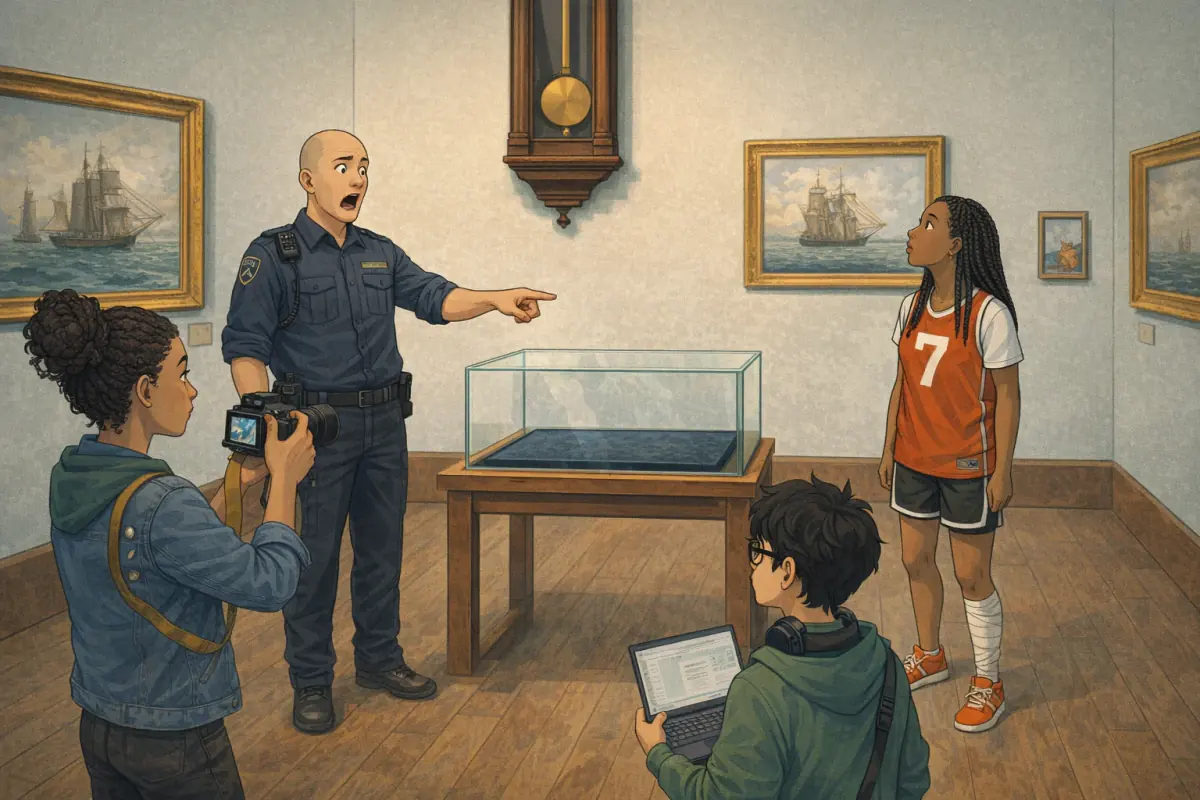
In the museum's Sea Gallery the guard points at an empty display case while one teenager films and another looks up at the clock.

Cómo escribir la historia de B1 Preliminary y B1 Preliminary for Schools: empezar con la frase dada, planificar tres párrafos, combinar past continuous y past simple, unir los hechos con expresiones de tiempo y terminar con una sorpresa.

En la Parte 2 de Writing de B1 Preliminary puedes elegir una historia de unas 100 palabras que empieza exactamente con la frase que te dan. Planifica tres párrafos: presenta la escena, haz crecer el problema y termina con una sorpresa que se explica por una pista anterior. Usa el past continuous para el fondo (“I was walking home”) y el past simple para los hechos principales (“I heard a noise”), y únelos con while, until y as soon as. Esta guía es para estudiantes de nivel intermedio (B1) de unos 12–16 años.

¿Para quién es este artículo?

  • Estudiantes de unos 12–16 años que preparan B1 Preliminary o B1 Preliminary for Schools y piensan elegir la historia en la Parte 2 de Writing.
  • Tienes buenas ideas, pero tu historia se convierte en una lista de “and then … and then …” o el final aparece de la nada.
  • Para madres y padres: antes de que escriba, pide a tu hijo o hija que te cuente la historia en voz alta en un minuto. Si puedes seguir lo que pasó y el final te sorprende, el plan funciona.
  • Demasiado pronto: si los tiempos del pasado todavía se te mezclan en textos cortos de A2, empieza por el correo de A2 Key para quedar con indicaciones (enlace abajo).
  • Demasiado fácil: si ya escribes historias de 100 palabras con un buen giro, prueba la otra opción de la Parte 2, el artículo, o pasa a la siguiente tarea de escritura, el CV de un personaje inventado (enlaces abajo).

Abrir las páginas de muestra

Abrir las páginas de muestra

Tarjetas de vocabulario

while

during the time that a longer action was happening

While the children were singing, a young man went upstairs.

until

up to the moment when something happens, and then it stops

Mr Pike stayed downstairs until the singing stopped.

as soon as

immediately after something happens

As soon as Kai opened the video, he saw the young man.

before

earlier than something

Professor Parsons went downstairs before Josh opened the case.

after

later than something

After Josh cleaned the compass, he put it back.

Conversación

Narrator At four o'clock the next day, The Loop walked into Kingsbay Museum. The museum wanted a video about its new exhibition, but the first day was not going well.

Narrator 'It's gone!' shouted Mr Pike, the security guard. 'The antique compass has disappeared from its display case!'

Zara OK, everyone, stay calm. I'll keep filming. We'll talk to everyone who was here this afternoon.

Narrator 'I was drawing the compass at three o'clock,' said Professor Parsons. 'It was definitely there. Then I went downstairs to watch the school group.'

Narrator 'I was selling tickets at the entrance,' said Mrs Quinn, a volunteer. 'While the children were singing, a young man went upstairs.'

Narrator 'I was only away for a minute!' said Mr Pike. 'When I went down, the clock said half past three. When I came back, it still said half past three!'

Theo Everyone remembers the afternoon differently. This is a real mystery.

Kai The museum has security cameras. Maybe I can check the video on my laptop.

Amara Wait. There's something strange about that clock…

Estructura de la frase

Your story must begin with: 'As soon as I opened the door, I knew something was wrong.'

As soon as I opened the door, I knew something was wrong. The kitchen was silent, and there was flour all over the floor. While I was looking around, I suddenly noticed some small white marks on the floor. They went across the room and stopped behind the curtain. I didn't move until I heard a quiet noise. Was it a thief? I pulled back the curtain and laughed. My little brother was hiding there with a bowl. 'I wanted to make you a birthday cake,' he said. Shortly afterwards, Mum came home, and we cleaned the kitchen before we made the cake together.

The model has 105 words. Plan first (2 minutes): Where are you? What's wrong? What happens next? How does it end? Then write three paragraphs. Don't copy the model's ideas.

  • While I was …, …
  • … when, suddenly, …
  • I didn't … until …
  • Meanwhile, …
  • Shortly afterwards, …
  • In the end, …

Más práctica

Which action was longer?

While everyone was watching the children, Josh took the compass.

LONGER ACTION in the background: was / were + -ing (past continuous). SHORT ACTION in the middle of it: past simple.

Professor Parsons was drawing the compass when Mr Pike walked past.

when + past simple: a short action in the middle of the longer past continuous action.

Amara looked at the clock, checked her phone and called Kai.

MAIN EVENTS one after another: past simple for each step of the story.

When Mr Pike came back, the compass had disappeared.

JUST NOTICE: had + past participle (the past perfect) shows something that happened even earlier. You don't have to use it yet.

What were the children doing when Josh took the compass?

They were singing. While everyone was watching them, Josh took the compass.

Use the past continuous for a longer action in the background. Use the past simple for the main events, one after another, and for a short action in the middle of a longer one.

  • was / were + -ing = a longer action in the background
  • past simple = a short action or the main events
  • when + past simple
  • while + was / were + -ing

Tell it with suspense

I opened the door… and the room was empty.

Stop for a moment before the most important words. Then say them clearly.

The case was there. The cushion was there. But the compass… was gone.

Say the first two parts slowly, with the voice going up. Then stop, and say 'was gone' strongly.

Suddenly, the lights went out.

Say 'Suddenly' strongly, then stop for a moment.

Amara looked at the clock. It still said… half past three.

Stop before the surprising fact, then say it slowly.

Nobody moved. Nobody spoke.

Short sentences, a quiet voice and slow speed make people listen.

Check your story

Is my story ready?

Yes. I used the first sentence exactly. I've got three paragraphs, two time words, the past continuous and the past simple, and the adverb suddenly. It's about 100 words.

Tick each point. If a point is missing, add it now.

  • first sentence exactly as given
  • past simple + past continuous
  • two or more time words (while, until …)
  • suddenly / meanwhile / shortly afterwards
  • a clear ending
  • about 100 words
Aprende esta unidad
¿Cómo quieres aprender?

Cómo es la tarea de la historia

En la Parte 2 escribes un artículo o una historia, solo uno de los dos. La tarea de la historia te da la primera frase y la extensión, como en esta tarea de práctica que hemos escrito nosotros:

  • “Your story must begin with this sentence: The lights went out in the middle of my school concert.”
  • “Write your story in about 100 words.”

Planifica tres párrafos en dos minutos

Mantén el tiempo verbal y el narrador de la frase dada: aquí, el pasado y “I”. Después responde a cuatro preguntas; tus respuestas serán los tres párrafos:

  • ¿Dónde estabas y qué estaba pasando? (el fondo)
  • ¿Qué salió mal? (el problema)
  • ¿Qué pasó después? (hechos y una pista)
  • ¿Cómo terminó? (una sorpresa que la pista explica)

Una historia modelo, párrafo a párrafo

Después de la flecha ves la función de cada párrafo. Las dos pistas, una mano fría y unos amigos que se ríen, hacen que el final sea justo y no casual.

  • “The lights went out in the middle of my school concert. I was standing on the stage with my guitar, and the hall was silent.” → inicio: la frase dada y la escena
  • “While our teacher was looking for a torch, I heard footsteps behind me. I didn’t move until the footsteps stopped. Suddenly, a cold hand touched my shoulder. Meanwhile, my friends were laughing quietly at the back.” → desarrollo: hechos, tensión y dos pistas
  • “As soon as the lights came back on, I turned around. It was our head teacher with a huge birthday cake for me. Her hand was cold because the cake had come straight from the fridge! Shortly afterwards, everyone was singing ‘Happy Birthday’.” → final: la sorpresa que explican las pistas

¿Fondo o hecho? Past continuous y past simple

El past continuous (was / were + -ing) pinta el fondo, una acción que ya estaba en marcha. El past simple cuenta los hechos principales en orden y la acción corta que interrumpe: “I was standing on the stage when the lights went out.” Se parece a la pareja imperfecto e indefinido: “mientras caminaba, oí un ruido”.

Pero los verbos de estado como know o want van en past simple aunque en español uses el imperfecto: “sabía” es “I knew”, no “I was knowing”. El “had come” del modelo es past perfect (had + participio): un hecho aún anterior, un extra que suma en B1.

Busca el fondo y el hecho en esta declaración de una testigo:

Narrador 'I was selling tickets at the entrance,' said Mrs Quinn, a volunteer. 'While the children were singing, a young man went upstairs.'

Expresiones de tiempo que unen los hechos

Un ejemplo de cada una:

  • while (mientras) + una acción larga: “While I was waiting for the bus, my phone rang.”
  • until (hasta que): “I stayed under the bed until the noise stopped.”
  • as soon as (en cuanto): “As soon as I saw the clock, I knew something was wrong.”
  • before / after: “I locked the door before I went to bed.”
  • “Suddenly,” trae una sorpresa, “Meanwhile,” otro lugar al mismo tiempo y “Shortly afterwards,” el paso siguiente. Suelen ir al principio de la frase, con coma.
Aprende esta unidad a tu manera

Crea suspense y luego sorprende

El suspense hace que el lector quiera saber qué pasa después. Frena el desarrollo: una pregunta (“Was it a thief?”), frases muy cortas (“Nobody moved. Nobody spoke.”), una pausa justo antes del dato clave.

Luego haz que la sorpresa sea justa: deja una pista que el final explique. “Then I woke up. It was a dream.” parece una trampa. En esta grabación de misterio, la pista es un reloj:

Narrador 'I was only away for a minute!' said Mr Pike. 'When I went down, the clock said half past three. When I came back, it still said half past three!'

Estudiante Wait. There's something strange about that clock…

Errores típicos y cómo corregirlos

Búscalos cuando termines:

  • Cambiar la frase dada → cópiala palabra por palabra.
  • “While I walked home, I was hearing a noise.” → “While I was walking home, I heard a noise.”
  • “I was knowing it was a trick.” → “I knew it was a trick.” Viene de traducir “sabía”.
  • “Suddenly the door opens.” → “Suddenly, the door opened.”

Una rutina de práctica de 20 minutos

Dos veces por semana, prueba con este comienzo: “As soon as I opened the door, I knew something was wrong.”

  • 2 minutos: copia la frase y responde a las cuatro preguntas.
  • 12 minutos: escribe tres párrafos, unas 100 palabras.
  • 4 minutos: revisa la primera frase, los tiempos, dos expresiones de tiempo y la pista.
  • 2 minutos: léela en voz alta con una pausa antes de la sorpresa y mejora una frase.

Tu siguiente paso

Cuando las historias te resulten fáciles, prueba el artículo, la otra opción de la Parte 2, o pasa a la siguiente tarea de escritura: el CV de un personaje inventado (enlaces abajo).

Preguntas frecuentes

¿Cuántas palabras debe tener la historia de B1 Preliminary?

Unas 100. No cuentes cada palabra; comprueba que tiene un inicio, un desarrollo y un final claros.

¿Tengo que empezar exactamente con la frase dada?

Sí. Cópiala sin cambiar las palabras ni el tiempo verbal y sigue en pasado.

¿Elijo la historia o el artículo en la Parte 2?

Solo escribes uno: la historia si te gusta inventar hechos, el artículo si prefieres dar tu opinión.

Flalingo no está afiliado a Cambridge English, entidad que ofrece A2 Key y B1 Preliminary, ni cuenta con su respaldo.

Aprende esta unidad
¿Cómo quieres aprender?

¿Qué viene después?

Clases individuales con un profesor en vivo

En Flalingo, los adolescentes trabajan unidades como esta en clases individuales con un profesor en vivo, a su propio ritmo.

Reserva una clase de prueba gratis