
Ir al contenido
Flalingo

Práctica de inglés

Reservar entradas en inglés con niños (A2, 9–12 años): horarios, asientos agotados y un cartel de evento

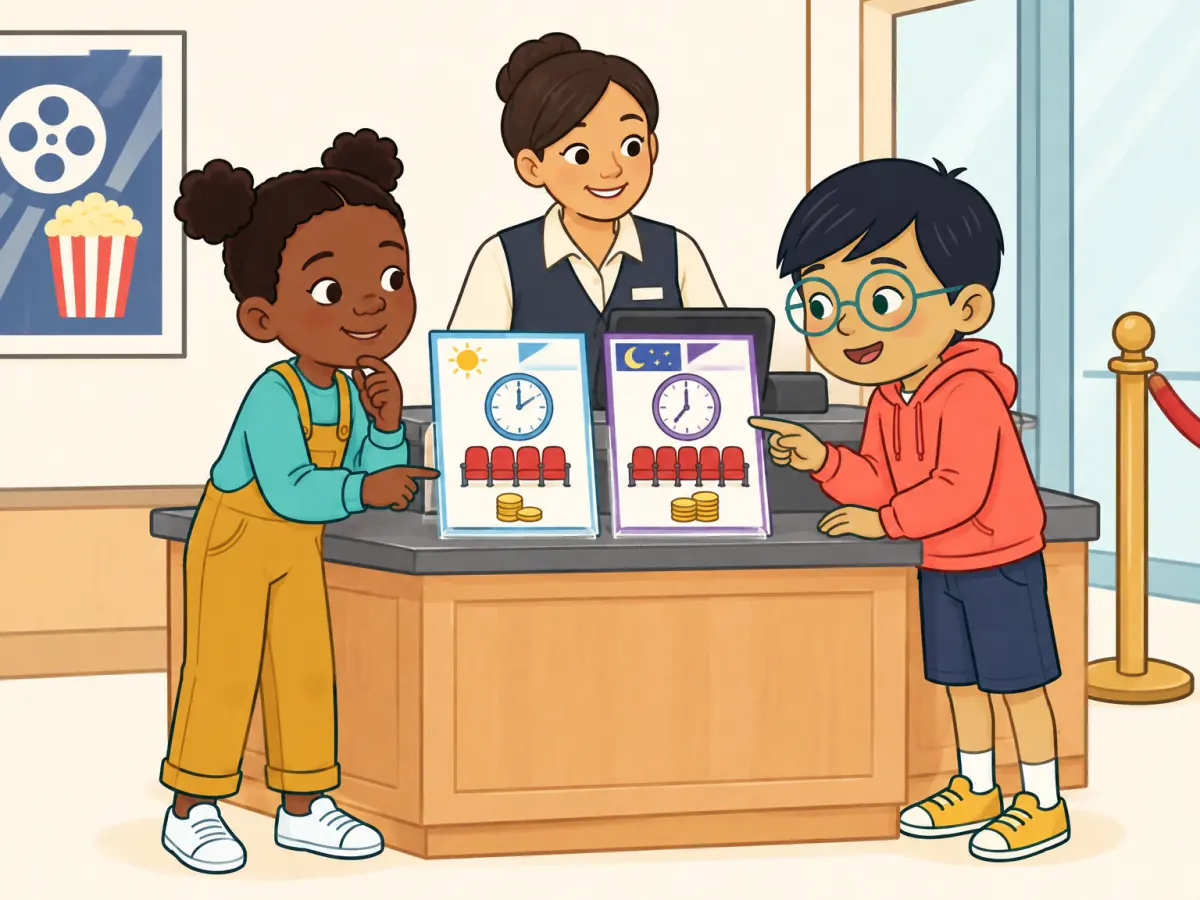
At a community cinema ticket desk, two children compare a matinee and evening performance using clock, seat and price pictures; an adult clerk stands behind the desk.

Ayuda a tu peque de 9 a 12 años (A2) a preguntar “What time does it start?”, cambiar un plan con entradas agotadas y comprobar si quedan asientos, y después a escribir en inglés un cartel que responda todas las preguntas del lector.

Para preguntar por un espectáculo en inglés, los niños dicen “What time does it start?” y responden con el presente simple: “It starts at seven.” Si una función está agotada, proponen otra (“Can we see the evening performance, not the matinee?”) y la comprueban: “Are there any seats left for that?” Después, los mismos datos pasan a un cartel: qué, quién, dónde, cuándo, cuánto cuesta y cómo reservar. Este artículo es para familias con niños de nivel A2, de unos 9 a 12 años, que ya saben hacer preguntas sencillas.

¿Para quién es este artículo?

  • Familias con peques que ya preguntan y responden cosas sencillas como “Where is it?” y “How much is it?” y están listos para una conversación más larga y real.
  • Familias a las que les gusta salir: antes de ir al cine, al teatro o a un concierto del colegio, tu peque puede ensayar las preguntas en inglés en casa.
  • Familias que ayudan con la escritura del colegio: la lista de comprobación del cartel sirve para cualquier aviso, folleto o invitación, y cada línea de la conversación tiene grabación.
  • Demasiado pronto: si todavía no responde a preguntas cotidianas con un detalle, empieza por el artículo sobre lo habitual y lo que pasó ayer, enlazado abajo.
  • Demasiado fácil: si ya escribe un cartel completo y resuelve sin ayuda un plan con entradas agotadas, pasa al artículo sobre comparar dos textos de espectáculos, enlazado abajo.

Abrir las páginas de muestra

Abrir las páginas de muestra

Tarjetas de vocabulario

What time does it start?

Use this phrase for its practical conversational purpose.

It starts at seven.

Use this phrase for its practical conversational purpose.

The matinee is sold out.

Use this phrase for its practical conversational purpose.

Can we see the evening performance, not the matinee?

Use this phrase for its practical conversational purpose.

Are there any seats left for that?

Use this phrase for its practical conversational purpose.

Conversación

Nia What time does it start?

Leo It starts at seven.

Leo The matinee is sold out.

Nia Can we see the evening performance, not the matinee?

Leo Are there any seats left for that?

Nia Yes. The clerk says two seats are left.

Estructura de la frase

What will your project communicate?

FILM NIGHT MOON GARDEN — a new mystery film Starring Lily Park and Omar Hayes Community Hall · Friday 18 October · 7:00 p.m. Tickets: €5 · Book at the library desk.

  • event and short description
  • performers and place
  • date, time and price
  • booking method

Más práctica

Change one detail

At a community cinema ticket desk, Nia and Leo compare a matinee and evening performance using clock, seat and price pictures; an adult clerk stands behind the desk.

Nia Can we book two seats for the puppet show?

Leo Yes. There are two seats left in the front row.

Leo So that’s two seats for Saturday at three?

Nia Yes, that’s right. Two seats at three o’clock.

Can we book two seats for the puppet show?

Yes. There are two seats left in the front row.

  • Are there any seats left?
  • So that’s ...?
  • Yes, that’s right.

Plan every required part

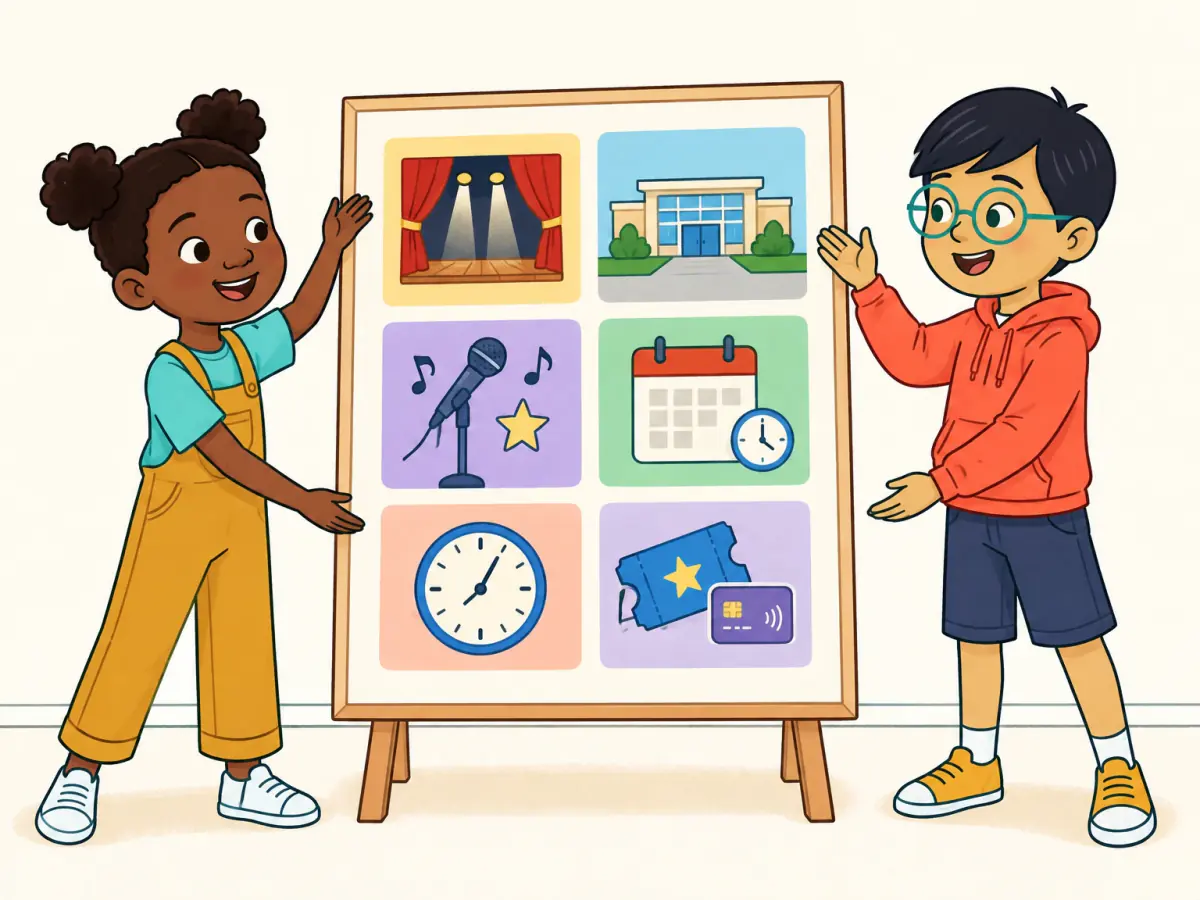
A blank event-poster board shows event type, place, performers, date, time, ticket cost and buying method through separate picture spaces.
event type

Include this in the finished project.

place

Include this in the finished project.

performers

Include this in the finished project.

date

Include this in the finished project.

time

Include this in the finished project.

ticket cost

Include this in the finished project.

how to buy

Include this in the finished project.

Make the full project

A blank event-poster board shows event type, place, performers, date, time, ticket cost and buying method through separate picture spaces.

Nia Who will read your text?

Leo Families at the community hall will read the poster.

Leo What will you check?

Nia I will check my spelling and punctuation.

What will your project communicate?

FILM NIGHT MOON GARDEN — a new mystery film Starring Lily Park and Omar Hayes Community Hall · Friday 18 October · 7:00 p.m. Tickets: €5 · Book at the library desk.

  • event and short description
  • performers and place
  • date, time and price
  • booking method

Use it with a partner

A blank event-poster board shows event type, place, performers, date, time, ticket cost and buying method through separate picture spaces.

Nia What time does it start?

Leo It starts at seven.

Leo How much are the tickets?

Nia They cost five euros. You can book at the library desk.

What time does it start?

It starts at seven.

  • The matinee is sold out.
  • Can we see the evening performance, not the matinee?
  • Are there any seats left for that?
Aprende esta unidad
¿Cómo quieres aprender?

Preguntar cuándo empieza algo

La pregunta clave es “What time does it start?” La respuesta usa el presente simple aunque el espectáculo sea más tarde: “It starts at seven.” El inglés usa esta forma para horarios y programas. “It will start at seven.” no está mal, pero el presente simple suena más natural.

En “¿A qué hora empieza?” no hay ninguna palabra como “does”, así que es fácil decir “What time it starts?”. Muéstrale el patrón: en la pregunta, “does” y el verbo sin -s; en la respuesta, la -s. Con la misma forma se pregunta “When does it finish?”

Nia What time does it start?

Leo It starts at seven.

At, on e in: horas, días y fechas

Usa “at” para la hora, “on” para un día o una fecha, e “in” para un mes o una parte del día. En español los días llevan artículo (“el viernes”), pero en inglés llevan “on”: “on Friday”. El orden puede cambiar: “at seven on Friday” o bien “on Friday at seven”. Ojo: “in the evening”, pero “on Friday evening”.

  • at: at seven, at half past six
  • on: on Saturday, on 18 October
  • in: in October, in the afternoon

¿Agotado? Cambia el plan y vuelve a comprobar

Una “matinee” es una función de día, normalmente por la tarde; en español también existe “matiné”. “Sold out” significa que no quedan entradas. Un buen hablante propone otra opción y la comprueba antes de celebrarlo.

El final “…, not the matinee” deja claro el contraste; pide a tu peque que marque EVENING y MATINEE con la voz. En la siguiente pregunta, “that” se refiere a la función de noche, y “left” significa “que todavía queda”.

Leo The matinee is sold out.

Nia Can we see the evening performance, not the matinee?

Leo Are there any seats left for that?

Nia Yes. The clerk says two seats are left.

Palabras de taquilla y cómo confirmar los datos

“Are there any seats left?” usa “any” porque es una pregunta; la respuesta lleva un número o “no”: “There are two seats left.”, “There are no seats left.” Para confirmar, se repiten los datos: “So that’s two seats for Saturday at three?” “Yes, that’s right.” Así se detecta un error antes de pagar.

  • book – reservar asientos antes de ir
  • the clerk – la persona que vende las entradas en la taquilla

Las partes de un cartel de evento

Un cartel hace por escrito el trabajo de la taquilla: quien lo lee debe encontrar todas las respuestas sin preguntar a nadie. Primero, tu peque decide quién lo va a leer, por ejemplo las familias de un centro cívico. Aquí tienes un ejemplo completo.

“Starring” significa “protagonizada por”. En español escribimos “viernes 18 de octubre” en minúscula, pero en inglés los días y los meses siempre llevan mayúscula: “Friday 18 October”. Además, el símbolo de la moneda va delante: “€5”, no “5 €”.

  • Qué es: “FILM NIGHT”
  • Una descripción corta y emocionante: “MOON GARDEN: a new mystery film”
  • Quién actúa: “Starring Lily Park and Omar Hayes”
  • Dónde y cuándo: “Community Hall · Friday 18 October · 7:00 p.m.”
  • Precio y reserva: “Tickets: €5 · Book at the library desk.”
Aprende esta unidad a tu manera

Prueba el cartel con un lector de verdad

Un cartel está terminado solo cuando otra persona puede usarlo. Alguien de la familia hace las preguntas de un visitante: “Where is it?”, “How much are the tickets?”, “How do I book?” Tu peque responde solo con lo que pone el cartel: “They cost five euros. You can book at the library desk.” Si falta una respuesta, falta una parte.

Un juego en casa: la taquilla familiar

Dibuja dos planos de asientos, uno para una matiné a las 3 de la tarde y otro para la función de las 7, y tacha todos los asientos del primero. Tú vendes las entradas. Tu peque pregunta la hora, oye que la matiné está agotada, propone la función de las 7, comprueba si quedan asientos y confirma: “So that’s two seats for seven o’clock?” Cambiad los papeles y modificad un detalle en cada ronda. Al final, haced un cartel para una noche de cine en familia y probadlo.

Errores frecuentes y cómo corregirlos

Son normales en A2: repite la frase bien dicha y seguid.

  • “What time it starts?”: la pregunta necesita “does”: “What time does it start?”
  • “What time does it starts?”: después de “does”, el verbo va sin -s: “What time does it start?”
  • “It start at seven.”: con “it”, el verbo lleva -s: “It starts at seven.”
  • “Is there any seats left?”: “seats” es plural, así que va con “are”: “Are there any seats left?”
  • “friday 18 october”: días y meses con mayúscula: “Friday 18 October”.

El siguiente paso

Después, tu peque puede leer textos más largos sobre espectáculos y comparar un informe con un cuento. Otro paso es enlazar ideas: “The matinee was sold out, so we booked the evening show.”

Preguntas frecuentes

¿Qué significa “matinee”?

Una función de día en un teatro o un cine, normalmente por la tarde. Viene del francés “matin” (mañana). En inglés británico se suele acentuar la primera sílaba: MAT-i-nay.

¿Se dice “It starts at seven” o “It will start at seven”?

Para una hora fija de un horario, lo más natural es el presente simple: “The film starts at seven.” “It will start at seven.” se entiende y no es incorrecto.

¿Qué debe incluir el cartel de un evento hecho por un niño?

Qué es el evento, una descripción corta, quién actúa, el lugar, la fecha, la hora, el precio y cómo reservar. Si quien lo lee todavía tiene que preguntar algo, falta una parte.

Aprende esta unidad
¿Cómo quieres aprender?

¿Qué viene después?

Clases individuales con un profesor en vivo

En las clases infantiles de Flalingo, tu hijo practica unidades como esta en clases individuales con un profesor en vivo, con juegos en la misma pantalla.

Reserva una clase de prueba gratis