
 pen
pen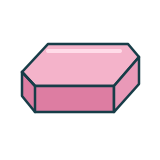 rubber
 pencil
 ruler
ruler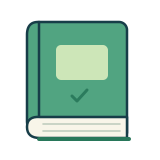 book
book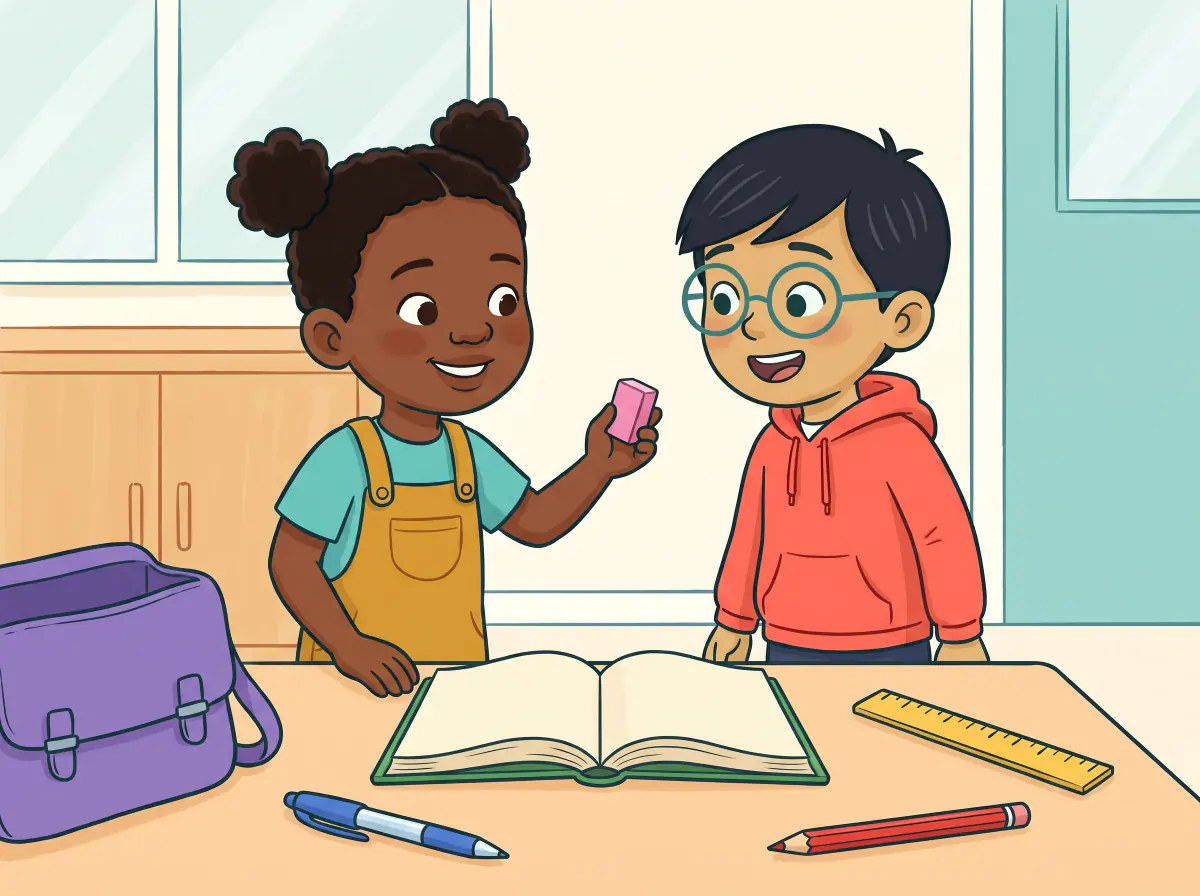
 bag
bagFive school things to start with
Use the real things from your child’s bag and pencil case: a word sticks better when your child holds the object. Play a card, hold up the matching thing and let your child repeat. Three words are plenty on the first day.
Two pairs cause most of the trouble: “pen” and “pencil” look and sound alike, and “ruler” and “rubber” both begin with the letters “ru”. Show the difference with what each thing does.
- pen: writes in ink
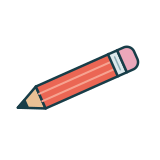
- pencil: writes in grey and can be rubbed out
- ruler: draws straight lines
- rubber (American English: eraser): rubs out pencil
- book: for reading
Asking “What’s this?” and answering “It’s a …”
“What’s this?” is the short form of “What is this?”, and “It’s” means “It is”. Teach the short forms from the start: that is how people speak.
The small word “a” goes before one thing: “It’s a pen.”, not “It’s pen.” Before a vowel sound it becomes “an”: “It’s an eraser.” A one-word answer (“Pencil!”) is a good start; repeat the full sentence back.
- What’s this? It’s a book.
- And this? It’s a ruler.
- What’s in your bag? A pen and a pencil!
Listen: what’s in the bag?
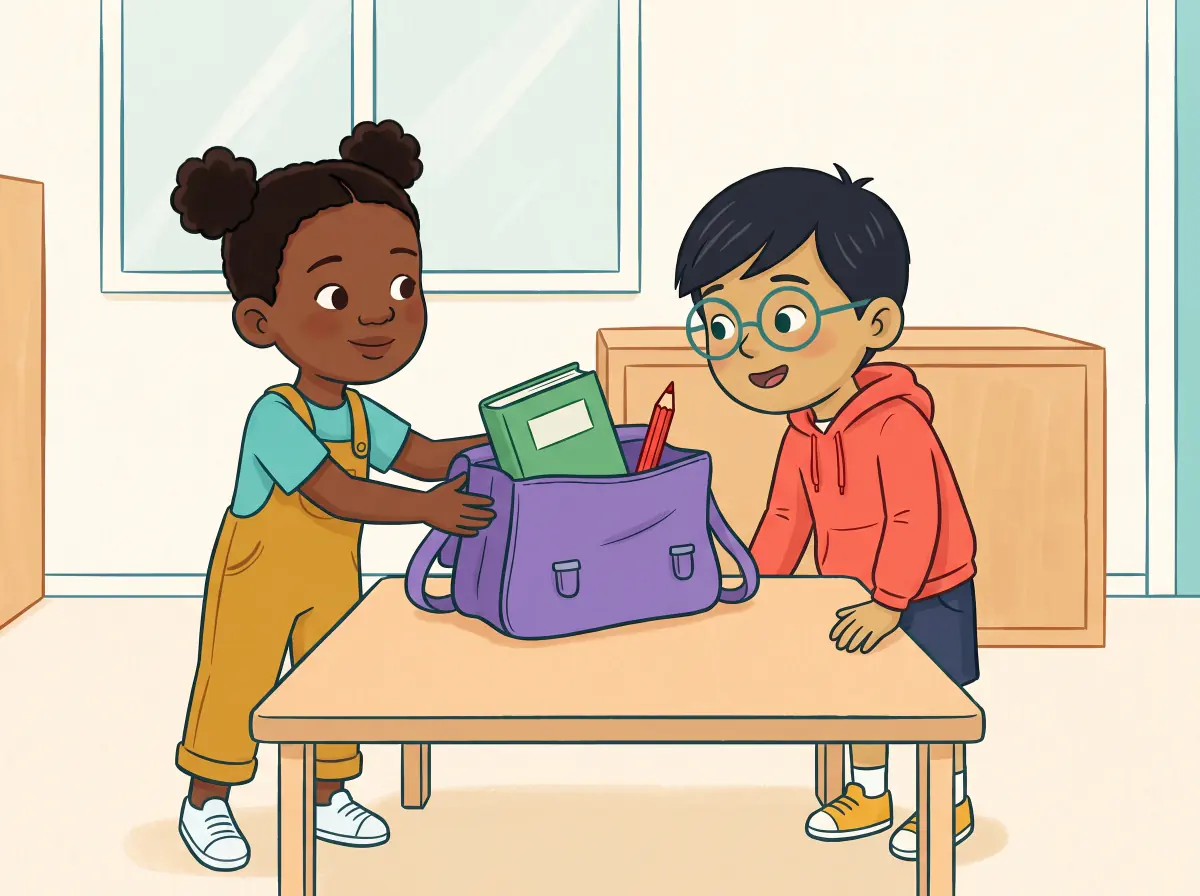
In this short story, one child asks about the things in a friend’s bag. Listen once while your child points to the real objects. Then take a role each: you ask, your child answers. Next time, swap.
Leo Nia, what's in your bag?
Nia A book ... and a pencil!
Leo What's this?
Nia It's a ruler.
Leo And this?
Nia It's a pen!
Leo Oh! What's in the book?
Nia My rubber! There it is!
Classroom words with “open” and “close”
Five more words describe the room: bag, folder, door, window and bookcase. Children learn them fastest with actions: give an instruction, do it together, then let your child give you one. Keep “the” in the sentence; your child will copy it without a rule.
- Open the book.
- Close the bag.
- Open the folder.
- Close the door.
Adding a colour: “This is my green book.”
Once the names are easy, add colours. In English the colour comes before the thing, and “a” or “my” comes first of all: “It’s a yellow ruler.” Use the real colours of your child’s things, so every sentence is true. Then try show and tell: your child picks three things and says one sentence about each.
- This is my green book.
- Here’s my blue pen.
- My pink rubber!
First sounds: a, b, c and d
School words also make good examples for first sounds. Say the sound, not the letter name: “bag” starts with a short “b”, not “bee”. The “c” in “cat” sounds like “k”, and the “a” in “apple” is the short, open sound you also hear in “bag”.
- a: apple
- b: bird, book, bag
- c: cat
- d: dog, door
Three five-minute games at home
Stop while your child still wants to play.
- Mystery bag: put the five things in a bag. Your child closes their eyes, feels one and guesses: “It’s a ruler!” Then they take it out to check.
- Wrong on purpose: hold up a pencil and say “It’s a pen!” Your child corrects you: “No! It’s a pencil.” Children love catching an adult’s mistake.
- Teacher says: your child gives you two instructions, such as “Open the book.” and “Close the bag.” You do them, then swap.
Common mistakes and quick fixes
These slips are normal; just say the right version again.
- Pen or pencil?: hold both up, show what each one does and say the words side by side: “pen”, “pen-cil”.
- Ruler or rubber?: say each one clearly, “roo-ler” and “rub-ber”, while you draw a line or rub out a mark.
- Leaving out “a”: answer “Yes, it’s a pen.” with the “a” clear.
What comes next
When your child can ask and answer about all five things, add “my” and “your”: “Is this your pen?” “Yes, it’s my pen.” Later come “that”, “these” and “those” for things further away or more than one. Keep using real objects your child can touch.