
Skip to content
Flalingo

English practice

Past continuous and past simple for children (A2, ages 10–12): telling a story with when and while

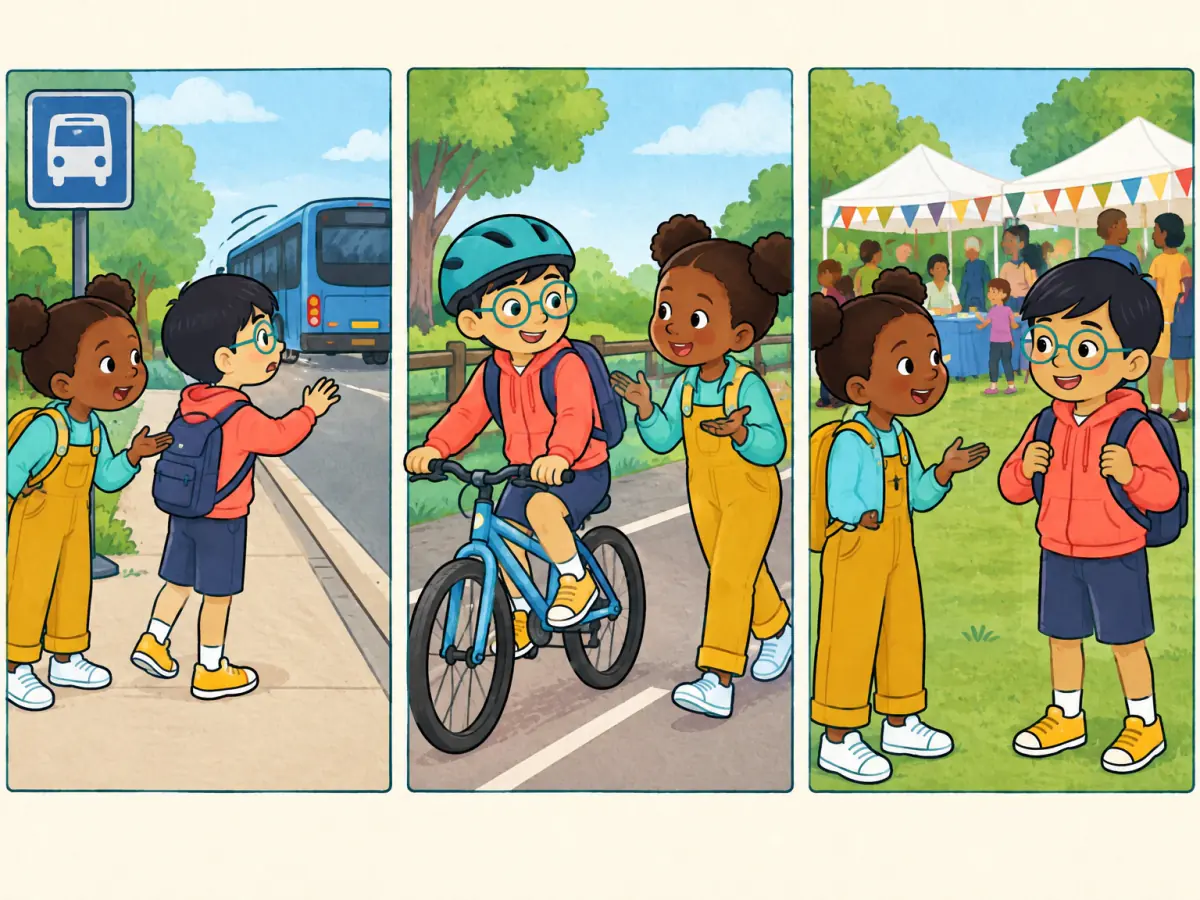
A three-part picture timeline shows a child missing a bus, cycling safely and arriving at a community event while another child asks follow-up questions.

Help your 10–12-year-old tell a past event in English at A2: the past continuous for what was happening, the past simple for what happened, joined with when and while, then written as a short news story.

To tell a past event in English, children combine two tenses. The past continuous (was or were + -ing) sets the scene, and the past simple tells the short event that interrupted it and each step after it: “I was checking the timetable when the bus left.” “When” goes before the short event; “while” goes before the longer action. This A2 topic suits children of about 10–12 who already use the past simple and want to tell their news in more detail.

Who this is for

  • Parents of children who already use the past simple: your child can say “Yesterday I went to the park.” and knows a few irregular verbs.
  • Families coming back to English after the holidays: holiday news is a natural way to bring past tenses back.
  • Parents who want to help with school writing: the four-part story plan below works for diaries, news reports and short stories.
  • Too early: if your child still says “I go to the park yesterday.”, start with the past simple on its own, for example in a journal about usually, now and yesterday (linked below).
  • Too easy: if your child already writes “While we were walking home, it started to rain, so we ran.” without help, go to “What comes next” at the end.

Open the sample pages

Open the sample pages

Word cards

waiting for the bus
the bus left
cycling to the event
go → went
take → took
see → saw
make → made

Conversation

Nia What were you doing when the bus left?

Leo I was checking the timetable.

Nia What did you do next?

Leo I called an adult and cycled on the safe path.

Nia Did you miss the event?

Leo No. I arrived before it started.

Language pattern

What were you doing when the bus left?

I was checking the timetable.

  • The bus left while I was looking away.
  • I cycled to the event and arrived safely.

More practice

Share an update

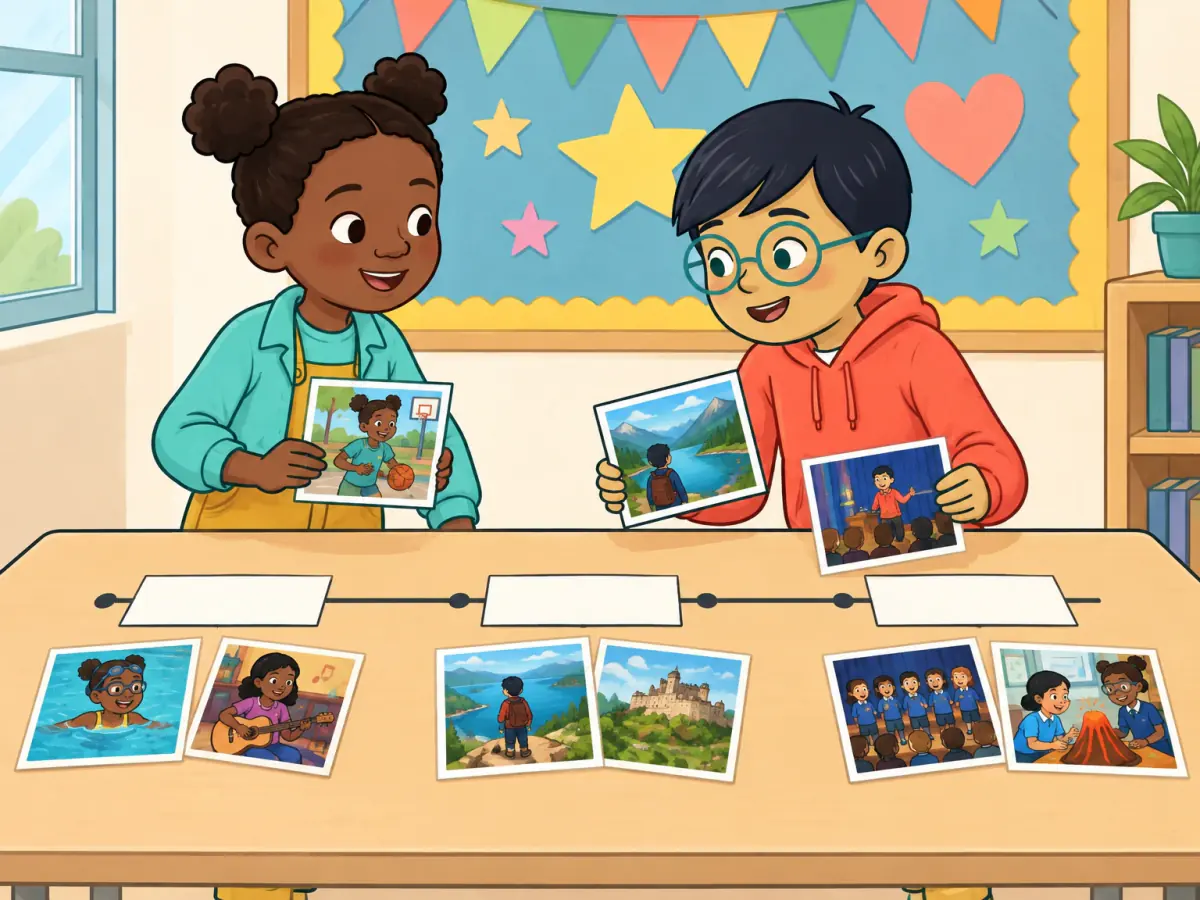
At a welcome-back display, Nia and Leo compare photos of current hobbies, a recent trip and a school event using blank timeline cards.

Nia What are you working on now?

Leo I am preparing a photo display.

Leo What did you do yesterday?

Nia I visited my cousin and took photos.

Nia Do you still cycle every week?

Leo Yes, I do.

What are you working on now?

I am preparing a photo display.

  • I visit the club every week.
  • We finished the mural yesterday.

Writer's studio

A three-part picture timeline shows Leo missing a bus, cycling safely and arriving at a community event while Nia asks follow-up questions.

Nia Who will read your text?

Leo My teacher will read my news.

What happened?

I was checking the timetable when the bus left. I called an adult, chose the safe cycle path and arrived before the event started.

  • while
  • when
  • next
  • finally
Learn this unit
How would you like to learn?

Background and event: two jobs, two tenses

A story about the past usually has a longer action already going on and a short event in the middle of it. The longer action is the background and uses the past continuous: “I was waiting for the bus.” The short event uses the past simple: “The bus left.”

The past continuous is was or were plus the -ing form: “was” with I, he, she and it; “were” with you, we and they.

  • Background: “We were playing football.”
  • Event: “It started to rain.”
  • Together: “We were playing football when it started to rain.”

When or while?

“When” goes with the short event: “I was checking the timetable when the bus left.” “While” goes with the longer background action: “The bus left while I was looking away.” Either part can come first. If the sentence starts with “when” or “while”, add a comma: “While I was looking away, the bus left.”

One detail: “when” with two past simple verbs shows order, not overlap. “When the bus left, I called an adult.” means the call came after the bus left. Ask your child: “Which one started first?”

Asking about what happened

“What were you doing when…?” asks about the background, so the answer uses was or were + -ing. “What did you do next?” asks for the next step in the past simple. After “did”, use the base form: “Did you miss the event?”, not “Did you missed…?” Hear all three below.

Nia What were you doing when the bus left?

Leo I was checking the timetable.

Nia What did you do next?

Leo I called an adult and cycled on the safe path.

Nia Did you miss the event?

Leo No. I arrived before it started.

Irregular past forms for stories

Practise irregular past forms inside full sentences, not as a list. With “did”, the base form comes back: “I took the bus.” but “I didn’t take the bus.”

  • go → went: “We went to the sports centre.”
  • take → took: “I took the safe path.”
  • see → saw: “I saw the bus at the corner.”
  • make → made: “We made a new plan.”
Learn this unit your way

From spoken news to a short written story

Once your child can tell the event aloud, writing it is a small step: four parts, one or two sentences each. Here is a model your child can change: “Last Saturday, my sister and I were waiting at the bus stop. While we were talking, the bus went past without stopping. We called Dad, and he drove us to the stadium. In the end, we arrived just before the match started.”

  • Scene: who, where, what was happening
  • Event: what happened, with when or while
  • Next steps: then, after that
  • Ending: in the end, finally

Common mistakes and quick fixes

These are normal at A2. Repeat the sentence back correctly and let your child carry on.

  • “I was check the timetable.”: it needs was or were and -ing: “I was checking the timetable.”
  • “We was waiting.”: with we, you and they it is “were”.
  • “While the bus left, I was reading.”: use “when” for a short event: “When the bus left, I was reading.”
  • “I was calling an adult and I was cycling there.”: steps in order use the past simple: “I called an adult and cycled there.”
  • “He goed home.”: irregular verbs have their own past form: “He went home.”

A home game: the interrupted story

Play for 15 minutes at dinner. Round 1: name a time, such as “at seven o’clock yesterday evening”, and everyone says what they were doing. Round 2: one person starts a background sentence, “I was reading in bed…”, and the next interrupts with an event: “…when the lights went out.” Round 3: say what happened next. Once a week, your child writes one story and underlines background verbs in one colour and events in another.

What comes next

Next, add two actions at the same time: “While I was cooking, my brother was laying the table.” Then add results with so: “The bus left, so I called an adult.”

Frequently asked questions

What is the difference between the past simple and the past continuous?

The past simple is for finished actions and steps in order: “I called an adult.” The past continuous is for an action in progress at a past moment: “At eight o’clock I was checking the timetable.”

Can you use “while” with the past simple?

Not with a short, sudden event: say “when the bus left”, not “while the bus left”. With a longer action it is possible (“While I waited, I read a book.”), but at A2 the safe rule is “while” + was/were + -ing.

Is it “did you miss” or “did you missed”?

“Did you miss the event?” is correct. “Did” already shows the past, so the main verb stays in its base form: “I didn’t miss it.”

Learn this unit
How would you like to learn?

What comes next?

One-to-one lessons with a live teacher

In Flalingo kids lessons, your child practises units like this one-to-one with a live teacher, through games on the same screen.

Book a free trial lesson