Skip to content
Flalingo

English practice

Describing a painting in English for children (A2, ages 10–12): foreground, background, left and right

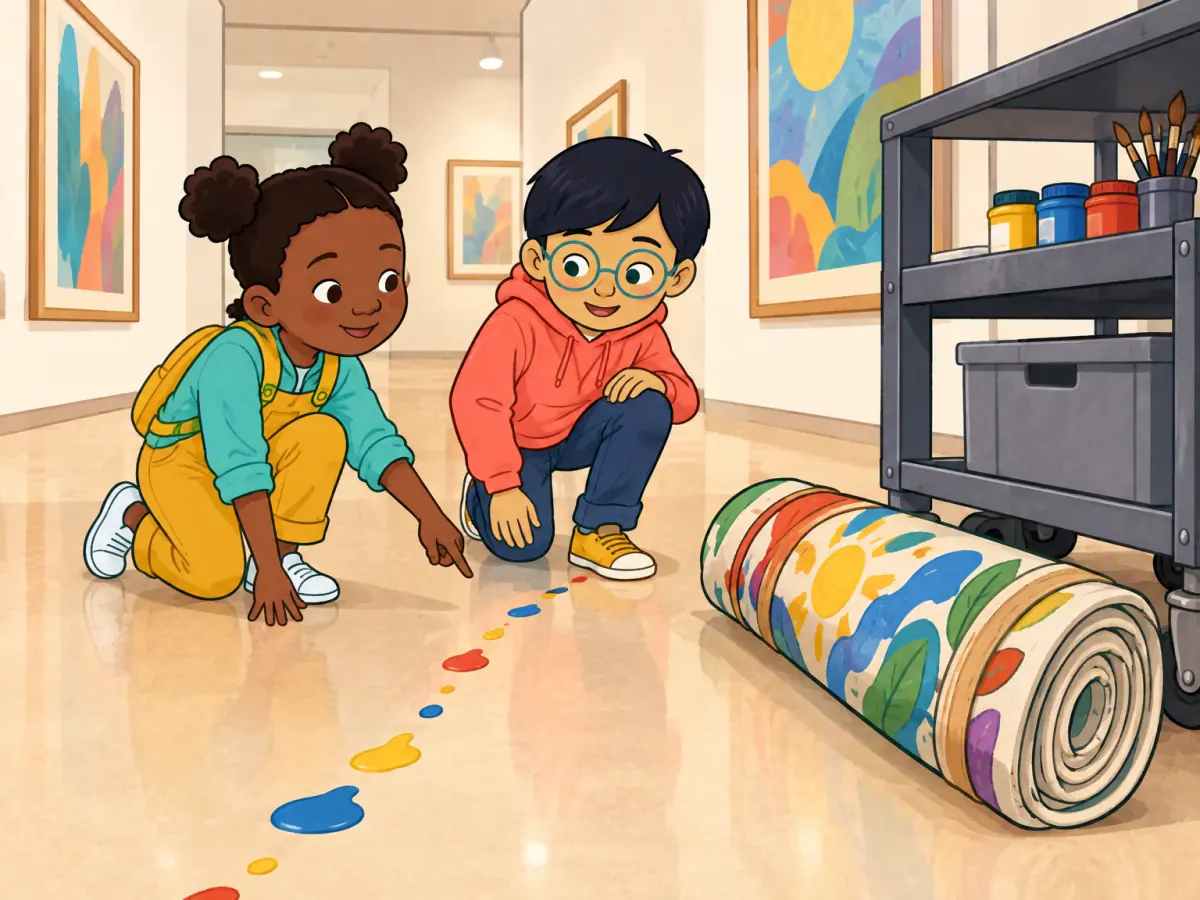
An original adventure scene in a closed gallery: two children follow a trail of red, yellow and blue paint drops to find a rolled community mural safely beside a storage cart.

Help your child describe a painting in English with “in the foreground”, “in the background” and “on the left”, then plan an art project with going to, will and the present continuous (A2, ages 10–12).

To describe a painting in English, children say what they see, add a detail and say where it is: “A woman in a yellow coat stands in the foreground.” The key phrases are “in the foreground”, “in the background”, “on the left” and “on the right”. Then they plan an art project with three future forms: “I am going to paint a river mural.” (a plan), “I will carry the brushes.” (an offer) and “We are meeting the artist on Friday.” (an arrangement). This A2 topic suits children of about 10–12 who already make simple sentences about people and places.

Who this is for

  • Parents of children who can describe people and places in simple sentences: your child can say “There is a bridge.” and “She is wearing a coat.”
  • Children who like drawing, museums or making things: talking about art gives them a reason to build longer sentences.
  • Parents who want to practise at home: any picture works, from a postcard to a book cover, and the dialogue below has a recording of every line.
  • Too early: if your child still mixes up “She stands” and “She is standing”, start with the A2 article on breakfast habits with usually and right now, linked below.
  • Too easy: if your child already describes pictures in detail and keeps going to, will and the present continuous apart, go to the A2 article on a weekend diary with plans and offers, linked below.

Open the sample pages

Open the sample pages

Word cards

art galleryart gallery
paintingpainting
muralmural
backgroundbackground
foregroundforeground
portraitportrait
landscapelandscape
sculpturesculpture
What are you going to paint?

I am going to paint a river mural.

I will carry the brushes.
We are meeting the artist on Friday.
The foreground will be bright.

Conversation

Nia Describe the painting for my audio guide, Leo.

Leo A woman in a yellow coat stands in the foreground.

Nia What is behind her?

Leo A blue bridge crosses the background, under a pale grey sky.

Nia Where are the boats?

Leo Three red boats are on the left, beside a dark green riverbank.

Language pattern

What are you going to paint?

I am going to paint a river mural.

  • I will carry the brushes.
  • We are meeting the artist on Friday.
  • The foreground will be bright.

More practice

Talk with the grammar

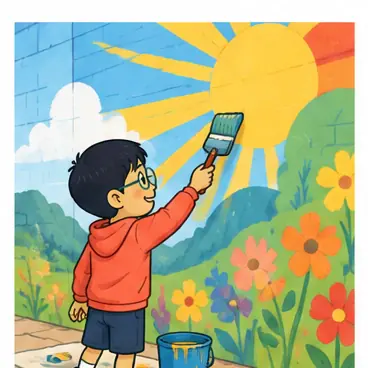
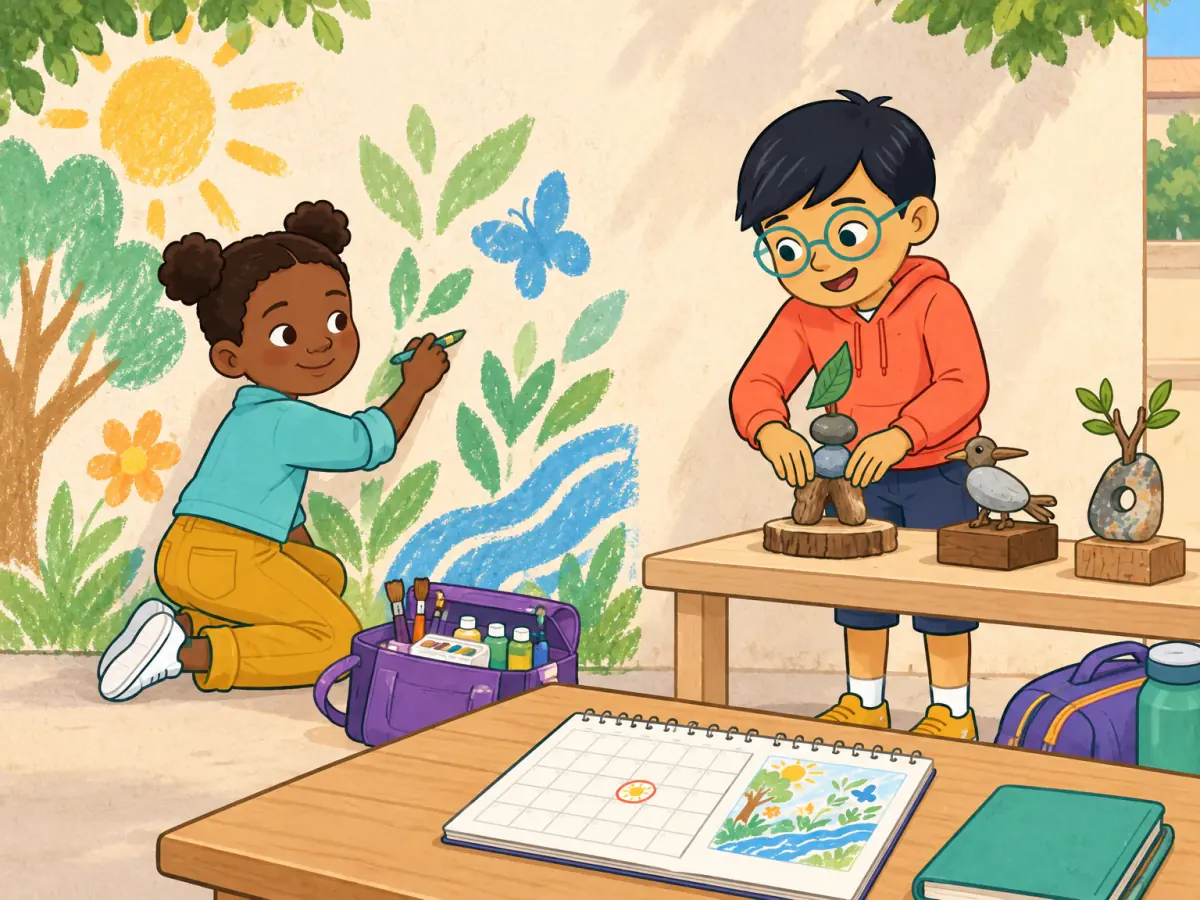
At an empty courtyard wall, Nia sketches a nature mural while Leo offers to arrange a small sculpture display; a calendar and packed art materials show firm future plans.

Leo What are you going to paint?

Nia I am going to paint a river mural.

Nia The paint box is heavy.

Leo I will carry it.

Nia When are we meeting the artist?

Leo We are meeting her on Friday.

What are you going to paint?

I am going to paint a river mural.

  • I will carry the brushes.
  • We are meeting the artist on Friday.
  • The foreground will be bright.

The colour trail

An original adventure scene in a closed gallery: Nia and Leo follow a trail of red, yellow and blue paint drops to find a rolled community mural safely beside a storage cart.

THE COLOUR TRAIL

Nia and Leo were helping to close the community gallery when they noticed a trail of red, yellow and blue paint drops on the floor. They followed the marks past the portrait room and into the quiet store. A large roll rested beside a cart. It was the neighbourhood mural for Saturday, but its label had fallen off. Nia phoned the artist instead of opening it. “I am coming now,” the artist said. Leo smiled. “We found the missing display, and we kept it safe.”

Writer's studio

An original adventure scene in a closed gallery: Nia and Leo follow a trail of red, yellow and blue paint drops to find a rolled community mural safely beside a storage cart.

Nia Who will read your text?

Leo My teacher and my family will read it.

How will your adventure end?

The lights went out, but I used a small torch. I found the missing sculpture behind a curtain. I called the gallery manager before I moved it. We will display it safely tomorrow.

  • I will carry the brushes.
  • We are meeting the artist on Friday.
  • The foreground will be bright.
Learn this unit
How would you like to learn?

Art words for a gallery visit

A painting is any picture made with paint; a mural is painted straight onto a wall. A portrait shows a person, and a landscape shows countryside, rivers or the sea. A sculpture is not flat: you can walk around it. Children may know “portrait” and “landscape” from tablets, meaning a tall screen and a wide screen; portrait paintings are usually tall, and landscapes usually wide.

  • art gallery – a place to look at art
  • sculpture – art made of stone, metal, wood or clay

Foreground, background, left and right

The foreground is the part of a picture that seems nearest to you, usually at the bottom. The background seems furthest away: often sky, hills or buildings. English says “in the foreground” and “in the background”, but “on the left” and “on the right”. Corners take “in”: “in the top left corner”.

  • in the middle – between the front and the back
  • behind, beside, under, above – to link two things

One precise sentence: what, detail, place

At A2, “There is a woman.” grows into one sentence with a detail and a place. Shade words such as pale, dark and bright go before the colour: “a pale grey sky”. In conversation, people often say “is standing”; “stands” sounds more like an audio guide. Both are correct. Here, one speaker describes a painting for a gallery audio guide.

Nia Describe the painting for my audio guide, Leo.

Leo A woman in a yellow coat stands in the foreground.

Nia What is behind her?

Leo A blue bridge crosses the background, under a pale grey sky.

Nia Where are the boats?

Leo Three red boats are on the left, beside a dark green riverbank.

Going to, will and the present continuous

English has three common ways to talk about the future. Going to is a plan already decided: “What are you going to paint?” “I am going to paint a river mural.” Will is an offer or decision made while speaking: “I will carry the brushes.”, usually said “I’ll carry the brushes.” It also makes predictions: “The foreground will be bright.” The present continuous with a time is an arrangement fixed with other people: “We are meeting the artist on Friday.”

Opposites with un- and im-

Many English opposites start with a prefix. Un- is the most common; im- often comes before words starting with p or m. No rule works every time (“popular” takes un-), so learn each pair together.

  • popular – unpopular
  • friendly – unfriendly
  • tidy – untidy
  • patient – impatient
  • possible – impossible
  • polite – impolite
Learn this unit your way

An adventure story with a clear ending

Children of 10–12 often write short adventures, and the ending is the hard part: the story just stops, or it was all a dream. A strong ending says what was found and where, shows a sensible choice and looks ahead with a future form: “Inside the cupboard, I found the missing portrait. I didn’t move it; I called the gallery manager instead. Tomorrow we are going to hang it back on the wall.”

A home game: be the audio guide

Choose any picture: a postcard, a book cover or a painting online. Your child is the audio guide and gives three sentences, about the foreground, the background and one side, each with a colour. You draw what you hear without looking, then compare and swap. Finish with “What are you going to draw next?” and wait for “I am going to…”.

Common mistakes and quick fixes

Repeat the sentence back correctly and keep going.

  • “in the left”: sides take “on”: “on the left”.
  • “in foreground”: keep “the”: “in the foreground”.
  • “a grey pale sky”: the shade word comes first: “a pale grey sky”.
  • “I’m going to carry it!” as a quick offer: use will: “I’ll carry it.”
  • “unpossible”, “unpolite”: these take im-: “impossible”, “impolite”.

What comes next

Next, your child can write a whole weekend diary with arrangements, plans and an offer. After that come plans that depend on something else: “If it rains, we will paint indoors.”

Frequently asked questions

How do you describe a picture in English?

Go from front to back, then side to side: say what is in the foreground, in the background and on each side, with a colour or detail each time. Three or four sentences are enough.

What is the difference between foreground and background?

The foreground looks closest to you, usually at the bottom; the background looks furthest away, such as the sky or distant hills. Both take “in the”.

When should my child use going to and when will?

Going to is for a plan made before speaking; will is for an offer or decision made while speaking, and for predictions. A fixed arrangement with a time takes the present continuous: “We are meeting the artist on Friday.”

Learn this unit
How would you like to learn?

What comes next?

One-to-one lessons with a live teacher

In Flalingo kids lessons, your child practises units like this one-to-one with a live teacher, through games on the same screen.

Book a free trial lesson