Skip to content
Flalingo

English practice

Talking about future plans in English for children (A2, ages 10–12): “I’m meeting”, “going to” and “I’ll”

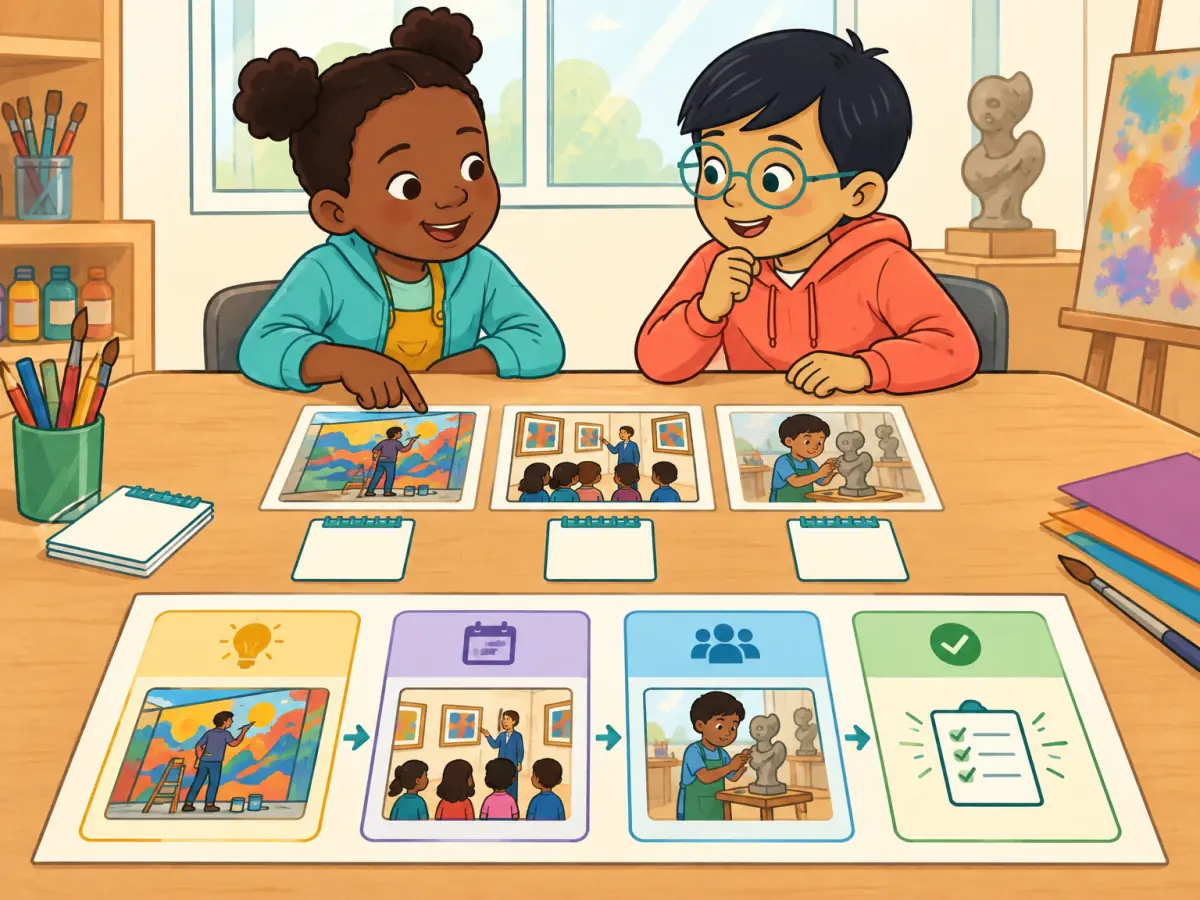
At a youth arts weekend desk, two children compare a mural workshop, gallery tour and sculpture class with blank calendar cards. A completed plan has four picture panels for purpose, sequence, support and final check.

Help your 10–12-year-old choose the right future form in English at A2: the present continuous for arrangements, going to for intentions and will for quick offers, then plan and write a short weekend diary.

English has three common ways to talk about the future. For a plan fixed with other people, often with a time, use the present continuous: “I am meeting the mural team at ten.” For something already decided, use going to: “I am going to photograph three sculptures.” For an offer made while speaking, use will: “I will check the closing time.” This A2 article is for parents of children aged about 10–12 who know these forms but mix them up when speaking or writing.

Who this is for

  • Parents of children who already use the present continuous for now (“I’m reading.”) and know going to and will, but pick one at random.
  • Families with a real weekend, trip or holiday coming up: your own plans make the best practice.
  • Parents who want to help with school writing: the diary plan below works for any plan or invitation, and every line of the conversation has a recording.
  • Too early: if your child doesn’t yet say “I’m reading.” for something happening now, practise the present continuous first; the guide to English for children linked below shows where to start.
  • Too easy: if your child already says “I’m meeting Sam at four, so I’m going to finish my homework first.” without help, go to the sports leaflet article with if sentences, linked below.

Open the sample pages

Open the sample pages

Word cards

What are you doing on Saturday?
I am meeting the mural team at ten.
Could we visit the gallery afterwards?
Yes. I will check the closing time.
purposepurpose

why you are writing

first actionfirst action

what happens first

supportsupport

who or what will help you

final checkfinal check

what you check at the end

Conversation

Nia What are you doing on Saturday?

Leo I am meeting the mural team at ten.

Leo Could we visit the gallery afterwards?

Nia Yes. I will check the closing time.

Language pattern

What are you doing on Saturday?

I am meeting the mural team at ten.

  • Could we visit the gallery afterwards?
  • Yes. I will check the closing time.

More practice

Test the plan aloud

At a youth arts weekend desk, Nia and Leo compare a mural workshop, gallery tour and sculpture class with blank calendar cards. A completed plan has four picture panels for purpose, sequence, support and final check.

Leo What is the first useful detail?

Nia I will state the purpose first.

Nia How will you make it clear?

Leo I will order the actions and check them.

What is the first useful detail?

I will state the purpose first.

  • Then I will order the actions.
  • Finally, I will check the reader can follow.

Writer's studio

At a youth arts weekend desk, Nia and Leo compare a mural workshop, gallery tour and sculpture class with blank calendar cards. A completed plan has four picture panels for purpose, sequence, support and final check.

Nia Who will read your text?

Leo Young artists who want to join the weekend will read it.

What will you create?

SATURDAY DIARY 10:00 Meet the mural team. 12:00 Visit the gallery. I am going to photograph three sculptures. I will carry the shared sketchbooks.

  • purpose
  • sequence
  • specific detail
  • check
Learn this unit
How would you like to learn?

Three ways to talk about the future

English has no single future tense; the form depends on how fixed the plan is. Teach your child one question: “Is it arranged, decided, or am I deciding now?” Going to and the present continuous need am, is or are; “will” is the same for everyone.

  • Arranged with others: the present continuous. “I’m playing tennis with Ana at four.”
  • Decided, nothing booked: going to. “I’m going to clean my bike.”
  • Decided while speaking: will. “I’ll carry that bag for you.”

Arrangements: “What are you doing on Saturday?”

To ask about plans, use the present continuous with a future time: “What are you doing on Saturday?” The answer keeps the same form and adds who, where or what time: “I am meeting the mural team at ten.”

“What do you do on Saturdays?” is different: it asks about a routine, answered in the present simple: “I usually play basketball.” Ask both in the same week so your child hears the difference.

Nia What are you doing on Saturday?

Leo I am meeting the mural team at ten.

Intentions with going to

Going to shows a decision already made: am, is or are + going to + verb. “I am going to photograph three sculptures.” People often say “gonna”, but in writing it is always “going to”.

Many plans take either form: “I’m visiting Grandma on Sunday.” and “I’m going to visit Grandma on Sunday.” are both correct; the first sounds already arranged. If both fit, accept both.

Suggestions and offers: “Could we…?” and “I’ll…”

To suggest a plan politely, use “Could we…?” and a verb: “Could we visit the gallery afterwards?” “Afterwards” means after that, so no second time is needed. Replies: “Yes, good idea.” or “Sorry, I can’t. I’m helping my dad.”

When someone takes on a job on the spot, English uses will: “Yes. I will check the closing time.” In conversation this is “I’ll check.” More offers: “I’ll bring the snacks.”

Leo Could we visit the gallery afterwards?

Nia Yes. I will check the closing time.

Learn this unit your way

A weekend diary: plan before you write

A diary for the coming weekend puts all three kinds of plan in one short text: “SATURDAY DIARY. 10:00 Meet the mural team. 12:00 Visit the gallery. I am going to photograph three sculptures. I will carry the shared sketchbooks.” The timed lines are arrangements written as notes; the last two sentences add an intention and an offer.

Write a time only when it is known; otherwise write “closing time: check” and fill it in later. Timetables take the present simple: “The gallery closes at five.” Before writing, plan four things:

  • Purpose: who will read it and why
  • First action: what happens first, and when
  • Support: who or what will help
  • Final check: are the times right and the order clear?

Common mistakes and quick fixes

These are normal at A2. Repeat the sentence correctly and ask: “Arranged, decided or deciding now?”

  • “What do you do on Saturday?” for this weekend: that asks about a routine; say “What are you doing on Saturday?”
  • “I going to…”: add am, is or are: “I am going to…”
  • “I will to check.”, “Could we to visit…?”: no “to” after will or could.
  • “I’m going to check.” as an instant offer: “I’ll check.” sounds more natural.
  • “at Saturday”, “on ten o’clock”: on for days, at for clock times: “on Saturday at ten”.

A home game: plan the real weekend

On Thursday or Friday evening, plan the weekend in English for 15 minutes. Round 1: everyone asks “What are you doing on Saturday?” and answers with a real arrangement and time. Round 2: everyone adds one intention with going to. Round 3: name a small problem (“We need bread.”) and your child offers help: “I’ll buy some.”

Then your child writes a five-line family diary and marks unchecked times with a question mark until they are checked.

What comes next

Next, add conditions: “If it rains, we’ll go to the gallery first.” A short invitation with “Would you like to come?” is another good step.

Frequently asked questions

What is the difference between “going to” and the present continuous for the future?

The present continuous fits a plan arranged with someone, often with a time: “I’m meeting Sam at ten.” Going to shows a decision, even if nothing is booked: “I’m going to tidy my room.” Often both work.

When do you use “will” instead of “going to”?

Use will for a decision made while speaking, especially an offer: “I’ll check the closing time.” Use going to for something decided earlier. Will is also used for predictions: “It will be busy.”

How do you suggest a plan politely in English?

“Could we…?” is polite and friendly. “Shall we…?”, “Why don’t we…?” and “How about visiting…?” (with -ing) also work. Reply with “Yes, good idea.” or “Sorry, I can’t.”

Learn this unit
How would you like to learn?

What comes next?

One-to-one lessons with a live teacher

In Flalingo kids lessons, your child practises units like this one-to-one with a live teacher, through games on the same screen.

Book a free trial lesson