
Three times, three verb forms
The time word tells your child which form to choose. “Usually” and “every Saturday” mean a routine, so the verb stays simple: “I help”, “she helps”. “Right now” and “today” for a change of plan mean an action in progress: “am”, “is” or “are” plus -ing. “Last night” and “yesterday” mean a finished time, so the verb goes into the past: “I looked”, “I found”.
For a different day, the key pattern is “usually…, but today…”: one sentence, two verb forms.
- usually – a repeated routine: “I usually walk to school.”
- right now – happening at this moment: “Right now, I am waiting for the bus.”
- last weekend – a finished past time: “Last weekend, I visited my grandma.”
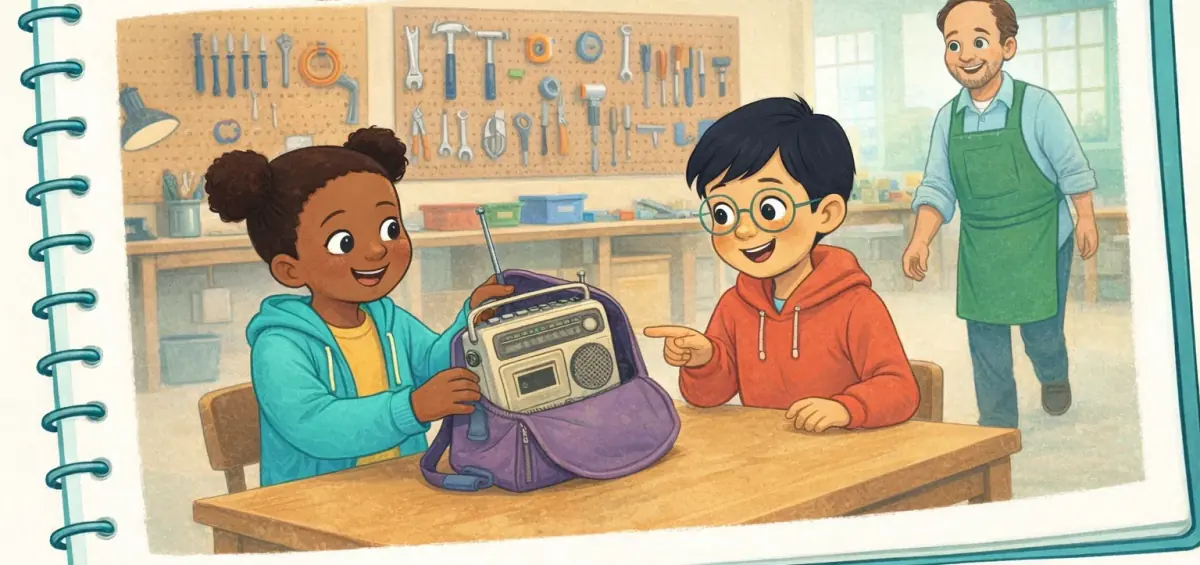
Leo What do you usually do on Saturday?
Nia I usually help in the garden, but today I am visiting a repair café.
One question for each time
Each time has its own question, and the answer copies its verb form: “do… usually” gets the plain verb, “are… doing” gets -ing, and “did… do” gets a past answer. After the conversation, ask your child the same questions about their own week.
Nia What did you do last night?
Leo I looked for the radio cover.
Leo What are we doing now?
Nia We are waiting for an adult volunteer.
Five punctuation marks and their jobs
Ask your child to say what each mark does, not just its name. After a very short opening word like “Now” the comma is sometimes left out, but adding it is a safe habit in school writing.
- full stop – ends a statement: “Now I’m ready.”
- comma – separates an opening time phrase: “Yesterday, I checked the route.”
- question mark – ends a direct question: “Is this our stop?”
- apostrophe – marks a missing letter or who owns something: “I’m”, “my sister’s bike”
- quotation marks – show the exact words someone said
Writing a spoken question
Quotation marks go around the exact spoken words. The question mark belongs to those words, so it sits inside the closing mark: “Have you brought the old radio?” my friend asks. The words that say who is speaking continue the sentence, so “my” takes a small letter. British books often use single marks (‘…’), American books double ones (“…”); either is fine if used consistently.
A four-sentence journal, step by step
A good entry tells one small change in four connected sentences. Here is a model about taking the bus.
Before your child reads it aloud, check the capitals, the end marks, the comma after the opening time phrase, the quotation marks and the apostrophe.
- Routine and change: “I usually walk home, but today I am taking the bus.”
- A spoken question: “Is this our stop?” I ask.
- A finished action: “Yesterday, I checked the route.”
- Now, with a contraction: “Now I’m ready.”
A home game: the “different day” journal
Two or three times a week, at dinner, ask: “What do you usually do on Fridays?”, “What are you doing differently today?” and “What did you do yesterday?” Your child answers aloud, then writes four sentences. To check, they circle each punctuation mark in a different colour and say its job. Sometimes write your own entry with two marks missing for them to find.
Common mistakes and quick fixes
These are normal at A2. Point to the time word and ask: “Usually, now or finished?”
- “Right now, I wait.”: an action in progress needs -ing: “Right now, I am waiting.”
- “I usually am helping.”: a routine takes the simple form: “I usually help.”
- “What did you did?”: after “did” the verb stays plain: “What did you do?”
- “I looked the cover.”: to search is “look for”: “I looked for the cover.”
- “Im ready.”: the apostrophe replaces the missing letter: “I’m ready.”
What comes next
Next, your child can tell a longer past story with “when” and “while”: “I was waiting for the bus when it started to rain.” Another step is checking finished jobs with “already” and “yet”: “I have already packed my bag.”