
Asking when something starts
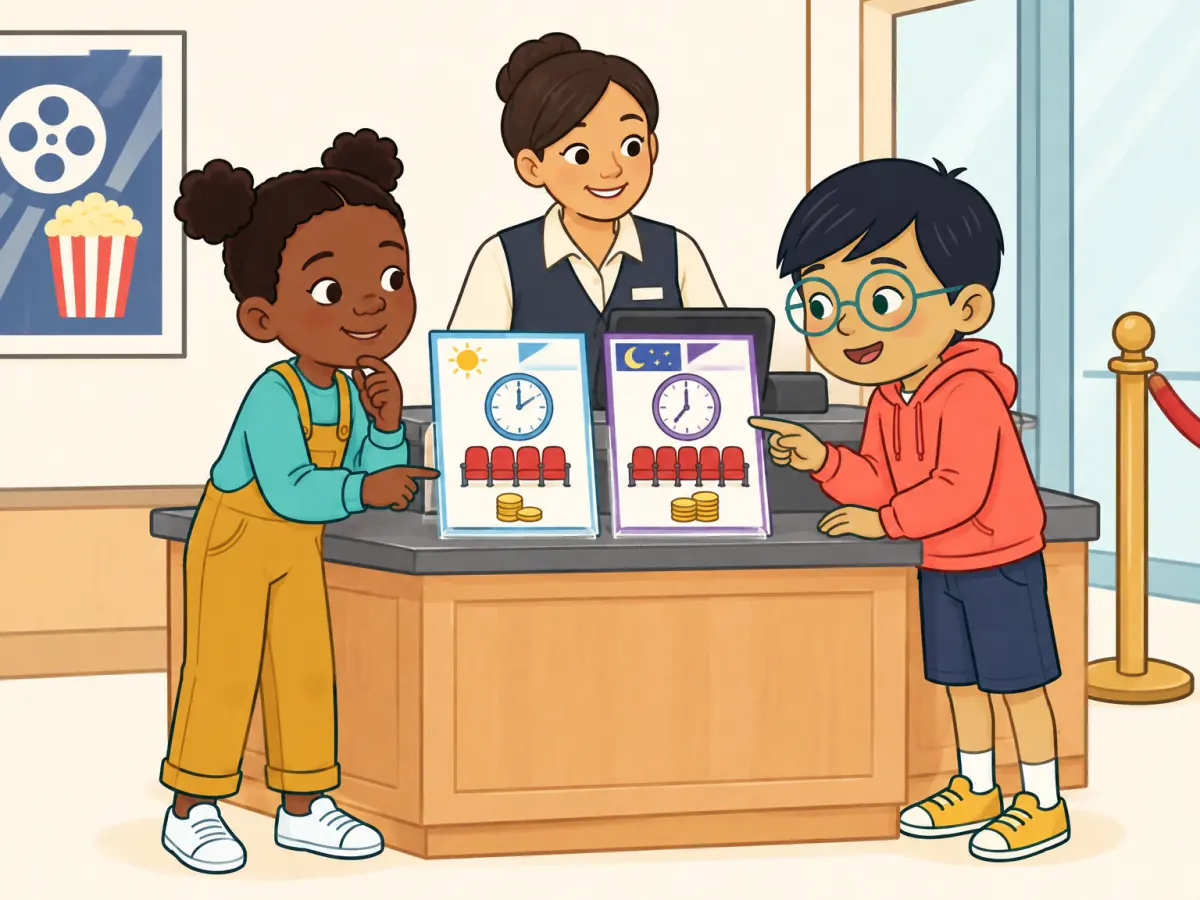
The key question is “What time does it start?” The answer uses the present simple even though the show is later: “It starts at seven.” English uses this form for timetables and programmes. “It will start at seven.” is not wrong, but the present simple sounds more natural.
Point out the pattern: “does” plus a plain verb in the question, -s in the answer. The same shape asks “When does it finish?”
Nia What time does it start?
Leo It starts at seven.
At, on and in: times, days and dates
Use “at” for a clock time, “on” for a day or date, and “in” for a month or part of the day. Either order works: “at seven on Friday” or “on Friday at seven”. Watch one switch: “in the evening”, but “on Friday evening”.
- at: at seven, at half past six
- on: on Saturday, on 18 October
- in: in October, in the afternoon
Sold out? Change the plan and check again
A matinee is a daytime performance, usually in the afternoon. “Sold out” means no tickets are left. A good speaker then suggests another option and checks it before celebrating.
The ending “…, not the matinee” makes the contrast clear; let your child stress EVENING and MATINEE. In the next question, “that” means the evening performance, and “left” means still available.
Leo The matinee is sold out.
Nia Can we see the evening performance, not the matinee?
Leo Are there any seats left for that?
Nia Yes. The clerk says two seats are left.
Ticket desk words and checking the details
“Are there any seats left?” uses “any” because it is a question; the answer gives a number or “no”: “There are two seats left.”, “There are no seats left.” To confirm, repeat the details back: “So that’s two seats for Saturday at three?” “Yes, that’s right.” This catches a mistake before anyone pays.
- book – reserve seats before you go
- the clerk – the person who sells tickets at the desk
The parts of an event poster
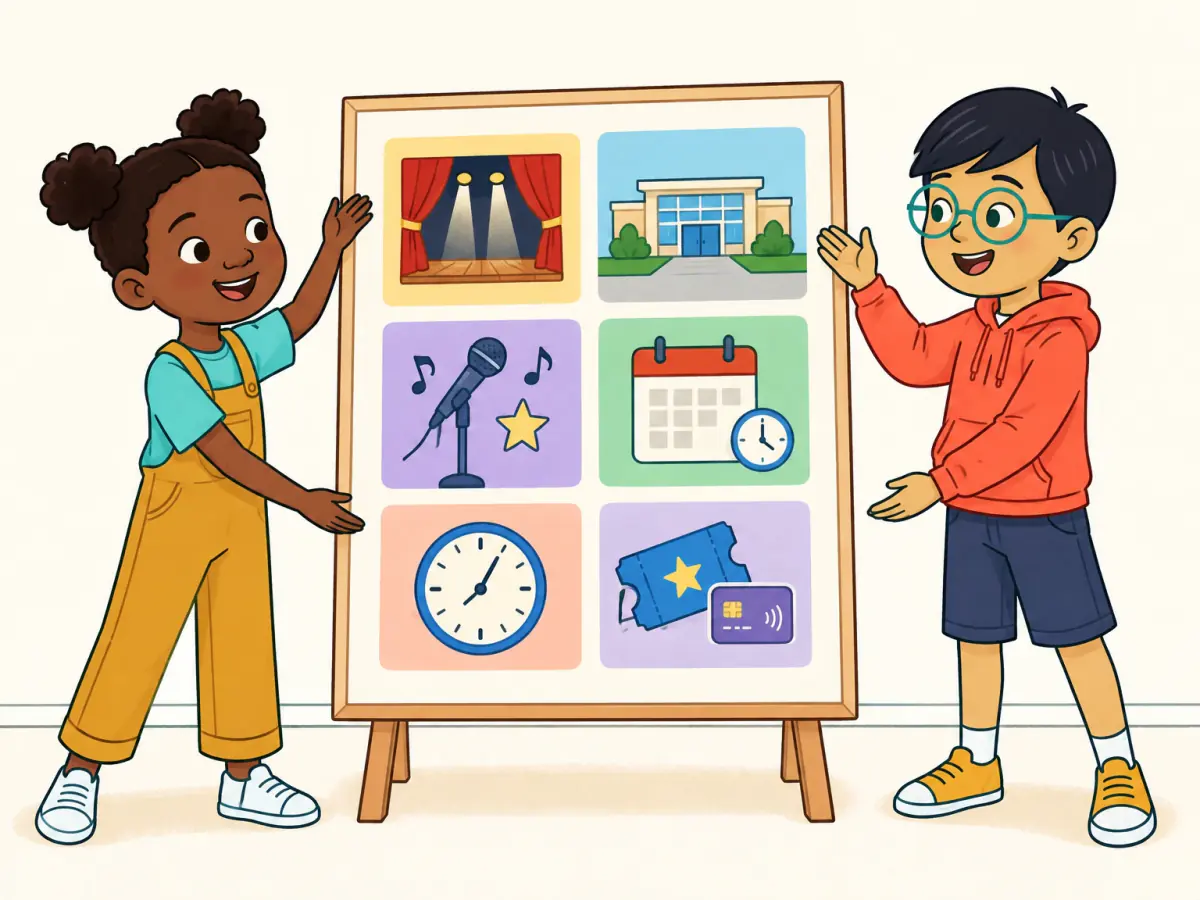
A poster does the clerk’s job in writing: a reader should find every answer without asking anyone. Your child first decides who will read it, for example families at a community hall. Here is a complete example.
“Starring” means “with these people in the main roles”. Days and months always take a capital letter, and the currency sign comes first: €5.
- What it is: “FILM NIGHT”
- A short, exciting description: “MOON GARDEN: a new mystery film”
- Who is in it: “Starring Lily Park and Omar Hayes”
- Where and when: “Community Hall · Friday 18 October · 7:00 p.m.”
- Price and booking: “Tickets: €5 · Book at the library desk.”
Test the poster with a real reader
A poster is finished only when someone else can use it. A family member asks a visitor’s questions: “Where is it?”, “How much are the tickets?”, “How do I book?” Your child answers only from the poster: “They cost five euros. You can book at the library desk.” A missing answer means a missing part.
A home game: the family box office
Draw two seat plans, a 3 p.m. matinee and a 7 p.m. show, and cross out every seat in the first. You are the clerk. Your child asks the time, hears that the matinee is sold out, suggests the evening show, checks for seats and confirms: “So that’s two seats for seven o’clock?” Swap roles and change one detail each round. Finally, make a poster for a family film night and test it.
Common mistakes and quick fixes
Normal at A2: repeat the sentence back correctly and carry on.
- “What time it starts?”: a question needs “does”: “What time does it start?”
- “What time does it starts?”: after “does”, no -s: “What time does it start?”
- “It start at seven.”: with “it”, add -s: “It starts at seven.”
- “Is there any seats left?”: plural “seats” takes “are”: “Are there any seats left?”
- “friday 18 october”: days and months take capitals: “Friday 18 October”.
What comes next
Next, your child can read longer texts about performances and compare a report with a story. Another step is linking ideas: “The matinee was sold out, so we booked the evening show.”