
Five phrases and the problem each one fixes
Children use a phrase more when they know its job. Teach them as a set and practise in real moments: a word on a cereal box, a name your child wants to write, or a word you say too fast on purpose.
- “What’s this in English?” – I don’t know the word.
- “Sorry?” – I missed it, please say it again.
- “Speak more slowly, please.” – that was too fast.
- “Can you spell it, please?” – tell me the letters.
- “Thank you.” – the polite ending.
Asking for a word: “What’s this in English?”
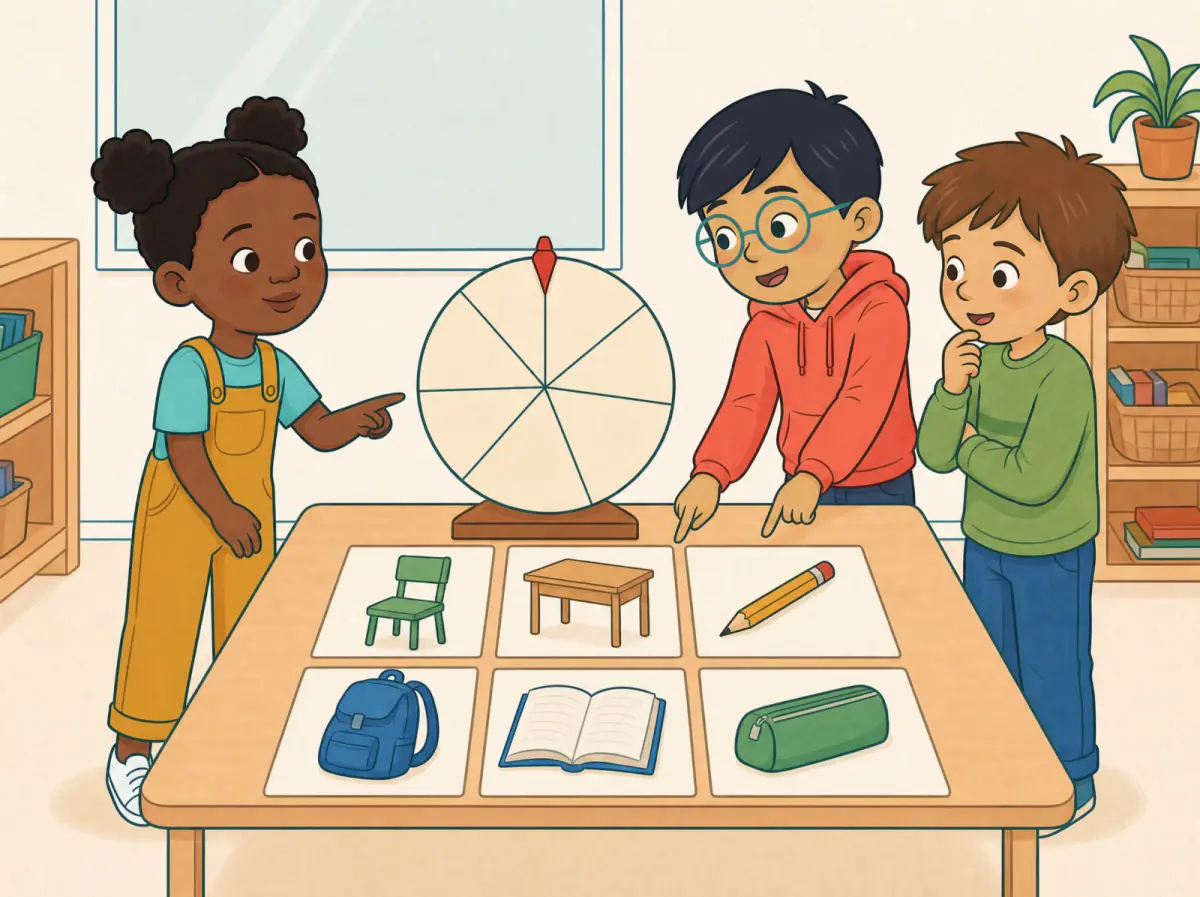
Your child points and asks “What’s this in English?” The answer starts with “It’s a…”. Keep the small word “a” for one thing: “It’s a book.”, not “It’s book.” With a two-word name, “a” comes once, at the front: “It’s a pencil case.”
For something not in the room, ask “How do you say … in English?” with the word in your language in the gap.
- “It’s a chair.”
- “It’s a table.”
- “It’s a pencil.”
- “It’s a bag.”
- “It’s a book.”
- “It’s a pencil case.”
Listen to the whole exchange
In seven short lines, a child asks for a word, misses it, asks for it more slowly, asks for the spelling and says thank you. The second answer is just “Pencil.”: after “Sorry?”, people often repeat just the key word, not the whole sentence. Play it, take a role each, then swap and change “pencil” to “book”.
Nia What's this in English?
Leo It's a pencil.
Nia Sorry? Speak more slowly, please.
Leo Pencil.
Nia Can you spell it, please?
Leo P-E-N-C-I-L.
Nia Thank you.
“Sorry?” and “Speak more slowly, please.”
“Sorry?” with the voice going up means “Please say that again.” With the voice going down, “Sorry.” is an apology; say both so your child hears the difference. “Pardon?” is also polite. “What?” is understood but can sound rude to a teacher.
“Speak more slowly, please.” is for words that were clear but too fast. When your child uses it, answer a little more slowly so the phrase works. A softer version for later: “Can you speak more slowly, please?”
Spelling aloud with letter names
To spell a word aloud, people use the letter names from the alphabet song: P-E-N-C-I-L sounds like “pee, ee, en, see, eye, el”. These are not the sounds letters make inside a word, so children who read with letter sounds still need the names.
Some names are easy to mix up: E sounds like “ee”, I like “eye” and A like “ay”. For the same letter twice, many people say “double”: “B, double O, K”. Start with “bag” and “book”, then try “pencil”.
- bag: B-A-G
- book: B-O-O-K
- table: T-A-B-L-E
- pencil: P-E-N-C-I-L
Make a school word wheel at home
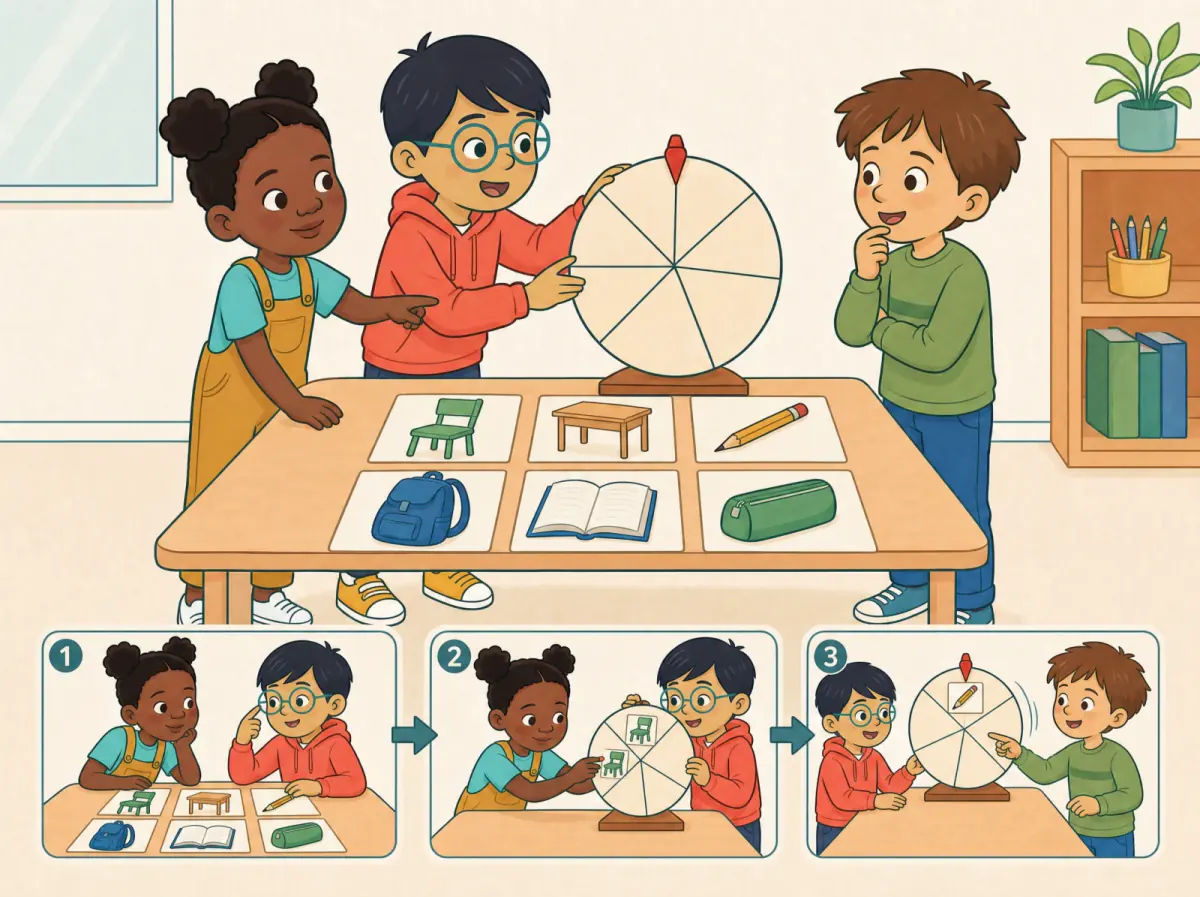
You need a large paper circle, a paper arrow, a split pin, six small cards, a pencil and crayons. The split pin is the adult’s job.
One person spins and asks “What’s this in English?”, the other answers “It’s a bag.”, and the asker adds one phrase: “Sorry?”, “Speak more slowly, please.” or “Can you spell it, please?” Take turns. For fun, the answerer can whisper or speak very fast on purpose, so “Sorry?” has a real job.
- Draw one of the six things above on each card.
- Divide the circle into six parts.
- Glue one picture in each part.
- Fix the arrow in the middle.
- Spin, ask, answer, spell.
Common mistakes and quick fixes
These are normal at this stage. Repeat the sentence back the right way and keep playing.
- “It’s pencil.”: keep “a” for one thing: “It’s a pencil.”
- “What?”: it can sound rude, so use “Sorry?” or “Pardon?”
- “Speak more slow, please.”: the phrase is “Speak more slowly, please.”
- “Can you spell, please?”: add “it”: “Can you spell it, please?”
- Spelling with the reading sounds of letters: use the alphabet names, “pee, ee, en”.
What comes next
Next, add “I don’t understand.” and “Can you say that again, please?”, and let your child spell their own name aloud. The same phrases then help with every new topic, such as talking about food with “have got”.