
Why four colours, and why pointing comes first
Colours make a good first topic: they are everywhere, and your child can show them without reading or speaking. Four are enough to start; once they are secure, new ones are easy to add.
Understanding comes before speaking. Many 3-year-olds still mix up colour names in their first language, so a correct point is real progress. Play a card above, point to the colour and pause; your child hears the word from the recording, then from you.
Step 1: listen and point with two colours
Put a red thing and a blue thing side by side. Say “Red!” and wait for your child to point or touch it, then do the same with “Blue!” Swap the objects around now and then, so you know your child is following the word and not the place. You only need the colour words, not the names of the objects.
- red – a tomato, a toy car
- blue – a sock, a bucket
- yellow – a banana, a rubber duck
- green – a leaf, a cucumber
Step 2: one question, one answer
When your child points without help, start taking turns. Hold up something red and ask “What colour is it?” At first, answer yourself: “It’s red.” Then hand over: “Your turn. What colour is it?” A point, “Red!” or the full answer all count.
“It’s” is the everyday short form of “it is”. A colour on its own has no “a”: “It’s red.”, but “It’s a red car.” Listen to the exchange below, then swap parts.
Nia Look, Leo. What colour is it?
Leo It's red.
Leo Your turn. What colour is it?
Nia It's blue.
Step 3: a colour hunt around the house
Choose one colour card and say “Find something green!” Your child brings or points to something green and says “Green!” or “It’s green!” Then swap roles: your child picks the card and you search. Stay in one room so each round is short. Now and then, bring the wrong colour on purpose; children love to correct you, and they have to listen to do it.
Step 4: count, share and make one picture
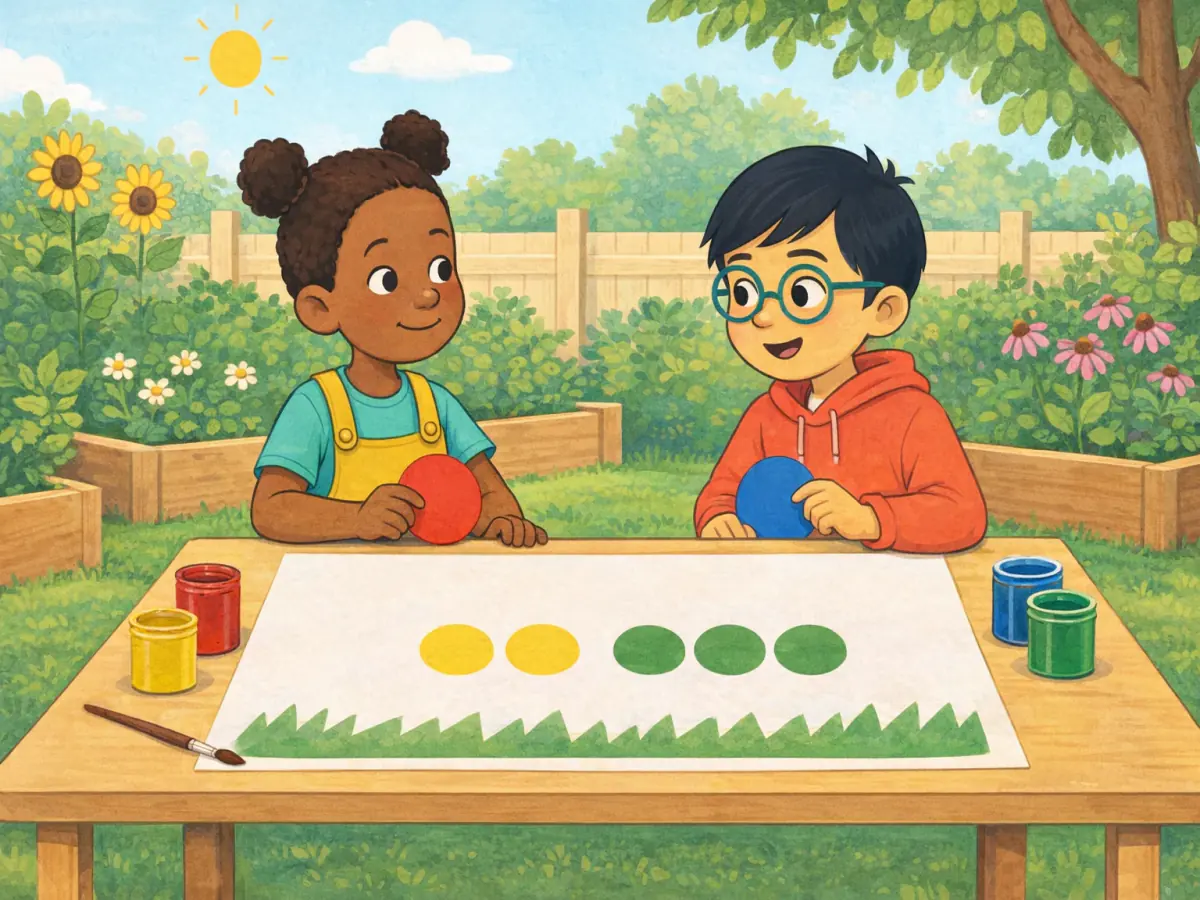
Cut out paper circles in the four colours. Decide together what you need, counting no higher than three: “We need one red circle and two blue circles.” One of you holds the paper while the other places the circles, then you swap jobs. After two and three, say the “s” on “circles” clearly. Passing the circles brings three short phrases:
- “Can we work together?” “Yes!”
- “Here is the green circle.” (as you pass one)
- “Thank you.” (as you take it)
A week of colour play
Five minutes a day, in the same order, works better than one long session a week:
- Days 1–2: red and blue. Listen and point.
- Days 3–4: add yellow and start the question and answer.
- Day 5: add green and try a colour hunt.
- Weekend: make one picture together.
- Next week: find the same colours in new places, such as the bath.
Common mistakes
Most of these are easy for parents to fix:
- Asking too soon: “What colour is it?” feels like a test if your child isn’t sure yet. Say the colour and let them point first.
- Adding colours too fast: begin with two very different colours.
- Same place every time: swap the objects so your child has to listen.
- Adding “a”: say “It’s red.” or “It’s a red ball.”, not “It’s a red.”
- Colour after the thing: in Spanish, Arabic and many other languages the colour follows the noun, so your child may say “circle red”. Say “a red circle” back and keep playing.
What comes next
When your child names all four colours, let the colours describe things: “a yellow bag”, “two green crayons”. On a day when it rains while the sun shines, stand with the sun behind you and look for a rainbow together: “Rainy. Sunny. A rainbow!” Then name one colour in it. The family words article below uses the same point-first steps with new words.