
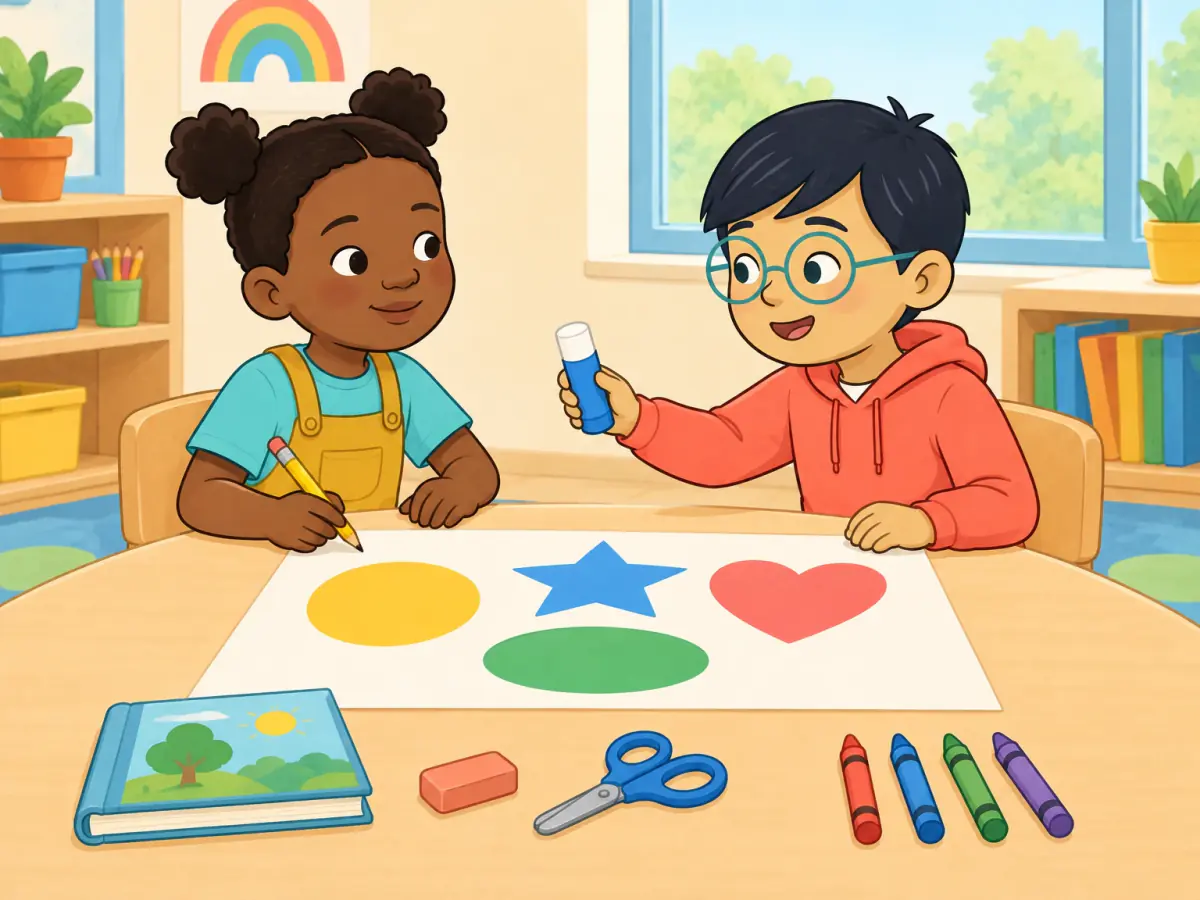
 pencil
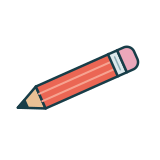
 book
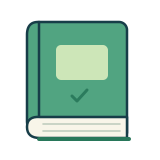
book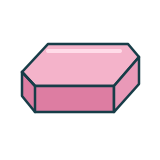 rubber
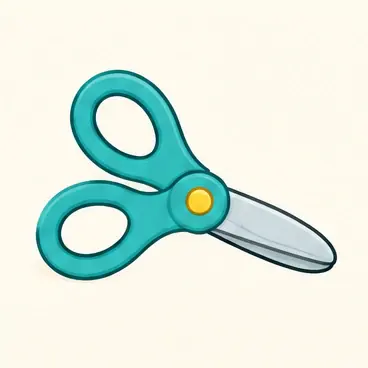 scissors
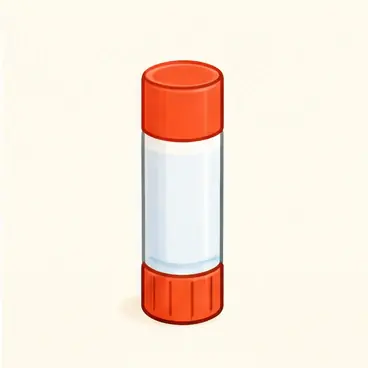 glue
glue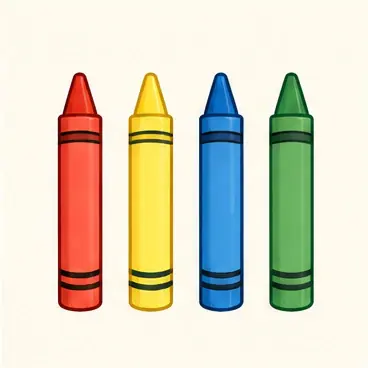 crayons
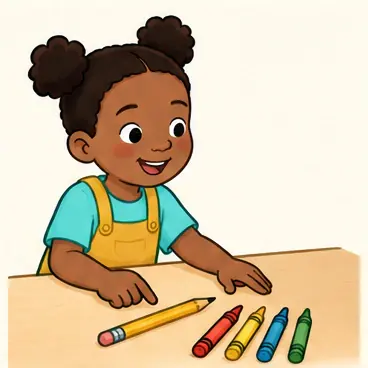 choose
 share
share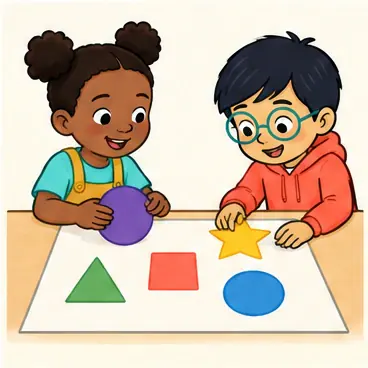 make
makeSix classroom objects to start with
Use things from a pencil case. Play each card above, put the real object on the table and let your child point to it before saying anything. Start with three and add the rest when those come easily. A gesture helps each word stick:
- pencil – draw a line in the air
- book – open your hands like a book
- rubber – rub out an imaginary mark (American English: “eraser”)
- scissors – snip with two fingers; say “SIZ-erz”
- glue – press your palms together
- crayons – colour a big circle in the air
“This is my…” for one thing, “These are my…” for more
Hold up one object and say “This is my pencil.” For a group, two words change: “this” becomes “these” and “is” becomes “are”: “These are my crayons.” Your child doesn’t need the rule. Hold up one crayon, then the whole box, and say both sentences.
Scissors are the surprise: one tool, but a plural word, so it is “These are my scissors.” To start a turn, ask “What have you got?” A one-word answer such as “Crayons!” is fine at first; say the full sentence back.
Choose, share, make: three steps for working together
Three action words turn the objects into a small project: choose a material, share it, then make something together. Pause between the words, so each one links to one action.
Between steps, ask “What do we do next?” The answer is a short instruction: “Share the glue.”, “Choose the crayons.” or “Make it together.”
- choose – look at two crayons, then pick one
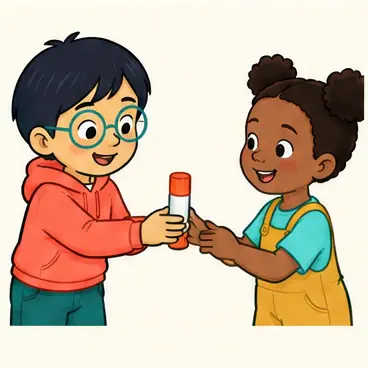
- share – hold the glue out to your partner
- make – both add something to the paper
Listen: saying what you need and handing things over
Here, two children get ready to make a poster. Notice three useful phrases: “We need…” says what is missing, “Here is…” goes with handing something over, and “Let’s…” invites someone to join in. Then act it out with real crayons and glue.
Leo We need colours for our poster.
Nia These are my crayons.
Leo Here is the glue.
Nia Thank you. Let's make it together.
The poster game: choose, share, make
You need paper, crayons, a glue stick and scraps of coloured paper (tear them by hand if you’d rather skip scissors). Pick a simple theme, such as a big sun:
- Choose: say “We need colours for our poster.” Your child picks crayons: “These are my crayons.”
- Share: hand over the glue: “Here is the glue.” Your child says “Thank you.”
- Make: say “Let’s make it together.” and take turns adding a shape.
- In between, ask “What do we do next?” and let your child name the next step.
- Tidy up together: “Shall we pick up the pencils?” – “Yes. Let’s help.”
A two-minute show-and-tell for other days
On other days, put a few classroom objects in a bag. Your child takes one out and you ask “What have you got?” – “This is my rubber.” Swap roles, and sometimes pull out two crayons, so your child has to switch to “These are…”. Stop while it is still fun.
Common mistakes
These slips are normal at this age. Say the right version back instead of correcting:
- “This is my crayons.”: more than one thing needs “These are…”: “Yes, these are your crayons!”
- “This is my scissor.”: many languages use a singular word, but English always says “scissors”.
- Leaving out small words: many languages have no “the”, and some need no “is” here, so “Here glue.” or “This my pencil.” is common. Answer with the full sentence: “Yes, here is the glue!”
- “This” and “these” sounding alike: stretch the vowel in “these” and end with a buzzing “z”.
What comes next
When your child uses both sentences without help, add a colour or a number: “This is my red crayon.”, “These are my two pencils.” Later come “this”, “that”, “these” and “those” for things near and far. The articles below continue with counting, the five senses and more classroom English.