
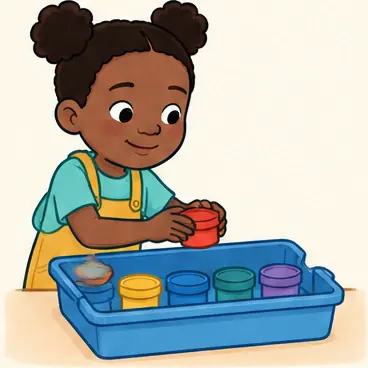
 paint in the tray
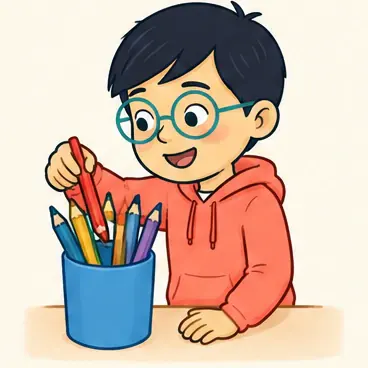 pencils in the cup
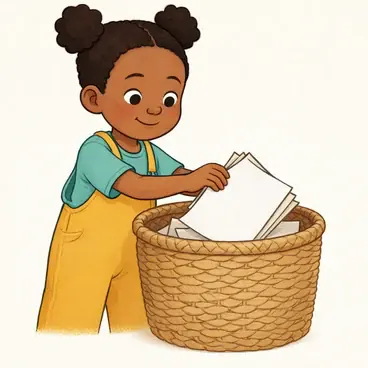 paper in the basket
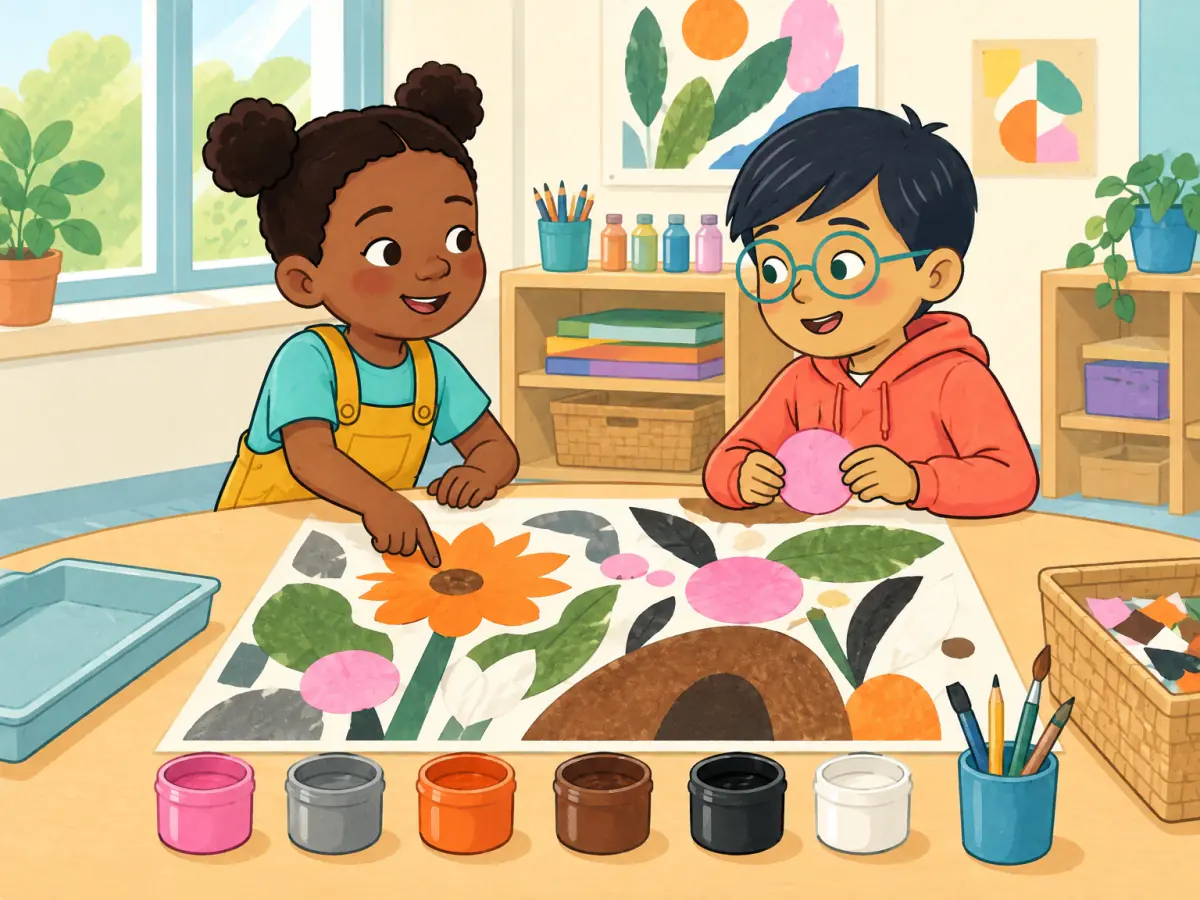
Three things, three places and one small word
Each phrase has three parts: a thing, the word “in” and a place. Your child needs only six nouns: paint, pencils and paper are the things; the tray, the cup and the basket are their places. Play each card, then show the phrase with real objects; your child can point before saying anything.
- “Paint in the tray.” – paint pots stand in a tray
- “Pencils in the cup.” – drop pencils into a cup, one by one
- “Paper in the basket.” – lay the sheets flat in a basket
- Show “in” with your hands: one hand makes a cup, and the other drops into it.
One question: “Where does it go?”
Hold up one thing and ask “Where does it go?” Here “go” means “belong”: the question asks where the thing is kept, not where it is moving. The natural answer is short: “In the tray.” or “Paint in the tray.” The full sentence “It goes in the tray.” is also correct.
With a handful of pencils you may also hear “Where do they go?”. The answer stays the same: “In the cup.”
Listen: from a finished picture to a tidy table
The four lines below hold the whole routine: a finished picture, “Let’s tidy up.” to start and “All tidy!” to finish. Use the same opening and closing lines at home, so your child knows when tidy-up time begins and ends.
“Let’s” means we do it together, so it sounds like an invitation, not an order.
Leo Our picture is ready.
Nia Let's tidy up.
Leo Paint in the tray.
Nia Pencils in the cup. All tidy!
The tidy-up game: your child chooses the order
Young children learn instructions best when they give them as well as follow them. Put the three things on the table, with their places next to them:
- Round 1: hold up the paint and ask “Where does it go?”. Your child points to the tray or says “In the tray!” Put it there and say the full phrase.
- Round 2: your child picks a thing and tells you where it goes, and you put it away. Now and then get one wrong on purpose; most children love to correct a grown-up.
- Memory round: your child chooses an order, and you repeat it by pointing to each place in turn. Then swap roles.
- After two or three rounds, finish with “All tidy!” and a high five.
Make it real after drawing time
The game works best at the end of a real art session. When the drawing is done, say “Our picture is ready.” and then “Let’s tidy up.” Keep the same places every time, so the question always has a clear answer.
Start with dry things, pencils and paper, and add paint when the routine is easy. If your paper lives in a box, say “Paper in the box.” The pattern works for anything: “Crayons in the box.”, “Brushes in the cup.”
Common mistakes
These slips are normal at this age. Say the right version back instead of correcting:
- “Pencils in cup.”: small words like “the” are the first to drop out of a young child’s English, and many languages have no such word. Repeat it with a little stress: “Yes, pencils in the cup!”
- “Pencils on the cup.”: “on” means on top. Show the difference: put one pencil in the cup and balance another on top.
- All three places on day one: start with the cup and the basket, and add the tray when those feel easy.
- Doing all the talking: the learning happens when your child gives the instructions, even if it takes longer.
What comes next
When your child names the places without help, add new ones around the house: “Books on the shelf.” brings in “on”, and “Toys in the box.” reuses “in”. Tidying also leads to helping others with “Can I help?”, and the articles below move on to families and playgrounds.