
The six colours of the rainbow
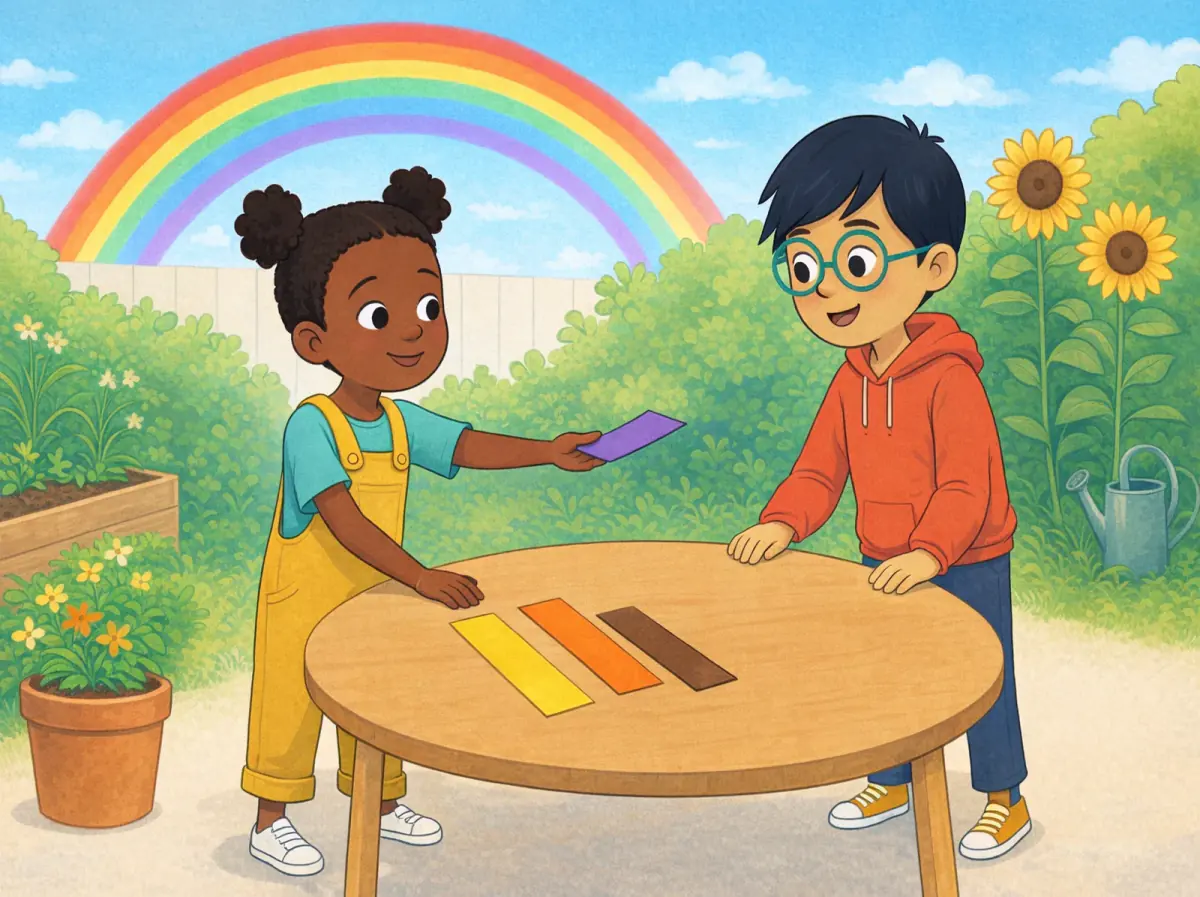
The rainbow in the picture at the top of this page has six bands, in this order: red, orange, yellow, green, blue and purple. Your child may know red, green and blue already; the cards above add purple, yellow and orange. Play each card and let your child point to that colour in the picture.
Then hunt for the colours at home. In English “orange” is both the colour and the fruit.
- red: a strawberry
- orange: an orange
- yellow: a banana
- green: a leaf
- blue: the sky
- purple: a plum
Which colour is missing? A gap game
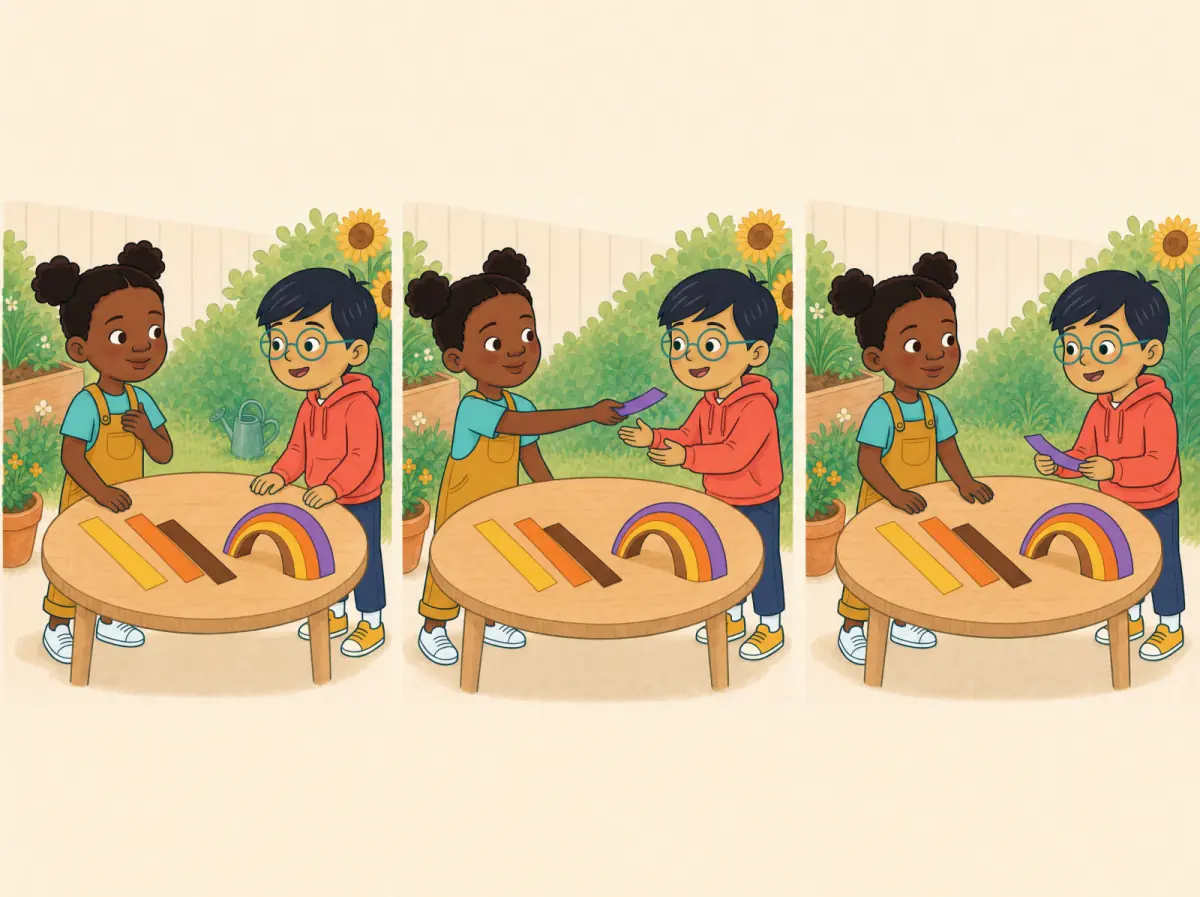
Lay six crayons or paper strips in rainbow order, with the picture still in view. While your child closes their eyes, take one away and ask “Which colour is missing?” Your child compares the row with the picture to find the gap.
Start with yellow, between orange and green. Then take purple from the end, after blue, and orange from between red and yellow. If your child hesitates, offer two choices: “Yellow or purple?”
- Swap roles: your child hides a colour and asks you.
- Get one wrong on purpose so your child can correct you.
- Stop after four or five rounds, while it is still fun.
Brown, pink and grey: colours around the rainbow
The last three cards above add brown, pink and grey. They are not in the rainbow, so give them a job around it: a brown tree, a pink flower, a grey cloud. A pink cat is a creative choice, not a mistake; it just doesn’t go in the rainbow.
“Grey” is the British spelling and “gray” the American one; both are correct and sound the same.
Asking nicely: “Purple, please?”
A young child doesn’t need a long sentence to ask politely: the colour plus “please” is enough. Said with a rising voice, “Purple, please?” sounds like a friendly question. The giver says “Here you are.” while handing it over, and the receiver says “Thank you!”
In the exchange below, one child asks for purple; then the roles swap and the other asks for orange. Do the same with your child: ask first, then let them ask, because giving is half of being polite.
Leo Purple, please?
Nia Here you are.
Leo Thank you!
Nia Orange, please?
Leo Here you are.
Nia Thank you!
Make a paper rainbow together
For the craft, put out paper strips in the rainbow colours, plus brown, pink and grey. First ask “What do we need?” and answer “We need purple paper.” (both lines have a recording above). Then build the rainbow band by band.
“Paper” as a material takes no “a”: “purple paper”, but “a purple crayon”.
- Your child asks: “Purple paper, please.” You: “Here you are.” Your child: “Thank you!”
- Your child glues the band, then it’s your turn to ask.
- Finally, your child adds one detail in brown, pink or grey.
- Hold it up together: “Our rainbow!”
Common mistakes and how to help
If your child just says “Purple!”, don’t hold the strip back until a perfect “please” appears. Say the polite version for them, “Purple, please? Here you are!”, and hand it over.
Some children say “please” while handing something over. In some languages, such as German and Polish, one word means both “please” and “here you are”, so the mix-up is natural. Show the difference with your hands: “please” when you ask, “Here you are.” when you give.
“Purple” and “orange” have two syllables each: PUR-ple, OR-ange. If your child adds a sound, clap the two beats together.
What comes next
Once your child asks for colours without help, use the exchange everywhere: “Teddy, please?” with toys, “Water, please?” at the table. Family words are a good next topic; the links below show how to start.