
Can AI accurately detect your English accent?
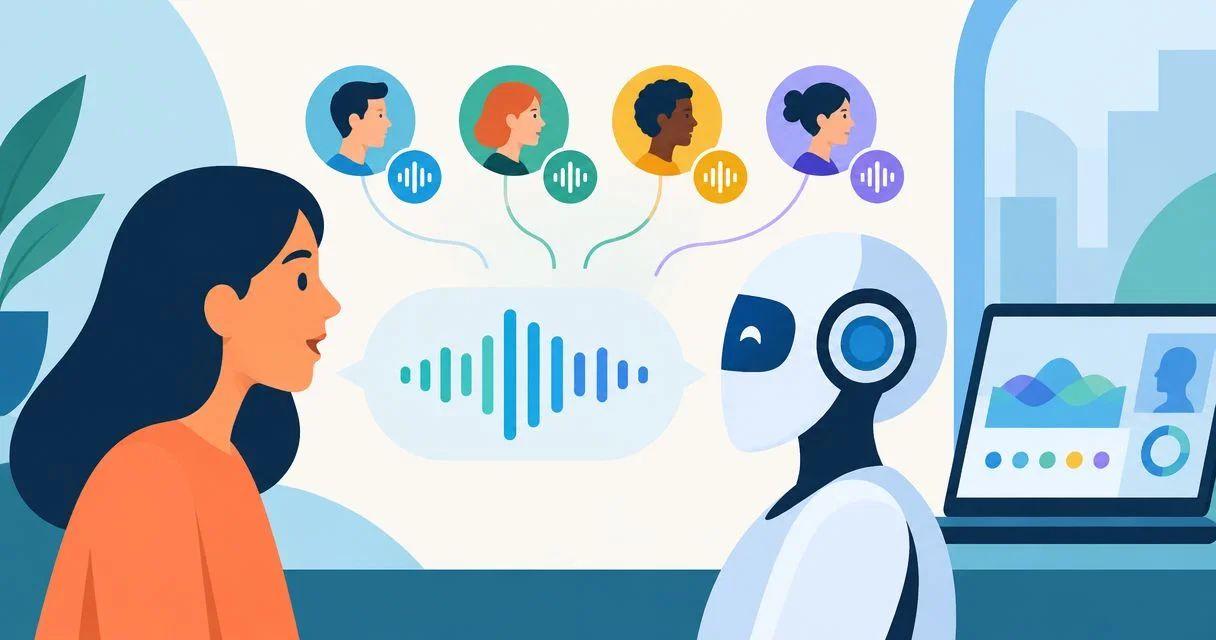
AI can detect patterns associated with an English accent, but an accent label is not proof of where you come from or how well you speak. In 2026, the useful question is whether a tool explains specific features of your speech and gives feedback you can check, rather than simply naming an accent.
Summary
- Can AI detect English accent patterns? Yes, but accent classification, speech recognition and pronunciation assessment answer different questions.
- Treat an accent label as an estimate, not a judgment of your English level or identity.
- Check pronunciation feedback against repeated recordings and a listener’s understanding.
- Flalingo suits learners seeking online one-to-one English lessons with certified native tutors.
Can AI accurately detect your English accent?
AI can identify accent-related speech patterns, but accuracy depends on the task, the recording and the system’s training data. A tool that transcribes your words correctly has not necessarily identified your accent. A tool that names an accent has not necessarily assessed whether you are easy to understand.
If you want help turning feedback into speaking practice, Flalingo offers online one-to-one English lessons with certified native tutors. Use an accent detector to generate questions for your learning, not to settle them.
| Type of tool | What it tries to identify | Best for | Useful output | Main limitation |
|---|---|---|---|---|
| Speech recognition | The words you said | Checking transcription | A transcript you can compare with your recording | Transcription errors do not explain their own cause |
| Accent classification | Similarity to accent categories | Exploring speech patterns | A predicted label or category | Categories can simplify mixed or changing accents |
| Pronunciation assessment | Features of your spoken delivery | Targeted speaking practice | Feedback on sounds, stress or timing | Scores depend on the assessment method and reference |
Before accepting a result, ask what the tool actually measures. The word accent on a screen does not tell you whether the system evaluates individual sounds, predicts a geographical label or compares you with a reference recording.
Why does this distinction matter for your English?
An accent describes patterns in speech. It is not the same thing as proficiency, and a familiar accent is not a requirement for clear communication.
You can pronounce individual words clearly but struggle to organise an answer. You can also have a noticeable accent while explaining a difficult idea successfully. An accent label cannot distinguish those situations by itself.
Choose feedback that helps a listener understand your meaning. Useful feedback identifies a word, sound or stress pattern you can practise. A label such as British, American or non-native offers little direction without an explanation.
This distinction matters when you practise workplace English. A successful negotiation depends on explaining conditions, checking understanding and responding to questions, not on receiving a particular accent label. The related guide on whether finance teams can negotiate better in English after training addresses that practical communication goal.
What can speech recognition tell you about your accent?
Speech recognition turns audio into written words. If the transcript repeatedly substitutes one word for another, that gives you something to investigate, but it does not establish that your pronunciation is wrong.
The recording might contain background noise. The sentence might include an unfamiliar name, or the system might favour a different word because of the surrounding context. Listen before drawing a conclusion.
For example, a mistaken transcript of a surname is a different problem from a listener repeatedly confusing two common words. Treat them differently. Practising your pronunciation will not necessarily resolve a system’s difficulty with a name.
Speech recognition is useful as a spot-check, not as a complete speaking assessment. A perfect transcript does not assess how appropriately you answered a question or how easily another person followed your explanation.
What can an accent classifier actually tell you?
An accent classifier compares speech with the categories it was designed to recognise. Its result describes that comparison, not your nationality, birthplace or personal history.
Your speech can reflect different teachers, languages and places where you have lived. A system that requires a single category still has to choose one, even when your speech does not fit that category neatly.
A confidence score also needs context. Without documentation, you cannot assume that a displayed percentage means the same percentage chance of being correct for your recording.
Look for an explanation of the available categories and how the system was evaluated. A tool that cannot explain those basics gives you little basis for interpreting a confident-looking label.
Speak English with more confidence
One-to-one online lessons with experienced tutors, at times that suit you.
Is pronunciation assessment more useful for learning?
Pronunciation assessment is more actionable when it identifies something specific you can change. Feedback about a missed final consonant or misplaced word stress gives you a practice target; a broad accent label does not.
Still, an automated score needs an explanation. Ask whether it reflects individual sounds, sentence stress, timing or similarity to a model recording. Do not treat an unexplained overall score as a complete description of your speaking.
Use your communication goal to decide what matters. If a listener cannot distinguish the key word in an instruction, practise that distinction. If the message is already clear, decide whether changing the feature serves a real need.
For a 2026 learning plan, keep automated pronunciation feedback separate from measures of vocabulary, grammar and conversational ability. Those are related skills, not interchangeable results.
Why does AI accent detection vary between recordings?
Accent detection varies because the system receives a particular recording, not a complete picture of your speech. Check these factors before treating a changed result as evidence of improvement or decline:
- Recording quality: Noise, distortion and an inconsistent microphone position change the audio available for analysis.
- Speech sample: A short phrase exposes fewer speech patterns than a longer, varied answer.
- Reading versus conversation: Reading supplied text and answering an unexpected question place different demands on you.
- Category coverage: A classifier cannot offer a category that its design does not include.
- Training and evaluation data: Performance on one group of speakers does not establish performance on every other group.
- Scoring target: Comparing pronunciation with a reference recording is different from checking whether listeners understand you.
Changing several conditions at once makes a result difficult to interpret. If you switch your microphone, text and speaking task, you cannot isolate why the output changed.
How can you check an accent detector yourself?
Use a repeatable check rather than chasing a higher score. The following recording lengths and listener checks are suggested practice steps, not validated accuracy thresholds.
- Choose your goal. Write down whether you want clearer word endings, better sentence stress or easier understanding in conversation. Do not substitute an accent label for that goal.
- Record a baseline. Make a 30-second reading and a 60-second spoken answer to a familiar question. Keep the original audio so you can compare later.
- Check the feedback. Replay every flagged word in its sentence. Note exactly what the tool claims, rather than rewriting it as a general weakness.
- Ask a listener. Ask 2 listeners independently what they heard in the disputed phrase. Avoid telling them the expected word first.
- Practise and repeat. Work on one feature, then record the same task under similar conditions. Add a new sentence to check whether the change transfers.
The test is not whether every output agrees. It is whether the feedback helps you identify a specific problem and produce speech that listeners understand more easily.
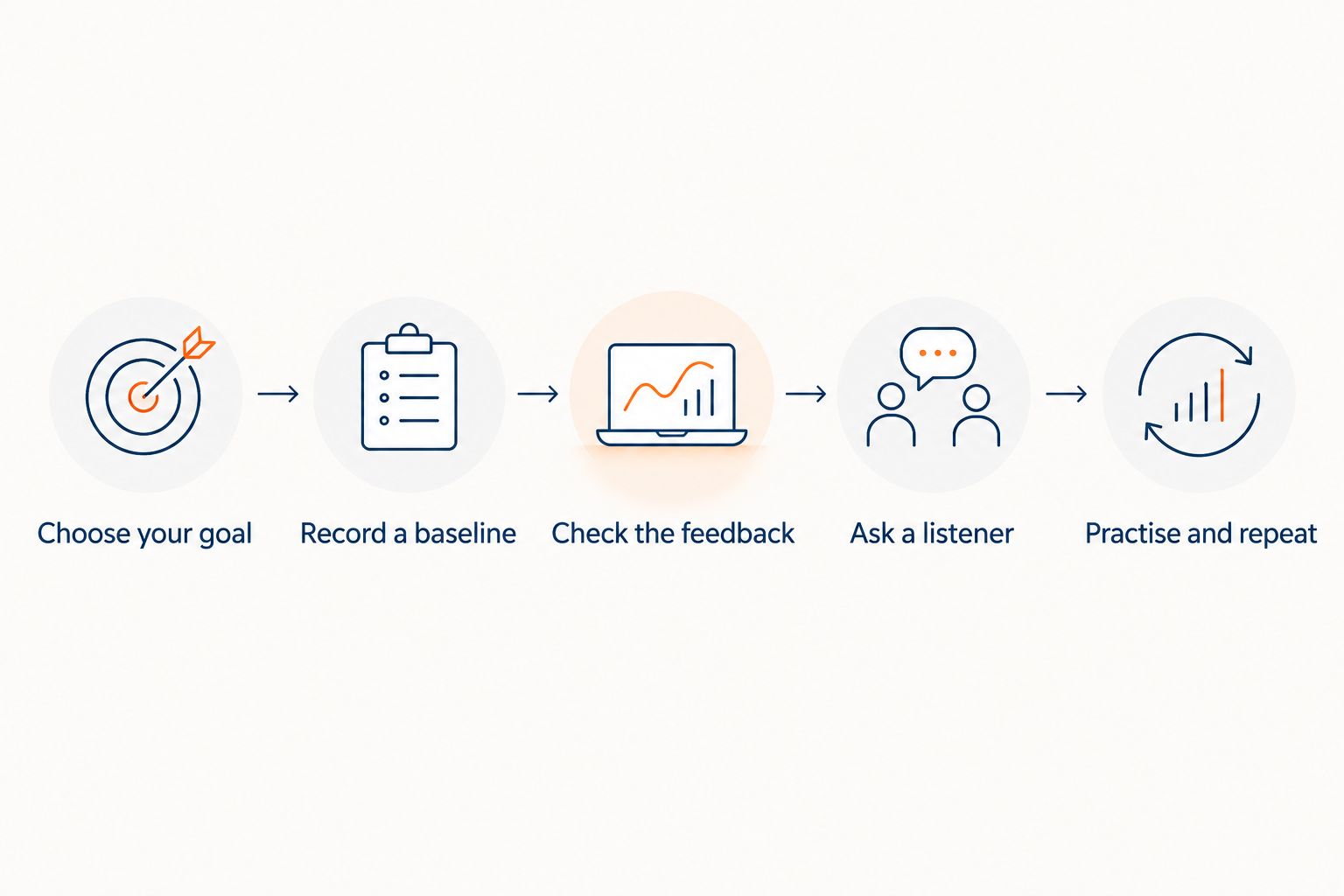
Check the recording and a listener’s understanding before accepting an automated result.
Keep a simple practice note with the original phrase, the feedback and what listeners understood. That record is more useful than collecting unrelated scores from different tools.
What should you ask a teacher after receiving accent feedback?
Ask a teacher to identify the feature, demonstrate it and check it in a new sentence. A correction you can reproduce independently is more useful than repeated imitation without explanation.
Flalingo provides online one-to-one English lessons with certified native tutors. That format suits learners who want a person to hear a disputed phrase and discuss its meaning. It does not make a separate accent detector’s output correct, and you still need to practise between lessons.
Here is an example dialogue, not a student testimonial:
Learner: The app keeps writing walk when I say work.
Teacher: Say the whole sentence so I can hear the word in context.
Learner: I start work early on Mondays.
Teacher: I understood work. Which part did the app flag?
Learner: It only showed a different word in the transcript.
Teacher: Then let’s compare the sounds before deciding what needs practice.
The useful move is the teacher’s request for context. A transcript error becomes a question to investigate rather than an automatic instruction to change your accent.
What should you check before uploading your voice?
A voice recording contains more than the pronunciation feature you want assessed. Read the service’s current privacy terms before uploading audio, especially when recording children or discussing work.
For a 2026 tool review, check whether recordings are stored, used for model training, shared with other organisations or available for deletion. These are questions to verify in the provider’s policy, not assumptions you should make from its advertising.
Use invented practice content instead of client names, account information or confidential meeting details. You can practise the same sounds without recording sensitive information.
Speak English with more confidence
One-to-one online lessons with experienced tutors, at times that suit you.
Frequently asked questions
Can an accent detector tell which city I come from?
An accent detector cannot establish your home city from a label alone. Check whether the system even includes regional categories and whether its evaluation supports that level of detail.
Should I use an accent detector to decide my CEFR level?
No, an accent label is not a CEFR level assessment. CEFR speaking descriptors address communicative performance, including fluency, interaction and phonological control.
Can I use AI accent feedback when preparing for IELTS?
Use AI accent feedback for practice, not as a predicted IELTS Speaking result. IELTS assesses pronunciation alongside fluency and coherence, lexical resource, and grammatical range and accuracy.
Should a child try to copy one particular English accent?
A child does not need to copy one particular accent to practise clear English. Focus practice on understandable words and meaningful conversation rather than a geographical label.
Does a high pronunciation score mean I am ready for a job interview?
A high pronunciation score does not establish interview readiness. Practise explaining your experience, answering follow-up questions and checking that you understood the interviewer.
Can employers use an accent label as proof of English ability?
An accent label alone is not proof of English ability. A work-related speaking task provides more relevant evidence of whether a candidate can explain information and respond to questions.
What is the best next step for your speaking?
Keep the feedback that leads to a clearer message; question the label that offers no explanation. Before your next practice session, choose one sentence that caused difficulty and check what another person actually hears.
If you want guided practice, Flalingo is an option for online one-to-one English lessons with certified native tutors. Bring the recording and a specific question, rather than asking only whether your accent is good or bad.
The most useful result from an accent tool in 2026 is not a new identity for your voice. It is a manageable next step you can test in conversation.
Sources
- Council of Europe, Common European Framework of Reference for Languages: Companion Volume. Reference for the distinction between phonological control and broader communicative proficiency.
- IELTS, IELTS Speaking Band Descriptors. Reference for pronunciation as one component of the Speaking assessment.
- Mozilla Foundation, Common Voice documentation. Reference for speech datasets and the importance of representing different speakers in speech technology.
Related guides
- How Many Words Do You Need to Know to Speak English Fluently?
- English Expressions to Use When Someone Is Sick
- What Are English Numbers? How Are They Written and Read?
- English Accent Test: How Much Does Your Accent Affect the Way You Speak?
- Cambly vs italki: Instant English Practice or Tutor Marketplace?




Dr Sait Tuzel is an associate professor and educational technology researcher working in the fields of Artificial Intelligence Enhanced Education (AIED), media literacy and learning analytics. His work examines how AI can improve mindfulness in learning processes, critical thinking and equal opportunities in education.
English with Flalingo

Learning English with Flalingo means progressing with an intelligent system that works in an integrated manner.