
Best apps for English speaking practice in 2026

Flalingo is best for English speaking practice with a certified native tutor. For 2026, ELSA Speak is the pronunciation pick, HelloTalk suits language exchange, and British Council LearnEnglish Sounds Right is the sound-reference choice. Choose by the speaking problem you need to solve, not by how many exercises an app offers.
Summary
- Choose Flalingo for English speaking practice with a certified native tutor and individual attention.
- Choose ELSA Speak for pronunciation feedback, not as a replacement for live conversation.
- Choose HelloTalk for language exchange when you can contribute practice in your own language.
- Use British Council LearnEnglish Sounds Right to check individual sounds alongside conversation practice.
What makes a good English speaking practice app?
A useful speaking app makes you produce language, notice a problem and try again. Completing a lesson is not the same as explaining an idea without a script.
Judge each option against these criteria:
- Speaking task: Does it ask you to communicate an idea or repeat a supplied sentence?
- Feedback: Does it identify a specific problem you can work on?
- Interaction: Can someone ask an unexpected follow-up question?
- Goal fit: Does the activity resemble the conversation you actually need?
- Repeatability: Can you return to the same task and check what changed?
For pronunciation tools, separate sound feedback from judgments about your whole speaking ability. This guide to whether AI can accurately detect your English accent addresses a question to consider before treating an automated assessment as your final verdict.
How do the best speaking apps compare at a glance?
The 2026 shortlist below compares different practice methods, not interchangeable products. A tutor, an exchange partner and a sound chart perform different jobs.
| Option | Best for | Speaking task | Feedback approach | Key limitation |
|---|---|---|---|---|
| Flalingo | Tutor-guided conversation | Individual English lessons | Certified native tutor | Requires participation in a live lesson |
| ELSA Speak | Pronunciation-focused repetition | Spoken exercises | Automated pronunciation feedback | Does not provide a human conversation partner |
| HelloTalk | Informal language exchange | Messages and conversations with other learners | Partner corrections and responses | Help depends on the partner and arrangement |
| British Council LearnEnglish Sounds Right | Checking individual English sounds | Listening to sounds and example words | Reference audio for comparison | Does not assess connected conversation |
Use the limitation column first. If an option cannot address your main difficulty, its other features will not make it the right starting point.
Why does your choice of speaking practice matter?
Speaking includes several tasks: finding words, organising ideas, understanding another person and making yourself understood. Your difficulty in one task does not automatically mean you need more work on all the others.
If you know the words but hesitate during questions, spend time answering questions. If listeners repeatedly misunderstand a particular word, isolate its sounds. Match the exercise to the problem before adding more practice time.
For your 2026 routine, choose one main method and one supporting tool. Give each a clear job. Otherwise, switching between apps becomes another activity that keeps you occupied without making you speak.
1. Is Flalingo best for tutor-guided speaking practice?
Best for: Learners who want individual conversation with a certified native tutor.
The service offers online one-to-one English lessons for individual learners, children and businesses. Its format puts you in a conversation with a teacher rather than leaving you to complete speaking exercises alone.
That distinction matters when your difficulty appears after the first answer. You might introduce yourself comfortably but struggle when someone asks why you changed jobs or how you would handle a disagreement. A live lesson gives you a setting in which to practise those less predictable turns.
Flalingo pros:
- Individual lessons give your speaking a dedicated setting.
- Certified native tutors provide a human conversation partner.
- The service covers individual, child and business learning needs.
Flalingo cons:
- A live lesson requires you to be present and ready to participate.
- Watching or listening passively will not fulfil a speaking goal.
- You still need a clear task, rather than expecting general conversation to address every weakness.
Before choosing tutor-led lessons, write down a situation you want to handle. Bring a short example: explaining a delayed order, answering an interview question or describing your weekend. Ask to practise the situation and then repeat the difficult part.
Verdict: Buy for guided conversation when individual attention is your priority.
2. Is ELSA Speak best for pronunciation practice?
Best for: Learners who want automated feedback on pronunciation exercises.
ELSA Speak uses speech recognition to provide pronunciation feedback. It gives you a way to say something aloud, receive an assessment and repeat the exercise without involving another person.
Use that format for a narrow target. Working on an unclear sound or a difficult word is a different task from discussing an unfamiliar topic, so do not treat success in one as proof of success in the other.
ELSA Speak pros:
- Automated feedback supports repeated pronunciation practice.
- Individual practice removes the need to coordinate with a partner.
- A focused exercise lets you concentrate on how you say something.
ELSA Speak cons:
- Automated feedback is not a human listener's response to your meaning.
- Repeating supplied language does not require you to develop your own argument.
- Pronunciation practice alone does not rehearse conversational turn-taking.
Try the target word in a sentence you actually need. Then use that sentence inside a longer answer. This checks whether the pronunciation work carries into your speech, rather than remaining an isolated exercise.
Verdict: Buy for focused pronunciation work, not as your only conversation method.
3. Is HelloTalk best for informal language exchange?
Best for: Learners who want to exchange languages with other people.
HelloTalk connects language learners through messaging and conversation features. The exchange model means you practise your target language while helping someone with a language you know.
This is useful when you want ordinary conversation rather than a lesson. It also requires cooperation. Your partner has learning needs too, so agree on how you will share the conversation before starting.
HelloTalk pros:
- You communicate with a person who has their own ideas and questions.
- Voice messages let you practise speaking without arranging a live call.
- Everyday topics create reasons to ask questions and explain yourself.
HelloTalk cons:
- A language partner is not necessarily a trained teacher.
- Your partner's availability and correction style can differ from yours.
- Language exchange requires you to contribute help, not only receive it.
Ask a potential partner a practical question: do they prefer casual conversation, corrections or a planned topic? A mismatch is easier to address before you begin than after several frustrating exchanges.
Use exchange conversations to practise clarification as well as fluent answers. Asking someone to explain a phrase is part of communication, not a failure to communicate.
Verdict: Buy into this method if you want reciprocal practice and can agree on expectations.
4. Is British Council LearnEnglish Sounds Right best for sound checks?
Best for: Learners who need a reference for individual English sounds.
British Council LearnEnglish Sounds Right provides an interactive pronunciation chart with sound recordings and example words. It helps you connect a phonemic symbol with the sound it represents.
Its role is specific. Use the chart when a dictionary's pronunciation symbols are unfamiliar or when you need to hear an individual sound before practising it in a word.
British Council LearnEnglish Sounds Right pros:
- The chart links pronunciation symbols to audio.
- Example words place individual sounds in a recognisable context.
- A reference format supports checking a particular pronunciation question.
British Council LearnEnglish Sounds Right cons:
- Reference audio does not assess your own speech.
- Individual sounds do not cover the demands of a whole conversation.
- Listening without speaking leaves the production task unfinished.
Choose a sound, listen to its examples and say a useful word containing it. Next, put that word into a sentence. If another person still cannot understand you, ask what they heard rather than assuming the isolated sound is the only problem.
Verdict: Hold as a supporting reference, not your main speaking routine.
How were these English speaking options ranked?
The shortlist ranks fit for different tasks: guided conversation, pronunciation repetition, reciprocal exchange and sound reference. It is not a claim that every option was tested under identical conditions.
The criteria favour meaningful speaking, actionable feedback and a clear connection to your goal. Tutor-led conversation takes the default position because it combines speaking with a human response. The other choices address narrower needs or use a different relationship between speakers.
For a workplace goal, define the task more precisely than “business English”. Negotiating a deadline requires different language from describing a financial result. This discussion of whether finance teams negotiate better in English after training focuses on a more specific workplace question.
How should you practise speaking with your chosen app?
Use this suggested 12-minute routine between conversations or lessons. The timings organise your session; they are not a promise of a particular improvement rate.
- Choose a task: Spend 2 minutes selecting a situation and preparing a few useful words. Choose something concrete, such as requesting a change to an appointment.
- Speak aloud: Spend 3 minutes answering without writing a complete script. Record yourself if you have a suitable recording tool.
- Check feedback: Spend 2 minutes identifying one issue from a tutor, partner, automated response or your own recording. Choose something you can act on.
- Repeat the task: Spend 5 minutes giving a fresh answer and checking whether you addressed that issue. Change a detail so you are not only reciting the first attempt.
Keep the goal small enough to check. “Explain the reason before asking for a new time” gives you a clearer target than “sound fluent”. In 2026, use app progress indicators as supporting information, not as a substitute for this practical check.
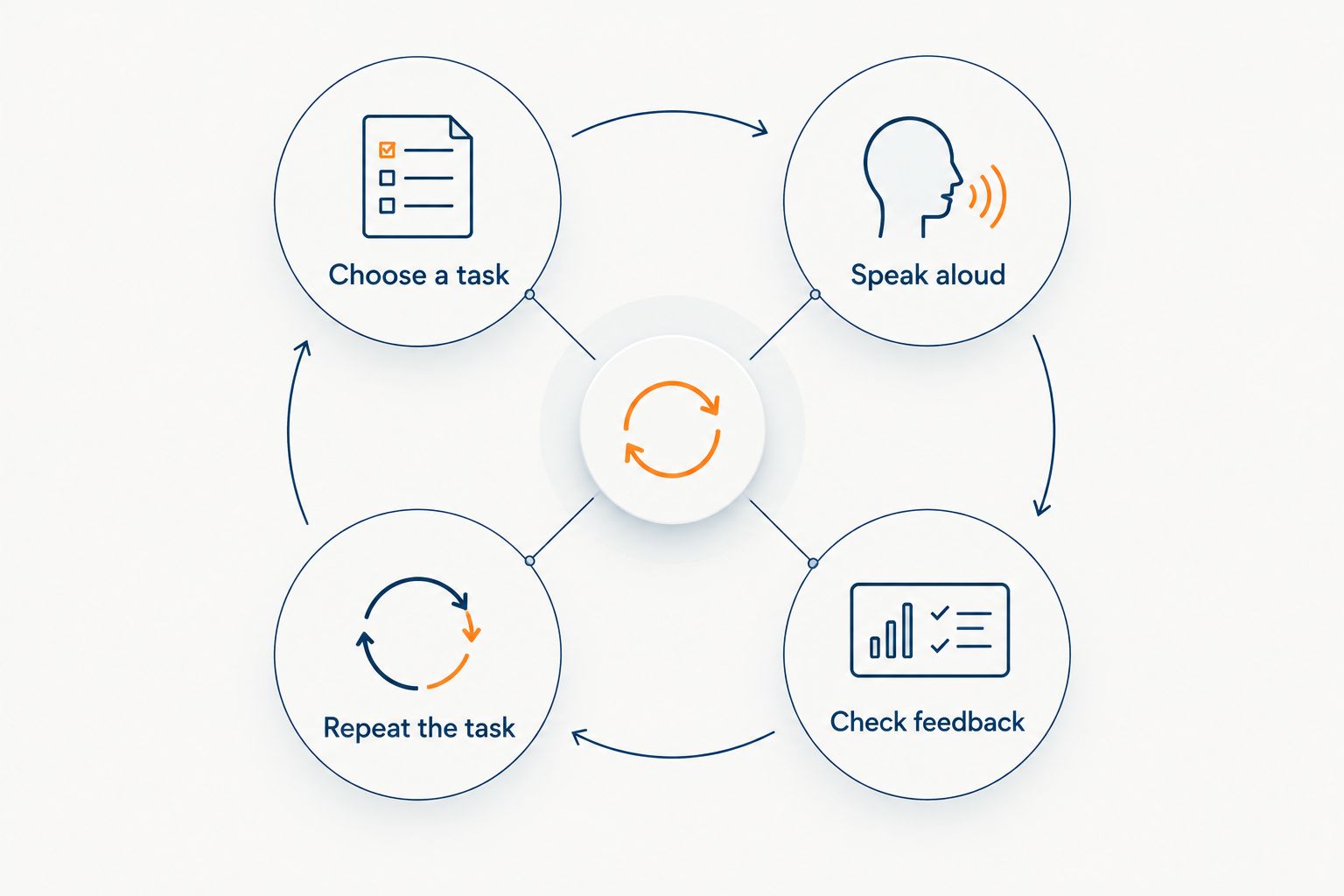
Repeat the same communication task after addressing one specific issue.
The repeated answer should still communicate a message. If you spend the entire session adjusting one sound and never finish your request, return to the task before ending.
What does useful speaking practice sound like?
This example dialogue practises requesting a change and explaining a reason. It is a model conversation, not a student testimonial.
Learner: Could we move our meeting to Thursday?
Partner: What time would work for you?
Learner: Would the afternoon work? I have a client call in the morning.
Partner: That works. Could you send an updated invitation?
Learner: Of course. Should I keep the same agenda?
Partner: Yes, please. Just change the date and time.
Practise the exchange again with a different reason and an unavailable partner. The extra difficulty should come from responding to the situation, not from replacing ordinary words with formal ones.
Frequently asked questions
Can a complete beginner start English speaking practice?
Yes. Start with short, supported exchanges about familiar information, such as your name, routine or preferences. Choose help that lets you understand the task before you answer.
Should I practise American or British pronunciation?
Choose a reference that fits the people and situations you expect to encounter. Focus on being understood rather than treating a different established pronunciation as an error.
What should I do if I cannot understand my speaking partner?
Ask your partner to repeat or rephrase the message. Phrases such as 'Could you say that another way?' let you stay in the conversation while checking meaning.
Is it useful to record myself speaking English?
Yes, a recording lets you listen again to a specific answer. Check one feature at a time, such as whether you finished your explanation or made your request clear.
Should every speaking mistake be corrected immediately?
No. Agree on a correction approach that fits the task. During a longer explanation, noting an issue for discussion afterwards lets you finish the message first.
Can I practise speaking English without sharing personal details?
Yes. Use fictional names, workplaces and situations in your exercises. You can practise introductions, requests and opinions without disclosing private information.
Which option should you choose for your next conversation?
Choose tutor-led lessons if you need guidance during real conversation. Choose pronunciation exercises for a specific sound problem, language exchange for reciprocal interaction, and a sound chart for reference.
For your 2026 decision, write one sentence beginning “I want to be able to…”. Finish it with an observable task. Select the method that makes you perform that task, then judge your next session by what you can communicate.
What is one final check before you repeat an answer?
Ask whether your listener understood the message, not only whether your grammar was correct. A polished sentence that misses the question still needs work. Repeat the answer with the listener's actual need in mind.
Sources
- Official service information, Flalingo. Brand description and teaching information supplied for this 2026 guide.
- ELSA Speak, official product information. Source for the pronunciation-feedback description.
- HelloTalk, official product information. Source for the language-exchange and messaging description.
- British Council, LearnEnglish Sounds Right. Official resource description for the pronunciation chart, recordings and example words.
Learn with Flalingo
- Online English lessons with a tutor
- Book a trial lesson
- Free English practice by level
- English for real-life situations
- Daily English news with audio and exercises
Related guides
- Flalingo vs ELSA Speak and Other AI English Apps: What's Missing from AI-Only Learning?
- How Much Does Flalingo English Speaking Practice Cost?
- Best AI English tutor apps in 2026
- Flalingo vs Duolingo: Can an App Replace a Real English Teacher?
- Cambly vs italki: Instant English Practice or Tutor Marketplace?
Other content that may interest you



Flalingo Team is a team of experienced teachers. Our aim is to share the most up-to-date information and expert analyses about online English language learning with our readers. Our mission is to guide you on your English learning journey with data-driven content.
English with Flalingo

Learning English with Flalingo means progressing with an intelligent system that works in an integrated manner.