
English Accent Test: How Much Does Your Accent Affect the Way You Speak?

When speaking English, most people worry less about grammar mistakes than about how their accent sounds. Questions like “Can people understand me?”, “Is my accent very obvious?”, and “Can I sound more natural?” are completely normal. In fact, they are a sign that you are a better speaker than someone who never thinks about pronunciation at all, because it means you are listening to your own voice.
Finding the answer on your own can be hard. Since your ear is blind to your own speech, you tend to hear yourself as either better or worse than you really are. It is worth stressing here that an accent is not a bad thing. Everyone has a vocal signature. What matters is being able to tell whether the accent gets in the way of communication, and for that, you need a neutral ear.
The Flalingo English Accent Test was designed for exactly this kind of awareness. With a short voice recording, it shows your accent strength, your native similarity score, and your pronunciation profile. The test is free, requires no sign-up, and takes about two minutes.
Table of Contents
- What Is an English Accent Test?
- How Does The Flalingo English Accent Test Work?
- What Does The Accent Strength Score Mean?
- Sample Result Interpretation: What Does 46/100 Mean?
- Why Do Non-Native Speakers Have an English Accent?
- Should I Get Rid of My Accent Completely?
- What Should You Do After Getting Your Accent Result?
- Is The Test Reliable? What Should You Watch Out For?
- Do minimal pair work: Take word pairs that match the pattern heard in you (ship/sheep, live/leave, tree/three), listen to them first, then say them and compare your recording with the original.
- Do shadowing: Repeat a short piece of native speech or a podcast segment sentence by sentence, following right behind the speaker like a shadow. This is the fastest way to improve rhythm and melody, and the test’s own feedback recommends this practice too.
- Record your own voice regularly: The ear is blind to its own speech, and recording breaks that blindness. Recording the same paragraph once a month or once a week and comparing it with the older recording shows progress more clearly than the score does.
- Back up your practice with real teacher feedback: Studying on your own only goes so far. Having a teacher tell you, live and in the moment, which sound you are getting stuck on is a different kind of help.
- This is not a clinical or academic diagnosis. The test is an analysis tool designed for speaking awareness; it does not replace a language proficiency certificate or an official measurement.
- The result can be affected by recording conditions. Background noise, microphone quality, and speaking time can move the score by a few points. Recording in a quiet place, with the device’s own microphone, and from a normal distance will give the most consistent result.
- A single score does not reflect your whole English communication skills. Some people have a light accent but a narrow vocabulary, while others have a noticeable accent but speak fluently and effectively. An accent score is not your grammar or vocabulary level.
- The same person can get a slightly different score on different days. Your reference should be your band and your recurring pronunciation notes, not individual point scores.
What Is an English Accent Test?
An accent test is an analysis tool that compares the sound features of your speech with native English speech. Here, it helps to separate two ideas that often get mixed up in everyday language.
Pronunciation is about whether you produce individual sounds correctly. For example, do you say “three” or “tree,” and does the “ld” at the end of “world” actually come out? Accent is a more holistic idea. You can think of it as the total imprint your native language leaves on your voice. Rhythm, word stress, vowel length, and sentence melody all shape your accent together. Two people can pronounce the same words correctly and still speak with very different accents.
The Flalingo English Accent Test measures this second thing and expresses the result with two main metrics.
Accent strength score is a score from 0 to 100 that shows how far your pronunciation is from a native English reference. According to Flalingo’s own explanation, 0 points indicate a pronunciation that is indistinguishable from a native speaker's, while 100 points indicate a very noticeable accent.
Native similarity is the same distance read the other way around. It shows how far your voice sits, as a percentage, toward the acoustic centre of native English speech samples.
What the test does not tell you is just as important as what it does. An accent test does not tell you whether your English is good or bad. It does not measure your grammar, your vocabulary, or your fluency. It only tries to measure how close to or far from a native English reference your voice sounds. Reading the score like a grade would be a misunderstanding of what the test is for.
Analyse Your Accent in 60 Seconds!
START THE TESTHow Does The Flalingo English Accent Test Work?
You can reach the test here. The process has four steps and takes about two minutes from start to finish.
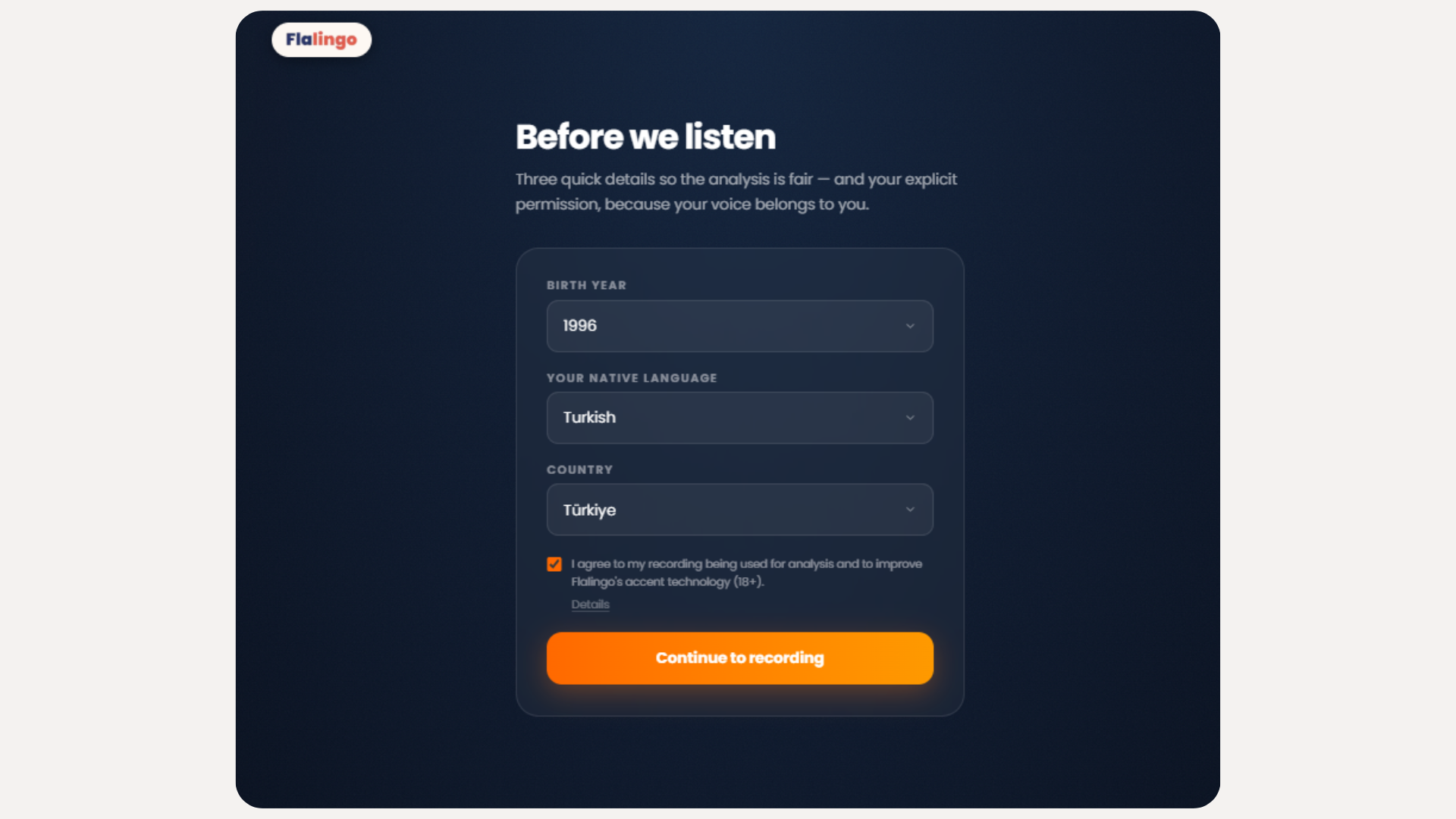
1. Information and consent screen: Before you start recording, you select your birth year, your native language, and your country. This information helps make the analysis fair. On the same screen, you give explicit consent for your voice recording to be analysed and used to improve Flalingo’s accent technology. The test will not start until the consent box is checked, and participation is limited to ages 18 and over.
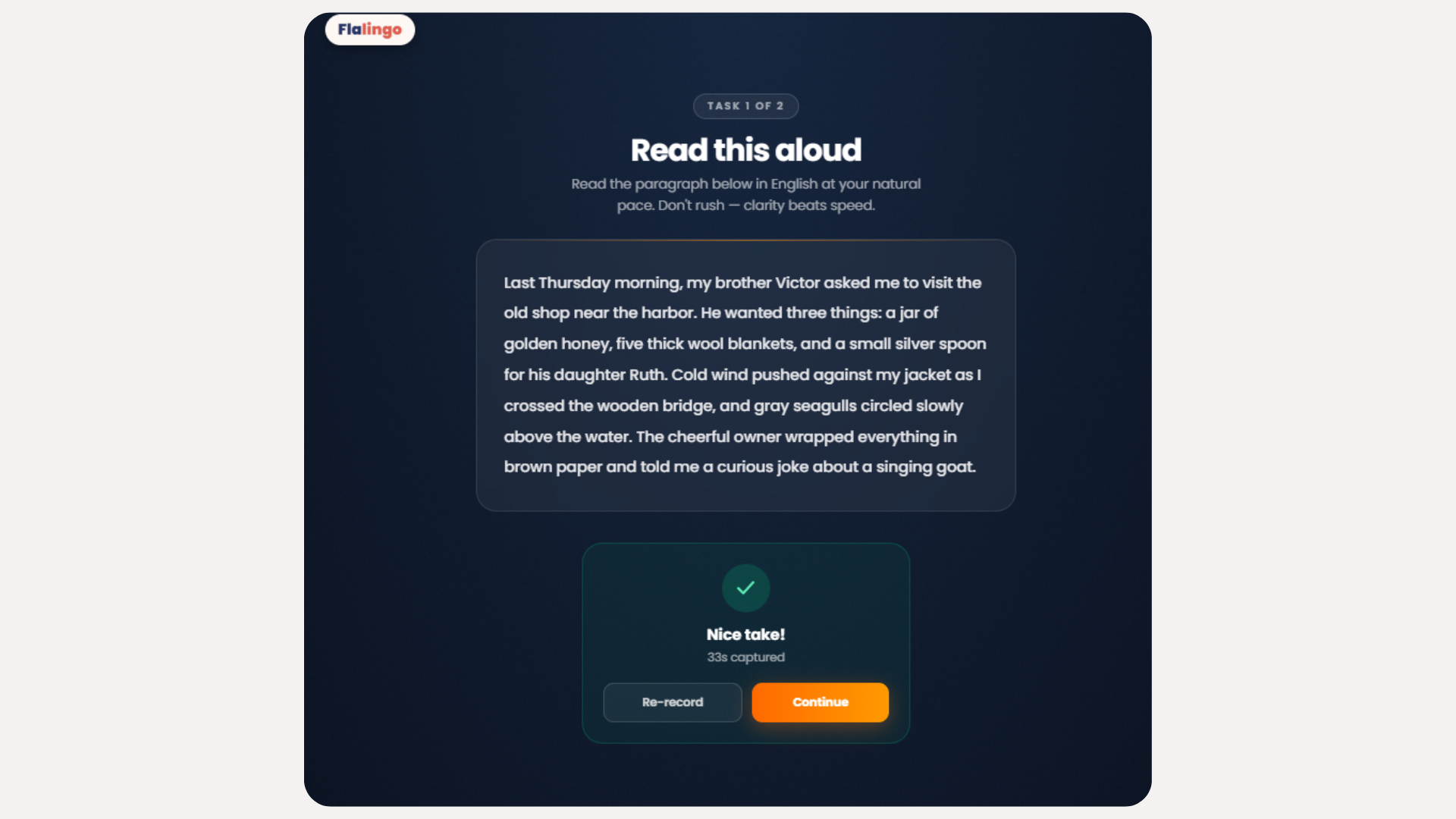
2. Task 1, reading a fixed paragraph: A short English paragraph appears on the screen, and you are expected to read it aloud at your natural pace. The paragraph is not random text. It deliberately includes the sounds that set accents apart, such as long and short vowels, sounds like “th” that many languages do not have, and different stress patterns. The recording needs to be at least 12 seconds, with an upper limit of 45 seconds.
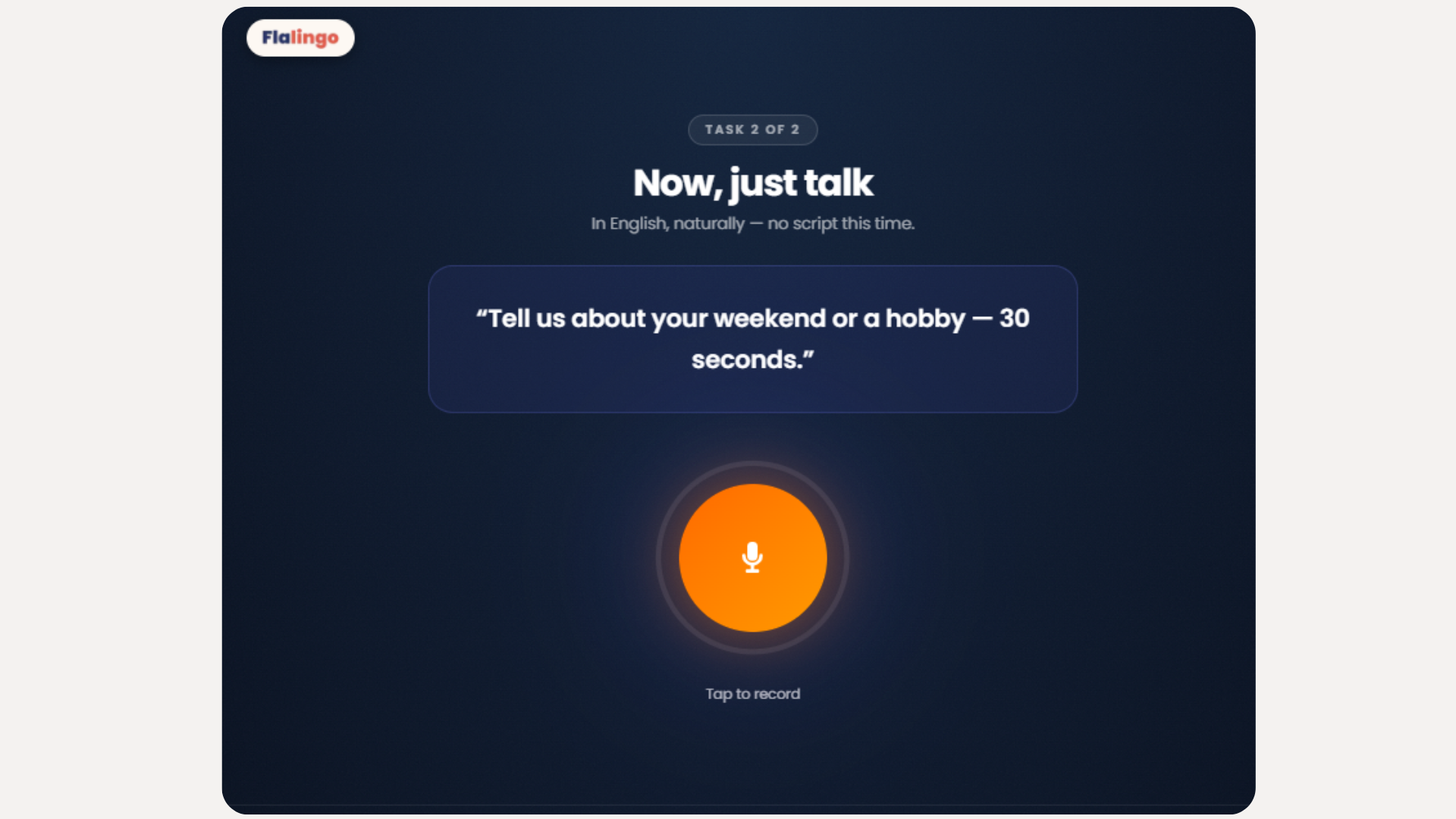
3. Task 2, free speech: This time, there is no text. You are given an everyday topic, such as your weekend or a hobby, and you speak freely for about 30 seconds. The recording stops automatically at the 35th second. Both tasks are used because the reading task captures your controlled, careful pronunciation, while free speech captures your natural voice in the moment when you feel no one is listening. The accent really shows up in the second one, and the two recordings together produce close to 90 seconds of audio.
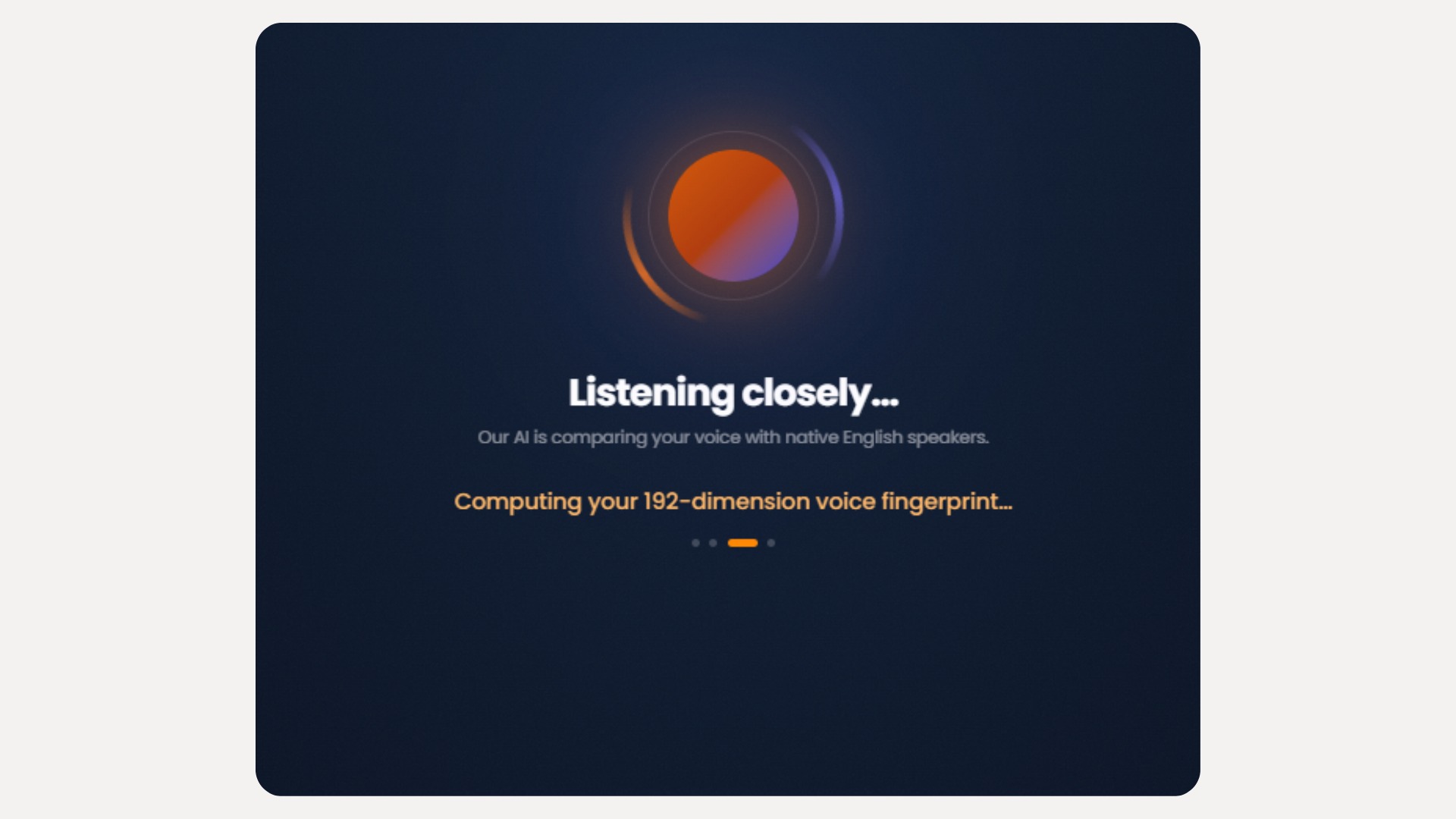
4. Analysis and result: The AI model turns your recording into a 192-dimensional acoustic fingerprint and measures how far that fingerprint is from the acoustic centre formed by thousands of native English speech samples. This distance becomes your score. Within a few seconds, the result screen appears. It shows your accent strength score from 0 to 100, your accent band, your native similarity percentage, and a shareable result card. You can also have your result sent to your email, and you can retake the test if you like.
What Does The Accent Strength Score Mean?
The test labels your score with one of four bands: faint, mild, moderate, and strong. The table below is an example framework for how these bands can be read in practice, and it should be used as a guide rather than as strict cutoffs:
Sample Result Interpretation: What Does 46/100 Mean?
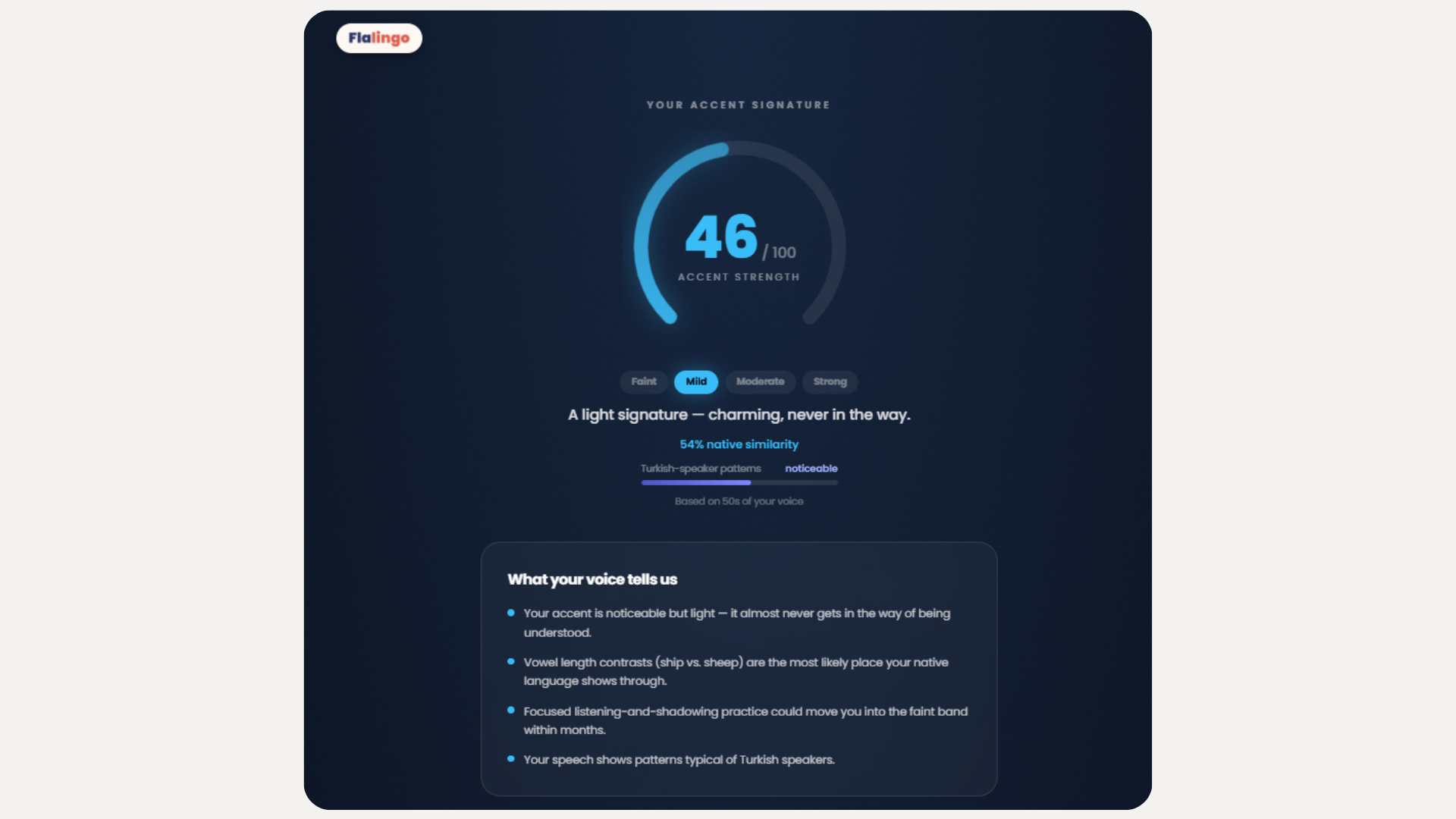
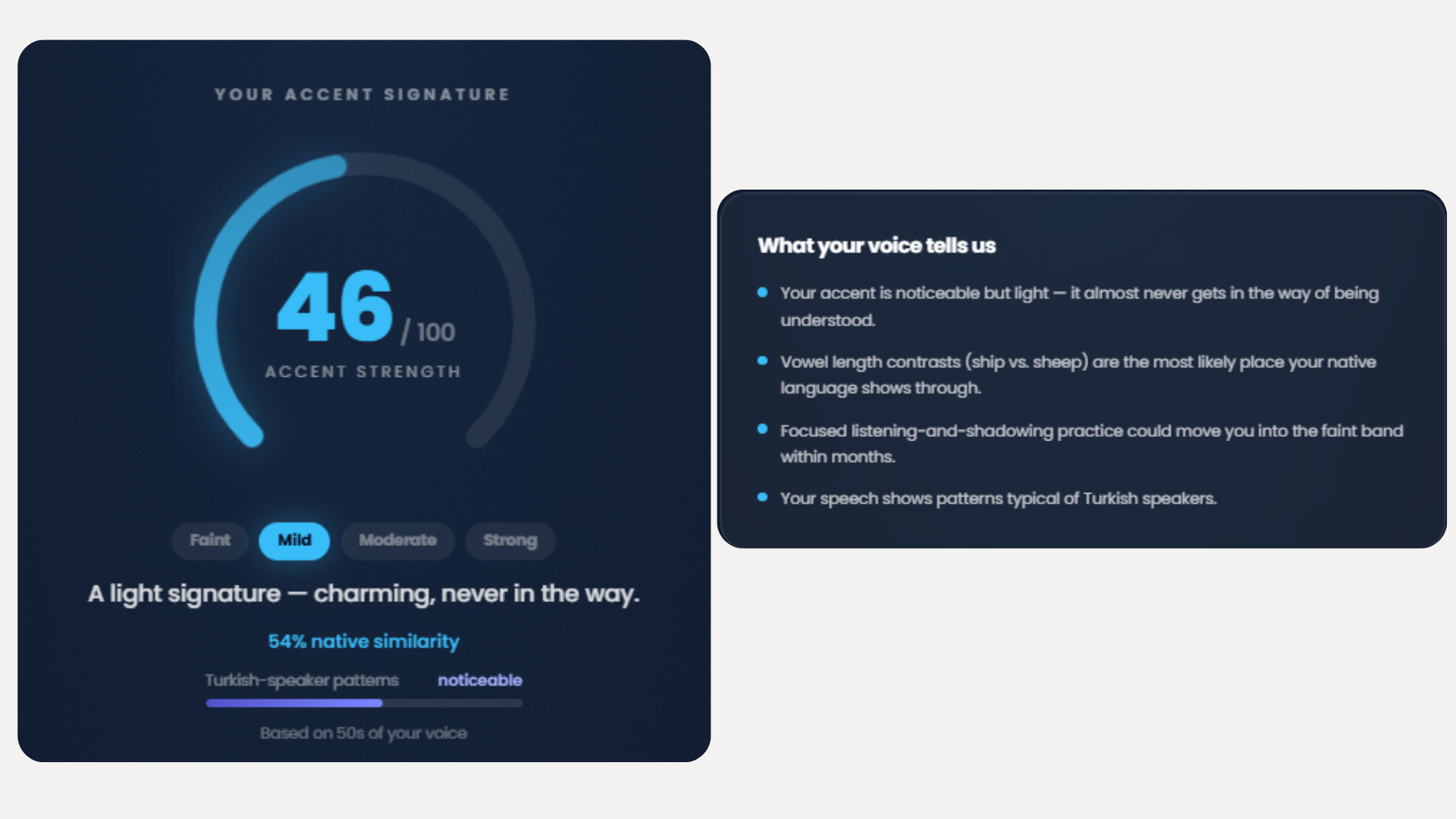
Before writing this article, I took the test with my own voice. My result screen showed an accent strength score of 46/100, which falls on the upper side of the mild band. It put my native similarity at 54%, and the analysis was based on 50 seconds of audio collected from the two tasks. The test also noted that my speech showed pronunciation patterns typical of Turkish speakers at a noticeable level.
I finished the reading paragraph in 33 seconds, and for the free-speech part, I was asked to talk about my weekend or a hobby. The second task felt harder than the first. While reading the text, I could keep an eye on my pronunciation, but during free speech, once I got caught up in the flow of my thoughts, Turkish habits slipped straight out of my mouth. Right there, I heard with my own ears why the test separates the two tasks.
The part that actually helped me was the “What your voice tells us” section under the result. It had three findings: my accent is noticeable but light and almost never stands in the way of being understood; the place where my native language shows itself most is in vowel length contrasts (words like ship and sheep); and with focused listening and shadowing practice, I could move into the faint band within a few months.
This result told me that my English is understandable, but that pronunciation habits carried over from Turkish can be heard, especially in short and long vowel sounds. The ship/sheep finding felt familiar to me too; one of the words I get stuck on most really is “sheet.” I take the “faint band in a few months” claim with some caution, though, because that timeline does not work the same for everyone and depends on regular practice.
But here is what matters: this is not a bad result. On the contrary, it is a practical starting point that shows me what to work on. Instead of general advice like “work on your pronunciation,” I now have a concrete target: vowel length.
Test Your Accent for Free!
Start the TestWhy Do Non-Native Speakers Have an English Accent?
Because the sound system of your native language differs from that of English, certain pronunciation patterns show up again and again among learners. Knowing them can make it easier to interpret your test results. The examples below come from a range of language backgrounds, so you may recognise some more than others depending on your first language.
Short and long vowel distinction
In many languages, vowel length does not change the meaning of a word, but in English it can. In pairs like ship/sheep, full/fool, and live/leave, the only difference is the length and tension of the vowel, and the wrong one turns one word into another. This is one of the most common traces of an accent for speakers of languages such as Spanish, Italian, Turkish, and Arabic, whose vowel systems do not split each vowel into the tense and lax versions that English uses.
The “th” sound
English has two “th” sounds, /θ/ and /ð/, as in think and this, that many languages do not use at all. The ear pulls an unfamiliar sound toward the nearest familiar one, so the result depends on your first language. French and German speakers often move it toward “z” or “s” (this becomes “zis”), Japanese and several Slavic-language speakers toward “s” or “z,”; and speakers of some other languages toward “t” or “d” (think becomes “tink”). The listener usually still understands, but the trace is audible.
Word stress
Languages place stress in different spots. English stress moves depending on the word, so when the wrong syllable is stressed, the word sounds foreign. Speakers of languages with a fixed stress position tend to carry that habit over: French speakers often push the stress toward the end of a word, Polish speakers toward the second-to-last syllable, and Hungarian or Czech speakers toward the first. That is how “hoTEL” can come out as “HOtel,” or “comforTAble” as “COMfortable.”
The schwa /ə/
The schwa, English’s most frequent vowel, is that vague, short sound in unstressed syllables: the beginning of “about,” the end of “teacher.” In languages where every vowel is pronounced fully and clearly, such as Spanish, Italian, and Turkish, the schwa does not come naturally. As a result, unstressed syllables get said more clearly than they should, and the rhythm of the speech changes.
Final consonants
In several languages, voiced consonants at the end of a word tend to harden into their voiceless pair. German, Russian, Polish, and Turkish speakers, for example, may move “bag” toward “back” and “had” toward “hat.” The listener can usually still tell the words apart from context, but the effect adds to the accent.
Consonant clusters
English piles consonants together in ways many languages avoid, as in “strengths” or “sixths.” Speakers whose languages break up such clusters often insert a small vowel to make them easier to say: Spanish speakers may add an “e” before an initial s-cluster (school becomes “eschool”), while Japanese speakers may slip a short vowel between the consonants (desk becomes “desku”). It smooths the word out but shifts its shape.
Merging separate sounds
Some single sounds simply do not exist as separate items in a given language, so two English sounds collapse into one. The /r/ and /l/ distinction is a well-known challenge for Japanese and Korean speakers, and the /v/ and /w/ pair often merges for Hindi, German, and some other backgrounds. None of this blocks meaning on its own, but it colours the accent.
None of these patterns is a mistake; each is simply the shape your native language gives to your voice. This is exactly where the value of the test shows up, because it points out which pattern is heard in you through your own voice rather than through a generic list.
Should I Get Rid of My Accent Completely?
No, and this is not a comforting line but a teaching choice.
“Sounding like a native” is neither necessary nor realistic for most learners. Remember that the vast majority of people speaking English today are not native speakers. In a meeting or while travelling, there is a good chance the person across from you has an accent too. What international communication looks for is not the absence of an accent but clarity.
Good English does not mean accent-free English. Good English is English that the other person can understand comfortably and that lets you express yourself with confidence.
So the right goal should not be to erase your accent. Aim to speak more clearly and with more control in your own voice. A score does not define you, but it can show you what to work on. The Flalingo English Accent Test was designed to build speaking awareness rather than to judge your voice.
What Should You Do After Getting Your Accent Result?
Whatever band your score falls into, the feedback on the result screen gives you a concrete area to work on. Once you have identified that area, the following methods can help.
Is The Test Reliable? What Should You Watch Out For?
No two-minute test can measure everything, and that needs to be said plainly. To interpret your result correctly, keep these limits in mind:
On the data side, the picture is clear too. Your voice recording is processed only after the explicit consent you give on the permission screen; it is used to produce your accent analysis and to improve Flalingo’s accent technology. You can request that your recording be deleted at any time. Participation requires you to be 18 or older. These conditions are stated clearly on the consent screen before the test begins, and no recording is taken without your consent.
Take the Free CEFR Level Test and Create Your Learning Plan.
START THE FREE LEVEL TEST



I am an English teacher with bachelor’s and master’s degrees in Teaching English as a Foreign Language (TEFL) and over ten years of experience teaching more than 180 students across different age groups. With a student-centered approach, I focus particularly on developing speaking skills, using games and interactive methods to make learning both effective and enjoyable. I adapt my teaching to meet the needs of students with ADHD and specific learning difficulties (SpLD). I also remain actively engaged in academic research.
English with Flalingo

Learning English with Flalingo means progressing with an intelligent system that works in an integrated manner.