
English Expressions to Use When Someone Is Sick

When someone is unwell, the most common phrase that comes to mind is “Get well soon.” However, depending on the situation and your relationship with the person, expressions like “Hope you feel better soon,” “Wishing you a speedy recovery,” or “Take care of yourself” can also be the perfect choice.
Falling ill is a universal part of the human experience, but do we always know exactly how to react or what to say? Just like expressing gratitude or apologizing, wishing someone a quick recovery is a crucial element of social communication that we frequently rely on in everyday life.
In this article, we explore the best English expressions to use when someone is sick. By learning these phrases, you can communicate more politely and thoughtfully in your daily conversations, all while expanding your English vocabulary. Enjoy the read!
Table of Contents
- How to Say 'Get Well Soon' in English
- What Can You Say Besides “Get Well Soon”?
- How Can Someone Who Is Ill Respond in English?
- What Do You Say in English When You Are Ill?
- English Expressions for Talking About Illness in the Workplace
- Expressions You Can Use to Cheer Up Someone Who Is Ill
- Example Sentences for Speaking Politely and Empathetically
- 10 English Sentences You Can Use When Visiting Someone Who Is Ill
- Examples of Expressions You Can Use in Online Messages
- Choosing Appropriate Sentences for Children, Older Adults, and Strangers
- Expressions to Use for Different Types of Illness
- Pronunciation of English Expressions Related to Illness
- Example of a Simple English Dialogue with Someone Who Is Ill
- English Phrases for Wishing Someone Well over the Phone
- In Summary: Essential Expressions to Use When Someone Is Ill
- Frequently Asked Questions
- References
We don't always know exactly what to say when someone tells us they are unwell. Sometimes it can be tricky to find the right words to express your sympathy, and depending on the situation, well-wishes can be expressed using a variety of different phrases.
When someone mentions they are sick, one of the most common and natural responses is simply, “Get well soon.” In everyday conversation, this is the most frequently used expression when you want to wish someone a quick recovery.
However, relying on just one basic phrase can sometimes sound repetitive or unnatural. Rather than using a one-size-fits-all approach, it is much better to learn a variety of natural English expressions so you can tailor your response perfectly to the situation and the person you are speaking with.
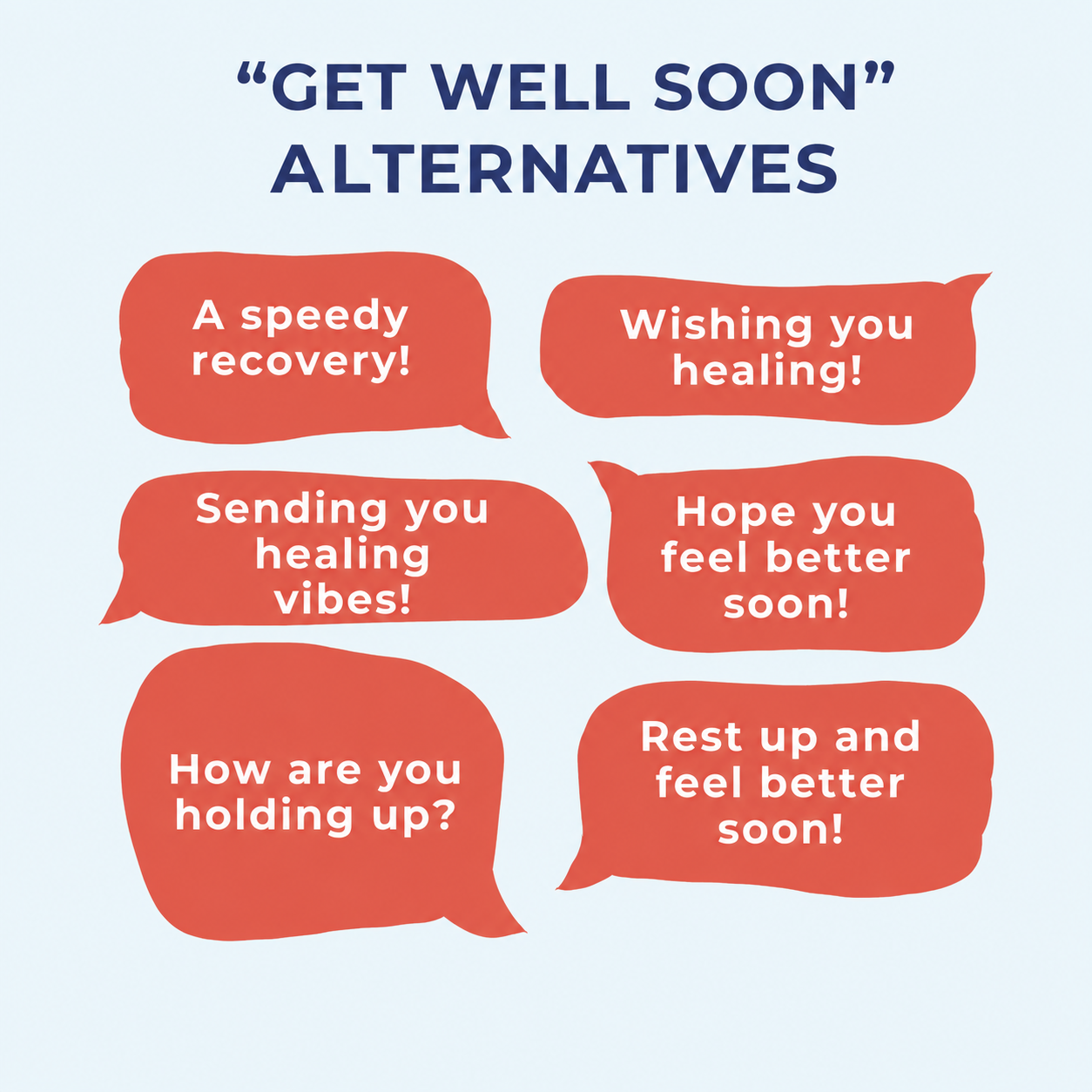
What Can You Say Besides “Get Well Soon”?
You do not have to express the same well-wishes with the same sentence in every situation. You can use different phrases depending on your relationship with the person and the nature of their illness.
Can “Get Well Soon” Be Used to Offer Condolences?
No. “Get well soon” is only said to someone who is ill or recovering.
This expression is not used when someone has passed away because it is no longer possible to wish them a speedy recovery. In such situations, expressions of condolence are used in English.
The distinction here is important: “Get well soon” is used for illness and recovery, while expressions of condolence are used when someone has passed away.
How Can Someone Who Is Ill Respond in English?
Knowing how to respond when someone wishes you well is just as important as knowing how to say “Get well soon.”
Some of the most natural responses are:
For example:
“How are you feeling?”
“I'm feeling much better, thanks for asking.”
What Do You Say in English When You Are Ill?
Besides saying “get well soon” to someone else, knowing how to say that you are feeling unwell in English is also very useful in everyday communication.
When You Are Not Feeling Well
English Expressions for Talking About Illness at Work
How Do You Say You Are Sick at Work?
When informing your manager or a coworker that you are sick, you do not need to provide a lengthy explanation about your health. A short, clear, and professional message is enough.
“I'm not feeling well today, so I need to take a sick day.”
“I'm not feeling well today, so I need to take a sick day.”
A slightly more formal option:
“I'm feeling unwell and won't be able to work today. I'll keep you updated if anything changes.”
“I'm feeling unwell and won't be able to work today. I'll keep you updated if anything changes.”
When writing these types of professional notifications, using the correct salutation, body, and closing structure in English emails also helps set the tone of the communication.
How Do You Write a Get-Well Message to a Coworker in English?
A get-well message to a coworker should generally be brief, warm, and professional.
For example:
“I'm sorry to hear you're not feeling well. Wishing you a speedy recovery. Take care and get plenty of rest.”
A shorter message:
“Hope you feel better soon. Take care!”
If you have a friendlier relationship with your coworker, you can also use the following expression:
“Missing your energy around here! Get better soon.”
“We're really missing your energy around here! Wishing you a speedy recovery.”
Because this expression is more informal, it is suitable for a coworker you work closely with. In more formal relationships, a neutral expression such as “Wishing you a speedy recovery.” may be preferable.
Expressions You Can Use to Cheer Up Someone Who Is Ill
Rather than simply saying “Get well soon” when someone is ill, you can use other expressions that show your support. However, which sentence is appropriate may vary depending on the seriousness of the illness and how close you are to the person.
Be Careful When Saying “You Look Great!”
“You look great!” is a perfectly correct expression grammatically, but it may not always be appropriate when visiting someone who is ill.
It may sound natural when said to someone close to you who has had a minor illness. However, in cases of serious illness, during recovery from surgery, or when the person may be sensitive about their appearance, it can come across as insincere or uncomfortable.
In such situations:
“It's good to see you.” or “I hope you're feeling a little better today.”
may be more appropriate expressions.
Is “I Pray That You Feel Better Soon” Appropriate for Everyone?
“I pray that you feel better soon.” has a religious connotation.
You can use it if you know the other person's beliefs or if you have a relationship in which religious expressions are natural. However, when speaking to someone you do not know or someone who may have different beliefs, the more neutral expression:
“I hope you feel better soon.”
is a more appropriate choice.
Example Sentences for Speaking Politely and Empathetically
If someone tells you they are ill, you can use these practical English expressions to respond in a very polite and empathetic way:
10 English Sentences You Can Use When Visiting Someone Who Is Ill
If you are visiting someone who is ill at home or in the hospital and are unsure what to say, these 10 sentence patterns may be useful:
Examples of Phrases You Can Use When Writing an Online Message
Nowadays, communication often takes place online and through short messages. If this is the context and you want to send get-well wishes to someone who is ill, it is best to avoid being too formal.
While “get well soon” works well here as a polite and natural way to express your wishes, you can also take a look at these alternatives:
- Hang in there! → Hang in there, stay strong!
- Sending you healing thoughts! → I'm sending you healing thoughts. / Wishing you healing.
- Wishing you a speedy recovery! → Wishing you a speedy recovery. / I hope you recover quickly.
- Rest up and feel better soon. → Rest and feel better soon.
- Get well and come back stronger than ever! → Get well and come back stronger than ever!
- Get well quick! → Get well quickly!

Choosing Appropriate Phrases for Children, Older Adults, and Strangers
To express your get-well wishes in the most appropriate way, you should choose the right sentence for the right person. For example, it may not always be appropriate to say to an older patient you do not know what you would say to a coworker. If you are wondering what to say and how to say it, here are a few examples:
For Children:
- Soon we’ll be playing again, just rest a little. → We’ll be playing again soon; just get some rest.
- The doctors will make you better, don’t worry! → The doctors will make you better, so don’t worry!
To make these kinds of short phrases part of everyday life with children, you can also use simple English sentences suitable for use at home.
For Older Adults:
- May you regain your strength and health soon. → I hope you regain your strength and health as soon as possible.
- I hope you find comfort and healing in this time. → I hope you find comfort and healing during this time.
For People You Do Not Know:
- Sending best wishes for your health and recovery. → Sending you my best wishes for your health and recovery.
- I hope you recover quickly and fully. → I hope you make a quick and full recovery.
Phrases to Use Based on the Type of Illness
Just as the most appropriate get-well phrase varies depending on the person, it will also vary depending on the illness. For example, it may not be appropriate to say to someone who has undergone surgery what you would say to someone with a mild cold.
After Surgery
- Can't wait for you to be back on your feet again. → I can’t wait for you to be back on your feet again.
Serious Illness
For a more serious or prolonged illness, rather than directly saying “get well quickly,” you may want to choose gentler phrases that express support and good wishes:
- Wishing you strength and comfort during this time.
- This too shall pass. Stay strong and know that we're rooting for you. Get well soon!
Flu or Mild Illness
- Hope you feel a little better every day. → I hope you feel a little better every day.
Pronunciation of English Phrases Related to Illness
Because these phrases are mostly used face-to-face or over the phone, simply knowing what they mean may not be enough. Especially if you are a beginner, it is helpful to listen to the sentences at a natural speaking pace and repeat them.
When evaluating your speech, knowing the difference between pronunciation and accent is just as important as pronouncing words correctly and gives you a more accurate perspective.
An Example of a Simple English Dialogue with Someone Who Is Ill
Of course, your communication with someone who is ill will not be one-sided. So, we would like to provide an example of how a dialogue between you might unfold.
— Hi, I heard that you were ill. How are you feeling?
+ Oh, thanks for asking. It’s just a cold. No worries.
— I am glad that it is nothing serious. I just wanted to remind you that I’m just a phone call away.
+ That’s so kind, thank you. I appreciate that.
— Anyway, I don’t want to keep you. Rest up and feel better soon.
+ Thanks again, bye.

Ways to Express Get-Well Wishes in English over the Phone
If you are going to speak to the person over the phone and offer your get-well wishes, it may be appropriate to keep the conversation brief depending on their condition.
Knowing the basic English phrases used in phone calls, from greeting someone to ending the conversation, makes it easier to handle these conversations more naturally.
As illustrated above, phrases such as “Get well soon,” “Wishing you a speedy recovery,” and “If you need anything, call me” will be sufficient.
It is also best not to bring up other topics that might tire the patient or be inappropriate at the time.
In Summary: Essential Phrases to Say When Someone Is Sick
In English, you do not have to use the same sentence in every situation to wish someone a speedy recovery. You can choose a warmer phrase for a close friend, a more neutral one for a coworker, and more thoughtful and supportive language in the case of a serious health condition.
The most important thing is not to craft a perfect sentence, but to choose a natural expression appropriate for the person and the situation. When in doubt, simple phrases such as “Get well soon,” “Hope you feel better soon,” or “I’m here for you” provide a safe starting point.
If you need to learn more and speak English fluently, remember that we at Flalingo are here for you!
Stay well.
Start using the phrases you have learned in real conversations.




Hi, I'm Glory. Teaching English is one of the most rewarding experiences of my life as I get to meet people from different cultures and help them express themselves with confidence. At Flalingo, I take care to create pleasant and relaxed teaching environments where students can speak without fear of making mistakes. My greatest happiness is witnessing the moments when my students realise that they are really making progress.
English with Flalingo

Learning English with Flalingo means progressing with an intelligent system that works in an integrated manner.