

본문으로 바로가기
Flalingo

영어 연습

OET Reading Part A: 짧은 글 네 개에서 15분 안에 정확한 답을 찾아 그대로 옮겨 적는 법

Two healthcare colleagues in uniform compare open blue folders at a desk; one points to a sheet of paper.

OET Reading Part A 푸는 법: 역할을 보고 글 고르기, 표의 올바른 행 읽기, 숫자를 단위와 조건까지 옮겨 적기, 마감 시각과 행사 시각 구분하기. B2 이상의 간호사와 의사를 위한 글.

OET Reading Part A에서는 하나의 보건의료 주제에 관한 짧은 글 네 개와 20문항을 15분 안에 풀어야 하므로 모든 글을 꼼꼼히 읽을 시간이 없습니다. 제목과 배치를 보고 질문에 필요한 역할을 하는 글을 고르세요. 그다음 훑어보며 세부 정보 주변의 문장이나 표의 행만 읽습니다. 답은 단위, 조건, 시간까지 그대로 옮겨 적으세요. 이 글은 영어가 중상급(B2) 이상인 간호사와 의사를 위한 글입니다.

이 글이 맞는 분

  • Part A의 글은 이해하지만 마지막 문항에 이르기 전에 시간이 모자라는 간호사와 의사.
  • 단위 누락, 옆 행, 빈칸 주변에서 옮겨 온 단어 때문에 거의 맞은 답에서 점수를 잃는 수험생.
  • 직장에서 근무표, 일정표, 규정을 확인하며 정확한 세부 정보를 빨리 찾고 싶은 전문가.
  • 아직 이릅니다: 한 페이지 분량의 영어 글을 읽는 데 아직 시간이 오래 걸린다면 먼저 일반 읽기 실력을 중상급(B2)까지 올리세요. 아래 학습 계획 가이드가 한 주의 목표 하나를 정하는 데 도움이 됩니다.
  • 너무 쉽습니다: Part A를 15분 안에 안정적으로 끝낸다면 Part B와 직원 공지문으로 넘어가세요(아래 링크).

예시 학습 페이지 열기

예시 학습 페이지 열기

단어 카드

Personal · finding information

When did you last struggle to find a simple piece of information in a document or on a website? What made it hard?

Useful: ‘I was looking for…, but…’ · ‘The information was there, but it was hidden under…’ · ‘In the end, I had to…’

Personal · how you read

Do you usually read instructions from beginning to end, or scan for what you need? Has that ever caused a problem?

Useful: ‘I tend to skim until…’ · ‘I only read carefully when…’ · ‘Once, I missed… because…’

Professional practice · documents at work

Which document at your workplace do staff or patients most often misread? How would you improve it?

Useful: ‘The one that causes most confusion is…’ · ‘I’d move… so that…’ · ‘The heading should say…’

Big idea · reader and writer

When a reader misunderstands an important document, whose responsibility is it: the writer’s or the reader’s?

Useful: ‘I’d say the writer has more responsibility, because…’ · ‘That’s true up to a point, but…’ · ‘Both have a part to play:…’

대화 예시

How can you explain a useful checking habit?

I would underline the deadline label before copying the time, because the same notice also gives the later session time.

One possible formulation; other coherent and accurate responses are welcome.

문장 형태

Copy the unit with the number

  • A number without its unit can change the meaning.
  • A notice says return within seven days. Recording seven without days leaves the time period incomplete.

Use the right condition

  • A general rule may have an exception.
  • Staff collect folders from reception; external visitors collect them from the training desk. The right place depends on who is collecting.

Answer the actual field

  • Avoid repeating words already printed around the gap.
  • Field: Send requests at least ___ before the session. Source: two working days. Copy two working days, not the whole sentence.

추가 연습

Read the information

Text A — Visitor-support desk: purpose

The visitor-support desk helps people understand practical arrangements at the clinic. Staff can explain where to wait, how to find a department and how to contact the appointment team. The desk does not make clinical decisions or change treatment plans. Questions about an individual’s care should be directed to the appropriate professional.

Text B — Finding the desk

From the main entrance, continue along the ground-floor corridor to the large noticeboard. The visitor-support desk is on the left immediately after the noticeboard, opposite the small meeting room. It is not beside the upstairs lift. Staff directing someone from the side entrance should first guide them towards the main entrance corridor.

Text C — Contacting the support team

For a routine practical enquiry, use the shared support inbox. Staff should include a callback number and a brief description of the information requested. Do not put detailed personal information in the subject line. For a same-day practical issue, telephone the support coordinator on the internal number shown in the staff directory.

Text D — Desk opening times

The desk is staffed from 09:00 to 12:00 and from 13:00 to 16:00 on weekdays. During the midday closure, written enquiries can still be left in the secure enquiry box next to the desk. The box is checked when the afternoon session begins. The desk is not staffed on weekends.

Practice context

  • Four reference extracts for staff at a community clinic. Read them as workplace information, not instructions for treating a patient.

Evidence questions

  • Which text explains the limits of what the service can do?
  • Which text would help a colleague direct a visitor from the main entrance?
  • Which text explains the communication channel for a same-day practical issue?

Read the information

Text A — Training folders

Training folders are prepared for registered participants. Internal staff collect them from reception; external visitors collect them from the training desk. Each folder contains the session outline and blank note pages. Participants who need a different print size should mention this when they register, so the correct version can be prepared.

Text B — Requests and changes

Requests for printed folders must reach the training team at least two working days before the session. Include the session title, date and number of participants. A change to the participant total after the deadline should be reported through the shared training inbox; staff should not assume that extra folders will already be available.

Text C — Borrowed learning resources

Reference folders borrowed for personal study should be returned within seven days. A borrower who needs more time may request an extension before the return date. The training team checks whether another person is waiting before confirming an extension. An unconfirmed request does not automatically change the original return date.

Text D — Returning a resource

Return borrowed reference folders to the labelled tray inside the training office. If the office is closed, use the secure return box beside its door. Do not leave borrowed material on a reception counter, where it may be mistaken for a new session pack. Staff check the return box each weekday morning.

Practice context

  • Four staff-training reference extracts from a training centre. Complete brief answers externally before looking at the supported choices.

Evidence questions

  • Where should an external visitor collect a prepared training folder?
  • How far in advance must a printed-folder request reach the team?
  • Where should a borrowed folder be placed when the training office is closed?

Read the information

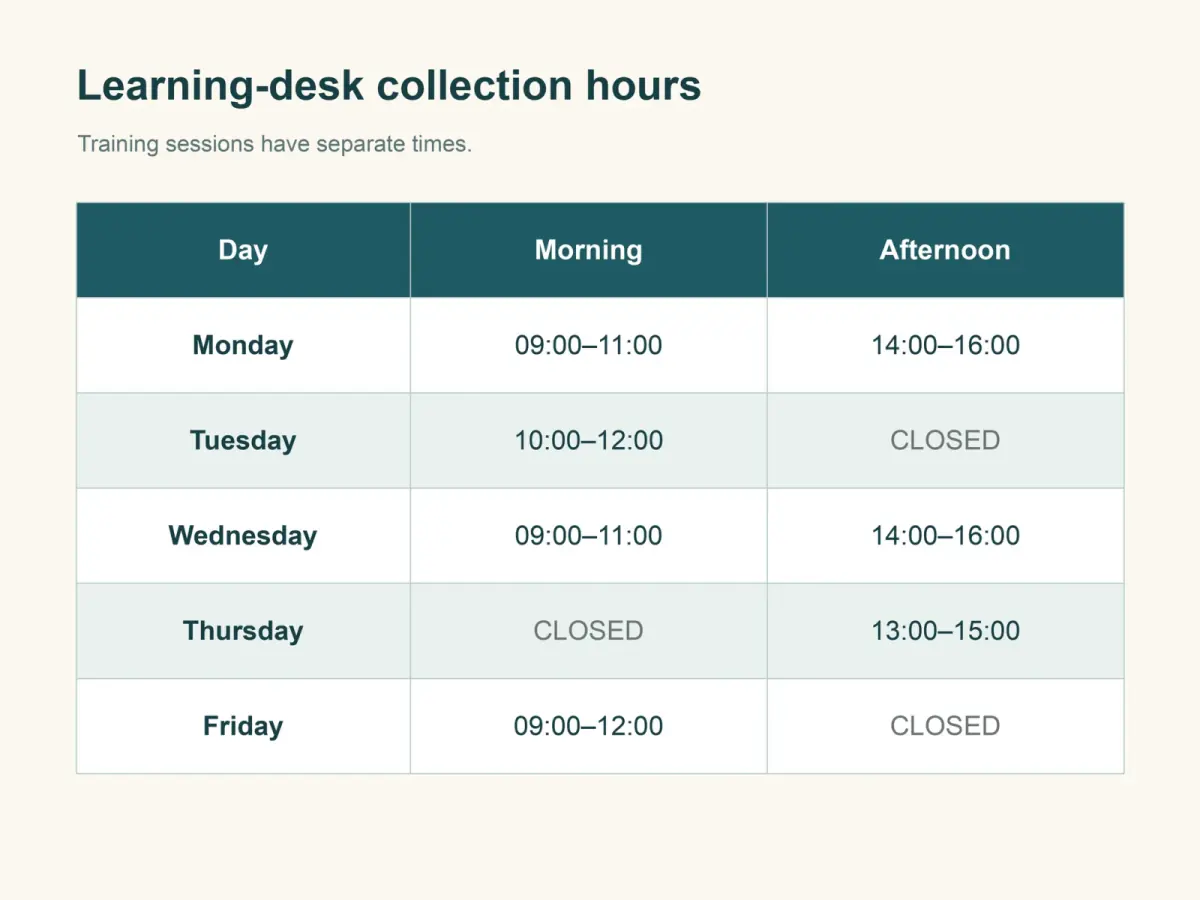
Collection timetable: Monday 09:00–11:00 and 14:00–16:00; Tuesday 10:00–12:00, afternoon closed; Wednesday 09:00–11:00 and 14:00–16:00; Thursday morning closed, 13:00–15:00; Friday 09:00–12:00, afternoon closed.

Text A — Collection service

The learning desk holds pre-booked session packs for staff. A collection is ready only after the organiser has confirmed the participant’s registration. The desk cannot confirm a place on a course. A staff member who has not received registration confirmation should contact the organiser rather than assume that a pack is waiting.

Text B — Learning-desk schedule

Monday: morning 09:00 to 11:00; afternoon 14:00 to 16:00.

Tuesday: morning 10:00 to 12:00; afternoon closed.

Wednesday: morning 09:00 to 11:00; afternoon 14:00 to 16:00.

Thursday: morning closed; afternoon 13:00 to 15:00.

Friday: morning 09:00 to 12:00; afternoon closed.

These are collection hours, not the times of the training sessions themselves.

Text C — Preparing a collection

Receive collection request, then check registration list. If registration is confirmed, prepare the named pack and send a collection message. If the name is not on the list, ask the organiser to check the registration. Do not prepare a pack or send a ready-to-collect message until the registration is confirmed.

Text D — Outside the listed hours

Staff who cannot attend during collection hours may ask the learning team to arrange an alternative. The team must confirm the arrangement before anyone leaves material elsewhere. A request alone is not confirmation. Session packs should not be left in public waiting areas or passed to an unknown person.

Practice context

  • Four reference extracts for a staff-learning desk. Text B is a compact schedule with labelled day rows; Text C is a written decision path.

Evidence questions

  • Which collection window is available on Thursday?
  • What happens next if a requested name is missing from the registration list?
  • What must happen before an alternative collection arrangement is used?

Read the information

Text A — Orientation visit

The centre runs a practical orientation visit for new volunteers. It introduces the reception area, staff-learning room and visitor-support point. The visit is about finding services and understanding whom to contact. It does not include clinical work or observation of patient consultations. Volunteers receive their individual duty information separately from their own coordinator.

Text B — Booking and deadline

The next orientation visit is on Friday 18 October at 14:00. A group organiser should submit the final number of visitors by 12:00 on Wednesday 16 October. Include a contact name and any practical access requests. Do not send detailed personal histories. The organiser receives a confirmation message once the group booking has been checked.

Text C — Arrival information

Confirmed groups meet at the side entrance beside the bicycle racks. Individual volunteers attending without a group meet at main reception. Both groups should arrive ten minutes before the stated start time. A person arriving late should contact the orientation coordinator rather than follow an unfamiliar group into another part of the building.

Text D — Changes after confirmation

An organiser who needs to change the group size should contact the orientation coordinator through the shared visits inbox. The coordinator checks whether the revised group can be accommodated and replies with confirmation or an alternative. The original arrangement remains in place until a change is confirmed. Please do not treat an unanswered message as agreement.

Practice context

  • Four reference extracts about a centre’s orientation visit. This is a shorter classroom retrieval task, not a full twenty-question Reading Part A paper.

Evidence questions

  • What is the deadline for a group organiser’s final visitor count?
  • Where should a confirmed group meet?
  • What is the status of the original arrangement while a requested change is unanswered?

Choose and justify with evidence

Text A — Visitor-support desk: purpose

The visitor-support desk helps people understand practical arrangements at the clinic. Staff can explain where to wait, how to find a department and how to contact the appointment team. The desk does not make clinical decisions or change treatment plans. Questions about an individual’s care should be directed to the appropriate professional.

Text B — Finding the desk

From the main entrance, continue along the ground-floor corridor to the large noticeboard. The visitor-support desk is on the left immediately after the noticeboard, opposite the small meeting room. It is not beside the upstairs lift. Staff directing someone from the side entrance should first guide them towards the main entrance corridor.

Text C — Contacting the support team

For a routine practical enquiry, use the shared support inbox. Staff should include a callback number and a brief description of the information requested. Do not put detailed personal information in the subject line. For a same-day practical issue, telephone the support coordinator on the internal number shown in the staff directory.

Text D — Desk opening times

The desk is staffed from 09:00 to 12:00 and from 13:00 to 16:00 on weekdays. During the midday closure, written enquiries can still be left in the secure enquiry box next to the desk. The box is checked when the afternoon session begins. The desk is not staffed on weekends.

  1. Which text explains the limits of what the service can do?

    정답과 해설 보기

    Text A

    Text A describes the desk’s practical role and says it does not make clinical decisions or change treatment plans.

  2. Which text would help a colleague direct a visitor from the main entrance?

    정답과 해설 보기

    Text B

    Text B gives the route and landmarks needed to find the desk.

  3. Which text explains the communication channel for a same-day practical issue?

    정답과 해설 보기

    Text C

    Text C distinguishes routine inbox enquiries from a same-day call to the coordinator.

Choose and justify with evidence

Text A — Training folders

Training folders are prepared for registered participants. Internal staff collect them from reception; external visitors collect them from the training desk. Each folder contains the session outline and blank note pages. Participants who need a different print size should mention this when they register, so the correct version can be prepared.

Text B — Requests and changes

Requests for printed folders must reach the training team at least two working days before the session. Include the session title, date and number of participants. A change to the participant total after the deadline should be reported through the shared training inbox; staff should not assume that extra folders will already be available.

Text C — Borrowed learning resources

Reference folders borrowed for personal study should be returned within seven days. A borrower who needs more time may request an extension before the return date. The training team checks whether another person is waiting before confirming an extension. An unconfirmed request does not automatically change the original return date.

Text D — Returning a resource

Return borrowed reference folders to the labelled tray inside the training office. If the office is closed, use the secure return box beside its door. Do not leave borrowed material on a reception counter, where it may be mistaken for a new session pack. Staff check the return box each weekday morning.

  1. Where should an external visitor collect a prepared training folder?

    정답과 해설 보기

    the training desk

    Text A distinguishes external visitors, who collect at the training desk, from internal staff at reception.

  2. How far in advance must a printed-folder request reach the team?

    정답과 해설 보기

    two working days

    Text B says at least two working days; calendar days and seven days refer to different or unsupported periods.

  3. Where should a borrowed folder be placed when the training office is closed?

    정답과 해설 보기

    the secure return box

    Text D specifies the secure return box beside the closed office door.

Choose and justify with evidence

Collection timetable: Monday 09:00–11:00 and 14:00–16:00; Tuesday 10:00–12:00, afternoon closed; Wednesday 09:00–11:00 and 14:00–16:00; Thursday morning closed, 13:00–15:00; Friday 09:00–12:00, afternoon closed.

Text A — Collection service

The learning desk holds pre-booked session packs for staff. A collection is ready only after the organiser has confirmed the participant’s registration. The desk cannot confirm a place on a course. A staff member who has not received registration confirmation should contact the organiser rather than assume that a pack is waiting.

Text B — Learning-desk schedule

Monday: morning 09:00 to 11:00; afternoon 14:00 to 16:00.

Tuesday: morning 10:00 to 12:00; afternoon closed.

Wednesday: morning 09:00 to 11:00; afternoon 14:00 to 16:00.

Thursday: morning closed; afternoon 13:00 to 15:00.

Friday: morning 09:00 to 12:00; afternoon closed.

These are collection hours, not the times of the training sessions themselves.

Text C — Preparing a collection

Receive collection request, then check registration list. If registration is confirmed, prepare the named pack and send a collection message. If the name is not on the list, ask the organiser to check the registration. Do not prepare a pack or send a ready-to-collect message until the registration is confirmed.

Text D — Outside the listed hours

Staff who cannot attend during collection hours may ask the learning team to arrange an alternative. The team must confirm the arrangement before anyone leaves material elsewhere. A request alone is not confirmation. Session packs should not be left in public waiting areas or passed to an unknown person.

  1. Which collection window is available on Thursday?

    정답과 해설 보기

    13:00–15:00

    The Thursday row has the morning closed and the afternoon window 13:00–15:00.

  2. What happens next if a requested name is missing from the registration list?

    정답과 해설 보기

    Ask the organiser to check the registration

    Text C requires an organiser check before preparation or collection confirmation.

  3. What must happen before an alternative collection arrangement is used?

    정답과 해설 보기

    The learning team must confirm the arrangement

    Text D says the learning team must confirm an alternative; requesting one is not enough.

Choose and justify with evidence

  1. What is the deadline for a group organiser’s final visitor count?

    정답과 해설 보기

    Wednesday 16 October at 12:00

    Text B separates the Friday visit from the Wednesday noon deadline for group numbers.

  2. Where should a confirmed group meet?

    정답과 해설 보기

    the side entrance beside the bicycle racks

    Text C gives a different meeting point for confirmed groups and individual volunteers.

  3. What is the status of the original arrangement while a requested change is unanswered?

    정답과 해설 보기

    Still in place until the change is confirmed

    Text D explicitly keeps the original arrangement in place pending confirmation.

이 단원 배우기
어떻게 배우고 싶나요?
계정이 있나요?

무료 계정은 한 단원을 계속 열어 둘 수 있습니다.

Part A는 무엇을 요구할까요?

Part A는 60분짜리 Reading 시험의 첫 부분입니다. 하나의 보건의료 주제에 관한 짧은 글 A–D 네 개가 나오고, 그중에는 표나 단계 목록이 자주 들어 있습니다. Part A에는 따로 15분이 주어지고, 그 뒤에는 Part B와 C로 넘어갑니다.

문제 유형은 세 가지이며, 뒤의 두 유형에서는 철자도 채점됩니다.

  • Matching(연결하기): 이 정보는 어느 글에 있나요? A, B, C, D 중 하나로 답합니다.
  • Short answer(단답형): 단어, 숫자 또는 짧은 구.
  • Sentence completion(문장 완성): 빠진 단어를 글에서 그대로 옮겨 적습니다.

역할을 보고 글을 고른 뒤 훑어보세요

Part A의 네 글은 같은 주제를 다뤄도 하는 일이 서로 다릅니다. 첫 1분은 제목과 배치만 보고 각 글에 두 단어 정도의 이름표를 붙이세요. 그리고 단어를 찾기 전에 각 질문을 글의 역할과 연결합니다. 마지막으로 답을 문장 자체에서 확인하세요.

  • “What can’t the desk do?” → 목적과 한계.
  • “How do I reach the desk?” → 찾아가는 길.
  • “Whom do I phone about a same-day problem?” → 운영 시간이 아니라 연락처.
  • “When is the desk staffed?” → 시간표.

그대로 옮겨 적기: 단위, 조건, 빠진 단어만

거의 맞은 답도 점수를 받지 못합니다. 다음 세 가지를 확인하세요.

  • 단위까지 옮겨 적으세요. “within seven days”에서 “seven”만 쓰면 불완전하고, “two days”는 “two working days”와 다릅니다.
  • 올바른 조건을 고르세요. “Internal staff collect them from reception; external visitors collect them from the training desk.” 외부 방문객이라면 답은 “the training desk”입니다.
  • 빈칸이 묻는 것만 쓰세요. “Send requests at least ___ before the session.” 글에는 “two working days”라고 되어 있으니 그것만 쓰고, 빈칸 주변의 단어는 옮기지 마세요.

시간 제한을 정확하게 만드는 작은 단어들

시간 제한은 전치사가 정하므로 숫자만큼 꼼꼼히 읽으세요. 한국어의 “까지”는 by와 until 양쪽에 쓰이지만 영어는 둘을 구분합니다.

  • by 12:00 on Wednesday: 늦어도 그 시각까지. 마감입니다.
  • until 16:00: 그 시각까지 계속되다가 끝남.
  • within seven days: 7일이 다 지나기 전 아무 때나. “in seven days”는 보통 지금부터 7일 뒤를 뜻합니다.
  • at least two working days before: 최소 기준이며, 더 일찍은 괜찮습니다.
  • from 09:00 to 12:00 and from 13:00 to 16:00: 사이에 쉬는 시간이 있는 두 개의 시간대.

표에서는 올바른 행을 읽으세요

행을 먼저, 그다음 열을, 그다음 숫자의 의미를 설명하는 메모를 찾으세요. 한 연습용 시간표의 목요일 행은 “morning closed; afternoon 13:00 to 15:00”입니다. 답은 13:00–15:00이며, 더 위에 있는 화요일의 10:00–12:00이 아닙니다.

순서도에서는 상황에 맞는 갈래를 따라가세요. “If the name is not on the list, ask the organiser to check the registration.”

나에게 맞는 방법으로 이 단원 배우기

마감 시각과 행사 시각을 구분하세요

한 공지문에 역할이 다른 두 시각이 나올 수 있습니다. “The next orientation visit is on Friday 18 October at 14:00. A group organiser should submit the final number of visitors by 12:00 on Wednesday 16 October.” 아래 수험생이 설명하듯, 시각을 옮겨 적기 전에 by, deadline, starts 같은 표시어에 밑줄을 그으세요.

튜터 How can you explain a useful checking habit?

수험생 I would underline the deadline label before copying the time, because the same notice also gives the later session time.

방문객 최종 인원의 마감은 언제인가요?

Part A에서 흔한 실수

실수마다 이름표를 붙이세요. 이름표가 무엇을 연습할지 알려 줍니다.

  • 엉뚱한 글: 제목에는 방문객이 나오지만 질문은 직원에 관한 것.
  • 첫 일치: 맞아 보이지만 다른 행이나 다른 글에서 온 숫자.
  • 빠진 것: 단위, 조건, 복수형(“two working day”).
  • 덧붙인 단어: 빈칸 뒤에 이미 인쇄된 “before the session”을 다시 쓰는 것.
  • 요청을 확정으로 착각하기: “The original arrangement remains in place until a change is confirmed.”
  • 한국어는 숫자 뒤의 명사에 복수 표시를 하지 않는 경우가 많아(“7일”), 영어 답의 마지막 -s가 빠지기 쉽습니다. days, participants처럼 끝을 확인하세요.

Part A 연습 루틴

일주일에 세 번, 연습용 Part A 한 세트로 합니다.

  • 15분: 시험과 같은 시간으로 풀되, 제목부터 봅니다.
  • 10분: 채점하고 실수마다 이름표를 붙입니다.
  • 5분: 틀린 답을 글에 나온 그대로 다시 씁니다.
  • 다음 세트: 가장 자주 나온 이름표부터 신경 씁니다.

다음 단계

Part B에는 짧은 직장 글 여섯 개가 나오고 글마다 3지선다 문제가 하나씩 있습니다. Part C에는 긴 글 두 개가 나오고 글마다 4지선다 문제가 여덟 개씩 있습니다.

말하기 연습으로, 잘못 읽힌 공지문의 책임이 누구에게 있는지 토론해 보세요. “I’d say the writer has more responsibility, because…”

자주 묻는 질문

OET Reading Part A는 몇 분인가요?

20문항에 15분입니다. 그 뒤에는 Part B와 C로 넘어갑니다.

OET Reading Part A에서 철자도 채점하나요?

네. 단답형과 문장 완성 문제에서는 철자가 틀린 단어가 있으면 오답이 됩니다.

OET Reading은 간호사와 의사에게 같은 시험인가요?

네. Reading은 모든 직종이 같고, 답은 임상 지식이 아니라 글에서 나옵니다.

Flalingo는 OET를 운영하는 기관과 제휴 관계가 없으며 해당 기관의 추천이나 승인을 받지 않았습니다.

이 단원 배우기
어떻게 배우고 싶나요?
계정이 있나요?

무료 계정은 한 단원을 계속 열어 둘 수 있습니다.

다음에는 무엇을 할까요?

Flai로 계속 연습하세요

Flai는 음성 대화, 교정 내용, 수업 보고서로 말하기 연습을 돕는 Flalingo의 AI 말하기 앱입니다.

라이브 선생님과 배우기

Flalingo 수업에서는 이런 단원을 라이브 선생님과 1:1로 연습합니다.