
Ir al contenido
Flalingo

Práctica de inglés

Cómo describir una foto en inglés y especular sobre ella (B2): looks as if, might have y must have

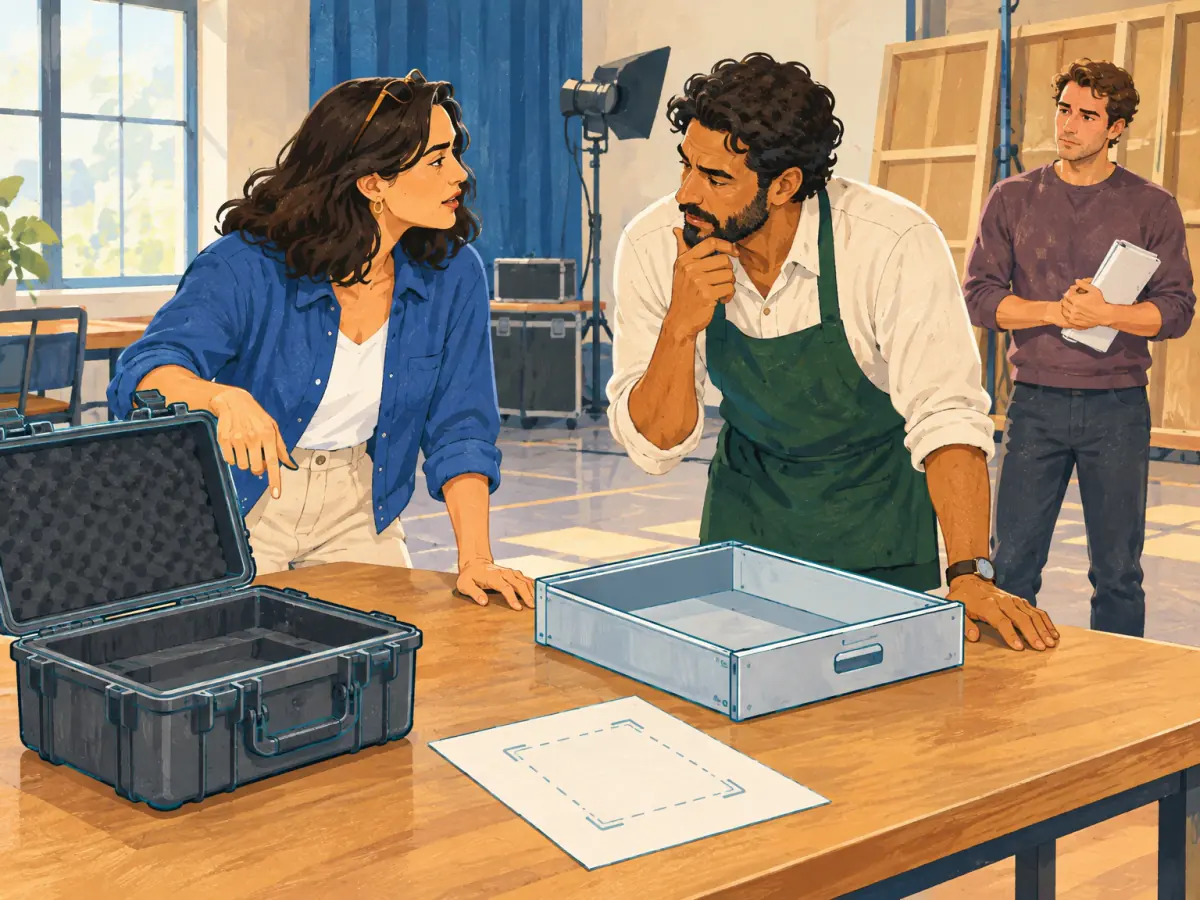
Two friends look at an empty instrument case and its tray on a rehearsal-room table.

Guía B2 para describir una foto en inglés: expresiones de lugar, vocabulario de lenguaje corporal, look y seem, y modales como might have y must have, para que cada suposición quede marcada y apoyada en algo visible.

Para describir una foto en inglés, cuenta primero lo que se ve y solo después interprétalo. Guía al lector del primer plano al fondo y marca cada suposición con expresiones como may, looks as if o must have, unida a un detalle visible. “His raised eyebrows suggest that the damage is unexpected.” es una frase justa; “He is shocked.” es una suposición presentada como un hecho. Es un tema de nivel B2 (intermedio alto) para adultos que ya saben decir qué hay en una imagen y quieren especular con cuidado.

¿Para quién es este artículo?

  • Adultos de nivel intermedio alto que saben enumerar lo que hay en una imagen pero acaban presentando suposiciones como hechos.
  • Personas que describen imágenes en inglés: una prueba oral con fotos, un informe de incidencias, una revisión de un diseño o de una actuación, un texto para una exposición.
  • Estudiantes que quieren sonar justos: prudentes con may y looks as if, y seguros con must have solo cuando las pruebas son sólidas.
  • Demasiado pronto: si nombrar lugares, personas y acciones en una foto todavía es nuevo, empieza por una descripción de foto de nivel B1 que explica por qué una imagen es importante para ti.
  • Demasiado fácil: si ya separas las pruebas de la interpretación sin pensar, pasa a una reseña de arte de nivel C1 que apoya cada opinión en pruebas observables.

Abrir las páginas de muestra

Abrir las páginas de muestra

Tarjetas de vocabulario

in the foreground/centre/background

locate elements by depth

In the foreground, Maya stands by the open door.

on the left/right; in front of; behind; opposite; outside

locate one element relative to another

Owen is opposite the window, behind the case.

may/might/perhaps

mark a possible interpretation

The case might have been moved.

looks/seems as if/as though

connect visible evidence to a clause

It looks as though rain entered overnight.

The photo reminds me of…

connect the image to a relevant memory or genre

The photo reminds me of an unresolved workplace incident.

Conversación

maya Her folded arms look defensive at first.

owen Yes, but the raised shoulder later looks as if it is protecting her.

maya The metal sound seems important, although we never see its source.

owen And the door feels like stone, but it is a painted prop.

Estructura de la frase

look/feel/smell/sound/taste + adjective

describe a quality

The fabric feels rough and the alarm sounds urgent.

sense verb + like + noun phrase

compare with a thing

The prop feels like real stone.

sense verb + as if/as though + clause

give an apparent situation

It sounds as if somebody is behind the curtain.

look

impression specifically from appearance

Maya looks tired under the stage light.

seem

general impression from any evidence

Owen seems worried after reading the schedule.

feel like + noun/-ing

want something or want to do something

I feel like watching the second performance.

as: role/reason/time/example/comparison

marks function, cause, simultaneous time, example, or comparison

As the actor left, Maya worked as a reviewer and noted details such as gesture and pace.

Más práctica

A rehearsal-room decision

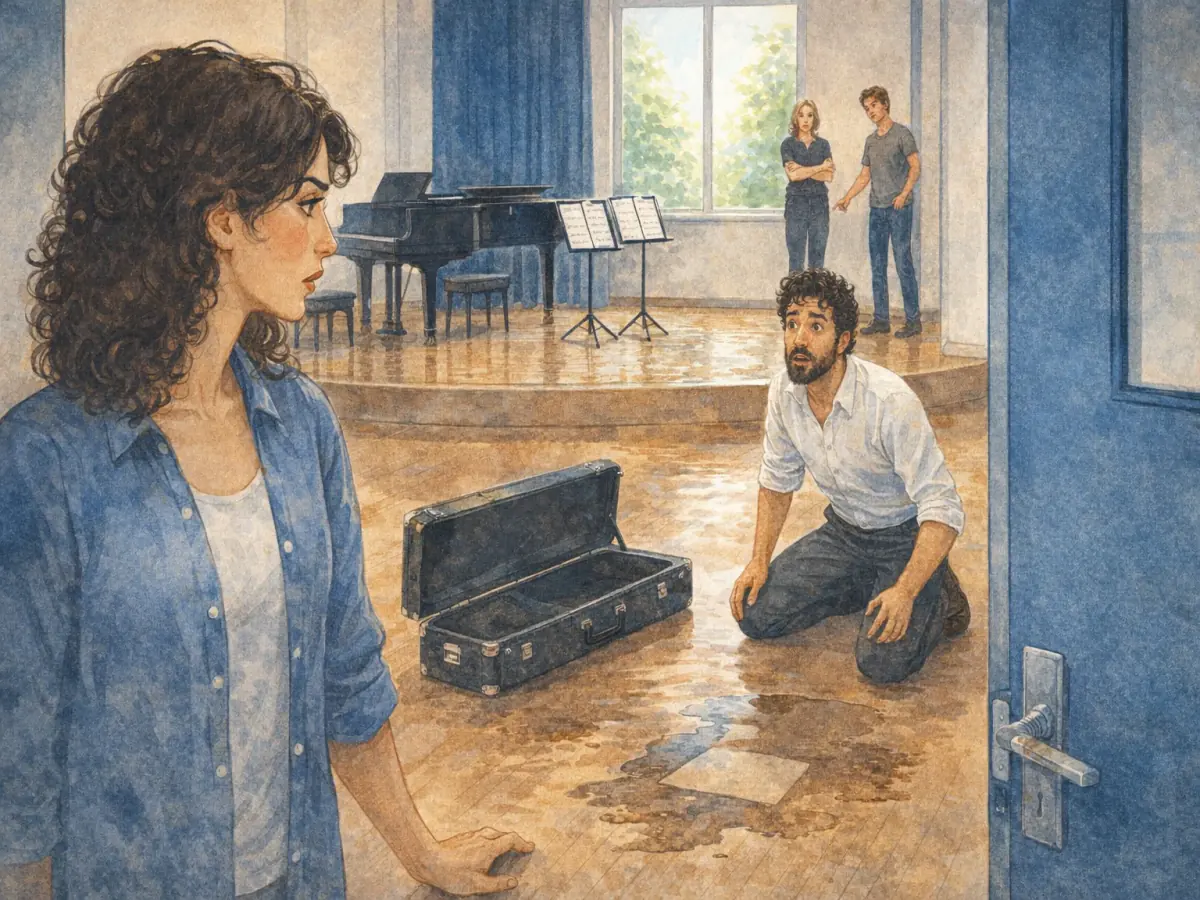
Maya just inside the open door, Owen kneeling by a damaged case, and two performers near a wet patch below the window.

In the foreground of the photograph, Maya is standing just inside an open rehearsal-room door. Her face and shoulders look tense. In the centre, Owen is kneeling next to a damaged instrument case. He looks worried, and his raised eyebrows suggest that the damage is unexpected.

In the background, two performers are waiting near the stage. One has folded her arms; the other is pointing towards a wet patch below the window. It looks as if rain has entered during the night. The case may have been moved away from the wall, because its original position is marked by a dry rectangle.

The photo reminds me of the moment before a practical decision. Nobody is posing, and each gesture contributes evidence without proving exactly what happened.

Body and gestures 1

ankle

joint connecting foot and lower leg

Maya rotated her ankle.

calf

muscular back of the lower leg

Owen stretched his calf.

heel

back part of the foot

The shoe rubbed her heel.

knee

joint between thigh and lower leg

He knelt on one knee.

elbow

joint in the middle of the arm

Maya rested an elbow on the table.

fist

closed hand

Owen relaxed his fist.

nails

hard coverings at the ends of fingers or toes

The actor bit her nails.

palm

inner surface of the hand

She placed her palm on the door.

Body and gestures 3

kidneys

two organs that filter blood and make urine

The scan showed both kidneys.

liver

large organ that processes substances in the blood

The liver metabolizes many medicines.

lungs

two organs used for breathing

The singer filled her lungs.

forehead

area above the eyebrows

Sweat appeared on Owen’s forehead.

cheek

side of the face below the eye

Stage paint covered one cheek.

lips

soft edges of the mouth

Maya pressed her lips together.

neck

part joining head to torso

The collar covered his neck.

chin

lower front part of the face

Owen raised his chin.

Write a complete photo description

Evidence audit

Aprende esta unidad
¿Cómo quieres aprender?
¿Ya tienes cuenta?

Una cuenta gratis abre una unidad para siempre.

Un plan en cuatro partes para una descripción de 140–190 palabras

Imagina una sala de ensayo: una mujer en la puerta y un hombre arrodillado junto a un estuche dañado. Usa cuatro expresiones de lugar y seis palabras de lenguaje corporal:

  • Visión general: “The photo shows a rehearsal room with four people and a damaged case.”
  • Detalle espacial: “In the centre, a man is kneeling next to the case.”
  • Deducción prudente unida a una prueba: “The case may have been moved: a dry rectangle marks where it stood.”
  • Reacción personal: “The photo reminds me of the moment before a practical decision.”

Expresiones de lugar que guían la mirada

Avanza en una sola dirección: de delante hacia atrás o de izquierda a derecha. Ojo con “enfrente de”: en español puede significar in front of u opposite, pero en inglés son dos posiciones distintas.

  • Profundidad y lados: in the foreground, in the centre, in the background, on the left, on the right. “In the foreground, a woman is standing in the doorway.”
  • Relaciones: in front of (más cerca de quien mira), behind, next to, opposite (al otro lado y de cara; sin of). “The man is opposite the window, behind the case.”

Lenguaje corporal: nómbralo con precisión, léelo con prudencia

Usa el present continuous para las acciones y un participio para las posturas: “She is pointing at the window.” “Her arms are folded.”

Un gesto es una prueba, no una entrada de diccionario: los brazos cruzados pueden indicar una actitud defensiva, frío o simple comodidad. Antes de escribir, comenta: “Should interviewers judge candidates by their body language?” “Why do we feel so sure about other people’s feelings when the evidence is weak?”

  • Postura y manos: folded arms (brazos cruzados), a raised shoulder, a clenched fist (puño apretado), a hand on the hip.
  • Cara: raised eyebrows (cejas levantadas), a frown (ceño fruncido), a furrowed brow (frente arrugada), pressed lips.
  • Acciones: kneeling, pointing, shrugging, staring, leaning against a wall.

¿Look, seem, look like o look as if?

Los verbos de percepción dan una impresión, no una certeza, y van con adjetivo, no con adverbio. En español “parece” sirve para casi todo (“parece cansada”, “parece de piedra”, “parece que ha llovido”); en inglés cada idea tiene su estructura. Aquí, un detalle posterior cambia cómo se lee una escena muda:

  • Look, feel o sound + adjetivo: “Her shoulders look tense.”
  • Look o feel + like + sustantivo: “The prop feels like real stone.”
  • Look o sound + as if o as though + oración: “It looks as if rain has come in overnight.”
  • Seem, para una impresión basada en cualquier prueba: “He seems worried after reading the schedule.”

Maya Her folded arms look defensive at first.

Owen Yes, but the raised shoulder later looks as if it is protecting her.

Owen And the door feels like stone, but it is a painted prop.

¿Qué seguridad tienes? Modales de deducción

En español, “debe de haber llegado” expresa una suposición y “debería haber llegado”, una crítica; en inglés son must have y should have. Elige el modal según la fuerza de tus pruebas. Para el presente, modal + be; para lo ocurrido antes de la foto, modal + have + participio:

  • Casi seguro, must: “They must have arrived a while ago: their coats are hanging up.”
  • Posible, may, might o could: “She may be waiting for someone.”
  • Casi seguro que no, can’t o couldn’t: “The door can’t be real stone: one actor is carrying it with one hand.”
  • Must have es una deducción; should have, una crítica: “She must have called; she should have called me too.”
Aprende esta unidad a tu manera

Revisa cada deducción

Subraya cada frase que vaya más allá de lo que registró la cámara y anota su prueba. Sin prueba: bórrala. Prueba débil: suavízala. Prueba sólida: mantenla.

  • “She is angry.” pasa a ser “She is frowning with her arms folded; she may be annoyed, or simply cold.”
  • “Rain came in overnight.” pasa a ser “It looks as if rain came in: there is a wet patch below the window.”
  • “The performers damaged the case.” pasa a ser “Nothing in the photo shows who damaged the case.”

Errores frecuentes

Revisa estos puntos en tu descripción:

  • “on the foreground” o “in the left”. Di in the foreground y on the left.
  • “She looks like tired.” Di “She looks tired.” Like va delante de un sustantivo.
  • “He must went.” o “He must of gone.” Di “He must have gone.” Al hablar: must’ve.
  • “It remembers me of my first job.” Di “It reminds me of my first job.” Es un calco de “me recuerda a”: lo que te hace recordar algo es remind, no remember.

Práctica diaria de 10 minutos

Sirve cualquier foto. Una vez a la semana, escribe y revisa una descripción completa.

  • 2 minutos: escucha las tres frases de arriba y di el patrón de cada una.
  • 3 minutos: describe una foto en voz alta con cuatro expresiones de lugar.
  • 3 minutos: haz tres suposiciones con must have, might have y can’t have, cada una con because.
  • 2 minutos: escribe una visión general y una reacción con reminds me of.

Siguiente paso

Después, en B2, escribe un artículo de opinión que deja visibles sus correcciones y luego un informe urbano en el que una media oculta problemas locales. En C1, una reseña de arte apoya cada opinión en pruebas.

Preguntas frecuentes

¿Qué diferencia hay entre look like y look as if?

Look like + sustantivo compara con una cosa: “The door looks like stone.” Look as if + oración describe una situación: “It looks as if it has rained.” Delante de un adjetivo no se usa ninguno de los dos: “She looks tired.”

¿Cómo se especula sobre una foto en inglés?

Une un modal a una prueba: “The case may have been moved: a dry rectangle marks where it stood.” Must have es casi seguro; can’t have, casi seguro que no.

¿Se dice in the foreground u on the foreground?

In the foreground, in the background e in the centre, pero on the left y on the right.

Aprende esta unidad
¿Cómo quieres aprender?
¿Ya tienes cuenta?

Una cuenta gratis abre una unidad para siempre.

¿Qué viene después?

Sigue practicando con Flai

Flai es la aplicación de Flalingo para practicar conversación con IA mediante diálogos de voz, correcciones e informes de cada lección.

Aprende con un profesor en vivo

En las clases de Flalingo practicas unidades como esta en clases individuales con un profesor en vivo.