
Ir al contenido
Flalingo

Práctica de inglés

Cómo contar un recuerdo de comida en inglés (C1+): palabras sensoriales, verbos para comer y beber y detalles honestos

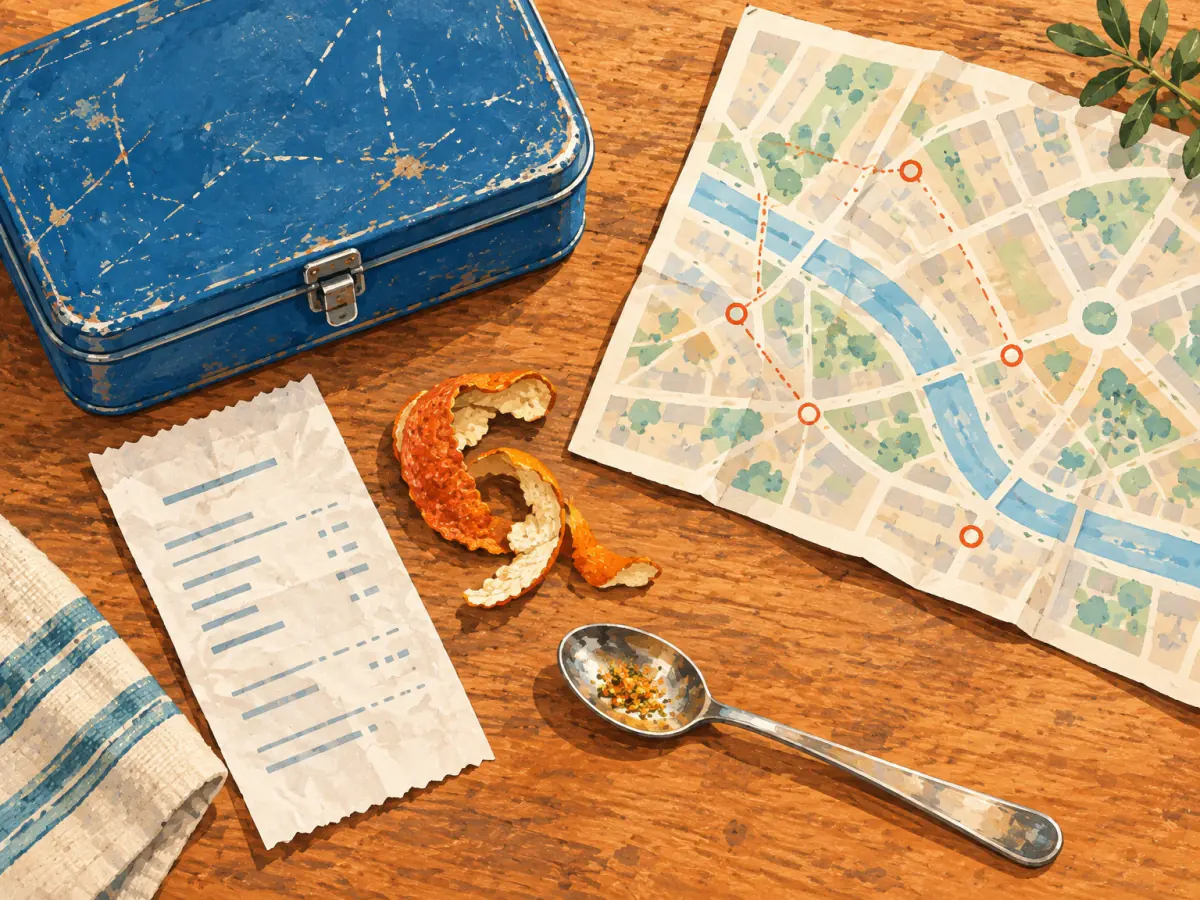
A blue lunch tin, receipt, citrus peel, spoon and marked map lie together on a desk.

Guía C1+ (avanzado superior) para contar en inglés un recuerdo que despierta la comida: palabras precisas de olor y sabor, verbos para comer y beber, cinco vocales cortas y cómo separar lo que recuerdas de lo que puedes comprobar.

Para contar bien un recuerdo de comida en inglés, empieza por lo que lo despertó, describe la sensación con precisión y separa lo que recuerdas de lo que se podría comprobar. Un whiff es un olor breve y un aroma suele ser agradable; sip, slurp y guzzle son formas distintas de beber. Vívido no significa exacto, así que marca tu grado de certeza: “I suspect it was me that had changed.” Este tema es de nivel C1+ (avanzado superior) y está pensado para adultos con fluidez que quieren contar historias precisas y honestas.

¿Para quién es este artículo?

  • Adultos de nivel avanzado que hablan con fluidez pero describen la comida siempre con las mismas palabras: eat, drink, nice, smell.
  • Personas que cuentan historias en inglés: en conversaciones, entrevistas, pódcasts o proyectos de historia oral y familiar.
  • Quienes quieren sonar vívidos sin exagerar, sobre todo cuando la historia incluye a otras personas.
  • Demasiado pronto: si todavía te cuesta apoyar una afirmación con pruebas, empieza por el ensayo C1 que relaciona el turismo cinematográfico con los costes de gestión.
  • Demasiado fácil: si los verbos precisos y los matices ya te salen solos, pasa a corregir una generalización cultural con acento contrastivo o a escribir una opinión equilibrada sobre trabajar a solas.

Abrir las páginas de muestra

Abrir las páginas de muestra

Tarjetas de vocabulario

Personal · a taste of the past

Is there a dish that instantly brings back a particular place or person for you? What exactly do you remember about it?

Useful: ‘The moment I catch a whiff of…, I’m back in…’ · ‘If I had to recreate it, I’d start with…’ · ‘What I remember most vividly is…’

Personal · going back

Have you ever gone back to a food or a place from your past and found it was not as you remembered? What had changed, it or you?

Useful: ‘Had I known…, I might not have gone back.’ · ‘It tasted nothing like…’ · ‘I suspect it was me that had changed.’

Conversación

Gammon, cabbage, carrots, pineapple: the vowel in cat.

Herring, pepper, cherries, lettuce: the vowel in bed.

Sniff, dill, dribble, kipper: the vowel in sit.

Scoff, chopped, broccoli, porridge: in British English, the vowel in hot.

Guzzle, stuffed, mussels, Brussels sprouts: the vowel in cup.

After a w sound, the written a in swallow, quarrel, swapped, squabble, quarry and waddle sounds like the vowel in hot.

Sip becomes sipped, and hot becomes hotter: double the final consonant after one stressed short vowel before a vowel-initial ending.

Estructura de la frase

Sensory meanings

  • sniff (noun or verb) — a short act of breathing in through the nose to detect a smell: “Owen gave the tin a cautious sniff before describing it.”
  • whiff — a slight smell that is noticed briefly: “A whiff of scorched peel escaped when Maya lifted the felt.”
  • aroma — a noticeable smell, often a pleasant one associated with food or drink: “The tea left a warm citrus aroma inside the tin.”

Más práctica

Eleven actions, not eleven synonyms

Mouth and throat actions

  • chew — bite food into pieces and move it around the mouth: “Chew the dried pear before judging its texture.”
  • lick — move the tongue over a surface: “Maya licked sauce from the tasting spoon.”
  • suck — keep something in the mouth and pull on it with the lips or tongue: “Owen sucked a mint during the journey.”
  • swallow — make food or drink pass down the throat: “She swallowed the capsule with water.”

Quantity, speed and attitude

  • devour — eat all of something quickly because of strong hunger: “After the night shift, Maya devoured the rice bowl.”
  • guzzle — informally and disapprovingly drink, or sometimes eat, a large amount quickly: “He guzzled two energy drinks during the briefing.”
  • scoff — informally and disapprovingly eat a lot very fast: “They scoffed the pastries before the guests arrived.”

Sound, size and rhythm

  • munch — eat steadily and often noisily, especially something crisp: “She munched raw carrots while editing.”
  • nibble — take small bites: “He nibbled a corner of the unfamiliar cheese.”
  • sip — drink a very small amount at a time: “Maya sipped the hot broth cautiously.”
  • slurp — make a loud noise while drinking: “Owen slurped the noodles and apologized.”

The blue lunch tin

A blue lunch tin, receipt, citrus peel, spoon and marked map lie together on a desk.

When sound archivist Owen opened a donated blue lunch tin, a faint aroma of scorched orange peel escaped from its lining. He held the tin beneath his nostrils—the two openings at the end of the nose through which a person breathes—and sniffed once more. The whiff made him picture his first radio job: a windowless studio, a nervous producer and a winter broadcast interrupted by a fire alarm. He was certain the producer had brought citrus cake that afternoon. The memory felt complete, down to the sugar on his fingers.

Instead of putting that recollection into the public catalogue, Maya asked him to test it. They sniffed the tin again, examined the hinge and found a bakery receipt trapped beneath the felt. Its date was six years later than Owen’s broadcast. A former owner then explained that she had carried smoked-orange tea in the tin during overnight bus shifts. The smell had not recovered Owen’s event; it had supplied vivid detail to a different event that already mattered to him.

At a tasting session the next day, a sharp sweet made Owen’s taste buds—the small structures on the tongue that detect flavours—react strongly. Lemon syrup began to dribble, or run in a thin stream, from the corner of his mouth. This intense sensation produced no confident story at all. The contrast persuaded him that intensity is not proof of accuracy. The archive now records sensory memories in two layers: the recollection itself and the independent evidence, if any, that supports it.

Sensory meanings

  • sniff (noun or verb) — a short act of breathing in through the nose to detect a smell: “Owen gave the tin a cautious sniff before describing it.”
  • whiff — a slight smell that is noticed briefly: “A whiff of scorched peel escaped when Maya lifted the felt.”
  • aroma — a noticeable smell, often a pleasant one associated with food or drink: “The tea left a warm citrus aroma inside the tin.”

Record a responsible sensory memory

A blue lunch tin, receipt, citrus peel, spoon and marked map lie together on a desk.
Aprende esta unidad
¿Cómo quieres aprender?
¿Ya tienes cuenta?

Una cuenta gratis abre una unidad para siempre.

Olor y sabor: seis palabras precisas

El olor suele abrir el recuerdo, así que nómbralo con exactitud. En español “olor” sirve para casi todo; en inglés la palabra cambia según lo breve o lo agradable que sea:

  • Sniff: inspirar brevemente por la nariz; es verbo y sustantivo.
  • Whiff: un olor leve que se percibe un instante. “I caught a whiff of smoke.”
  • Aroma: un olor marcado y normalmente agradable de comida o bebida, como en español: “the aroma of fresh coffee”. Para un olor desagradable, di odour o, si es muy fuerte, stench.
  • Nostrils: las fosas nasales.
  • Taste buds: las papilas gustativas, las pequeñas estructuras de la lengua que detectan el sabor.
  • Dribble: caer en un hilo fino, a menudo de la boca. “Lemon syrup dribbled from the corner of his mouth.”

Comer y beber, con precisión

Cada verbo añade cantidad, velocidad, sonido o actitud. Guzzle y scoff suenan críticos, y scoff con este sentido es sobre todo británico. Ojo con tomar: en español sirve para comer y para beber; en inglés, aparte de have, tienes que elegir.

  • Acciones de la boca: chew (masticar), lick (lamer), suck (chupar) y swallow (tragar).
  • Hambre y velocidad: devour (comérselo todo deprisa por hambre), guzzle (beber mucho y deprisa) y scoff (comer mucho y deprisa). “We scoffed the pastries before the guests arrived.”
  • Tamaño y sonido: nibble (dar mordisquitos), munch (comer sin parar, a menudo haciendo ruido), sip (beber a sorbos) y slurp (sorber haciendo ruido). “He slurped his noodles and apologised.”
  • Empezar: dig in (a menudo una invitación, como “¡A comer!”) y tuck into (lanzarse a comer con ganas).
  • Terminar: eat up (acabarse tu ración), polish off (acabar con lo que queda), put away (comer una cantidad sorprendente) y wolf down (engullir).
  • Sin apetito: pick at (picotear sin ganas) y toy with (jugar con la comida en el plato). “She toyed with her pasta while she waited for the news.”

Lo que recuerdas frente a lo que se puede comprobar

Un olor intenso puede reconstruir una escena entera y darte sensación de certeza, pero la intensidad no es una prueba. Imagina a un archivero que huele piel de naranja quemada en una fiambrera donada y cree recordar un pastel de su primer trabajo. Un recibo que hay dentro es de seis años después del día que recuerda. El olor era real; la historia, no.

Cuenta el recuerdo por capas:

  • Lo que lo despertó, contado con viveza: “What I remember most vividly is the steam on the windows.”
  • Lo que crees, marcado como recuerdo: “I’m fairly sure it was a Sunday, but I couldn’t swear to it.”
  • Lo que se podría comprobar: una foto, un recibo, una fecha, otra persona.
  • Lo que cambió: “It tasted nothing like I remembered.”

Fórmulas para volver al pasado y su gramática

Apréndelas como bloques completos:

  • “The moment I catch a whiff of…, I’m back in…” The moment significa as soon as, es decir, “en cuanto”; el presente simple indica que pasa cada vez.
  • “If I had to recreate it, I’d start with…” Un condicional de segundo tipo para una tarea imaginada.
  • “Had I known…, I might not have gone back.” Un condicional de tercer tipo con inversión: Had I known equivale a If I had known, como “de haberlo sabido” en español.
  • “I suspect it was me that had changed.” Una oración escindida que desplaza el foco de la comida a ti.
Aprende esta unidad a tu manera

Escucha: cinco vocales cortas en palabras de comida

Las palabras de cada línea comparten una vocal corta, y la consonante doble suele señalarla: compara dinner con diner. Por eso también se escribe chopped y hotter. El español tiene cinco vocales, así que las de cat, cup y hot tienden a sonar como una a o una o españolas; en cat abre más la boca, con un sonido entre a y e. La línea de hot es británica; en inglés americano esa vocal es más abierta.

Gammon, cabbage, carrots, pineapple: the vowel in cat.

Herring, pepper, cherries, lettuce: the vowel in bed.

Sniff, dill, dribble, kipper: the vowel in sit.

Scoff, chopped, broccoli, porridge: in British English, the vowel in hot.

Guzzle, stuffed, mussels, Brussels sprouts: the vowel in cup.

Errores frecuentes

Revisa tu historia:

  • “It smells well.” Es un calco de “huele bien”. Di “It smells good.” Smell well significa tener buen olfato.
  • “an awful aroma” Aroma es normalmente agradable; di “an awful smell”.
  • “I drank my soup.” En español te tomas la sopa, pero si es con cuchara, en inglés se suele decir eat soup o have soup.
  • “Choped” o “hoter”. Dobla la consonante: chopped, hotter.
  • Un detalle vívido contado como hecho: “My aunt made it every Friday.” Mejor: “I remember it as a Friday dish, but I may be mixing up two visits.”

Práctica diaria de 15 minutos

Primero habla; después corrige.

  • 3 minutos: repite las cinco líneas grabadas y usa una palabra de cada una en una frase.
  • 4 minutos: describe lo que comiste ayer con cinco verbos de esta página, sin eat ni drink.
  • 4 minutos: graba un recuerdo de comida propio con dos de las fórmulas de arriba.
  • 4 minutos: escúchalo, marca cada detalle como recordado o comprobable y vuelve a contarlo. Después, debate: “Is a memory that is partly rebuilt or invented still true in any meaningful sense?”

Siguiente paso

Lleva el mismo cuidado a otras afirmaciones: corrige una generalización cultural acentuando justo lo que estaba mal, explica un porcentaje que baja mientras el total crece o escribe una opinión equilibrada sobre trabajar a solas.

Preguntas frecuentes

¿Qué diferencia hay entre whiff y aroma?

Un whiff es un olor leve y breve, agradable o no. Un aroma es un olor marcado y normalmente agradable, sobre todo de comida o bebida.

¿Qué diferencia hay entre sip, slurp y guzzle?

Sip es beber a sorbos pequeños, slurp es sorber haciendo ruido y guzzle es beber mucho y deprisa, normalmente con desaprobación.

¿Cómo cuento un recuerdo en inglés sin exagerar?

Cuenta con viveza lo que lo despertó, marca tu grado de certeza (I’m fairly sure, I suspect) y separa lo que recuerdas de lo que podrían confirmar una foto, un recibo u otra persona.

Aprende esta unidad
¿Cómo quieres aprender?
¿Ya tienes cuenta?

Una cuenta gratis abre una unidad para siempre.

¿Qué viene después?

Sigue practicando con Flai

Flai es la aplicación de Flalingo para practicar conversación con IA mediante diálogos de voz, correcciones e informes de cada lección.

Aprende con un profesor en vivo

En las clases de Flalingo practicas unidades como esta en clases individuales con un profesor en vivo.