


Skip to content
Flalingo

English practice

How to teach weather words in English to preschoolers: 4 words and a weather game (ages 4–6, Pre-A1)

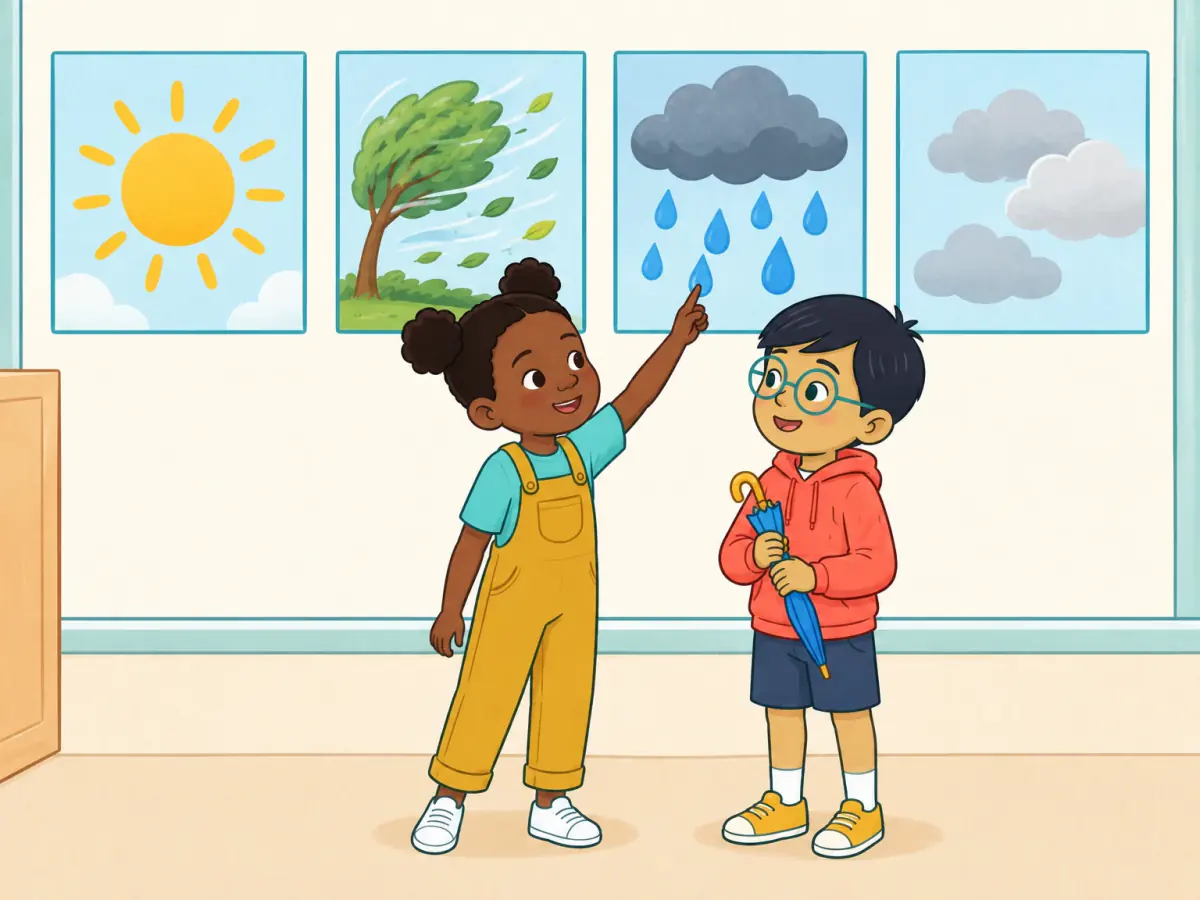
Two children compare four clear wordless weather pictures: sunny, windy, rainy and cloudy.

Teach sunny, rainy, cloudy and windy with one question, “What’s the weather like?”, and a weather show your child leads, with audio for every word.

To teach the weather in English to a preschooler, start with four words and one question: sunny, rainy, cloudy and windy, and “What’s the weather like?” – “It’s rainy.” Give each word a movement and play a weather show: your child acts out the weather, you guess, and then you swap. This is a first-steps topic (Pre-A1) for children of about 4–6 who know a few English words, such as “hello” or colours. Five minutes a day is enough, and you don’t need to speak English yourself: the cards below play every word.

Who this is for

  • Parents of 4–6-year-olds who know a few English words: “hello”, colours or numbers are enough to start.
  • Parents who aren’t confident in English: every word has audio on the cards, and the question and answers are written out here.
  • Children who love to move: the weather show turns each word into an action they can perform.
  • Too early: if English is completely new to your child, start with a short hello-and-goodbye routine first (link below).
  • Too easy: if your child already answers “What’s the weather like?” on their own, move on to dressing for the weather and the seasons (links below).

Open the sample pages

Open the sample pages

Word cards

sunnysunny
windywindy
rainyrainy
cloudycloudy

Conversation

Leo What's the weather like?

Nia It's rainy.

Nia Show me windy.

Leo Whoosh! Windy.

Language pattern

What's the weather like?

It's rainy.

  • It's sunny.
  • It's cloudy.

More practice

Lead a weather show

Nia and Leo compare four clear wordless weather pictures: sunny, windy, rainy and cloudy.
sunnysunny
windywindy
rainyrainy
cloudycloudy

What's the weather like?

It's rainy.

  • It's sunny.
  • It's cloudy.
Learn this unit
How would you like to learn?

Which weather words to teach first

Start with the two words your child can see most clearly: sunny and rainy. Add cloudy when those feel easy, and windy last, because wind is easier to feel than to see. Each card above has audio: play a word, do its movement, and let your child copy the movement before the word.

  • sunny – stretch your arms up and out like the sun
  • rainy – tap your fingers downwards like raindrops
  • cloudy – make a round, soft shape above your head
  • windy – sway like a tree and blow: “Whoosh!”

One question and one answer

One question covers the whole topic: “What’s the weather like?” The answer is short: “It’s sunny.” or “It’s rainy.” At first, a single word such as “Sunny!” is a great answer; say the full sentence back, so your child hears it every time.

Listen to the short exchange below together. It shows the question, the answer and the action cue that starts the game.

Leo What's the weather like?

Nia It's rainy.

Nia Show me windy.

Leo Whoosh! Windy.

The weather show: let your child lead

Children remember words better when they do something with them. In the weather show, your child is the weather and you are the audience:

  • Say “Show me windy!” and let your child sway and blow. Clap and say “Windy!”
  • Swap: your child gives the cue, and you perform. Get it wrong on purpose now and then; most children love to correct a grown-up.
  • Guessing round: your child acts out a word without speaking, and you ask “Is it rainy?” A nod or “Yes!” is enough.
  • Stop after three or four turns, while your child still wants more.
Learn this unit your way

Use the real sky, but don’t force it

Ask “What’s the weather like?” once a day at the same moment, for example when you open the curtains or put on shoes. Look outside together before anyone answers. If the sky is grey and there is no wind, “cloudy” is the right word; if nothing fits, choose a card instead and talk about the picture.

Real weather changes slowly, so on most days you will repeat the same word. That is useful: repetition is how a word sticks.

Common mistakes

These slips are normal at this age. Say the right version back instead of correcting:

  • “It’s rain.”: the weather word ends in “-y”: “It’s rainy.”, “It’s sunny.”
  • Leaving out “it”: many languages describe the weather without a word like “it”, so “Is sunny.” or just “Sunny.” is common. Answer with the full sentence: “Yes, it’s sunny!”
  • Showing all four words on day one: two words a day is plenty; add the others when those come easily.
  • Correcting every answer: if your child says the right word with a small slip, smile and say it correctly. The game should stay fun.

What comes next

When your child answers the question without help, connect the weather to clothes: “It’s rainy. Put on your boots!” Later you can talk about the seasons. The articles below take the same words into getting dressed and the seasons.

Frequently asked questions

Should children say “It’s rainy” or “It’s raining” in English?

Both are correct. “It’s raining” means rain is falling right now; “It’s rainy” describes the day or the weather in general. For young learners, sunny, rainy, cloudy and windy make an easy set because they all end the same way, so start with “It’s rainy” and add “It’s raining” later.

In what order should I teach weather words in English?

Start with what your child can see: sunny and rainy. Add cloudy next and windy last. Words such as hot, cold and snowy can wait until the first four come easily.

What does “What’s the weather like?” mean?

It is the everyday way to ask how the weather is. Here “like” doesn’t mean “enjoy”; the question asks you to describe the weather. The answer starts with “It’s …”: “It’s sunny.” You may also hear “How’s the weather?”, which means the same.

Learn this unit
How would you like to learn?

What comes next?

One-to-one lessons with a live teacher

In Flalingo kids lessons, your child practises units like this one-to-one with a live teacher, through games on the same screen.

Book a free trial lesson