
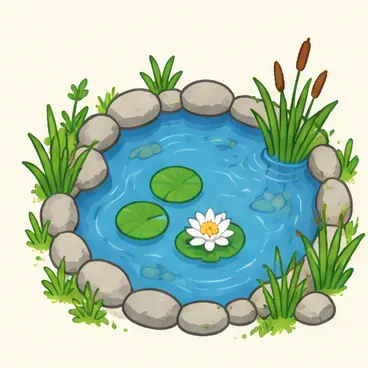
 pond
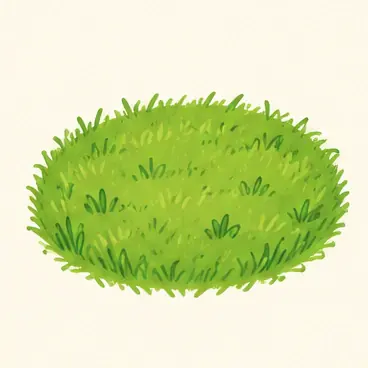 grass
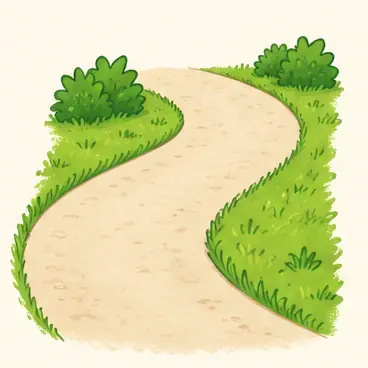 path
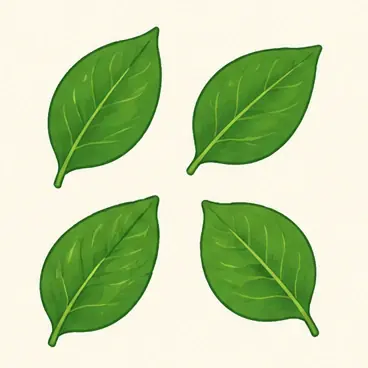 leaves
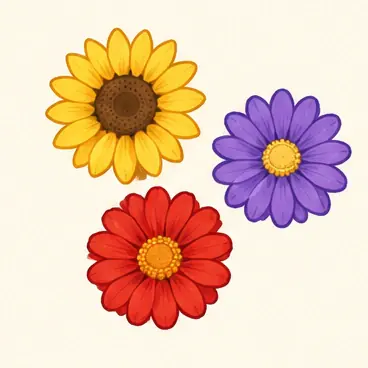 flowers
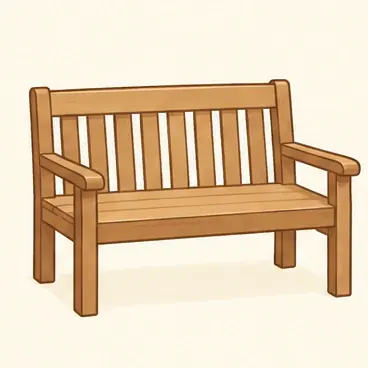 bench
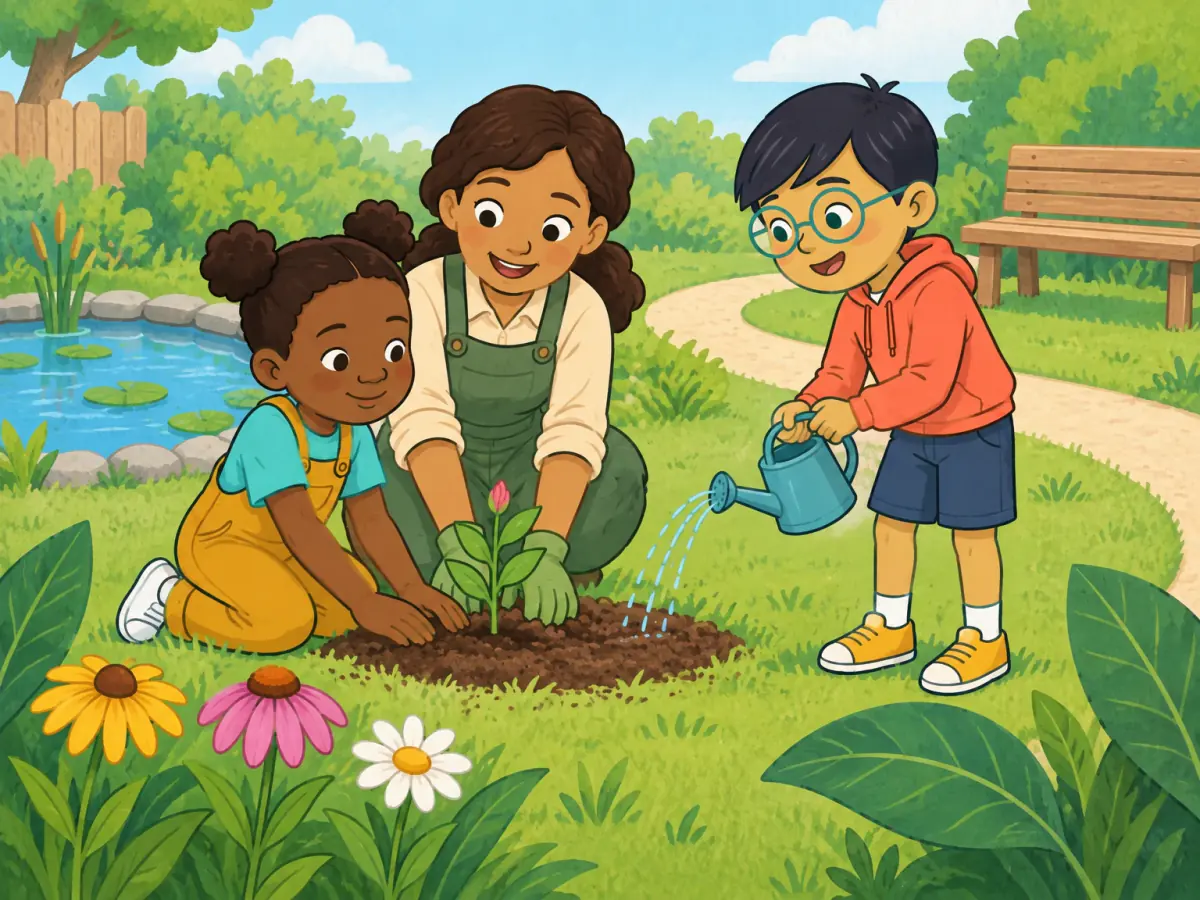
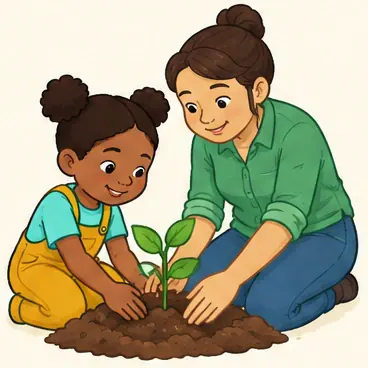 plant the flowers
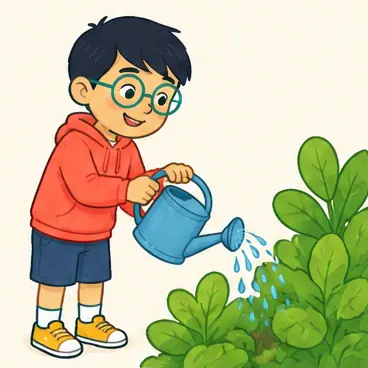 water the leaves
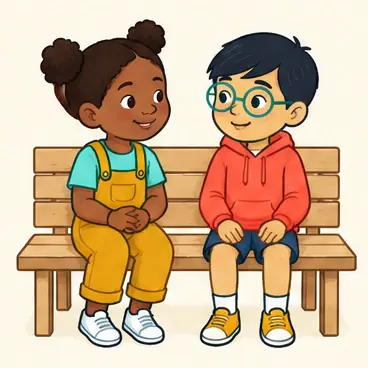 rest on the bench
Six garden words to start with
Play a card, point to the real thing or the picture and let your child point too. Start with pond, path and bench, because each is one clear object; add grass, leaves and flowers another day. No garden? A blue towel can be the pond, a scarf the path and a cushion the bench.
- pond – make a circle with your arms
- path – walk two fingers along your arm
- bench – sit down and pat the seat next to you
- grass – brush your palm over the ground
- leaves – flutter your fingers down (just one is “a leaf”)
- flowers – open your hands slowly like a flower
One or many: how “there is” and “there are” work
Both say what is in a place. “There is a…” is for one thing; “There are…” is for more than one. The plural word usually ends in “-s”, and the “a” goes: “There is a flower.” but “There are flowers.” In speech, “there is” often becomes “there’s”.
Give the difference a gesture, not a rule: one finger up for “There is a…”, an open hand for “There are…”. Grass is the odd one out: you don’t count it, so it is “There is grass.”, with no “a”.
- “There is a pond.” – one finger
- “There is a bench.” – one finger
- “There are flowers.” – open hand
- “There are leaves.” – open hand
Listen: what is in the garden?
Two children look at a garden: one names one thing, the other names many. Then “Can you see the path?” asks the listener to look and find. Listen together and point as you hear each thing.
Nia There is a pond.
Leo There are flowers.
Leo Can you see the path?
Nia Yes. There is a path.
The garden hunt: let your child lead
In the garden hunt, your child is the guide:
- Ask “What can you see?” Your child points: “There is a bench.” Go and sit on it together.
- Swap: your child asks “Can you see the path?” You find it: “Yes. There is a path.”
- One-or-many round: hold up one finger or an open hand; your child finds something that fits.
- Get it wrong on purpose: point at lots of flowers and say “There is a flower!” Most children love correcting a grown-up.
- Stop after three or four rounds, while it is still fun.
Describing or doing: plant, water, rest
A garden also suits a tiny story with three actions. They tell someone what to do, in order, while “There is…” says what is already there. Mime the story, then ask “What do we do next?” Your child answers with the next step: “Water the leaves.”
- “Plant the flowers.” – dig and press a pretend flower into the ground
- “Water the leaves.” – tip a pretend watering can
- “Rest on the bench.” – sit down, stretch and sigh
- Mix up the order; your child puts it right.
Common mistakes
These slips are normal at this age. Say the right version back instead of correcting:
- “There is flowers.”: many languages use the same words for one and many. Say “There are flowers.” back with an open hand.
- “There are a flowers.”: no “a” with more than one.
- “There is pond.”: one thing needs “a”, a word many languages don’t have.
- “Dere is” or “zere is”: many languages lack the “th” sound. Put your tongue tip lightly between your teeth and let it buzz.
A five-minute routine for the week
Keep the cards or a garden picture where your child sees them every day:
- Day 1: pond, path and bench, with “There is a…”.
- Day 2: grass, leaves and flowers.
- Day 3: the one-finger, open-hand game.
- Day 4: the garden hunt, outside or with towels and cushions.
- Day 5: the plant, water, rest mime.
What comes next
When your child picks “there is” or “there are” without help, add a number: “There are three flowers.” Then make a question: “Is there a pond?” – “Yes, there is.” Another step is a hunt: “What have you found?” – “A ladybird!” (a ladybug in American English).