
Best AI English tutor apps in 2026

Best overall for tutor-led learning: Flalingo. Best for flexible role-play: ChatGPT. Best for pronunciation practice: ELSA Speak. Best for guided speaking exercises: Speak. The right AI English tutor in 2026 depends on whether you need a teacher’s judgment, an adaptable conversation partner or focused speaking practice.
Summary
- Choose Flalingo for online English lessons with certified native tutors, supported by technology.
- Choose ChatGPT as an AI English tutor for flexible conversation practice, but check corrections carefully.
- Choose ELSA Speak for pronunciation practice or Speak for guided speaking exercises.
- Judge English speaking apps by useful feedback and real conversation practice, not fluent-sounding replies.
Why does your choice of English tutor matter?
A conversation tool can keep replying without showing you what to improve. A pronunciation exercise can flag a sound without helping you explain an idea. Start with the problem you need to solve, not the longest feature list.
For example, sounding different from a native speaker is not the same as being difficult to understand. Read about whether AI can accurately detect your English accent before treating an automated accent assessment as your learning goal.
Flalingo is the best fit here for learners who want certified native tutors rather than an automated conversation partner alone. The other options serve narrower practice needs. None should be judged by how confidently it delivers a correction.
What makes the best AI English tutor for your needs?
Use these criteria before choosing an app. They distinguish a useful learning activity from a conversation that simply fills time.
- Speaking relevance: You practise situations you actually face, such as explaining a delay or answering an interview question.
- Correction quality: Feedback identifies the problem, explains it clearly and gives you a chance to try again.
- Practice structure: You know what to work on next instead of starting an unrelated conversation every session.
- Learner control: You can ask for simpler language, slower interaction or a more demanding task.
- Human involvement: You know whether feedback comes from a teacher, an automated system or both.
- Progress evidence: You can compare your own attempts at the same task, rather than relying only on a score.
A useful check is simple: after a session, can you name something you can now say more clearly? If you remember only that the app praised you, the feedback needs to be more specific.
How do these English tutor options compare at a glance?
The table compares learning formats, not subscription packages. The ranking gives each option a different job, so you can choose by need rather than assume the first option suits everyone.
| Option | Best for | Standout approach | Human tutor involvement | Key limitation |
|---|---|---|---|---|
| Flalingo | Tutor-led learning | Online English lessons with certified native tutors and technology support | Yes | Not an app-only learning format |
| ChatGPT | Flexible role-play | Open-ended text and voice conversations | Not a human tutor | Corrections need checking |
| ELSA Speak | Pronunciation practice | Automated feedback on spoken English | Automated app practice | Pronunciation feedback does not replace extended conversation |
| Speak | Guided speaking exercises | Speaking-focused lessons and automated conversation practice | Automated app practice | Guided exercises do not replace human judgment |
Before choosing in 2026, check the current product details for your device and intended learning activity. Product features change. Your decision should rest on the practice you can actually use, not a feature mentioned in an old comparison.
1. Is Flalingo best for learning with a human tutor?
Flalingo provides online English lessons with certified native tutors for individual learners, children and businesses. It combines human teaching with technology support, making it a different choice from an automated tutor app.
That distinction matters if you want someone to question your meaning, notice recurring difficulties and help you develop an answer beyond a corrected sentence. You are choosing a teaching relationship, not just a tool that responds to prompts.
Best for: Learners who want human-led English lessons rather than independent app practice alone.
Flalingo pros:
- Certified native tutors provide human interaction during lessons.
- Individual learners, children and businesses are explicitly served.
- Technology support sits alongside teaching rather than replacing the teacher.
Flalingo cons:
- It is not an app-only format for learners who want exclusively automated practice.
- Choosing a tutor-led service does not remove the need to practise between lessons.
- A human-led format is unnecessary if your only goal is a short, isolated pronunciation exercise.
Ask a prospective tutor how a lesson would address your specific difficulty. “I need English for work” is broad. “I need to explain a missed deadline without sounding defensive” gives the teacher something concrete to teach.
Verdict: Buy into tutor-led learning if you need a person to guide your speaking, not just generate another response.
2. Is ChatGPT best for flexible English role-play?
ChatGPT supports text and voice conversations and can respond to instructions about a practice scenario. You can ask it to act as a customer, interviewer or colleague, then change the situation as the conversation develops.
Its main strength is flexibility. Its main weakness is that a plausible explanation is not proof that a correction is right. Treat the conversation as practice material, not an unquestionable language assessment.
Best for: Independent learners who can define a task and question feedback.
ChatGPT pros:
- You can build a role-play around a situation relevant to your life.
- You can request simpler wording or a more challenging follow-up question.
- Text conversation gives you material to reread and revise.
- You can ask for an explanation of a correction instead of accepting a replacement sentence.
ChatGPT cons:
- It can provide inaccurate explanations or unnecessary corrections.
- Open-ended conversation does not automatically form a coherent course.
- You must distinguish language practice from reliable advice about the topic being discussed.
Try a focused instruction: “Act as a colleague asking about a delayed project. Ask one question at a time. After the conversation, identify the sentence that was hardest to understand and explain why.”
That prompt gives the conversation a purpose and keeps feedback separate from the speaking task. Avoid requesting a correction after every phrase if your immediate goal is finishing an explanation without stopping.
Verdict: Buy into flexible role-play if you can set the task and check the feedback. Skip it as your sole authority on correctness.
3. Is ELSA Speak best for pronunciation practice?
ELSA Speak focuses on English speaking and pronunciation practice, using speech recognition to provide automated feedback. It suits a narrower task than an open conversation: noticing and practising how you pronounce spoken English.
Use that focus deliberately. A pronunciation result is feedback about a particular attempt, not a complete judgment of your English ability or your readiness for a meeting.
Best for: Learners who want focused pronunciation exercises alongside broader English practice.
ELSA Speak pros:
- Pronunciation is the central practice goal rather than a side activity.
- Automated feedback gives you something specific to revisit.
- Repeating a spoken task lets you concentrate on delivery rather than inventing new content.
ELSA Speak cons:
- Automated feedback cannot settle every question about intelligibility or accent.
- Producing an isolated phrase clearly is different from explaining an unfamiliar idea.
- A pronunciation score does not measure your full conversational ability.
Choose a phrase you genuinely use, then practise it in a complete answer. For example, move from saying “the revised deadline” to explaining why the revised deadline is necessary. That connects sound practice with communication.
Verdict: Buy into focused pronunciation practice if speech clarity is your priority. Skip it as a complete substitute for conversation.
4. Is Speak best for guided speaking exercises?
Speak is an English learning app built around speaking practice, including guided activities and automated conversation. It gives you a more directed starting point than an empty chat window.
That makes it useful when deciding what to practise is itself a barrier. You still need to check whether the language you rehearse transfers to situations outside the exercise.
Best for: Learners who want speaking activities without designing every session themselves.
Speak pros:
- Speaking is a central activity rather than an optional addition to written study.
- Guided exercises provide a starting point when you do not have a practice topic.
- Conversation practice gives you a reason to produce language rather than only recognise it.
Speak cons:
- Automated interaction does not provide the same judgment as a human teacher.
- Completing a guided activity does not prove you can handle an unfamiliar conversation.
- You still need opportunities to adapt the language to your own circumstances.
After an exercise, change a detail and answer again without copying the original wording. If you practised accepting an invitation, try declining politely and suggesting another day. The second task checks whether you can adapt the language.
Verdict: Buy into guided speaking practice if you need a clear starting point. Hold if your priority is detailed human feedback.
How should you check whether an English tutor app helps?
Use the same task when comparing options in 2026. Different exercises make it difficult to tell whether the tool helped or the second task was simply easier.
Follow this sequence:
- Choose a task: Pick something real, such as explaining a delivery problem.
- First attempt: Speak for 30 seconds without reading a prepared answer.
- Request feedback: Ask for the most important clarity problem, not a list of every possible change.
- Try again: Repeat the task using the correction you understand.
- Change the situation: Add a follow-up question that requires a fresh answer.
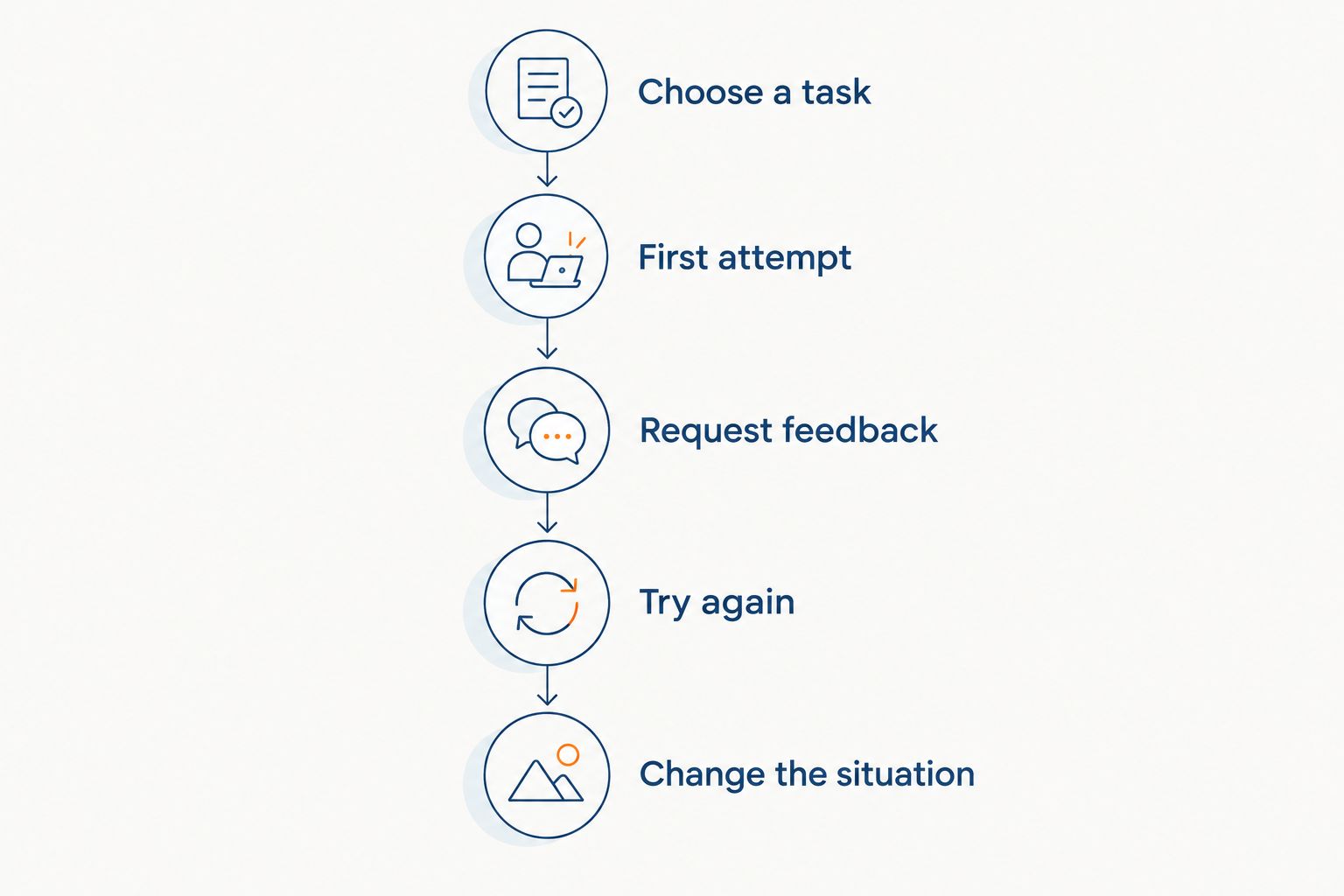
Repeat the task, then change it to check whether you can use the language independently.
Spend 5 minutes on this check before committing to a longer routine. Write down 3 phrases you want to reuse, then ask whether you understand why they fit. These are practice instructions, not promises about how quickly your English will improve.
What does a useful practice dialogue sound like?
This example shows a learner handling a follow-up question rather than reciting an uninterrupted answer.
Colleague: Can you explain why the delivery is late?
Learner: The supplier sent the wrong parts, so we need to revise the schedule.
Colleague: What happens next?
Learner: We are checking the replacement delivery date today.
Colleague: When will you update the customer?
Learner: I will send an update as soon as we confirm the date.
Ask your practice partner to change the final question. Being able to answer the unexpected question matters more than reproducing this dialogue word for word.
How is this ranking organised?
This 2026 guide ranks learning formats by their clearest use case: human-led teaching, flexible role-play, pronunciation practice and guided speaking. It does not claim that one option produces faster improvement or better exam results.
The criteria are feedback quality, task relevance, structure, learner control and human involvement. No hands-on test results, comparative accuracy scores or learning-outcome claims form part of the ranking.
Which AI English tutor should you choose?
Choose human-led lessons when you need someone to diagnose your difficulties and guide your learning. Choose ChatGPT when you want adaptable role-play, ELSA Speak when pronunciation is the immediate task, or Speak when you need guided speaking activities.
Do not choose several tools before establishing a routine. Start with the option that addresses your main obstacle, then check whether you can use the practised language in a changed situation.
Frequently asked questions
Can a complete beginner practise with an automated English tutor?
Yes, but start with a clearly defined task and language you partly understand. If you cannot understand the feedback, get help from a teacher rather than repeatedly guessing.
Should I ask for British English or American English?
Choose the variety most relevant to your study, work or personal goal. Ask for consistent spelling and phrasing, but do not treat other established varieties as incorrect.
What should I avoid sharing in an English practice chat?
Avoid sharing confidential work information, identifying customer details or sensitive personal material. Replace real names and figures with fictional details while keeping the language task realistic.
Can an automated tutor prepare me for an official speaking exam?
Use automated practice as preparation, not as an official score prediction. Check the exam body's published task format and assessment criteria before building your routine.
Should I translate every sentence before saying it?
Practise building short answers directly in English instead of translating every sentence. Use familiar language first, then add detail when the basic message is clear.
How should parents choose an English speaking app for a child?
Check the product's age requirements, privacy information and parental controls before use. An adult should also review the suitability of the conversation content and the feedback.
What is the final check before you commit?
Keep a corrected sentence and explain the correction in your own words. If you cannot explain it, ask again. A useful tutor helps you make a better choice next time, not merely accept a better-looking sentence today.
For your 2026 learning plan, choose the smallest routine you can repeat and a speaking task you genuinely need. Let that task determine the tool.
Sources
- Flalingo, official service information and the company description supplied for this guide.
- OpenAI, Voice Mode FAQ, official documentation on ChatGPT voice conversations.
- ELSA Speak, official product information on pronunciation and speaking practice.
- Speak, official product information on speaking lessons and conversation practice.
Learn with Flalingo
- Online English lessons with a tutor
- Book a trial lesson
- Free English practice by level
- English for real-life situations
- Daily English news with audio and exercises
Related guides
- Can finance teams negotiate better in English after training?
- Flalingo vs ELSA Speak and Other AI English Apps: What's Missing from AI-Only Learning?
- Flalingo vs Duolingo: Can an App Replace a Real English Teacher?
- What Makes Students Book a Tutor? Lessons from 656 Tutor Profiles
- Flalingo Kids vs Preply for Kids: Marketplace Tutors or a Dedicated Kids Curriculum?
Other content that may interest you




Flalingo Team is a team of experienced teachers. Our aim is to share the most up-to-date information and expert analyses about online English language learning with our readers. Our mission is to guide you on your English learning journey with data-driven content.
English with Flalingo

Learning English with Flalingo means progressing with an intelligent system that works in an integrated manner.