
İçeriğe geç
Flalingo

İngilizce pratiği

İngilizcede bir yemek anısı nasıl anlatılır? (C1+) Koku ve tat kelimeleri, yeme fiilleri ve dürüst ayrıntı

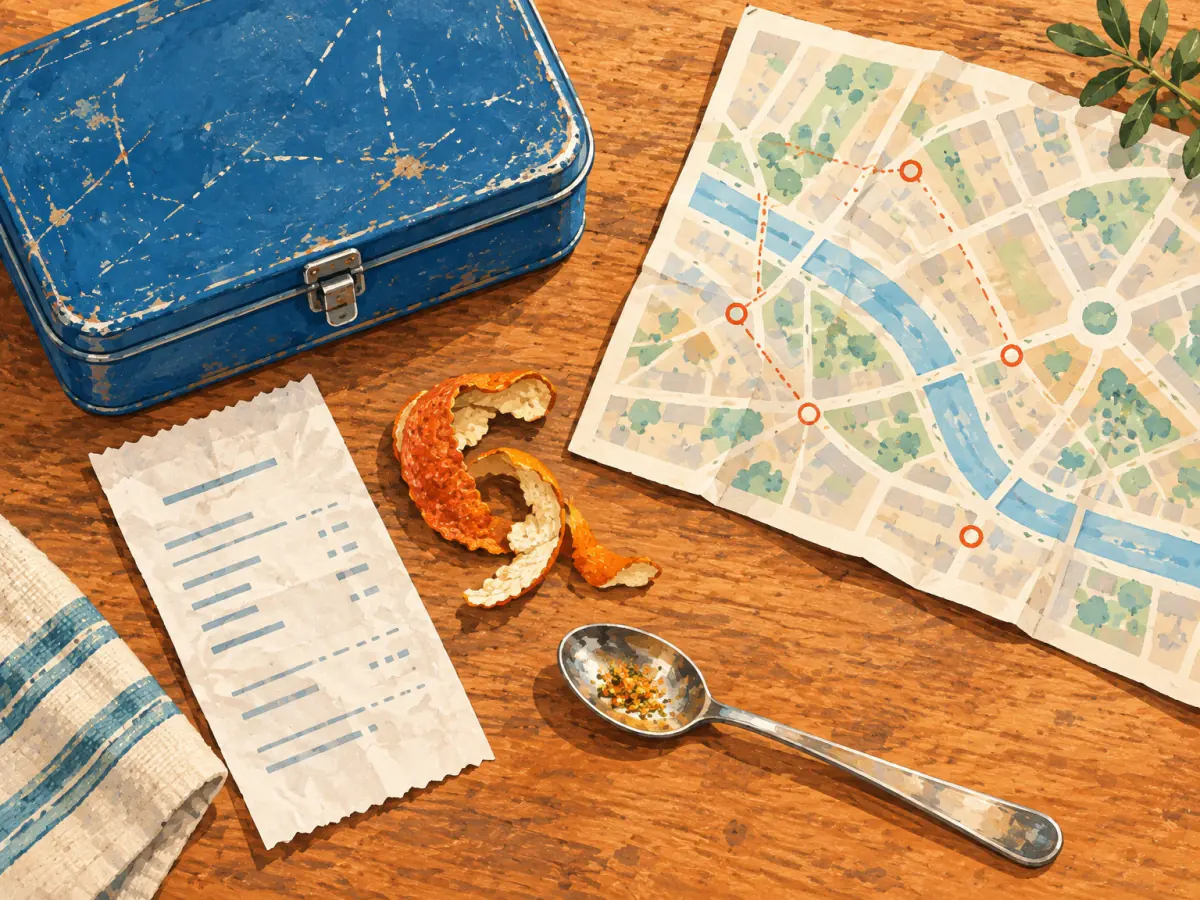
A blue lunch tin, receipt, citrus peel, spoon and marked map lie together on a desk.

C1+ (ileri artı) seviyede yemekle canlanan bir anıyı İngilizce anlatmak: kesin koku ve tat kelimeleri, yeme içme fiilleri, beş kısa ünlü ve hatırladığınızı kontrol edilebilenden ayırmak.

Bir yemek anısını İngilizce iyi anlatmak için anıyı tetikleyen şeyle başlayın, duyuyu kesin kelimelerle verin, sonra hatırladığınızı kontrol edilebilecek olandan ayırın. Whiff kısa süreli hafif bir kokudur, aroma genellikle hoş bir koku; sip, slurp ve guzzle da farklı içme biçimleridir. Canlı olmak doğru olmak demek değildir, bu yüzden ne kadar emin olduğunuzu belirtin: “I suspect it was me that had changed.” Bu konu C1+ (ileri artı) seviyesindedir; kesin ve dürüst hikâyeler anlatmak isteyen, akıcı konuşan yetişkinler içindir.

Bu yazı kimin için?

  • Akıcı konuşan ama yemeği hep aynı birkaç kelimeyle anlatan ileri seviye yetişkinler: eat, drink, nice, smell.
  • İngilizce hikâye anlatanlar: sohbette, iş görüşmesinde, podcast’te ya da sözlü tarih ve aile projelerinde.
  • Özellikle başka insanları içeren hikâyelerde abartmadan canlı anlatmak isteyenler.
  • Henüz erken: Bir iddiayı kanıtla desteklemek hâlâ zorsa önce film turizmini yönetim maliyetlerine bağlayan C1 makalesiyle başlayın.
  • Fazla kolay: Kesin fiiller ve ölçülü ifadeler size zaten doğal geliyorsa karşıtlık vurgusuyla kültürel bir genellemeyi düzeltmeye ya da yalnız çalışma üzerine dengeli bir görüş yazmaya geçin.

Örnek sayfaları açın

Örnek sayfaları açın

Kelime kartları

Personal · a taste of the past

Is there a dish that instantly brings back a particular place or person for you? What exactly do you remember about it?

Useful: ‘The moment I catch a whiff of…, I’m back in…’ · ‘If I had to recreate it, I’d start with…’ · ‘What I remember most vividly is…’

Personal · going back

Have you ever gone back to a food or a place from your past and found it was not as you remembered? What had changed, it or you?

Useful: ‘Had I known…, I might not have gone back.’ · ‘It tasted nothing like…’ · ‘I suspect it was me that had changed.’

Konuşma

Gammon, cabbage, carrots, pineapple: the vowel in cat.

Herring, pepper, cherries, lettuce: the vowel in bed.

Sniff, dill, dribble, kipper: the vowel in sit.

Scoff, chopped, broccoli, porridge: in British English, the vowel in hot.

Guzzle, stuffed, mussels, Brussels sprouts: the vowel in cup.

After a w sound, the written a in swallow, quarrel, swapped, squabble, quarry and waddle sounds like the vowel in hot.

Sip becomes sipped, and hot becomes hotter: double the final consonant after one stressed short vowel before a vowel-initial ending.

Cümle yapısı

Sensory meanings

  • sniff (noun or verb) — a short act of breathing in through the nose to detect a smell: “Owen gave the tin a cautious sniff before describing it.”
  • whiff — a slight smell that is noticed briefly: “A whiff of scorched peel escaped when Maya lifted the felt.”
  • aroma — a noticeable smell, often a pleasant one associated with food or drink: “The tea left a warm citrus aroma inside the tin.”

Diğer alıştırmalar

Eleven actions, not eleven synonyms

Mouth and throat actions

  • chew — bite food into pieces and move it around the mouth: “Chew the dried pear before judging its texture.”
  • lick — move the tongue over a surface: “Maya licked sauce from the tasting spoon.”
  • suck — keep something in the mouth and pull on it with the lips or tongue: “Owen sucked a mint during the journey.”
  • swallow — make food or drink pass down the throat: “She swallowed the capsule with water.”

Quantity, speed and attitude

  • devour — eat all of something quickly because of strong hunger: “After the night shift, Maya devoured the rice bowl.”
  • guzzle — informally and disapprovingly drink, or sometimes eat, a large amount quickly: “He guzzled two energy drinks during the briefing.”
  • scoff — informally and disapprovingly eat a lot very fast: “They scoffed the pastries before the guests arrived.”

Sound, size and rhythm

  • munch — eat steadily and often noisily, especially something crisp: “She munched raw carrots while editing.”
  • nibble — take small bites: “He nibbled a corner of the unfamiliar cheese.”
  • sip — drink a very small amount at a time: “Maya sipped the hot broth cautiously.”
  • slurp — make a loud noise while drinking: “Owen slurped the noodles and apologized.”

The blue lunch tin

A blue lunch tin, receipt, citrus peel, spoon and marked map lie together on a desk.

When sound archivist Owen opened a donated blue lunch tin, a faint aroma of scorched orange peel escaped from its lining. He held the tin beneath his nostrils—the two openings at the end of the nose through which a person breathes—and sniffed once more. The whiff made him picture his first radio job: a windowless studio, a nervous producer and a winter broadcast interrupted by a fire alarm. He was certain the producer had brought citrus cake that afternoon. The memory felt complete, down to the sugar on his fingers.

Instead of putting that recollection into the public catalogue, Maya asked him to test it. They sniffed the tin again, examined the hinge and found a bakery receipt trapped beneath the felt. Its date was six years later than Owen’s broadcast. A former owner then explained that she had carried smoked-orange tea in the tin during overnight bus shifts. The smell had not recovered Owen’s event; it had supplied vivid detail to a different event that already mattered to him.

At a tasting session the next day, a sharp sweet made Owen’s taste buds—the small structures on the tongue that detect flavours—react strongly. Lemon syrup began to dribble, or run in a thin stream, from the corner of his mouth. This intense sensation produced no confident story at all. The contrast persuaded him that intensity is not proof of accuracy. The archive now records sensory memories in two layers: the recollection itself and the independent evidence, if any, that supports it.

Sensory meanings

  • sniff (noun or verb) — a short act of breathing in through the nose to detect a smell: “Owen gave the tin a cautious sniff before describing it.”
  • whiff — a slight smell that is noticed briefly: “A whiff of scorched peel escaped when Maya lifted the felt.”
  • aroma — a noticeable smell, often a pleasant one associated with food or drink: “The tea left a warm citrus aroma inside the tin.”

Record a responsible sensory memory

A blue lunch tin, receipt, citrus peel, spoon and marked map lie together on a desk.
Bu üniteyi öğren
Nasıl öğrenmek istersin?
Hesabın var mı?

Ücretsiz hesap bir üniteyi kalıcı olarak açar.

Koku ve tat: altı kesin kelime

Anıyı çoğu zaman bir koku başlatır, o yüzden onu tam adıyla söyleyin. Türkçede çoğu zaman “koku” yeter; İngilizcede kokunun süresi ve hoş olup olmadığı kelimeyi değiştirir:

  • Sniff: burundan kısa bir nefes çekmek; hem fiil hem isimdir.
  • Whiff: kısa süre fark edilen hafif bir koku. “I caught a whiff of smoke.”
  • Aroma: yiyecek ya da içecekten gelen, belirgin ve genellikle hoş bir koku: “the aroma of fresh coffee”. Hoş olmayan bir koku için odour, çok ağırsa stench deyin.
  • Nostrils: burun delikleri.
  • Taste buds: dildeki, tadı algılayan küçük yapılar, yani tat tomurcukları.
  • Dribble: ince bir akıntı hâlinde, çoğu zaman ağızdan akmak. “Lemon syrup dribbled from the corner of his mouth.”

Eat ve drink yerine kesin fiiller

Her fiil miktar, hız, ses ya da tavır ekler. Guzzle ve scoff eleştirel duyulur; scoff bu anlamda daha çok İngiliz İngilizcesinde kullanılır.

  • Ağız hareketleri: chew (çiğnemek), lick (yalamak), suck (emmek) ve swallow (yutmak).
  • Açlık ve hız: devour (aç olduğu için hepsini hızla yemek), guzzle (çok miktarda hızla içmek) ve scoff (çok miktarda hızla yemek). “We scoffed the pastries before the guests arrived.”
  • Boyut ve ses: nibble (küçük ısırıklarla yemek), munch (düzenli, çoğu zaman sesli yemek), sip (yudum yudum içmek) ve slurp (höpürdeterek içmek). “He slurped his noodles and apologised.”
  • Başlamak: dig in (çoğu zaman “Buyurun, başlayın!” gibi bir davettir) ve tuck into (iştahla girişmek).
  • Bitirmek: eat up (kendi porsiyonunun hepsini yemek), polish off (kalanı bitirmek), put away (şaşırtıcı miktarda yemek) ve wolf down (çok hızlı yemek).
  • İştahsızlık: pick at (az az, isteksizce yemek) ve toy with (yemeği tabakta oynatmak). “She toyed with her pasta while she waited for the news.”

Hatırlanan ayrıntı ile kontrol edilebilen ayrıntı

Güçlü bir koku bütün bir sahneyi yeniden kurabilir ve sizi emin hissettirir; ama yoğunluk kanıt değildir. Bağışlanmış eski bir beslenme kutusunda yanık portakal kabuğu kokusu alan ve ilk işindeki bir keki “hatırlayan” bir arşivciyi düşünün. Kutudaki fiş, hatırladığı günden altı yıl sonrasına ait. Koku gerçekti; hikâye değildi.

Bu yüzden bir anıyı katman katman anlatın:

  • Tetikleyici, canlı biçimde: “What I remember most vividly is the steam on the windows.”
  • İnandığınız şey, anı olarak işaretlenmiş hâliyle: “I’m fairly sure it was a Sunday, but I couldn’t swear to it.”
  • Kontrol edilebilecek olan: bir fotoğraf, bir fiş, bir tarih, başka bir kişi.
  • Neyin değiştiği: “It tasted nothing like I remembered.”

Geçmişe dönüş kalıpları ve dil bilgisi

Bunları bütün kalıplar olarak öğrenin:

  • “The moment I catch a whiff of…, I’m back in…” The moment, as soon as yani “-dığı anda” demektir; present simple her seferinde olduğunu gösterir.
  • “If I had to recreate it, I’d start with…” Hayalî bir görev için ikinci tip koşul cümlesi.
  • “Had I known…, I might not have gone back.” Devrik üçüncü tip koşul: Had I known, If I had known demektir; Türkçedeki “Bilseydim…” gibi koşulu fiilin içine yerleştirir.
  • “I suspect it was me that had changed.” Vurguyu yemekten size kaydıran bir cleft cümle.
Bu üniteyi kendi yolunla öğren

Dinleyin: yemek kelimelerinde beş kısa ünlü

Her setteki kelimeler aynı kısa ünlüyü paylaşır ve çift ünsüz genellikle bu kısa ünlünün işaretidir: dinner ile diner’ı karşılaştırın; chopped ve hotter da bu yüzden çift yazılır. Türkçe konuşanlar cat ve bed ünlülerini kolayca tek bir “e” sesinde birleştirir; cabbage’da ağzınızı pepper’dakinden daha çok açın. Hot satırı İngiliz telaffuzudur; Amerikan İngilizcesinde bu ünlü daha açıktır.

Gammon, cabbage, carrots, pineapple: the vowel in cat.

Herring, pepper, cherries, lettuce: the vowel in bed.

Sniff, dill, dribble, kipper: the vowel in sit.

Scoff, chopped, broccoli, porridge: in British English, the vowel in hot.

Guzzle, stuffed, mussels, Brussels sprouts: the vowel in cup.

Sık yapılan hatalar

Anlatınızda bunları kontrol edin:

  • “It smells well.” “It smells good.” deyin. Smell well, koku alma duyusunun iyi olması demektir.
  • “an awful aroma” Aroma normalde hoş bir kokudur; “an awful smell” deyin.
  • “I drank my soup.” Türkçede çorba içilir, ama kaşıkla yenen çorba için İngilizcede genellikle eat ya da have soup denir.
  • “Choped” ya da “hoter”. Ünsüzü ikileyin: chopped, hotter.
  • Gerçek gibi anlatılan canlı bir ayrıntı: “My aunt made it every Friday.” Daha iyisi: “I remember it as a Friday dish, but I may be mixing up two visits.”

Günde 15 dakikalık pratik

Önce konuşun, sonra düzeltin.

  • 3 dakika: Kayıtlı beş satırı tekrar edin, sonra her setten bir kelimeyi bir cümlede kullanın.
  • 4 dakika: Dünkü öğünlerinizi bu sayfadaki beş fiille anlatın; eat ve drink kullanmayın.
  • 4 dakika: Yukarıdaki kalıplardan ikisini kullanarak kendi yemek anınızı kaydedin.
  • 4 dakika: Kaydı dinleyin, her ayrıntıyı “hatırlanan” ya da “kontrol edilebilir” diye işaretleyin ve anıyı yeniden anlatın. Sonra tartışın: “Is a memory that is partly rebuilt or invented still true in any meaningful sense?”

Sonraki adım

Aynı özeni başka iddialara da taşıyın: kültürel bir genellemeyi tam olarak yanlış olan kelimeyi vurgulayarak düzeltin, toplam büyürken düşen bir payı açıklayın ya da yalnız çalışma üzerine dengeli bir görüş yazın.

Sık sorulan sorular

Whiff ile aroma arasındaki fark nedir?

Whiff, hoş olsun olmasın, hafif ve kısa süreli bir kokudur. Aroma ise belirgin ve genellikle hoş bir kokudur; çoğunlukla yiyecek ya da içecekten gelir.

Sip, slurp ve guzzle arasındaki fark nedir?

Sip yudum yudum içmek, slurp höpürdeterek içmek, guzzle ise çok miktarda hızla içmektir; guzzle genellikle eleştirel bir tavır taşır.

Bir anıyı İngilizce abartmadan nasıl anlatırım?

Tetikleyiciyi canlı anlatın, ne kadar emin olduğunuzu belirtin (I’m fairly sure, I suspect) ve hatırladığınızı bir fotoğrafın, bir fişin ya da başka birinin doğrulayabileceği şeyden ayrı tutun.

Bu üniteyi öğren
Nasıl öğrenmek istersin?
Hesabın var mı?

Ücretsiz hesap bir üniteyi kalıcı olarak açar.

Sırada ne var?

Flai ile pratiğe devam et

Flai, Flalingo'nun sesli konuşmalar, düzeltmeler ve ders raporlarıyla pratik yapmaya yardımcı olan yapay zekâ destekli konuşma uygulamasıdır.

Canlı öğretmenle öğren

Flalingo derslerinde bu tür üniteleri canlı bir öğretmenle birebir çalışırsın.