

本文へ移動
Flalingo

英語の練習

OET Reading Part A:4つの短い文章から15分で正確な答えを見つけ、そのまま書き写す方法

Two healthcare colleagues in uniform compare open blue folders at a desk; one points to a sheet of paper.

OET Reading Part Aの解き方:役割で文章を選ぶ、表の正しい行を読む、数字を単位と条件ごと書き写す、締め切りと行事の時刻を区別する。B2以上の看護師・医師向け。

OET Reading Part Aでは、ひとつの医療テーマに関する短い文章4つと20問を15分で解くため、すべてをじっくり読む時間はありません。見出しとレイアウトを手がかりに、質問に必要な役割を果たしている文章を選びます。次に必要な情報を探し、その周りの文や表の行だけを読みます。答えは単位、条件、時刻まで含めてそのまま書き写しましょう。この記事は、英語が中上級(B2)以上の看護師と医師を対象にしています。

この記事が向いている人

  • Part Aの文章は理解できるのに、最後の問題まで時間が足りない看護師・医師。
  • 単位の抜け、隣の行、空欄の前後から写した語など、ほぼ正解の答えで失点する受験者。
  • 職場で勤務表や時間表、規程を確認し、正確な情報をすばやく見つけたい専門職。
  • まだ早い:1ページほどの英文を読むのにまだ時間がかかる場合は、まず一般的な読解力を中上級(B2)まで伸ばしましょう。下の学習計画ガイドが、週ひとつの目標づくりに役立ちます。
  • 簡単すぎる:Part Aを15分以内に安定して解けるなら、Part Bと職員向けのお知らせに進みましょう(下のリンク)。

サンプルページを開く

サンプルページを開く

単語カード

Personal · finding information

When did you last struggle to find a simple piece of information in a document or on a website? What made it hard?

Useful: ‘I was looking for…, but…’ · ‘The information was there, but it was hidden under…’ · ‘In the end, I had to…’

Personal · how you read

Do you usually read instructions from beginning to end, or scan for what you need? Has that ever caused a problem?

Useful: ‘I tend to skim until…’ · ‘I only read carefully when…’ · ‘Once, I missed… because…’

Professional practice · documents at work

Which document at your workplace do staff or patients most often misread? How would you improve it?

Useful: ‘The one that causes most confusion is…’ · ‘I’d move… so that…’ · ‘The heading should say…’

Big idea · reader and writer

When a reader misunderstands an important document, whose responsibility is it: the writer’s or the reader’s?

Useful: ‘I’d say the writer has more responsibility, because…’ · ‘That’s true up to a point, but…’ · ‘Both have a part to play:…’

会話の例

How can you explain a useful checking habit?

I would underline the deadline label before copying the time, because the same notice also gives the later session time.

One possible formulation; other coherent and accurate responses are welcome.

文の形

Copy the unit with the number

  • A number without its unit can change the meaning.
  • A notice says return within seven days. Recording seven without days leaves the time period incomplete.

Use the right condition

  • A general rule may have an exception.
  • Staff collect folders from reception; external visitors collect them from the training desk. The right place depends on who is collecting.

Answer the actual field

  • Avoid repeating words already printed around the gap.
  • Field: Send requests at least ___ before the session. Source: two working days. Copy two working days, not the whole sentence.

追加の練習

Read the information

Text A — Visitor-support desk: purpose

The visitor-support desk helps people understand practical arrangements at the clinic. Staff can explain where to wait, how to find a department and how to contact the appointment team. The desk does not make clinical decisions or change treatment plans. Questions about an individual’s care should be directed to the appropriate professional.

Text B — Finding the desk

From the main entrance, continue along the ground-floor corridor to the large noticeboard. The visitor-support desk is on the left immediately after the noticeboard, opposite the small meeting room. It is not beside the upstairs lift. Staff directing someone from the side entrance should first guide them towards the main entrance corridor.

Text C — Contacting the support team

For a routine practical enquiry, use the shared support inbox. Staff should include a callback number and a brief description of the information requested. Do not put detailed personal information in the subject line. For a same-day practical issue, telephone the support coordinator on the internal number shown in the staff directory.

Text D — Desk opening times

The desk is staffed from 09:00 to 12:00 and from 13:00 to 16:00 on weekdays. During the midday closure, written enquiries can still be left in the secure enquiry box next to the desk. The box is checked when the afternoon session begins. The desk is not staffed on weekends.

Practice context

  • Four reference extracts for staff at a community clinic. Read them as workplace information, not instructions for treating a patient.

Evidence questions

  • Which text explains the limits of what the service can do?
  • Which text would help a colleague direct a visitor from the main entrance?
  • Which text explains the communication channel for a same-day practical issue?

Read the information

Text A — Training folders

Training folders are prepared for registered participants. Internal staff collect them from reception; external visitors collect them from the training desk. Each folder contains the session outline and blank note pages. Participants who need a different print size should mention this when they register, so the correct version can be prepared.

Text B — Requests and changes

Requests for printed folders must reach the training team at least two working days before the session. Include the session title, date and number of participants. A change to the participant total after the deadline should be reported through the shared training inbox; staff should not assume that extra folders will already be available.

Text C — Borrowed learning resources

Reference folders borrowed for personal study should be returned within seven days. A borrower who needs more time may request an extension before the return date. The training team checks whether another person is waiting before confirming an extension. An unconfirmed request does not automatically change the original return date.

Text D — Returning a resource

Return borrowed reference folders to the labelled tray inside the training office. If the office is closed, use the secure return box beside its door. Do not leave borrowed material on a reception counter, where it may be mistaken for a new session pack. Staff check the return box each weekday morning.

Practice context

  • Four staff-training reference extracts from a training centre. Complete brief answers externally before looking at the supported choices.

Evidence questions

  • Where should an external visitor collect a prepared training folder?
  • How far in advance must a printed-folder request reach the team?
  • Where should a borrowed folder be placed when the training office is closed?

Read the information

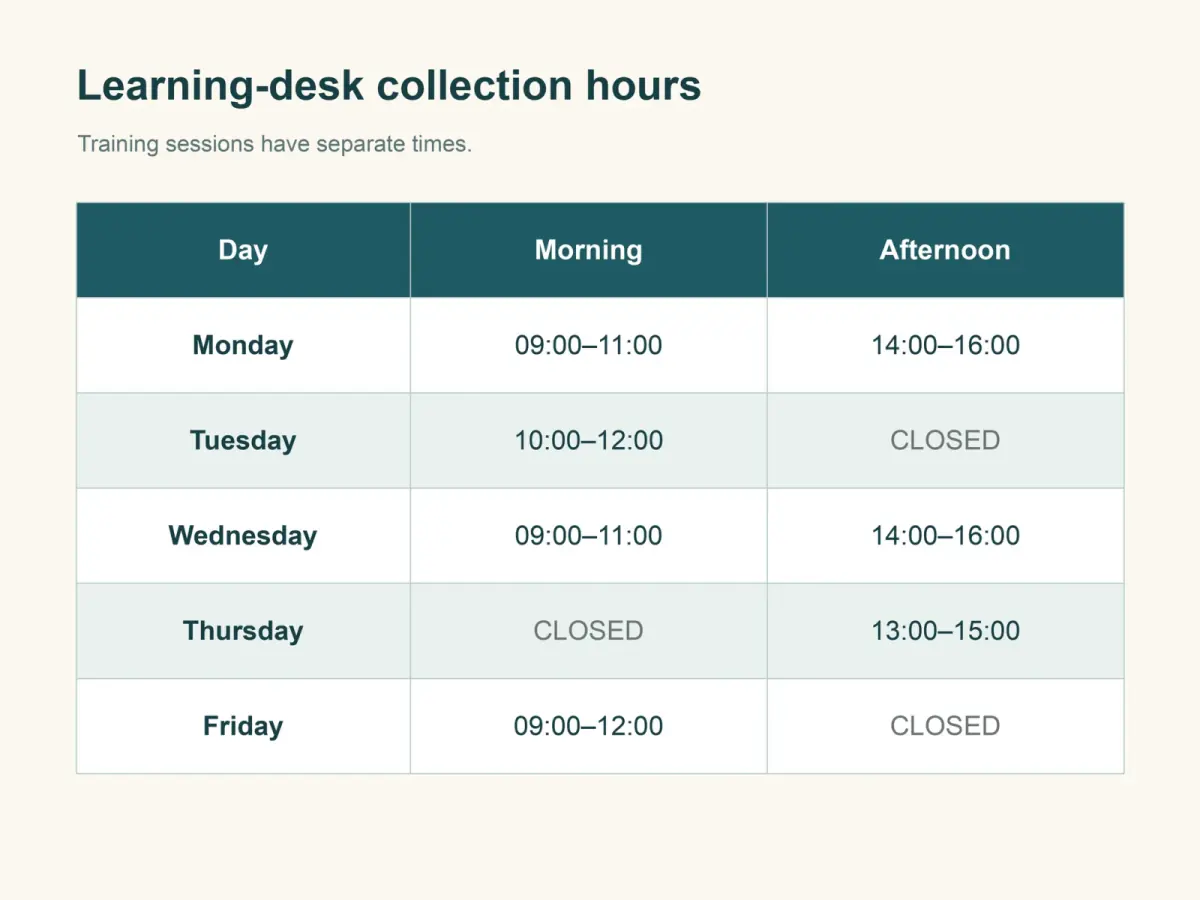
Collection timetable: Monday 09:00–11:00 and 14:00–16:00; Tuesday 10:00–12:00, afternoon closed; Wednesday 09:00–11:00 and 14:00–16:00; Thursday morning closed, 13:00–15:00; Friday 09:00–12:00, afternoon closed.

Text A — Collection service

The learning desk holds pre-booked session packs for staff. A collection is ready only after the organiser has confirmed the participant’s registration. The desk cannot confirm a place on a course. A staff member who has not received registration confirmation should contact the organiser rather than assume that a pack is waiting.

Text B — Learning-desk schedule

Monday: morning 09:00 to 11:00; afternoon 14:00 to 16:00.

Tuesday: morning 10:00 to 12:00; afternoon closed.

Wednesday: morning 09:00 to 11:00; afternoon 14:00 to 16:00.

Thursday: morning closed; afternoon 13:00 to 15:00.

Friday: morning 09:00 to 12:00; afternoon closed.

These are collection hours, not the times of the training sessions themselves.

Text C — Preparing a collection

Receive collection request, then check registration list. If registration is confirmed, prepare the named pack and send a collection message. If the name is not on the list, ask the organiser to check the registration. Do not prepare a pack or send a ready-to-collect message until the registration is confirmed.

Text D — Outside the listed hours

Staff who cannot attend during collection hours may ask the learning team to arrange an alternative. The team must confirm the arrangement before anyone leaves material elsewhere. A request alone is not confirmation. Session packs should not be left in public waiting areas or passed to an unknown person.

Practice context

  • Four reference extracts for a staff-learning desk. Text B is a compact schedule with labelled day rows; Text C is a written decision path.

Evidence questions

  • Which collection window is available on Thursday?
  • What happens next if a requested name is missing from the registration list?
  • What must happen before an alternative collection arrangement is used?

Read the information

Text A — Orientation visit

The centre runs a practical orientation visit for new volunteers. It introduces the reception area, staff-learning room and visitor-support point. The visit is about finding services and understanding whom to contact. It does not include clinical work or observation of patient consultations. Volunteers receive their individual duty information separately from their own coordinator.

Text B — Booking and deadline

The next orientation visit is on Friday 18 October at 14:00. A group organiser should submit the final number of visitors by 12:00 on Wednesday 16 October. Include a contact name and any practical access requests. Do not send detailed personal histories. The organiser receives a confirmation message once the group booking has been checked.

Text C — Arrival information

Confirmed groups meet at the side entrance beside the bicycle racks. Individual volunteers attending without a group meet at main reception. Both groups should arrive ten minutes before the stated start time. A person arriving late should contact the orientation coordinator rather than follow an unfamiliar group into another part of the building.

Text D — Changes after confirmation

An organiser who needs to change the group size should contact the orientation coordinator through the shared visits inbox. The coordinator checks whether the revised group can be accommodated and replies with confirmation or an alternative. The original arrangement remains in place until a change is confirmed. Please do not treat an unanswered message as agreement.

Practice context

  • Four reference extracts about a centre’s orientation visit. This is a shorter classroom retrieval task, not a full twenty-question Reading Part A paper.

Evidence questions

  • What is the deadline for a group organiser’s final visitor count?
  • Where should a confirmed group meet?
  • What is the status of the original arrangement while a requested change is unanswered?

Choose and justify with evidence

Text A — Visitor-support desk: purpose

The visitor-support desk helps people understand practical arrangements at the clinic. Staff can explain where to wait, how to find a department and how to contact the appointment team. The desk does not make clinical decisions or change treatment plans. Questions about an individual’s care should be directed to the appropriate professional.

Text B — Finding the desk

From the main entrance, continue along the ground-floor corridor to the large noticeboard. The visitor-support desk is on the left immediately after the noticeboard, opposite the small meeting room. It is not beside the upstairs lift. Staff directing someone from the side entrance should first guide them towards the main entrance corridor.

Text C — Contacting the support team

For a routine practical enquiry, use the shared support inbox. Staff should include a callback number and a brief description of the information requested. Do not put detailed personal information in the subject line. For a same-day practical issue, telephone the support coordinator on the internal number shown in the staff directory.

Text D — Desk opening times

The desk is staffed from 09:00 to 12:00 and from 13:00 to 16:00 on weekdays. During the midday closure, written enquiries can still be left in the secure enquiry box next to the desk. The box is checked when the afternoon session begins. The desk is not staffed on weekends.

  1. Which text explains the limits of what the service can do?

    答えと解説を見る

    Text A

    Text A describes the desk’s practical role and says it does not make clinical decisions or change treatment plans.

  2. Which text would help a colleague direct a visitor from the main entrance?

    答えと解説を見る

    Text B

    Text B gives the route and landmarks needed to find the desk.

  3. Which text explains the communication channel for a same-day practical issue?

    答えと解説を見る

    Text C

    Text C distinguishes routine inbox enquiries from a same-day call to the coordinator.

Choose and justify with evidence

Text A — Training folders

Training folders are prepared for registered participants. Internal staff collect them from reception; external visitors collect them from the training desk. Each folder contains the session outline and blank note pages. Participants who need a different print size should mention this when they register, so the correct version can be prepared.

Text B — Requests and changes

Requests for printed folders must reach the training team at least two working days before the session. Include the session title, date and number of participants. A change to the participant total after the deadline should be reported through the shared training inbox; staff should not assume that extra folders will already be available.

Text C — Borrowed learning resources

Reference folders borrowed for personal study should be returned within seven days. A borrower who needs more time may request an extension before the return date. The training team checks whether another person is waiting before confirming an extension. An unconfirmed request does not automatically change the original return date.

Text D — Returning a resource

Return borrowed reference folders to the labelled tray inside the training office. If the office is closed, use the secure return box beside its door. Do not leave borrowed material on a reception counter, where it may be mistaken for a new session pack. Staff check the return box each weekday morning.

  1. Where should an external visitor collect a prepared training folder?

    答えと解説を見る

    the training desk

    Text A distinguishes external visitors, who collect at the training desk, from internal staff at reception.

  2. How far in advance must a printed-folder request reach the team?

    答えと解説を見る

    two working days

    Text B says at least two working days; calendar days and seven days refer to different or unsupported periods.

  3. Where should a borrowed folder be placed when the training office is closed?

    答えと解説を見る

    the secure return box

    Text D specifies the secure return box beside the closed office door.

Choose and justify with evidence

Collection timetable: Monday 09:00–11:00 and 14:00–16:00; Tuesday 10:00–12:00, afternoon closed; Wednesday 09:00–11:00 and 14:00–16:00; Thursday morning closed, 13:00–15:00; Friday 09:00–12:00, afternoon closed.

Text A — Collection service

The learning desk holds pre-booked session packs for staff. A collection is ready only after the organiser has confirmed the participant’s registration. The desk cannot confirm a place on a course. A staff member who has not received registration confirmation should contact the organiser rather than assume that a pack is waiting.

Text B — Learning-desk schedule

Monday: morning 09:00 to 11:00; afternoon 14:00 to 16:00.

Tuesday: morning 10:00 to 12:00; afternoon closed.

Wednesday: morning 09:00 to 11:00; afternoon 14:00 to 16:00.

Thursday: morning closed; afternoon 13:00 to 15:00.

Friday: morning 09:00 to 12:00; afternoon closed.

These are collection hours, not the times of the training sessions themselves.

Text C — Preparing a collection

Receive collection request, then check registration list. If registration is confirmed, prepare the named pack and send a collection message. If the name is not on the list, ask the organiser to check the registration. Do not prepare a pack or send a ready-to-collect message until the registration is confirmed.

Text D — Outside the listed hours

Staff who cannot attend during collection hours may ask the learning team to arrange an alternative. The team must confirm the arrangement before anyone leaves material elsewhere. A request alone is not confirmation. Session packs should not be left in public waiting areas or passed to an unknown person.

  1. Which collection window is available on Thursday?

    答えと解説を見る

    13:00–15:00

    The Thursday row has the morning closed and the afternoon window 13:00–15:00.

  2. What happens next if a requested name is missing from the registration list?

    答えと解説を見る

    Ask the organiser to check the registration

    Text C requires an organiser check before preparation or collection confirmation.

  3. What must happen before an alternative collection arrangement is used?

    答えと解説を見る

    The learning team must confirm the arrangement

    Text D says the learning team must confirm an alternative; requesting one is not enough.

Choose and justify with evidence

  1. What is the deadline for a group organiser’s final visitor count?

    答えと解説を見る

    Wednesday 16 October at 12:00

    Text B separates the Friday visit from the Wednesday noon deadline for group numbers.

  2. Where should a confirmed group meet?

    答えと解説を見る

    the side entrance beside the bicycle racks

    Text C gives a different meeting point for confirmed groups and individual volunteers.

  3. What is the status of the original arrangement while a requested change is unanswered?

    答えと解説を見る

    Still in place until the change is confirmed

    Text D explicitly keeps the original arrangement in place pending confirmation.

この単元を学ぶ
どの方法で学びますか?
アカウントをお持ちですか?

無料アカウントで1つの単元をずっと開いておけます。

Part Aで求められること

Part Aは60分のReadingテストの最初のパートです。ひとつの医療テーマについてAからDの短い文章が4つ出され、表や手順のリストが含まれることもよくあります。Part Aだけで15分が割り当てられ、その後Part BとCに進みます。

問題形式は3種類で、後の2つではスペルも採点されます。

  • Matching(照合):この情報はどの文章にあるか。A、B、C、Dで答えます。
  • Short answer(短答):単語、数字、短い語句。
  • Sentence completion(文完成):抜けている語を文章からそのまま書き写します。

役割で文章を選び、それから探す

同じテーマでも、4つの文章の役割は違います。最初の1分は見出しとレイアウトだけを見て、それぞれの文章に短いラベルを付けましょう。語を探す前に、各質問をどの役割の文章が扱うかに結びつけます。最後に、答えを文そのもので確かめます。

  • “What can’t the desk do?” → 目的と限界。
  • “How do I reach the desk?” → 道順。
  • “Whom do I phone about a same-day problem?” → 開いている時間ではなく連絡先。
  • “When is the desk staffed?” → 時間表。

そのまま書き写す:単位、条件、抜けている語だけ

ほぼ正解の答えでは点になりません。次の3点を確かめましょう。

  • 単位まで写す。“within seven days” に対して “seven” だけでは不完全で、“two days” は “two working days” と同じではありません。
  • 正しい条件を使う。“Internal staff collect them from reception; external visitors collect them from the training desk.” 外部からの訪問者なら、答えは “the training desk” です。
  • 空欄が求めるものだけを書く。“Send requests at least ___ before the session.” 文章には “two working days” とあるので、それだけを書き、空欄の前後の語は写しません。

時間の制限を正確にする小さな語

時間の制限は前置詞で決まるので、数字と同じくらい注意して読みましょう。日本語の「までに」と「まで」の区別は、英語の by と until にほぼ対応します。

  • by 12:00 on Wednesday:遅くともその時刻までに。締め切りです。
  • until 16:00:その時刻まで続き、そこで終わる。
  • within seven days:7日が過ぎる前ならいつでも。“in seven days” はふつう今から7日後を表します。
  • at least two working days before:最低限の期限で、もっと早くてもかまいません。
  • from 09:00 to 12:00 and from 13:00 to 16:00:間に休みがある2つの時間帯。

表は正しい行を読む

まず行、次に列、それから数字の意味を説明する注記を探します。ある練習用の時間表では、木曜日の行が “morning closed; afternoon 13:00 to 15:00” となっています。答えは13:00~15:00で、上のほうにある火曜日の10:00~12:00ではありません。

フローチャートでは、状況に合う分岐をたどります。“If the name is not on the list, ask the organiser to check the registration.”

自分に合った方法でこの単元を学ぶ

締め切りと行事の時刻を区別する

ひとつのお知らせに、役割の違う2つの時刻が出てくることがあります。“The next orientation visit is on Friday 18 October at 14:00. A group organiser should submit the final number of visitors by 12:00 on Wednesday 16 October.” 下の受験者が説明しているように、時刻を写す前に、by、deadline、starts などの目印に下線を引きましょう。

講師 How can you explain a useful checking habit?

受験者 I would underline the deadline label before copying the time, because the same notice also gives the later session time.

訪問者の最終人数の締め切りはいつですか?

Part Aでよくある間違い

間違いごとにラベルを付けましょう。ラベルが次に練習すべきことを教えてくれます。

  • 違う文章:見出しは訪問者についてだが、質問は職員について。
  • 最初の一致:正しそうに見えるが、別の行や別の文章から来た数字。
  • 抜け:単位、条件、複数形(“two working day”)。
  • 余分な語:空欄の後にすでに印刷されている “before the session” をもう一度書く。
  • 依頼を確定と思い込む:“The original arrangement remains in place until a change is confirmed.”
  • 日本語の名詞はふつう単数と複数で形が変わらないため、英語の答えの最後の -s が抜けやすくなります。days、participants のように語尾を確認しましょう。

Part Aの練習ルーティン

週3回、練習用のPart Aを1セット使います。

  • 15分:本番と同じ時間で解く。まず見出しから。
  • 10分:採点し、間違いごとにラベルを付ける。
  • 5分:間違えた答えを、文章にあるとおりに書き直す。
  • 次のセット:いちばん多かったラベルから意識する。

次のステップ

Part Bでは職場の短い文章が6つ出され、それぞれに3択の問題が1問あります。Part Cでは長い文章が2つ出され、それぞれに4択の問題が8問あります。

スピーキングの練習として、誤読されたお知らせの責任は誰にあるのかを話し合ってみましょう。“I’d say the writer has more responsibility, because…”

よくある質問

OET Reading Part Aの時間はどのくらいですか?

20問で15分です。その後、Part BとCに進みます。

OET Reading Part Aではスペルも採点されますか?

はい。短答と文完成の問題では、スペルを間違えた語があると不正解になります。

OET Readingは看護師と医師で同じですか?

はい。Readingは全職種共通で、答えは臨床知識ではなく文章の中にあります。

FlalingoはOETを運営する団体と提携しておらず、それらの団体から推奨や承認を受けていません。

この単元を学ぶ
どの方法で学びますか?
アカウントをお持ちですか?

無料アカウントで1つの単元をずっと開いておけます。

次は何をしましょうか?

Flaiで練習を続けよう

Flaiは、音声会話、訂正内容、レッスンレポートでスピーキング練習を支えるFlalingoのAIアプリです。

ライブの先生と学ぶ

Flalingoのレッスンでは、このような単元をライブの先生とマンツーマンで練習します。