

Ir al contenido
Flalingo

Práctica de inglés

OET Reading Part A: cómo encontrar y copiar respuestas exactas de cuatro textos cortos en 15 minutos

Two healthcare colleagues in uniform compare open blue folders at a desk; one points to a sheet of paper.

Cómo resolver OET Reading Part A: elegir el texto por su función, leer la fila correcta de una tabla, copiar números con su unidad y su condición, y distinguir un plazo de la hora de un evento. Para profesionales de enfermería y medicina con nivel B2 o superior.

OET Reading Part A te da cuatro textos cortos sobre un mismo tema sanitario y 20 preguntas en 15 minutos: no hay tiempo para leerlo todo con calma. Elige el texto que cumple la función que pide la pregunta, guiándote por los títulos y el formato. Después busca el dato y lee solo la frase o la fila de la tabla que lo rodea. Copia la respuesta exacta, con su unidad, su condición y su hora. Esta guía es para profesionales de enfermería y medicina con un inglés de nivel intermedio alto (B2) o superior.

¿Para quién es este artículo?

  • Profesionales de enfermería y medicina que entienden los textos de Part A pero se quedan sin tiempo antes de las últimas preguntas.
  • Candidatos que pierden puntos con respuestas casi correctas: una unidad que falta, la fila de al lado, palabras copiadas de alrededor del hueco.
  • Profesionales que consultan turnos, horarios y protocolos en el trabajo y quieren encontrar el dato exacto rápido.
  • Demasiado pronto: si un texto de una página en inglés todavía te lleva mucho tiempo, lleva primero tu lectura general al nivel intermedio alto (B2); la guía del plan de estudio de abajo te ayuda a fijar un objetivo semanal.
  • Demasiado fácil: si Part A ya te sale bien en 15 minutos, pasa a Part B y sus avisos para el personal (enlace abajo).

Abrir las páginas de muestra

Abrir las páginas de muestra

Tarjetas de vocabulario

Personal · finding information

When did you last struggle to find a simple piece of information in a document or on a website? What made it hard?

Useful: ‘I was looking for…, but…’ · ‘The information was there, but it was hidden under…’ · ‘In the end, I had to…’

Personal · how you read

Do you usually read instructions from beginning to end, or scan for what you need? Has that ever caused a problem?

Useful: ‘I tend to skim until…’ · ‘I only read carefully when…’ · ‘Once, I missed… because…’

Professional practice · documents at work

Which document at your workplace do staff or patients most often misread? How would you improve it?

Useful: ‘The one that causes most confusion is…’ · ‘I’d move… so that…’ · ‘The heading should say…’

Big idea · reader and writer

When a reader misunderstands an important document, whose responsibility is it: the writer’s or the reader’s?

Useful: ‘I’d say the writer has more responsibility, because…’ · ‘That’s true up to a point, but…’ · ‘Both have a part to play:…’

Ejemplo de conversación

How can you explain a useful checking habit?

I would underline the deadline label before copying the time, because the same notice also gives the later session time.

One possible formulation; other coherent and accurate responses are welcome.

Estructura de la frase

Copy the unit with the number

  • A number without its unit can change the meaning.
  • A notice says return within seven days. Recording seven without days leaves the time period incomplete.

Use the right condition

  • A general rule may have an exception.
  • Staff collect folders from reception; external visitors collect them from the training desk. The right place depends on who is collecting.

Answer the actual field

  • Avoid repeating words already printed around the gap.
  • Field: Send requests at least ___ before the session. Source: two working days. Copy two working days, not the whole sentence.

Más práctica

Read the information

Text A — Visitor-support desk: purpose

The visitor-support desk helps people understand practical arrangements at the clinic. Staff can explain where to wait, how to find a department and how to contact the appointment team. The desk does not make clinical decisions or change treatment plans. Questions about an individual’s care should be directed to the appropriate professional.

Text B — Finding the desk

From the main entrance, continue along the ground-floor corridor to the large noticeboard. The visitor-support desk is on the left immediately after the noticeboard, opposite the small meeting room. It is not beside the upstairs lift. Staff directing someone from the side entrance should first guide them towards the main entrance corridor.

Text C — Contacting the support team

For a routine practical enquiry, use the shared support inbox. Staff should include a callback number and a brief description of the information requested. Do not put detailed personal information in the subject line. For a same-day practical issue, telephone the support coordinator on the internal number shown in the staff directory.

Text D — Desk opening times

The desk is staffed from 09:00 to 12:00 and from 13:00 to 16:00 on weekdays. During the midday closure, written enquiries can still be left in the secure enquiry box next to the desk. The box is checked when the afternoon session begins. The desk is not staffed on weekends.

Practice context

  • Four reference extracts for staff at a community clinic. Read them as workplace information, not instructions for treating a patient.

Evidence questions

  • Which text explains the limits of what the service can do?
  • Which text would help a colleague direct a visitor from the main entrance?
  • Which text explains the communication channel for a same-day practical issue?

Read the information

Text A — Training folders

Training folders are prepared for registered participants. Internal staff collect them from reception; external visitors collect them from the training desk. Each folder contains the session outline and blank note pages. Participants who need a different print size should mention this when they register, so the correct version can be prepared.

Text B — Requests and changes

Requests for printed folders must reach the training team at least two working days before the session. Include the session title, date and number of participants. A change to the participant total after the deadline should be reported through the shared training inbox; staff should not assume that extra folders will already be available.

Text C — Borrowed learning resources

Reference folders borrowed for personal study should be returned within seven days. A borrower who needs more time may request an extension before the return date. The training team checks whether another person is waiting before confirming an extension. An unconfirmed request does not automatically change the original return date.

Text D — Returning a resource

Return borrowed reference folders to the labelled tray inside the training office. If the office is closed, use the secure return box beside its door. Do not leave borrowed material on a reception counter, where it may be mistaken for a new session pack. Staff check the return box each weekday morning.

Practice context

  • Four staff-training reference extracts from a training centre. Complete brief answers externally before looking at the supported choices.

Evidence questions

  • Where should an external visitor collect a prepared training folder?
  • How far in advance must a printed-folder request reach the team?
  • Where should a borrowed folder be placed when the training office is closed?

Read the information

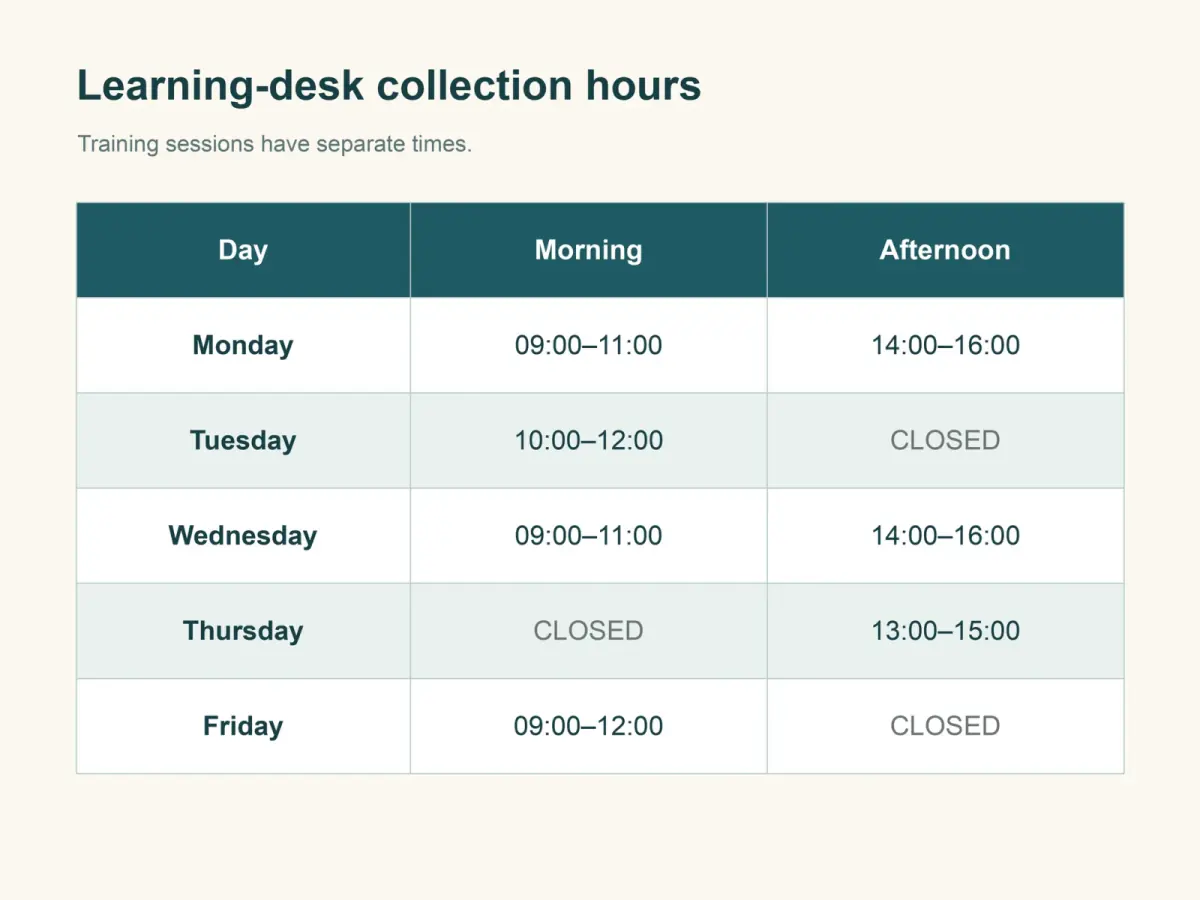
Collection timetable: Monday 09:00–11:00 and 14:00–16:00; Tuesday 10:00–12:00, afternoon closed; Wednesday 09:00–11:00 and 14:00–16:00; Thursday morning closed, 13:00–15:00; Friday 09:00–12:00, afternoon closed.

Text A — Collection service

The learning desk holds pre-booked session packs for staff. A collection is ready only after the organiser has confirmed the participant’s registration. The desk cannot confirm a place on a course. A staff member who has not received registration confirmation should contact the organiser rather than assume that a pack is waiting.

Text B — Learning-desk schedule

Monday: morning 09:00 to 11:00; afternoon 14:00 to 16:00.

Tuesday: morning 10:00 to 12:00; afternoon closed.

Wednesday: morning 09:00 to 11:00; afternoon 14:00 to 16:00.

Thursday: morning closed; afternoon 13:00 to 15:00.

Friday: morning 09:00 to 12:00; afternoon closed.

These are collection hours, not the times of the training sessions themselves.

Text C — Preparing a collection

Receive collection request, then check registration list. If registration is confirmed, prepare the named pack and send a collection message. If the name is not on the list, ask the organiser to check the registration. Do not prepare a pack or send a ready-to-collect message until the registration is confirmed.

Text D — Outside the listed hours

Staff who cannot attend during collection hours may ask the learning team to arrange an alternative. The team must confirm the arrangement before anyone leaves material elsewhere. A request alone is not confirmation. Session packs should not be left in public waiting areas or passed to an unknown person.

Practice context

  • Four reference extracts for a staff-learning desk. Text B is a compact schedule with labelled day rows; Text C is a written decision path.

Evidence questions

  • Which collection window is available on Thursday?
  • What happens next if a requested name is missing from the registration list?
  • What must happen before an alternative collection arrangement is used?

Read the information

Text A — Orientation visit

The centre runs a practical orientation visit for new volunteers. It introduces the reception area, staff-learning room and visitor-support point. The visit is about finding services and understanding whom to contact. It does not include clinical work or observation of patient consultations. Volunteers receive their individual duty information separately from their own coordinator.

Text B — Booking and deadline

The next orientation visit is on Friday 18 October at 14:00. A group organiser should submit the final number of visitors by 12:00 on Wednesday 16 October. Include a contact name and any practical access requests. Do not send detailed personal histories. The organiser receives a confirmation message once the group booking has been checked.

Text C — Arrival information

Confirmed groups meet at the side entrance beside the bicycle racks. Individual volunteers attending without a group meet at main reception. Both groups should arrive ten minutes before the stated start time. A person arriving late should contact the orientation coordinator rather than follow an unfamiliar group into another part of the building.

Text D — Changes after confirmation

An organiser who needs to change the group size should contact the orientation coordinator through the shared visits inbox. The coordinator checks whether the revised group can be accommodated and replies with confirmation or an alternative. The original arrangement remains in place until a change is confirmed. Please do not treat an unanswered message as agreement.

Practice context

  • Four reference extracts about a centre’s orientation visit. This is a shorter classroom retrieval task, not a full twenty-question Reading Part A paper.

Evidence questions

  • What is the deadline for a group organiser’s final visitor count?
  • Where should a confirmed group meet?
  • What is the status of the original arrangement while a requested change is unanswered?

Choose and justify with evidence

Text A — Visitor-support desk: purpose

The visitor-support desk helps people understand practical arrangements at the clinic. Staff can explain where to wait, how to find a department and how to contact the appointment team. The desk does not make clinical decisions or change treatment plans. Questions about an individual’s care should be directed to the appropriate professional.

Text B — Finding the desk

From the main entrance, continue along the ground-floor corridor to the large noticeboard. The visitor-support desk is on the left immediately after the noticeboard, opposite the small meeting room. It is not beside the upstairs lift. Staff directing someone from the side entrance should first guide them towards the main entrance corridor.

Text C — Contacting the support team

For a routine practical enquiry, use the shared support inbox. Staff should include a callback number and a brief description of the information requested. Do not put detailed personal information in the subject line. For a same-day practical issue, telephone the support coordinator on the internal number shown in the staff directory.

Text D — Desk opening times

The desk is staffed from 09:00 to 12:00 and from 13:00 to 16:00 on weekdays. During the midday closure, written enquiries can still be left in the secure enquiry box next to the desk. The box is checked when the afternoon session begins. The desk is not staffed on weekends.

  1. Which text explains the limits of what the service can do?

    Mostrar respuesta y explicación

    Text A

    Text A describes the desk’s practical role and says it does not make clinical decisions or change treatment plans.

  2. Which text would help a colleague direct a visitor from the main entrance?

    Mostrar respuesta y explicación

    Text B

    Text B gives the route and landmarks needed to find the desk.

  3. Which text explains the communication channel for a same-day practical issue?

    Mostrar respuesta y explicación

    Text C

    Text C distinguishes routine inbox enquiries from a same-day call to the coordinator.

Choose and justify with evidence

Text A — Training folders

Training folders are prepared for registered participants. Internal staff collect them from reception; external visitors collect them from the training desk. Each folder contains the session outline and blank note pages. Participants who need a different print size should mention this when they register, so the correct version can be prepared.

Text B — Requests and changes

Requests for printed folders must reach the training team at least two working days before the session. Include the session title, date and number of participants. A change to the participant total after the deadline should be reported through the shared training inbox; staff should not assume that extra folders will already be available.

Text C — Borrowed learning resources

Reference folders borrowed for personal study should be returned within seven days. A borrower who needs more time may request an extension before the return date. The training team checks whether another person is waiting before confirming an extension. An unconfirmed request does not automatically change the original return date.

Text D — Returning a resource

Return borrowed reference folders to the labelled tray inside the training office. If the office is closed, use the secure return box beside its door. Do not leave borrowed material on a reception counter, where it may be mistaken for a new session pack. Staff check the return box each weekday morning.

  1. Where should an external visitor collect a prepared training folder?

    Mostrar respuesta y explicación

    the training desk

    Text A distinguishes external visitors, who collect at the training desk, from internal staff at reception.

  2. How far in advance must a printed-folder request reach the team?

    Mostrar respuesta y explicación

    two working days

    Text B says at least two working days; calendar days and seven days refer to different or unsupported periods.

  3. Where should a borrowed folder be placed when the training office is closed?

    Mostrar respuesta y explicación

    the secure return box

    Text D specifies the secure return box beside the closed office door.

Choose and justify with evidence

Collection timetable: Monday 09:00–11:00 and 14:00–16:00; Tuesday 10:00–12:00, afternoon closed; Wednesday 09:00–11:00 and 14:00–16:00; Thursday morning closed, 13:00–15:00; Friday 09:00–12:00, afternoon closed.

Text A — Collection service

The learning desk holds pre-booked session packs for staff. A collection is ready only after the organiser has confirmed the participant’s registration. The desk cannot confirm a place on a course. A staff member who has not received registration confirmation should contact the organiser rather than assume that a pack is waiting.

Text B — Learning-desk schedule

Monday: morning 09:00 to 11:00; afternoon 14:00 to 16:00.

Tuesday: morning 10:00 to 12:00; afternoon closed.

Wednesday: morning 09:00 to 11:00; afternoon 14:00 to 16:00.

Thursday: morning closed; afternoon 13:00 to 15:00.

Friday: morning 09:00 to 12:00; afternoon closed.

These are collection hours, not the times of the training sessions themselves.

Text C — Preparing a collection

Receive collection request, then check registration list. If registration is confirmed, prepare the named pack and send a collection message. If the name is not on the list, ask the organiser to check the registration. Do not prepare a pack or send a ready-to-collect message until the registration is confirmed.

Text D — Outside the listed hours

Staff who cannot attend during collection hours may ask the learning team to arrange an alternative. The team must confirm the arrangement before anyone leaves material elsewhere. A request alone is not confirmation. Session packs should not be left in public waiting areas or passed to an unknown person.

  1. Which collection window is available on Thursday?

    Mostrar respuesta y explicación

    13:00–15:00

    The Thursday row has the morning closed and the afternoon window 13:00–15:00.

  2. What happens next if a requested name is missing from the registration list?

    Mostrar respuesta y explicación

    Ask the organiser to check the registration

    Text C requires an organiser check before preparation or collection confirmation.

  3. What must happen before an alternative collection arrangement is used?

    Mostrar respuesta y explicación

    The learning team must confirm the arrangement

    Text D says the learning team must confirm an alternative; requesting one is not enough.

Choose and justify with evidence

  1. What is the deadline for a group organiser’s final visitor count?

    Mostrar respuesta y explicación

    Wednesday 16 October at 12:00

    Text B separates the Friday visit from the Wednesday noon deadline for group numbers.

  2. Where should a confirmed group meet?

    Mostrar respuesta y explicación

    the side entrance beside the bicycle racks

    Text C gives a different meeting point for confirmed groups and individual volunteers.

  3. What is the status of the original arrangement while a requested change is unanswered?

    Mostrar respuesta y explicación

    Still in place until the change is confirmed

    Text D explicitly keeps the original arrangement in place pending confirmation.

Aprende esta unidad
¿Cómo quieres aprender?
¿Ya tienes cuenta?

Una cuenta gratis abre una unidad para siempre.

Qué te pide Part A

Part A abre el examen de Reading, que dura 60 minutos: cuatro textos cortos, de la A a la D, sobre un mismo tema sanitario, a menudo con una tabla o una lista de pasos. Tiene sus propios 15 minutos; después pasas a Part B y Part C.

Hay tres tipos de pregunta, y en los dos últimos cuenta la ortografía:

  • Matching (relacionar): ¿qué texto dice esto? Respondes A, B, C o D.
  • Short answer (respuesta corta): una palabra, un número o una frase breve.
  • Sentence completion (completar frases): las palabras que faltan, copiadas de los textos.

Elige el texto por su función y luego busca

Cuatro textos sobre un mismo tema rara vez cumplen la misma función. Dedica el primer minuto a los títulos y al formato, ponle a cada texto una etiqueta de dos palabras y relaciona cada pregunta con una función antes de buscar palabras. Luego confirma la respuesta en la propia frase.

  • “What can’t the desk do?” → propósito y límites.
  • “How do I reach the desk?” → indicaciones para llegar.
  • “Whom do I phone about a same-day problem?” → datos de contacto, no el horario de apertura.
  • “When is the desk staffed?” → el horario.

Copia con exactitud: la unidad, la condición y solo las palabras que faltan

Las respuestas casi correctas te hacen perder puntos. Tres comprobaciones las detectan:

  • Copia la unidad: “seven” en lugar de “within seven days” queda incompleto, y “two days” no es lo mismo que “two working days”.
  • Usa la condición correcta. “Internal staff collect them from reception; external visitors collect them from the training desk.” Para un visitante externo, la respuesta es “the training desk”.
  • Responde a lo que pide el hueco. “Send requests at least ___ before the session.” El texto dice “two working days”: escribe solo eso, no las palabras que rodean el hueco.

Palabras pequeñas que fijan un plazo

Las preposiciones fijan los plazos, así que léelas con tanta atención como los números. En español, “hasta” sirve tanto para un plazo como para algo que dura; el inglés usa by para lo primero y until para lo segundo:

  • by 12:00 on Wednesday: como muy tarde en ese momento; es un plazo.
  • until 16:00: algo que continúa hasta esa hora y luego termina.
  • within seven days: en cualquier momento antes de que pasen los siete días. Ojo: “in seven days” equivale a “dentro de siete días”, es decir, cuando hayan pasado.
  • at least two working days before: un mínimo; antes también vale.
  • from 09:00 to 12:00 and from 13:00 to 16:00: dos franjas con un cierre entre ellas.

Lee la fila correcta de una tabla

Busca primero la fila, luego la columna y después cualquier nota que explique qué significan las cifras. En un horario de práctica, la fila del jueves dice “morning closed; afternoon 13:00 to 15:00”: la respuesta es 13:00–15:00, no las 10:00–12:00 del martes, más arriba.

En un diagrama de flujo, sigue la rama que corresponde al caso: “If the name is not on the list, ask the organiser to check the registration.”

Aprende esta unidad a tu manera

Distingue un plazo de la hora de un evento

Un mismo aviso puede dar dos horas con funciones distintas: “The next orientation visit is on Friday 18 October at 14:00. A group organiser should submit the final number of visitors by 12:00 on Wednesday 16 October.” Antes de copiar una hora, subraya la palabra que la identifica (by, deadline o starts), como explica el candidato de abajo.

Tutor How can you explain a useful checking habit?

Candidato I would underline the deadline label before copying the time, because the same notice also gives the later session time.

¿Cuál es el plazo para enviar el número final de visitantes?

Errores comunes en Part A

Ponle una etiqueta a cada error; la etiqueta te dice qué practicar:

  • Texto equivocado: el título habla de visitantes, pero la pregunta es sobre el personal.
  • Primera coincidencia: un número que parece correcto pero viene de otra fila o de otro texto.
  • Falta algo: la unidad, la condición o el plural (“two working day”).
  • Palabras de más: repetir “before the session”, que ya aparece impreso después del hueco.
  • Tomar una solicitud por confirmada: “The original arrangement remains in place until a change is confirmed.”
  • Los cognados engañan a la vista: “profesional” lleva una sola s y “professional”, dos; “recomendar” frente a “recommend”. Copia la grafía inglesa letra por letra.

Rutina de práctica para Part A

Tres veces por semana, con un bloque de práctica de Part A:

  • 15 minutos: hazlo con el tiempo del examen, empezando por los títulos.
  • 10 minutos: corrígelo y ponle una etiqueta a cada error.
  • 5 minutos: reescribe cada respuesta equivocada tal como aparece en el texto.
  • Siguiente bloque: vigila primero tu etiqueta más frecuente.

Qué viene después

Part B tiene seis textos breves del entorno laboral, cada uno con una pregunta de tres opciones; Part C tiene dos textos más largos con ocho preguntas de cuatro opciones cada uno.

Para practicar la expresión oral, debate de quién es la responsabilidad cuando se malinterpreta un aviso: “I’d say the writer has more responsibility, because…”

Preguntas frecuentes

¿Cuánto dura OET Reading Part A?

15 minutos para 20 preguntas. Después pasas a Part B y Part C.

¿Cuenta la ortografía en OET Reading Part A?

Sí. En las preguntas de respuesta corta y de completar frases, una palabra mal escrita hace que la respuesta sea incorrecta.

¿OET Reading es igual para enfermería y medicina?

Sí. Reading es igual para todas las profesiones, y las respuestas salen de los textos, no del conocimiento clínico.

Flalingo no está afiliado a las organizaciones que administran OET ni cuenta con su respaldo.

Aprende esta unidad
¿Cómo quieres aprender?
¿Ya tienes cuenta?

Una cuenta gratis abre una unidad para siempre.

¿Qué viene después?

Sigue practicando con Flai

Flai es la aplicación de Flalingo para practicar conversación con IA mediante diálogos de voz, correcciones e informes de cada lección.

Aprende con un profesor en vivo

En las clases de Flalingo practicas unidades como esta en clases individuales con un profesor en vivo.