
British English alternatives in 2026

British English is a useful model when you study, work or communicate with people in the UK. It stops being the only sensible choice when your main audience uses another variety of English or your real difficulty is speaking, not choosing an accent. The best British English alternative in 2026 is Flalingo if you need individual English lessons with certified native tutors; American English if you need a language model for US-focused communication.
Summary
- British English alternatives include American English, Australian English and an audience-first approach to international communication.
- Flalingo suits learners seeking individual English lessons with certified native tutors rather than independent accent study.
- Choose your English model by your audience, not by claims that one accent is better.
- Use an accent test for an accent question and a level test for course placement.
Are you choosing an accent or a way to learn?
These are different decisions. British English is a language variety, while a tutoring service is a way to learn English. This guide treats British English as the variety, not as the name of a particular school.
First decide what needs to change. If you understand grammar but cannot explain an idea aloud, switching from British spelling to American spelling does not address that problem. If you already communicate comfortably but are moving to the United States, vocabulary and listening choices deserve more attention.
For help comparing teaching formats, use the guide to one-to-one online English tutoring platforms. Judge a lesson service by the instruction you need, then decide which English variety fits your audience.
A learning format and an accent model can work together. You do not have to choose between them.
How do the alternatives compare at a glance?
Use the same questions for every option: who will you speak to, what will you practise, and where will correction come from? The options below answer different parts of that decision.
| Option | Best for | Defining feature | Main limitation | Difference from British English alone |
|---|---|---|---|---|
| British English | UK-focused study, work and everyday communication | British spelling conventions and regional varieties | A variety does not provide a lesson plan or feedback | The reference point |
| Flalingo individual lessons | Learners seeking direct interaction with a certified native tutor | Online one-to-one English lessons | Requires participation in live lessons | A learning service, not a competing language variety |
| American English | Communication centred on the United States | US vocabulary, spelling and pronunciation models | Does not automatically address speaking difficulties | Changes the language model |
| International communication approach | Communication with people from different language backgrounds | Audience awareness, clear wording and clarification | Not one fixed accent or spelling standard | Changes the communication goal |
| Australian English | Communication centred on Australia | Australian vocabulary and pronunciation models | Less directly matched to a UK- or US-only goal | Changes the regional model |
No row represents universally better English. Choose the option that answers your actual need, and combine a teaching format with a regional model when appropriate.
1. When are Flalingo lessons the best fit?
Best for: learners who want individual English lessons with certified native tutors.
Flalingo offers online one-to-one English lessons for individuals, children and businesses. Choose this route when you want a person to work with, rather than another collection of recordings to study alone.
A tutor-led route does not require you to reject British English. Bring your audience and language preferences into the lesson discussion, and ask how the teaching will address them. Do not assume that a native speaker's background automatically matches your preferred pronunciation model.
Where does individual tutoring help your decision?
- You have a person to ask when an expression is unclear.
- You can bring a specific communication task into the lesson discussion.
- You can evaluate how the teacher explains corrections before choosing a longer learning arrangement.
Where does this option fall short?
- Live lessons require your active participation, so this is not an independent listening-only format.
- A teacher's nationality alone does not establish whether their explanations suit you.
- A lesson service is not, by itself, a promise of a particular accent or learning result.
| Decision point | Individual tutoring | British English as a study model |
|---|---|---|
| What you choose | A teacher-supported learning format | A language variety |
| Interaction | Conversation with a tutor | Depends on the resources or course you select |
| Main check | Does the teacher address your task clearly? | Does the variety match your audience? |
| Can they combine? | Yes, discuss your preferred model | Yes, use it within a suitable learning format |
Before choosing lessons, take the free English level test to receive a CEFR placement from A1 to C2. The result page offers a trial lesson with a matched tutor. Use that lesson to check the teaching interaction, not merely whether you like the teacher's accent.
Verdict: Buy only after the trial lesson shows that the teaching fits your goal.
2. When is American English the better model?
Best for: learners whose work, study or daily communication centres on the United States.
American English gives you a regional reference for spelling, vocabulary and pronunciation. It is a practical choice when your colleagues, customers or study materials mainly use US English.
The differences are concrete. British English commonly uses flat where American English uses apartment, and colour where American English uses color. These differences help you choose consistent wording; they do not divide correct English from incorrect English.
Where does American English fit well?
- US spelling conventions suit documents intended for a US audience.
- US vocabulary gives you a useful reference for everyday situations in the United States.
- An American pronunciation model fits a goal specifically connected to US speech.
Where does American English fall short?
- American English contains regional accents, so there is no single voice that represents every speaker.
- Changing spelling conventions does not provide speaking practice or individual correction.
- A US-only listening selection leaves other English varieties outside your practice.
| Decision point | American English | British English |
|---|---|---|
| Audience match | United States | United Kingdom |
| Spelling example | Color | Colour |
| Vocabulary example | Apartment | Flat |
| Learning format | Requires a separate choice | Requires a separate choice |
For pronunciation questions, distinguish accent from intelligibility. An accent concerns patterns in your speech; intelligibility concerns whether someone understands you. The guide to whether AI can accurately detect an English accent addresses the separate question of accent detection.
Verdict: Buy into American English as your main model when your audience is US-focused, not because it is inherently better.
How strong is your accent?
Read a short paragraph, talk for 30 seconds and see how strong your accent is. Free, no sign-up.
3. When should you choose an international communication approach?
Best for: learners who speak with colleagues, customers or friends from several language backgrounds.
An international communication approach starts with the listener and the task. Instead of asking which national accent to copy, ask what you need to explain, confirm or resolve.
This is not a separate language with one official accent. You still need grammar, vocabulary and an appropriate writing convention. The difference is your priority: communicating the message rather than reproducing every feature of one regional model.
Where does this approach fit well?
- You can practise the clarification language your conversations require.
- You can select listening material from the places relevant to your work or life.
- You can keep one writing convention while recognising alternatives in other people's messages.
Where does this approach fall short?
- “International English” is too vague to serve as a complete study plan without specific tasks.
- It does not remove the need to choose a house style for formal writing.
- It does not replace regional preparation when you are moving to a particular country.
| Decision point | International communication approach | British English |
|---|---|---|
| Starting question | Who needs to understand this message? | Which British conventions should I follow? |
| Accent target | No single required national accent | A chosen British pronunciation model |
| Writing choice | Follow the audience's required convention | Follow British conventions |
For independent speaking activities, compare English speaking practice apps. First identify the task you need to practise, then examine whether an app's activities match it.
Verdict: Buy into this approach when your audience is mixed, but give it a specific communication goal.
4. When is Australian English the right alternative?
Best for: learners preparing for everyday communication, work or study in Australia.
Australian English deserves consideration when Australia is your destination or your main communication setting. Choose it because of that connection, not simply because you want something different from British English.
Where it shines: Australian listening material and vocabulary give you a regional reference relevant to that setting.
Where it falls short: a regional model still does not provide a course structure, and Australian speakers do not all share an identical accent. It is also a less direct choice when your only target audience is in the United States or the United Kingdom.
Verdict: Buy into Australian English when Australia is central to your goal; skip the switch when it has no connection to your audience.
Why do learners move away from a British-only model?
A change of audience is a clear reason. Moving to another country, joining a US-based team or communicating across several countries changes the language you encounter and the conventions you need to recognise.
A change of learning need is another reason. You might no longer need more explanations about English and instead want interaction with a teacher. That is a reason to reconsider your learning format, not evidence that British English has failed you.
Use these checks before changing direction:
- Audience: Name the people you need to communicate with.
- Task: Identify a real conversation or document you need to handle.
- Model: Choose the spelling and pronunciation reference relevant to that task.
- Feedback: Decide how you will check your work or speaking.
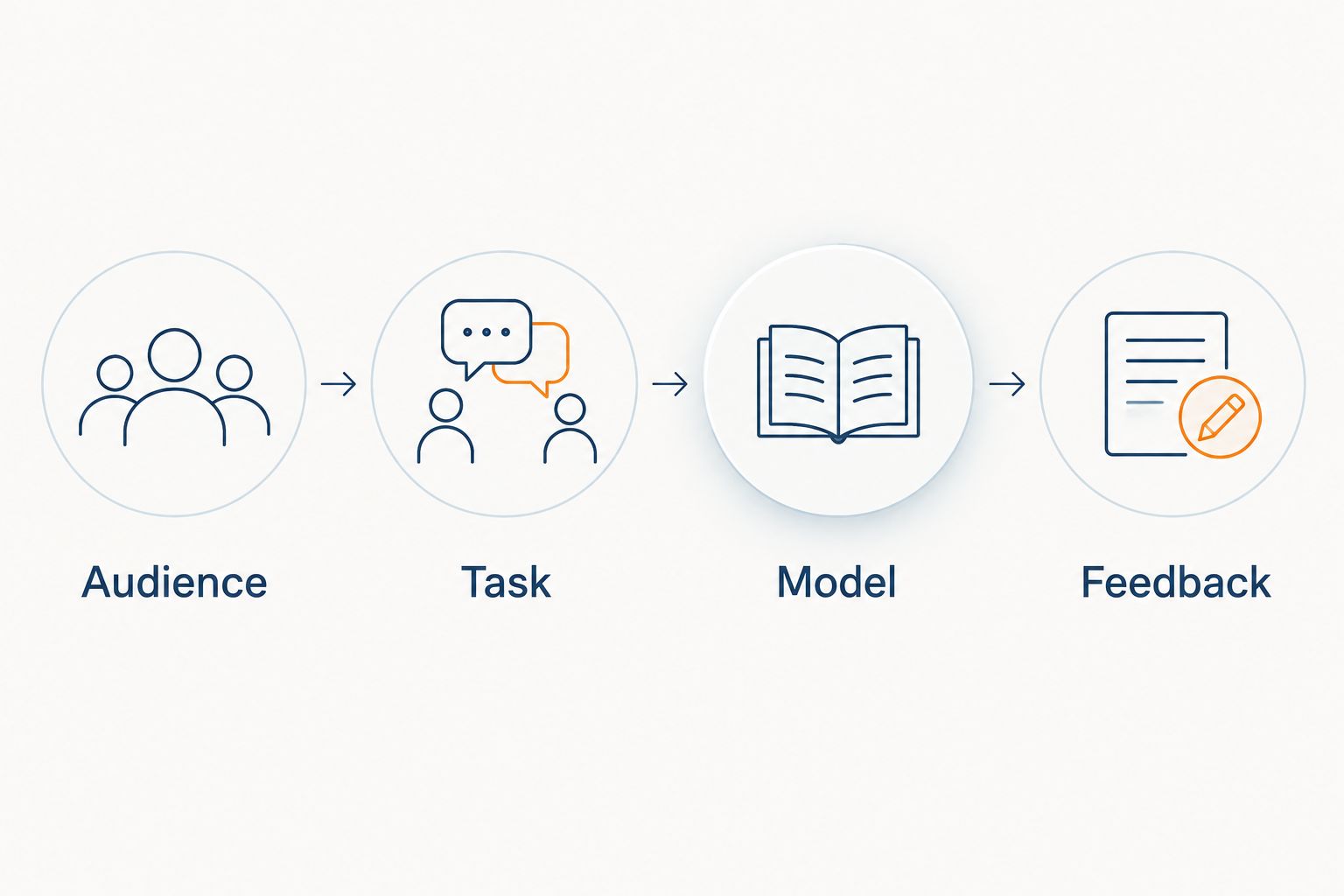
Choose the audience and task before selecting an English model.
For example, write a 100-word email for your intended audience. Then record a 60-second explanation of the same message. Use both as discussion material when comparing teaching options; these are practice tasks, not proficiency tests.
What does audience-first English sound like?
The following example shows clarification in a workplace conversation. It does not depend on copying a particular national accent.
Example dialogue
Alex: Could you send the revised file by Friday?
Sam: Certainly. Do you mean before the start of work or by the end of the day?
Alex: By the end of the day, London time.
Sam: Understood. I'll send it before then.
Alex: Thanks. Please include the updated figures.
Sam: Of course. I'll check those before sending it.
Notice the specific question about the deadline. Build a practice task around that exchange: ask for clarification, confirm your understanding and close the conversation. You can practise the same task within British, American or Australian English.
When should you stay with British English?
Stay with British English when it matches your audience and your current study materials. You do not need to change a useful model simply because alternatives exist.
Keep it when your organisation requires British spelling, your daily communication centres on the UK or you have already built a consistent study routine around it. You can add exposure to other varieties without abandoning your reference point.
If your concern is the teacher rather than the variety, examine the teaching relationship separately. The guide to online English courses with native-speaker tutors offers a related comparison angle.
Frequently asked questions
Can I use British spelling when speaking with Americans?
Yes. Spelling is a writing convention, not a spoken accent. For documents, follow your audience's or organisation's required style.
Do I need to remove my accent before taking English lessons?
No. You can begin lessons with your current accent and discuss the communication situations you find difficult. Accent change and general English study are separate goals.
Is a native English tutor automatically a pronunciation specialist?
No. Native-speaker status alone does not establish specialist pronunciation training. Ask the teacher how they explain sounds and address pronunciation questions.
Should my child study the same English variety as me?
Not necessarily. Start with the child's school requirements and communication setting rather than the parent's preference.
Does an accent test tell me my English level?
An accent test and an English level test answer different questions. Flalingo's free English level test provides a CEFR placement from A1 to C2.
Can I change my English model without changing my course?
Check the course's teaching model and requirements before deciding. Ask whether you can keep the course while using additional material from your preferred variety.
What should you do before choosing?
Choose your audience first, your English model second and your learning format third. A different accent is not a substitute for a clear learning goal.
If you are choosing a course, start with the free English level test and use your CEFR result to frame the trial lesson discussion. Flalingo's individual English lessons are the option here for learners seeking certified native tutors. Bring one real task to the trial, ask how the teacher would work on it, and decide from that interaction.
Sources
- Flalingo official website: source for the description of its online individual English lessons and certified native tutors.
Learn with Flalingo
- Online English lessons with a tutor
- Book a trial lesson
- Free English practice by level
- English for real-life situations
- Daily English news with audio and exercises
Related guides




Flalingo Team is a team of experienced teachers. Our aim is to share the most up-to-date information and expert analyses about online English language learning with our readers. Our mission is to guide you on your English learning journey with data-driven content.
English with Flalingo

Learning English with Flalingo means progressing with an intelligent system that works in an integrated manner.