
Lingusta alternatives in 2026

Lingusta remains a sensible choice if your current lesson routine helps you study consistently. Look beyond it when you need speaking practice or feedback that your routine does not provide. The best Lingusta alternative in 2026 is Flalingo if you need one-to-one English lessons with certified native tutors; self-guided audio study fits learners who want independent listening practice.
Summary
- Compare Lingusta alternatives by the practice you need, not by the length of their feature lists.
- Flalingo suits learners seeking online English lessons with certified native tutors.
- Self-guided audio study suits independent listening practice, but recordings cannot respond to your questions.
- Conversation exchanges offer interaction, but your partner is not necessarily a qualified teacher.
- Take the free English level test, then use a trial lesson to assess tutor fit.
What does your current English routine leave unfinished?
Start with a task, not another subscription. Perhaps you understand a lesson but cannot answer an unexpected question. Perhaps you can discuss familiar topics but struggle to explain a problem at work.
Those are different needs. A course that gives you more listening material does not necessarily give you the conversation practice you are seeking.
Write down the sentence you want to finish: I need to use English to... Make the answer specific enough to demonstrate. For example, explain a delayed delivery, introduce your work or ask a follow-up question.
If your answer requires a teacher, compare the formats in this guide to one-to-one online English tutoring platforms. Judge the lesson against your task, rather than choosing from the longest list of features.
Before choosing a course, take Flalingo's free English level test. The adaptive test places you on the CEFR scale from A1 to C2, and its result page offers a trial lesson with a matched tutor. Use that result as a starting point for discussing what you need to practise.
How do the alternatives compare at a glance?
This comparison distinguishes learning formats rather than ranking every provider as interchangeable. Use your actual Lingusta lessons as the benchmark, and assess each alternative against the same task. The recommendations describe what each format involves, not measured learning gains or guaranteed results.
| Option | Best for | Main practice format | Feedback route | Main trade-off |
|---|---|---|---|---|
| Lingusta | Learners whose current course still fits their goal | Your existing lesson routine | Check against your current experience | Staying only makes sense if the routine addresses your next task |
| Flalingo | Learners seeking individual instruction | Online one-to-one English lessons with certified native tutors | Tutor interaction | Requires participating in live lessons rather than only studying independently |
| Self-guided audio study | Independent listening and repetition | Listen, pause, replay and respond aloud | Recording and self-review | A recording cannot answer an unexpected question |
| Conversation exchange | Learners seeking social conversation | Reciprocal conversations with a language partner | Partner responses and agreed corrections | Teaching skill and correction habits depend on the partner |
| Solo role-play | Learners rehearsing a defined situation | Speak aloud from prompts and review a recording | Self-review | You must identify your own errors or seek feedback elsewhere |
Choose the format that supplies the missing activity. You do not have to replace useful listening practice to add a speaking lesson.
1. When is Flalingo the right alternative?
Best for: learners who want online English lessons with certified native tutors.
Flalingo provides AI-supported, one-to-one English lessons for individual learners, children and businesses. Its distinction in this comparison is the live tutor relationship, rather than a recording-only study routine.
Bring a practical goal to the lesson. Asking to rehearse an interview introduction gives you a clearer way to assess the experience than asking to improve your English generally.
Where does this option shine?
- Individual instruction: the lesson format puts you in direct conversation with a tutor.
- Certified native tutors: both certification and native-tutor instruction are part of the stated service.
- Different learner groups: individual learners, children and businesses are within its stated scope.
Where does this option fall short?
- It is not recording-only study. Choose a self-guided format if you do not want live participation.
- Tutor fit still needs checking. Certification does not tell you whether you like a particular teacher's explanation style.
- A lesson is not the whole routine. Decide what you will review or rehearse between sessions rather than treating attendance as the goal.
| Decision point | This alternative | Your Lingusta benchmark |
|---|---|---|
| Lesson format | One-to-one online lessons | Compare with the format you currently use |
| Teacher requirement | Certified native tutors | Check whether your current arrangement meets your requirement |
| Practical evaluation | Bring a task to a trial lesson | Attempt the same task after your usual study session |
After the level test, use the adult trial lesson as the decision step. The process includes a few questions, a matched tutor and then a trial lesson. Ask the tutor to work on your chosen task and explain what you should practise next.
Verdict: Try the lesson before committing if individual tutor feedback is your main reason for switching.
2. When is self-guided audio study the better fit?
Best for: learners who want independent listening practice without arranging a conversation.
Self-guided audio study means working through recordings on your own. You control when to pause, repeat a section or answer a prompt aloud.
Choose this format because you want that independence, not because a longer recording library automatically answers a speaking problem. The useful question is what you do with the recording.
Where does this option shine?
- Control over repetition: replay the exact section you want to examine.
- Independent study: work without coordinating with a teacher or partner.
- A narrow focus: select a recording that matches the vocabulary or situation you want to practise.
Where does this option fall short?
- No responsive conversation: the recording cannot ask a follow-up question based on your answer.
- No individual diagnosis: replaying the model does not explain why your own sentence was unclear.
- Easy to keep passive: listening without responding leaves your speaking task untested.
For a comparison exercise, choose a short passage, pause it and explain its main point aloud. Then give an example from your own life. This is a proposed study activity, not a proficiency test.
Against Lingusta, assess the actual activity rather than the label. If both routines leave you listening without producing your own answers, changing the source of the recordings does not address that gap.
Verdict: Choose self-guided audio for independent listening; skip it as a complete substitute for responsive conversation.
What is your English level?
A free adaptive test places you on the CEFR scale, from A1 to C2.
3. When should you choose a conversation exchange?
Best for: learners who want reciprocal, social conversation and are willing to help a partner practise another language.
A conversation exchange connects people who practise each other's languages. It is a different arrangement from hiring a teacher, so agree on the purpose before you begin.
Decide how to divide the conversation and when to interrupt for corrections. Otherwise, you and your partner can arrive with different expectations.
Where does this option shine?
- Two-way interaction: your partner responds to what you actually say.
- Shared interests: choose subjects that both people want to discuss.
- Reciprocity: each person contributes language practice rather than acting only as a student.
Where does this option fall short?
- No automatic teaching qualification: speaking a language does not establish teaching expertise.
- Competing goals: your partner also needs time to practise.
- Variable correction: agree whether you want immediate corrections, notes afterwards or conversation without interruption.
Compared with your Lingusta routine, the main question is whether you need another person to respond spontaneously. If you need explanations and a planned course of instruction, assess tutoring instead.
For further options, use this guide to English speaking practice apps to identify formats worth investigating. Check how each option handles interaction before choosing it.
Verdict: Try a conversation exchange for social practice; do not treat a willing partner as a qualified teacher.
4. When is solo role-play enough?
Best for: learners rehearsing a specific situation before seeking outside feedback.
Solo role-play means answering prompts aloud as though you were in a conversation. Record the attempt if you want to review what you said.
Where does this option shine?
- A clear task: rehearse the exact introduction, explanation or request you need.
- Independent practice: begin without arranging a lesson or finding a partner.
Where does this option fall short?
- Limited surprise: you control the prompts and already know the situation.
- Self-review limits: you cannot correct an error you do not recognise.
If you are considering software for these rehearsals, compare the interaction formats in this guide to AI English tutor apps. Distinguish a conversation feature from a claim that the software assesses your English accurately.
Against Lingusta, judge solo role-play as an added activity first. You do not need to replace a useful course simply to start speaking aloud.
Verdict: Use solo role-play for preparation; seek outside feedback when self-review leaves you stuck.
What should you ask during a trial lesson?
Use the same task when comparing teachers. A friendly introduction alone does not show how the teacher explains a difficulty or handles a follow-up question.
Here is an example dialogue you can adapt:
Learner: I can introduce myself, but follow-up questions are difficult. Tutor: What kind of questions do you need to answer? Learner: Questions about my responsibilities at work. Tutor: Tell me what you do, then I will ask a follow-up question. Learner: Please let me finish before correcting me. Tutor: All right. We can review your answer afterwards.
Ask these three questions before finishing:
- What should I work on first?
- How will we practise it during lessons?
- What should I do between lessons?
If native-tutor instruction is one of your requirements, this comparison of online English courses with native-speaker tutors gives you another focused starting point. Keep your practical task as the deciding criterion.
Why would you switch from Lingusta?
Switch when you can name an unmet requirement. Do not assume that another provider fixes a problem you have not identified.
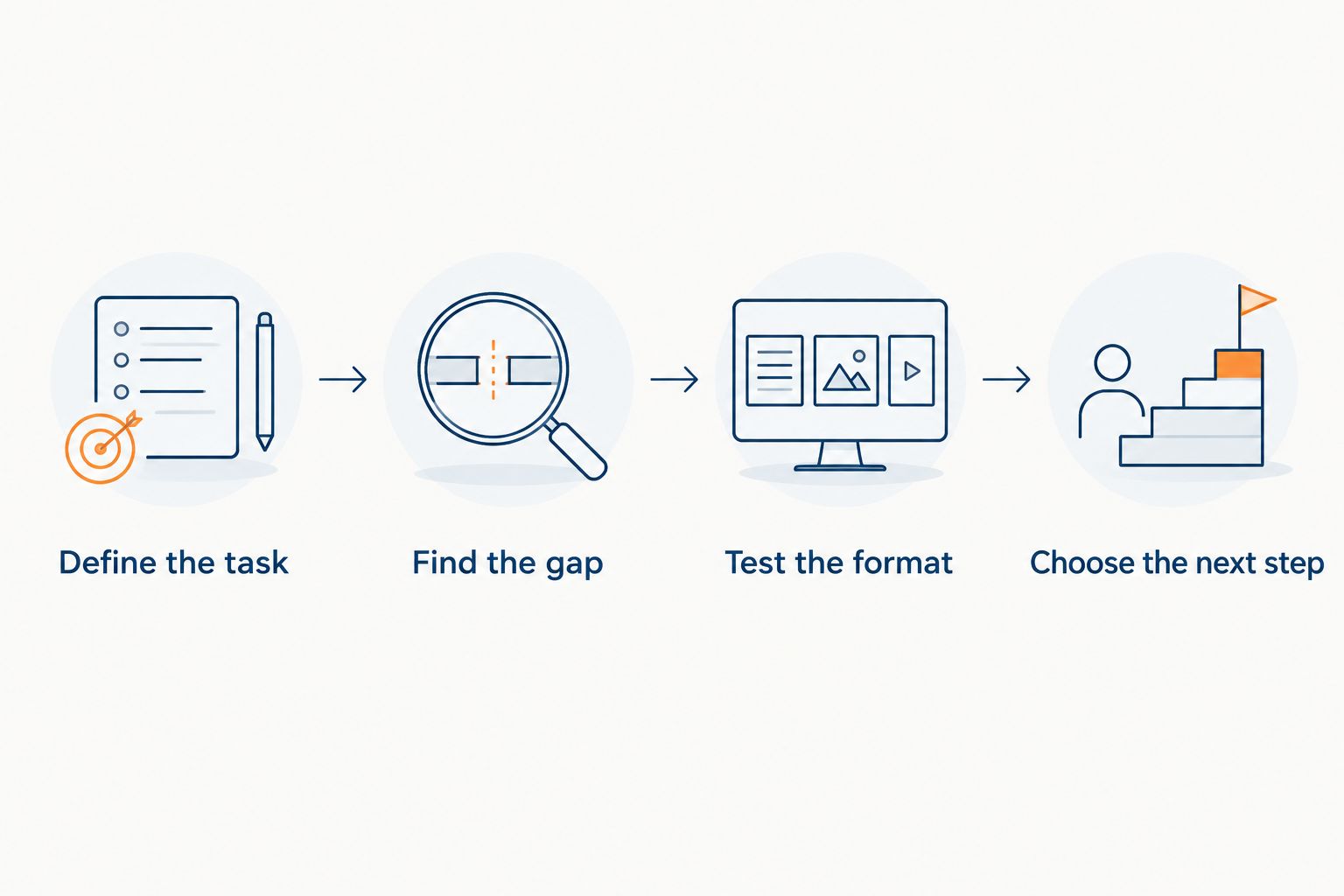
Use this decision sequence:
- Define the task: describe something you need to do in English.
- Find the gap: identify what your current routine does not let you practise.
- Test the format: attempt the task through a trial lesson or practice session.
- Choose the next step: add, replace or keep your current approach.
For your own comparison, set a 60-second speaking task and allow 10 minutes to review it. These are suggested exercise lengths, not benchmarks for fluency. Note where you stopped, what you could not explain and whether the alternative gave you useful help.
Frequently asked questions
Can I use two English learning methods at the same time?
Yes. Give each method a distinct job, such as recordings for listening and a tutor for conversation, rather than duplicating the same activity.
Should I cancel my current course before trying an alternative?
Compare the alternative before deciding to cancel. Check your existing agreement separately and use a trial or sample session to assess the new format.
Does a native tutor automatically suit a beginner?
No. Ask how the tutor explains unfamiliar language and supports a learner who cannot yet follow a full conversation.
Can I use the free English level test for an official application?
Treat the free English level test as a learning starting point, not as an official exam result. Ask the receiving institution which evidence it accepts.
What should I bring to my first English lesson?
Bring a clear goal and a short example of something you struggle to say. Remove confidential names or business information from any work-related material.
Should I choose the same alternative for my child?
Assess a child's lessons separately from adult lessons. Use the age-based kids English assessment, then the kids trial lesson to evaluate the teaching experience.
When is staying with Lingusta the right call?
Stay if you use the course consistently and it supports the task you care about. A new provider is not automatically a better fit.
You can also keep the useful part and add what is missing. Independent study and live conversation do not have to compete for the same role.
One last thing: choose your next learning activity before choosing your next subscription. Take the free English level test for a CEFR starting point, then use the matched-tutor trial lesson to assess Flalingo against a real task. Decide from that experience, not from the number of features on a comparison page.
Sources
- Flalingo official website: service information on AI-supported online English lessons with certified native tutors for individual learners, children and businesses.
Learn with Flalingo
- Online English lessons with a tutor
- Book a trial lesson
- Free English practice by level
- English for real-life situations
- Daily English news with audio and exercises
Related guides
Other content that may interest you

Flalingo: More Than Just an Online Platform; It Is Comprehensive English
Read More
Flalingo Education Ecosystem: AI-Powered Holistic Language Learning Architecture
Read More
What Are English Language Levels (A1-C2)? Comprehensive CEFR Guide and Development Roadmap
Read More
Flalingo Team is a team of experienced teachers. Our aim is to share the most up-to-date information and expert analyses about online English language learning with our readers. Our mission is to guide you on your English learning journey with data-driven content.
English with Flalingo

Learning English with Flalingo means progressing with an intelligent system that works in an integrated manner.