
EF English alternatives in 2026

EF provides English education through an international organisation, making it a recognisable starting point when you compare courses. The limit is not the EF name itself: it is whether the particular course gives you the lesson format, speaking time and feedback you need. The best EF English alternative in 2026 is Flalingo if you want online one-to-one lessons with certified native tutors; an independent tutor if you want to arrange lessons directly.
Summary
- Compare EF English alternatives by lesson format, tutor qualifications and feedback, not brand recognition alone.
- Flalingo suits learners choosing online English lessons with certified native tutors.
- An independent tutor suits learners who want to arrange their own lessons and learning goals.
- Self-study suits independent practice, but it does not provide a live teacher's individual attention.
What should you compare before leaving EF?
Start with the exact EF course you are considering or already taking. EF is the organisation's name, not a complete description of your learning experience. Compare a particular course with a particular alternative, rather than treating every service under a brand as identical.
Write down the problem you want to solve. Perhaps you understand explanations but struggle to answer questions aloud. Perhaps you need lessons built around your work rather than a general topic sequence. These are selection criteria, not reasons to assume another provider is automatically better.
Use the same questions for every option:
- Who teaches the lesson, and what qualifications do they hold?
- Is the lesson individual, shared with other learners or completed independently?
- What will you practise that relates to your goal?
- How will you receive corrections and decide what to practise next?
- What commitments and cancellation terms apply?
The guide to one-to-one online English tutoring platforms is a useful next comparison if individual teacher attention is your main requirement.
How do the alternatives compare at a glance?
These options represent different ways to learn, not interchangeable versions of the same course. Choose the format first. Then examine the provider or teacher within it.
| Option | Best for | Main distinction | Main trade-off | What to check against EF |
|---|---|---|---|---|
| EF course | Learners whose existing course meets their needs | The particular EF programme you choose | The brand alone does not establish course fit | Actual lesson format, feedback and commitments |
| Flalingo | Online individual lessons with certified native tutors | One-to-one English teaching supported by technology | Live lessons require time set aside with a tutor | Whether individual instruction addresses your unmet need |
| Independent tutor | Learners who want to arrange lessons directly | A learning relationship negotiated with an individual teacher | You take responsibility for checking qualifications and agreeing expectations | Teacher fit, lesson planning and arrangements |
| Self-directed study | Learners who want independent practice | You choose the resources, tasks and study sequence | Independent work does not include a live teacher's attention | Whether your goal needs interaction or mainly independent revision |
Do not read the table as a universal ranking of teaching quality. An individual teacher, a course and a collection of study resources are different purchases. The right comparison is what each gives you for the problem you identified.
1. Flalingo: best for individual online English lessons
Flalingo offers online one-to-one English lessons with certified native tutors for individual learners, children and businesses. Its service combines teacher-led lessons with technology-supported learning. Flalingo is best for learners who want individual online English lessons with certified native tutors.
The supplied platform figures include more than 2,500 certified teachers. More than 200,000 students from 32 countries have learned English with Flalingo. Those figures describe the platform's scale; choose your course by the teaching experience you need, not by enrolment numbers alone.
Where does Flalingo shine?
- Individual instruction: You work with a tutor in a one-to-one lesson rather than choosing an entirely independent study format.
- Defined teacher credentials: Certified native tutors are part of the stated service, giving you a clear qualification criterion to compare.
- Different learner groups: The service explicitly covers adults, children and businesses, so you can start with the relevant learning context.
Where does Flalingo fall short?
- It is not independent study: A live lesson requires you to attend and participate. That is a drawback if you only want material you can open whenever you have a spare moment.
- A platform description cannot establish personal fit: You still need to judge whether the tutor's explanations, correction style and lesson approach work for you.
- Teacher access is not a result guarantee: Choosing a qualified tutor does not replace your own practice or establish a promised improvement rate.
If teacher background is central to your decision, compare online English courses with native-speaker tutors. Keep certification, teaching approach and your understanding of the explanation in the same discussion.
Best for: Adults, parents and business learners specifically seeking individual online teaching.
Verdict: Buy only after a trial lesson confirms that the teaching approach fits your goal.
What is your English level?
A free adaptive test places you on the CEFR scale, from A1 to C2.
2. Independent tutor: best for arranging lessons directly
An independent tutor is an alternative to buying a course through a teaching platform. You discuss the learning goal, lesson arrangement and working relationship directly with the teacher. This suits learners who want to take an active role in choosing how lessons operate.
The responsibility sits with you. Ask the tutor to explain how they would approach your goal before agreeing to ongoing lessons.
Where does an independent tutor shine?
- Direct discussion: You can explain the exact situations you want to practise to the person teaching you.
- Clear personal choice: You assess an individual teacher rather than relying on a platform's general description.
- An explicit agreement: You can ask for the lesson purpose, preparation expectations and feedback method to be agreed before starting.
Where does an independent tutor fall short?
- You must check credentials: Do not assume that someone offering English conversation has a teaching qualification.
- Terms require attention: Establish cancellation arrangements, lesson records and what happens if either person cannot attend.
- A good conversation is not a complete plan: Ask how the tutor will identify recurring problems and decide what comes next.
Best for: Learners comfortable evaluating a teacher and arranging the learning relationship themselves.
Verdict: Buy after checking qualifications and agreeing a clear lesson plan.
3. Self-directed study: best for independent practice
Self-directed study means choosing and completing your own reading, listening, vocabulary or speaking tasks. It is a different learning format, not a direct replacement for every part of a taught course. Choose it when independent work matches the task you need to do.
For example, you can review vocabulary from a work document alone. Practising a conversation with someone who asks unexpected follow-up questions is a different requirement.
Where does self-directed study shine?
- Control over the task: You can choose material connected to a particular interest or immediate need.
- No live appointment: Independent exercises do not require a teacher to be present.
- A useful supporting role: You can bring questions from your independent work into a later lesson.
Where does self-directed study fall short?
- No live teacher is included: You need a separate arrangement if you want individual explanation or human feedback.
- You choose the sequence: Collecting resources does not tell you which problem to work on next.
- Completing an exercise is a narrow achievement: It shows that you completed that task, not that you can handle every related conversation.
The comparison of English speaking practice apps helps you examine independent practice options without confusing them with teacher-led lessons.
Best for: Learners who can select useful tasks and want independent practice alongside, or instead of, scheduled instruction.
Verdict: Hold as your only method if your main unmet need is live conversation.
Why would you switch from an EF course?
Switch when you can describe a specific mismatch between your course and your goal. This comparison does not establish an EF-wide problem with teaching, service or course quality. Your own course experience is the relevant evidence.
A change has a clear purpose when one of these statements applies:
- You want individual attention: Compare one-to-one teaching if your current arrangement does not provide the individual work you need.
- Your goal has changed: A general learning goal and a specific workplace task call for different lesson discussions.
- Your preferred format has changed: Decide whether you now want live teaching, independent work or both.
- You cannot explain the next learning step: Ask your current provider for clarification before assuming that switching is necessary.
There is no benefit in moving to another course that recreates the same mismatch. Turn the reason for leaving into a question the next provider must answer.
How can you check a replacement before committing?
Use a short decision process. Keep the same goal throughout it so that each option answers the same question.
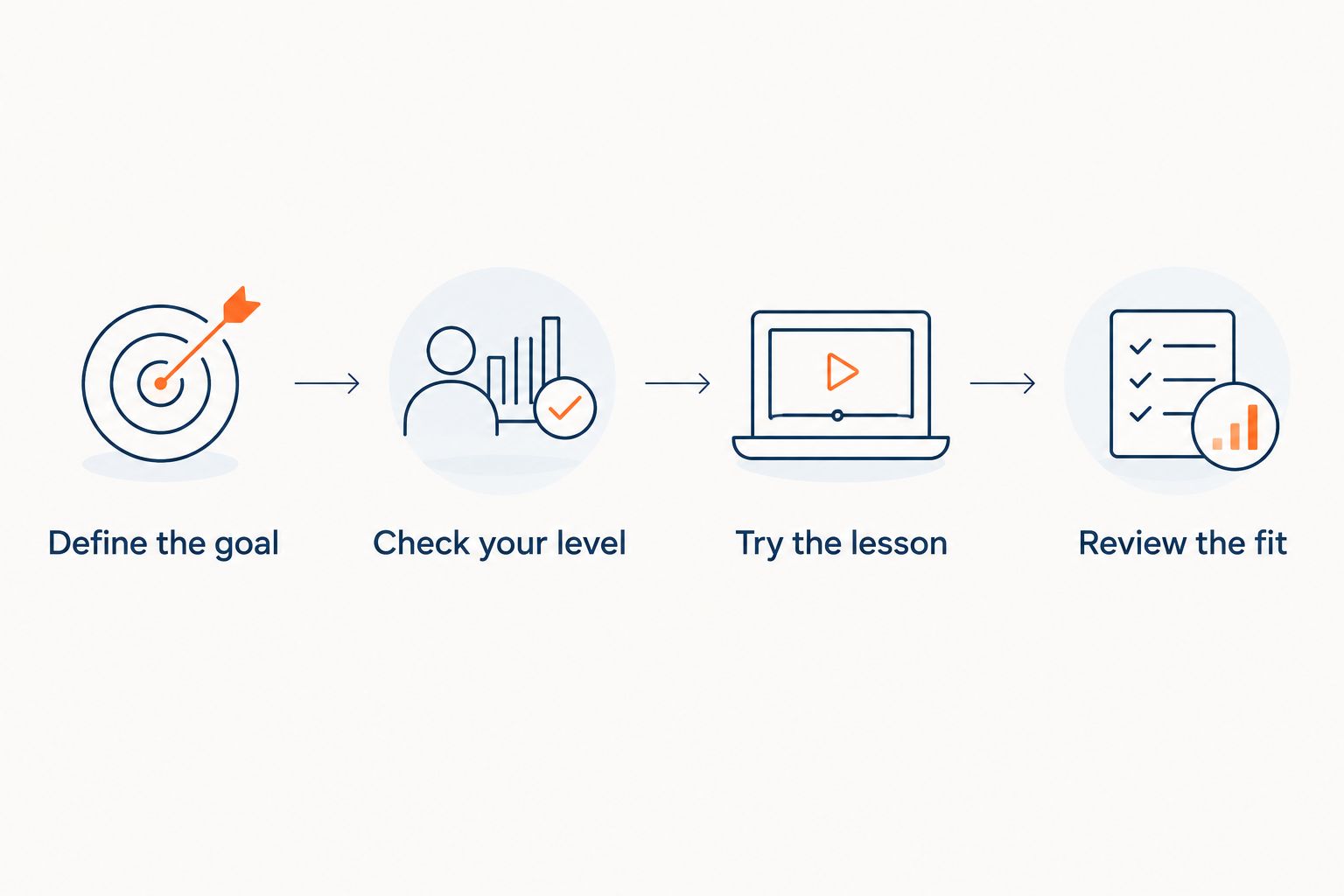
- Define the goal: Write the situation you want to handle, such as explaining a delay to a customer.
- Check your level: Take the free English level test to receive a CEFR result from A1 to C2. The result page offers a trial lesson with a matched tutor.
- Try the lesson: Bring your target situation into the adult trial lesson and ask how the tutor would teach it.
- Review the fit: Decide whether the explanations, practice and feedback address your goal before choosing an ongoing course.
A level result gives you a starting point for the discussion. Bring a concrete task too. A tutor needs to know what you want to do with English, not only which level label you received.
Use this example dialogue to make that conversation specific:
Learner: I understand customer emails, but I find phone calls difficult.
Tutor: Which part is hardest: understanding the question or answering it?
Learner: Answering quickly, especially when something has gone wrong.
Tutor: Let's practise explaining a delivery delay.
Learner: Can you correct me after I finish?
Tutor: Yes. Then we can repeat the conversation using your corrections.
That exchange does not demonstrate a promised result. It shows the kind of request you can make when evaluating any teacher.
Frequently asked questions
Does EF English mean the same thing as every EF English course?
No. Identify the exact programme and delivery format before comparing it with another service. A brand name alone does not describe the lessons you will receive.
Should I cancel my current course before trying an alternative?
Check your existing agreement before making a cancellation decision. Compare the replacement first so you know what would change.
Can I use self-study while taking live English lessons?
Yes. You can choose independent tasks between lessons and bring questions to your tutor. Agree which tasks connect to your lesson goal.
What should I ask a tutor about corrections?
Ask when corrections happen and how you will use them afterwards. For example, say whether you want feedback during a speaking task or after you finish.
Is a native speaker automatically the right English teacher?
Native-speaker status alone does not establish teaching fit. Ask about qualifications and check whether you understand the teacher's explanations.
What should a parent ask before choosing online lessons?
Ask how the teacher would adapt the lesson to the child's age, level and interests. Use a trial to observe the actual interaction rather than choosing from an adult course description.
When is staying with EF the right decision?
Stay when your particular EF course provides suitable teaching, useful feedback and a clear next step. A different brand is not a learning goal. If your concern is the lesson focus, first ask whether the existing course can address it.
Before switching, write a sentence beginning: My next course must help me... Finish it with an action, not a level label or a vague promise of fluency.
If individual online teaching matches that action, take Flalingo's free English level test for a CEFR starting point. Then use the trial lesson offered on the result page to judge the tutor and teaching approach. Choose from that experience, not from the longest feature list.
Sources
- Flalingo official website, undated. Source for the supplied service description, teacher count, student count and country count.
Learn with Flalingo
- Online English lessons with a tutor
- Book a trial lesson
- Free English practice by level
- English for real-life situations
- Daily English news with audio and exercises
Related guides
Other content that may interest you



Flalingo Team is a team of experienced teachers. Our aim is to share the most up-to-date information and expert analyses about online English language learning with our readers. Our mission is to guide you on your English learning journey with data-driven content.
English with Flalingo

Learning English with Flalingo means progressing with an intelligent system that works in an integrated manner.