
A2 Key for Schools preparation: Practise the email and picture story
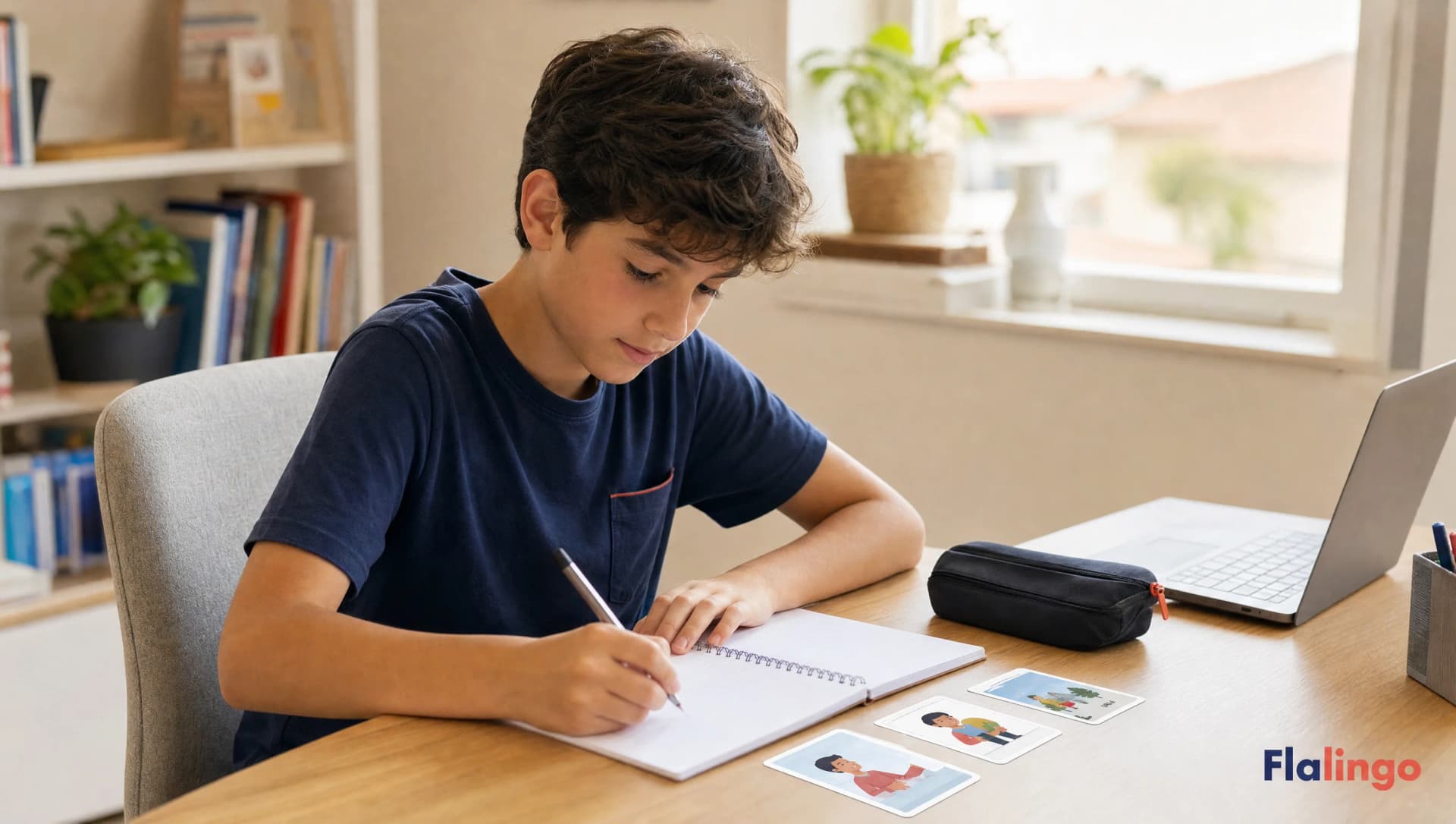
The most useful A2 Key for Schools writing practice starts with a reader, not a word counter. Can a friend find the club meeting from your child’s email? Can someone follow what happened across three pictures without seeing the pictures? Those are better first questions than whether a draft sounds sophisticated. The exam, still often called KET, gives children a clear reason to practise short communication across reading, writing, listening and speaking.
Put the official format beside the study plan
The Cambridge English A2 Key for Schools format has a combined Reading and Writing component lasting one hour. Parts 1–5 mainly assess reading; Parts 6–7 mainly assess writing. Part 6 is an email or note of at least 25 words. Part 7 is a story of at least 35 words based on three picture prompts. Listening has five parts and Speaking has two. In the real Speaking test, candidates work face to face with one or two other candidates and two examiners. Home practice can develop question-and-answer skills, while the school or teacher can explain the actual procedure.
A minimum word count is not a complete quality target. A 25-word email that omits the meeting place leaves the reader stranded. A 50-word story that lists objects in three pictures without connecting events is still hard to follow. Teach the child to identify the required information or event sequence, draft, then read their own answer from the recipient’s point of view. That sequence is transferable to an unfamiliar prompt.
Build the email with four boxes
Try this original practice prompt: “Your friend wants to come to the school garden on Friday. Tell them the meeting time, exactly where to meet and what to bring.” Draw four small boxes labelled time, place, thing to bring and friendly close. Your child writes a keyword in each box before making sentences. A possible practice opening is: “Hi Leo, our club meets on Friday at four. Please come to the school garden. Bring your camera because we will take photos. See you there!” Use it to illustrate the structure, then give your child a different place and activity so that they write their own message.
On the first read, use three marks: a tick for information the reader can find, a question mark where they must guess, and an arrow for a sentence that could be clearer. Discuss missing content before selecting one or two language errors. Correcting every small error at once can hide the more important problem: the friend still does not know where to go. Keep the first draft and ask for a second draft after your child has re-read the prompt independently.
Turn three scenes into one story
For a home rehearsal, invent three simple scenes: Mina leaves her bag on a bus; she tells the driver; she gets the bag back. Ask your child to choose one verb for each event before writing full sentences. “First, then, finally” can help, but the links must express real movement through the story. Who notices the missing bag? What does Mina do next? How is the problem resolved? The official task uses three picture prompts and requires at least 35 words; these invented scenes are a way to practise the underlying skill.
Read the answer without looking at the scene notes. If it says only “There is a bus. There is a bag. There is a driver,” it describes three objects but tells little story. If it says “Mina left her bag on the bus, so she called the driver. He found it and brought it back,” a reader can follow cause and result. Let your child add a sensible detail or feeling rather than padding to reach the minimum. Compare a fresh story one week later, not just a polished version of the same scene.
Use a small four-skill weekly rhythm
On Monday, read a few short messages or notices and identify the main point. On Tuesday, draft an email from a new prompt. On Wednesday, listen for a specific time, place or number in a short recording; the Cambridge format notes that recordings are heard twice in the exam. On Thursday, practise personal questions and a short discussion about likes and dislikes with reasons. On Friday, write a three-scene story. At the end of the week, choose one repeated issue for the next cycle, such as remembering the place in an invitation or using a clear ending.
Do one untimed attempt before adding a clock. When a child cannot yet identify what the prompt asks, time pressure gives you less useful information. Later, use current official sample materials to experience the real timing. The Reading and Writing component lasts 60 minutes, so a short 25-minute tutoring session is a place to learn a task or review a draft, not a complete timed written exam.
What should go to the teacher?
Bring the first and revised email, the first story, the original prompts and a note of whether help or a dictionary was used. “She forgot two details in both email prompts” is a clearer teaching target than “her writing is weak.” Flalingo’s teacher-led A2 materials include practical short-email, direction-giving and picture-story situations. You can explore the English-for-kids learning guide for a teacher discussion and see the materials overview for the task sequence. Ask the teacher to pick one change that can be observed in the next independent draft.
Record the date, time limit and level of assistance beside every piece of work. A corrected story written together and a fresh story written alone should not be treated as identical evidence. If the child moves from needing the parent to name every event to identifying the three event verbs independently, that is a meaningful observation even while spelling still needs work.
Common questions
Should my child aim for exactly 25 or 35 words?
No. Those are minimum lengths for the relevant official tasks. Clarity and coverage still matter.
Would memorising a story help?
Practising a reusable sequence of events is more useful than memorising one answer for unknown pictures.
Is a full paper needed every day?
No. Small tasks, specific feedback and a new task to test the same skill provide clearer evidence.
Source checked 27 September 2026: Cambridge English A2 Key for Schools exam format. The home prompts above are original practice exercises.
Discuss your child’s work with a teacher
Keep the first writing sample and any exam notice you have received from the school. When exploring Flalingo’s teacher-led programmes, share the particular skill your child needs to practise: Programme for ages 9–12 · Programme for ages 13+.
Age is a starting point; exam level and lesson suitability also depend on the skills your child can use independently.
Related Cambridge preparation articles




Flalingo Team is a team of experienced teachers. Our aim is to share the most up-to-date information and expert analyses about online English language learning with our readers. Our mission is to guide you on your English learning journey with data-driven content.
English with Flalingo

Learning English with Flalingo means progressing with an intelligent system that works in an integrated manner.