
English Education for Ages 4–5: Not a Lesson for Your Child, but an English Playtime!
Introduction: “You Bend the Tree While It’s Young” — But How?
As parents, there is a proverb we all know well and often turn to: “You bend the tree while it’s young.” This saying is especially accurate for the ages of 4–5 so much so that it almost summarizes a scientific fact. This period is a magical window that linguists call the “critical period,” when a child’s brain is most open to a new language, absorbing its rhythm, sounds, and structure effortlessly, like a sponge.
However, right at this point, we must remember that even the most well-intentioned efforts require a delicate balance. On one hand, there is the desire to make the most effective use of the time your child spends in front of a screen. On the other, there is the concern that pushing “education” too hard may cause your child to lose interest in a foreign language or worse, turn it into something they fear.
We understand this dilemma deeply. So how can we make the most of this critical period? The answer is actually very simple: at this age, learning is not possible through abstract and demanding methods like grammar rules or vocabulary memorization, but only through play and interaction.
This is exactly where Flalingo Kids steps in, completely rejecting the word “lesson” in parents’ minds and replacing it with a much warmer, more inviting concept: “English playtime.”
The goal here is not so much to teach your child something, but to introduce them to a high-energy, native-English-speaking “play buddy” someone who knows how to communicate with children. This approach transforms learning from a task into an enjoyable activity your child looks forward to with excitement.
In a Nutshell
We know how valuable time is on the parenting journey. As the Flalingo family, we’ve briefly summarized our vision and professional approach to English education for ages 4–5 for parents who may not have time to read this detailed guide:
- • Turning the Critical Period into Play: Ages 4–5 are the most effective years for language learning. We design this process not as a boring “lesson,” but as an “English playtime” your child eagerly looks forward to.
- • Not Just Native, but Pedagogically Trained: Your child is not matched with random instructors, but with certified teachers (play buddies) who understand child psychology and remain consistent in every session.
- • Oxford Assurance: We eliminate the uncertainty of “What will they learn today?” by using age-appropriate, interactive, and gamified content from Oxford University Press.
- • Transparent Technology (FLAI): Even if you’re not present during the lesson, our AI-powered analysis reports allow you to track exactly what your child is learning and how they’re progressing—with clear, concrete data.
1. Qualified Guidance: Why a “Certified Teacher” Is More Valuable Than Just a “Native Speaker”
A child’s first connection with a language is directly shaped by who guides them along the way. For a 4–5-year-old, choosing the right guide for their very first language experience is one of the most critical decisions—it can determine whether they develop a love for the language or a sense of fear toward it. This process is about far more than simple conversation practice; it is about laying a solid pedagogical foundation.
Analysis: The Risk Behind a Common Market Approach
Many platforms in the market promise one main thing: letting your child “talk to a foreigner.” However, being a native English speaker does not automatically qualify someone to interact appropriately with a 4–5-year-old child. A guide who lacks knowledge of child psychology, attention span management, and age-specific learning dynamics may, at best, bore a child—and at worst, intimidate them, creating a lasting negative bias toward language learning. This is a significant risk taken in the name of “practice.”
Evaluation: The Pedagogical Difference of Flalingo Kids
Flalingo Kids eliminates this risk by not selecting its instructors at random. Instead, teachers are chosen meticulously based on clear pedagogical criteria—criteria that elevate the experience from casual conversation to a professional educational interaction:
- Professional Certification: All teachers on the platform hold internationally recognized teaching certifications such as TESOL or CELTA. This means they are not only fluent speakers of the language, but professionals who know how to teach it.
- Area of Expertise: Instructors are selected from those who specialize in child development, early language acquisition, and play-based teaching methods. Their expertise goes beyond language instruction, encompassing child-centered communication and motivation techniques that adapt to each child’s level and needs.
More Than a Conversation—A Pedagogical Process
This approach completely removes the parental concern of “Is this time being wasted?” and reassures you that your child is not only having fun, but is also being guided by a qualified professional.
Of course, for even the most qualified teacher to reach their full potential, they need the right tools—namely, the right learning materials.
2. Quality Content: Ending the “What Will We Talk About Today?” Uncertainty with Oxford Assurance
One of the most common concerns among parents is: “So what actually happens during this playtime? Is the content high-quality and suitable for my child?” Unlike randomly chosen YouTube videos or unprepared conversations, structured, reputable, and developmentally appropriate content is the cornerstone of effective learning.
Analysis: The Problem Created by Content Uncertainty
In unplanned interactions, the frequent question of “What will we talk about today?” creates an inefficient environment for both the child and the teacher. A child’s attention drifts easily, the instructor is forced to improvise, and valuable time is lost. Education should not rely on random, unprepared conversations, but on goal-oriented and engaging content.
Evaluation: Flalingo Kids’ Oxford University Press Solution
Flalingo Kids addresses this issue at its core through its collaboration with Oxford University Press, widely regarded as the gold standard in educational publishing. This partnership guarantees both the quality and pedagogical validity of the platform’s content. Key features of these materials include:
- Age Appropriateness: All content is specifically designed with the cognitive and emotional development levels of preschool-aged children in mind.
- Interactive Structure: The materials are built around colorful visuals, fun characters, songs, and interactive games. This structure keeps children engaged and transforms learning from passive listening into active participation.
Education That Feels Like a Cartoon
This approach turns your child from a passive screen consumer into an active participant in a structured curriculum—often without them even realizing it. Here, fun is not the goal of learning, but the tool that makes learning possible.
But even with the best teachers and the highest-quality materials, how effective can the process truly be if a child feels insecure every time they face a new stranger in each session?
3. Routine and Trust: A Familiar “Play Buddy,” Not a Different Face Every Session
For children aged 4–5, routine and predictability form the foundation of emotional security. Feeling safe in a learning environment is a prerequisite for acquiring new knowledge and expressing themselves. Building a secure bond has a direct and positive impact on the learning process.
Analysis: The Anxiety Caused by Constant Change
On some platforms, meeting a different teacher or a new “foreign face” in every session can easily intimidate or cause a 4–5-year-old to withdraw. Constantly trying to adapt to someone new drains a child’s energy and emotional capacity. Moreover, on many platforms, continuing with the same teacher is nearly impossible. This situation reduces a child’s motivation to attend sessions and significantly lowers learning efficiency.
Evaluation: Flalingo Kids’ Fixed Teacher Model
Flalingo Kids addresses this psychological need through its “Smart Matching” algorithm and fixed teacher model. The system first helps match your child with the teacher who best fits their interests, energy level, and learning style. Once this initial match is made, families are offered the option to continue all sessions with the same teacher. This feature is one of the most valued by users and plays a key role in the platform’s success.
From Teacher to “Foreign Friend”
This strong bond transforms English from a subject that must be learned into a meeting your child eagerly looks forward to, and turns speaking anxiety into a safe space built on trust. Knowing that your child feels happy and secure during lessons is priceless. Still, as parents, you also want to see tangible results from this enjoyable process.
4. Transparency for Parents: An AI-Powered Answer to the Question “Did They Just Play?”
One of the most fundamental questions on parents’ minds is: “Am I really getting a return on this investment? Is this fun activity actually turning into real learning?” Flalingo addresses this valid curiosity by leveraging technology to provide a transparent and measurable solution.
Analysis: Parental Curiosity and the “Black Box” Problem
When you’re not able to sit in on your child’s session, it’s natural to wonder: “What did my child do during the lesson? Did they truly learn something new, or did they just play games on the screen?” Platforms that lack a feedback mechanism can feel like a “black box” for parents, creating uncertainty and mistrust.
Evaluation: Flalingo Kids’ Transparency Tool — the FLAI Report
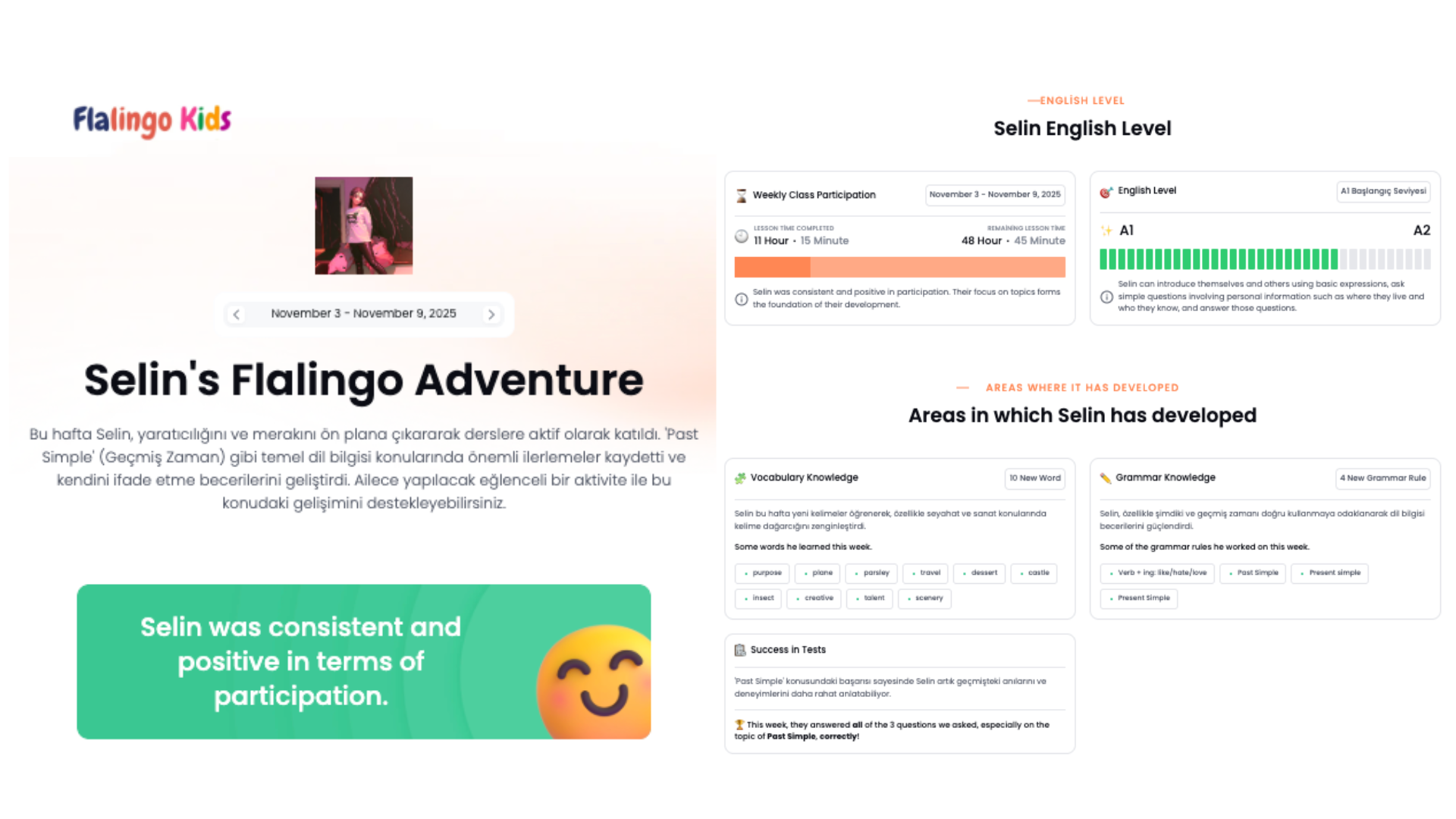
Flalingo solves this “black box” problem with its AI assistant called FLAI (Flalingo AI). After every English playtime, FLAI analyzes the session recording and generates a detailed, easy-to-understand progress report for parents. This report acts as a sophisticated, personalized language coach, revealing the concrete data behind the fun and games:
- Speaking Time Analysis: A percentage breakdown of how much the teacher and your child spoke during the session.
- Fluency Metrics: An analysis of how many words per minute your child used.
- Vocabulary Depth: A breakdown of the vocabulary used—categorized by beginner or advanced levels along with a diversity analysis.
- Error Detection and Correction: Identification of mistakes made during the session, presented together with correct usage examples.
- Personalized Homework: Tailored practice suggestions and assignments based on your child’s specific areas for improvement.
Even When You’re Not There, FLAI Is
FLAI acts as your extra “eyes and ears,” following each session on your behalf amid your busy schedule. Even when life gets hectic, these detailed reports allow you to track your child’s progress with concrete data after every lesson so you can clearly see how far they’ve come and confidently continue the journey with complete peace of mind.
Conclusion: A Safe, Fun, and Professional Start for Your Child’s Most Receptive Years
In short, introducing your child to English between the ages of 4–5 is one of the most valuable gifts you can give for their future. However, how this introduction is made is critically important. Flalingo Kids designs this sensitive process not as a “lesson,” but around play—the method most aligned with a child’s natural way of learning.
We can summarize Flalingo Kids’ approach with three key words:
- Safe: With certified teachers who understand child psychology and remain consistent in every session, your child feels emotionally secure.
- Fun: Thanks to the gamified and interactive content of the world-renowned Oxford University Press, learning turns into an enjoyable adventure for your child.
- Professional: FLAI AI reports provide parents with clear, concrete data, making it possible to track progress throughout this fun learning journey with full transparency.
Built on these three core pillars, Flalingo Kids ensures that your child’s first encounter with English is both positive and long-lasting.
Don’t miss this most receptive stage of your child’s life!
Frequently Asked Questions
Is 4–5 years old too early for English learning? Will my child struggle?
No—on the contrary, this age range is what linguists call the “critical period,” when the brain learns a new language with the least effort. We design the process not as an academic “lesson,” but as an enjoyable “playtime.” This way, your child doesn’t struggle; instead, they naturally acquire the language while having fun.
Who are your instructors? Do they have pedagogical training?
We don’t just select native English speakers—we choose professionals who specialize in child development, play-based learning, and classroom management. All of our instructors hold internationally recognized certifications such as TESOL or CELTA. Teachers at Flalingo Kids don’t simply chat with your child; they guide them with strong pedagogical awareness.
What materials do you use in lessons?
Instead of random content, we use resources from Oxford University Press, a global leader in educational publishing. These colorful, interactive, and gamified materials—designed specifically for your child’s age group—make learning feel as enjoyable as watching a cartoon.
Will there be a different teacher in every lesson?
No. We understand the importance of trust and routine for children aged 4–5. With our “Smart Matching” algorithm, once we find the teacher your child connects with best, we offer the option to continue all lessons with the same “fixed teacher.” This allows your child to build a strong and secure bond.
How can I track my child’s progress?
Thanks to our AI-powered assistant FLAI, the process is fully transparent. After every lesson, you receive a detailed analysis report including metrics such as your child’s speaking time, vocabulary range, and fluency level. This allows you to follow their progress step by step—even if you’re not present during the lesson.
References
-
Wikipedia. Critical Period Hypothesis. View Source
-
Oxford University Press. (Preschool English Teaching Resources). View Source
-
Cambridge Assessment English. CELTA (Certificate in Teaching English to Speakers of Other Languages) Standards. View Source
-
UNICEF. Learning through Play: Strengthening Learning through Play in Early Childhood Education Programmes. View Source
-
Flalingo Kids. English Education Curriculum for Children and the FLAI AI-Powered Reporting System. Explore the Platform
Other content that may interest you




As an ESL educator of 5+ years, I am a guide for students and parents. I simplify complex English topics and online course selection for you. My goal is to help you turn learning from a stressful task into an enjoyable adventure.
English with Flalingo

Learning English with Flalingo means progressing with an intelligent system that works in an integrated manner.