

İçeriğe geç
Flalingo

İngilizce pratiği

OET Reading Part A: dört kısa metinden 15 dakikada doğru cevap nasıl bulunur ve eksiksiz aktarılır

Two healthcare colleagues in uniform compare open blue folders at a desk; one points to a sheet of paper.

OET Reading Part A nasıl çözülür: metni işlevine göre seçmek, tablonun doğru satırını okumak, sayıyı birimi ve koşuluyla aktarmak, son tarihi etkinlik saatinden ayırmak. B2 ve üstü hemşire ve doktorlar için.

OET Reading Part A size tek bir sağlık konusunda dört kısa metin ve 15 dakikada 20 soru verir; her şeyi dikkatle okumaya vaktiniz yoktur. Başlıklara ve düzene bakarak sorunun aradığı işi yapan metni seçin. Sonra tarayın ve yalnızca ayrıntının çevresindeki cümleyi ya da tablo satırını okuyun. Cevabı birimi, koşulu ve zamanıyla birlikte aynen aktarın. Bu yazı İngilizcesi en az orta üstü (B2) seviyede olan hemşire ve doktorlar için.

Bu yazı kimin için?

  • Part A metinlerini anlayan ama son sorulara gelmeden süresi biten hemşire ve doktorlar.
  • Neredeyse doğru cevaplarda puan kaybeden adaylar: eksik birim, komşu satır, boşluğun çevresinden kopyalanan kelimeler.
  • İş yerinde nöbet listelerine, çizelgelere ve kurum talimatlarına bakan, tam ayrıntıyı hızlı bulmak isteyen profesyoneller.
  • Henüz erken: bir sayfalık İngilizce metin size hâlâ uzun sürüyorsa önce genel okumanızı orta üstü (B2) seviyeye taşıyın; aşağıdaki çalışma planı rehberi haftalık tek bir hedef koymanıza yardım eder.
  • Fazla kolay: Part A 15 dakikada güvenilir şekilde bitiyorsa Part B’ye ve personel duyurularına geçin (bağlantı aşağıda).

Örnek sayfaları açın

Örnek sayfaları açın

Kelime kartları

Personal · finding information

When did you last struggle to find a simple piece of information in a document or on a website? What made it hard?

Useful: ‘I was looking for…, but…’ · ‘The information was there, but it was hidden under…’ · ‘In the end, I had to…’

Personal · how you read

Do you usually read instructions from beginning to end, or scan for what you need? Has that ever caused a problem?

Useful: ‘I tend to skim until…’ · ‘I only read carefully when…’ · ‘Once, I missed… because…’

Professional practice · documents at work

Which document at your workplace do staff or patients most often misread? How would you improve it?

Useful: ‘The one that causes most confusion is…’ · ‘I’d move… so that…’ · ‘The heading should say…’

Big idea · reader and writer

When a reader misunderstands an important document, whose responsibility is it: the writer’s or the reader’s?

Useful: ‘I’d say the writer has more responsibility, because…’ · ‘That’s true up to a point, but…’ · ‘Both have a part to play:…’

Örnek konuşma

How can you explain a useful checking habit?

I would underline the deadline label before copying the time, because the same notice also gives the later session time.

One possible formulation; other coherent and accurate responses are welcome.

Cümle yapısı

Copy the unit with the number

  • A number without its unit can change the meaning.
  • A notice says return within seven days. Recording seven without days leaves the time period incomplete.

Use the right condition

  • A general rule may have an exception.
  • Staff collect folders from reception; external visitors collect them from the training desk. The right place depends on who is collecting.

Answer the actual field

  • Avoid repeating words already printed around the gap.
  • Field: Send requests at least ___ before the session. Source: two working days. Copy two working days, not the whole sentence.

Diğer alıştırmalar

Read the information

Text A — Visitor-support desk: purpose

The visitor-support desk helps people understand practical arrangements at the clinic. Staff can explain where to wait, how to find a department and how to contact the appointment team. The desk does not make clinical decisions or change treatment plans. Questions about an individual’s care should be directed to the appropriate professional.

Text B — Finding the desk

From the main entrance, continue along the ground-floor corridor to the large noticeboard. The visitor-support desk is on the left immediately after the noticeboard, opposite the small meeting room. It is not beside the upstairs lift. Staff directing someone from the side entrance should first guide them towards the main entrance corridor.

Text C — Contacting the support team

For a routine practical enquiry, use the shared support inbox. Staff should include a callback number and a brief description of the information requested. Do not put detailed personal information in the subject line. For a same-day practical issue, telephone the support coordinator on the internal number shown in the staff directory.

Text D — Desk opening times

The desk is staffed from 09:00 to 12:00 and from 13:00 to 16:00 on weekdays. During the midday closure, written enquiries can still be left in the secure enquiry box next to the desk. The box is checked when the afternoon session begins. The desk is not staffed on weekends.

Practice context

  • Four reference extracts for staff at a community clinic. Read them as workplace information, not instructions for treating a patient.

Evidence questions

  • Which text explains the limits of what the service can do?
  • Which text would help a colleague direct a visitor from the main entrance?
  • Which text explains the communication channel for a same-day practical issue?

Read the information

Text A — Training folders

Training folders are prepared for registered participants. Internal staff collect them from reception; external visitors collect them from the training desk. Each folder contains the session outline and blank note pages. Participants who need a different print size should mention this when they register, so the correct version can be prepared.

Text B — Requests and changes

Requests for printed folders must reach the training team at least two working days before the session. Include the session title, date and number of participants. A change to the participant total after the deadline should be reported through the shared training inbox; staff should not assume that extra folders will already be available.

Text C — Borrowed learning resources

Reference folders borrowed for personal study should be returned within seven days. A borrower who needs more time may request an extension before the return date. The training team checks whether another person is waiting before confirming an extension. An unconfirmed request does not automatically change the original return date.

Text D — Returning a resource

Return borrowed reference folders to the labelled tray inside the training office. If the office is closed, use the secure return box beside its door. Do not leave borrowed material on a reception counter, where it may be mistaken for a new session pack. Staff check the return box each weekday morning.

Practice context

  • Four staff-training reference extracts from a training centre. Complete brief answers externally before looking at the supported choices.

Evidence questions

  • Where should an external visitor collect a prepared training folder?
  • How far in advance must a printed-folder request reach the team?
  • Where should a borrowed folder be placed when the training office is closed?

Read the information

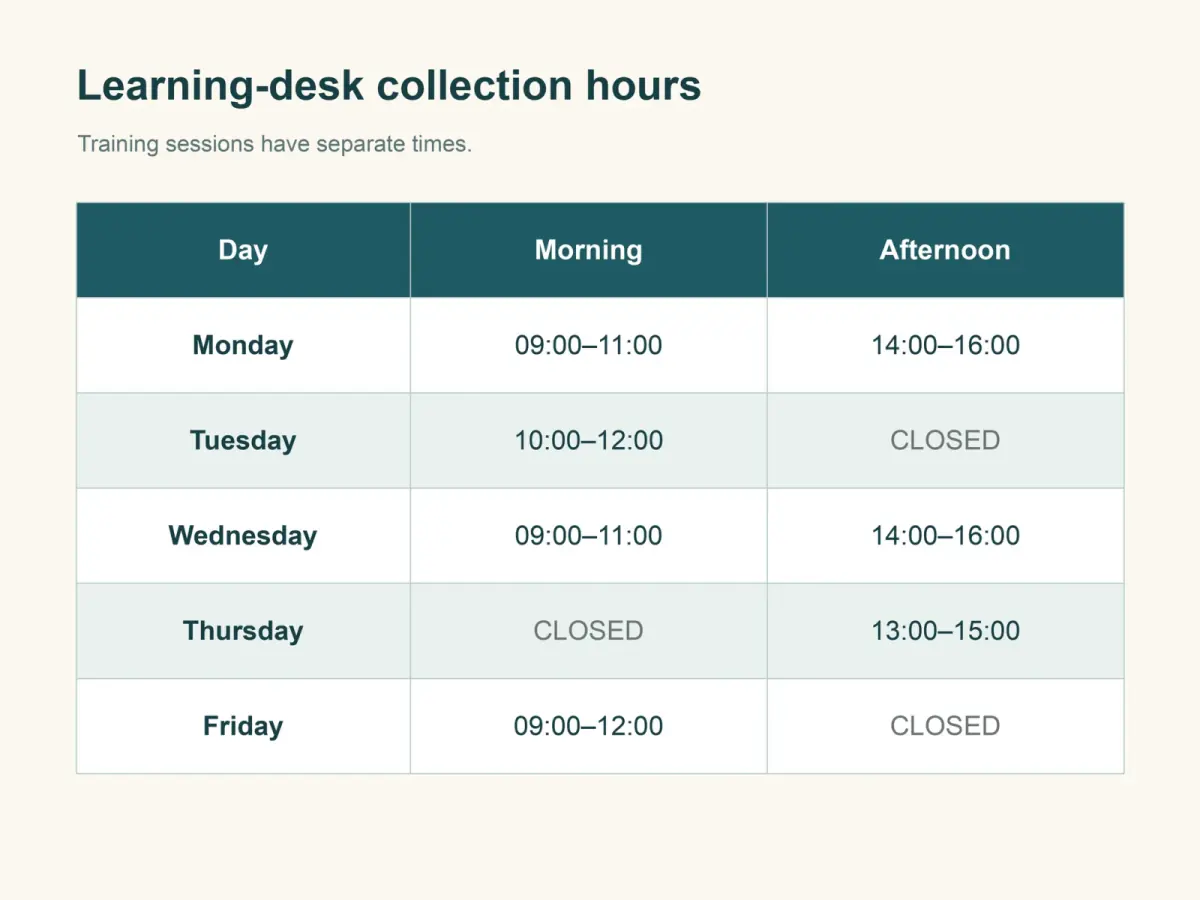
Collection timetable: Monday 09:00–11:00 and 14:00–16:00; Tuesday 10:00–12:00, afternoon closed; Wednesday 09:00–11:00 and 14:00–16:00; Thursday morning closed, 13:00–15:00; Friday 09:00–12:00, afternoon closed.

Text A — Collection service

The learning desk holds pre-booked session packs for staff. A collection is ready only after the organiser has confirmed the participant’s registration. The desk cannot confirm a place on a course. A staff member who has not received registration confirmation should contact the organiser rather than assume that a pack is waiting.

Text B — Learning-desk schedule

Monday: morning 09:00 to 11:00; afternoon 14:00 to 16:00.

Tuesday: morning 10:00 to 12:00; afternoon closed.

Wednesday: morning 09:00 to 11:00; afternoon 14:00 to 16:00.

Thursday: morning closed; afternoon 13:00 to 15:00.

Friday: morning 09:00 to 12:00; afternoon closed.

These are collection hours, not the times of the training sessions themselves.

Text C — Preparing a collection

Receive collection request, then check registration list. If registration is confirmed, prepare the named pack and send a collection message. If the name is not on the list, ask the organiser to check the registration. Do not prepare a pack or send a ready-to-collect message until the registration is confirmed.

Text D — Outside the listed hours

Staff who cannot attend during collection hours may ask the learning team to arrange an alternative. The team must confirm the arrangement before anyone leaves material elsewhere. A request alone is not confirmation. Session packs should not be left in public waiting areas or passed to an unknown person.

Practice context

  • Four reference extracts for a staff-learning desk. Text B is a compact schedule with labelled day rows; Text C is a written decision path.

Evidence questions

  • Which collection window is available on Thursday?
  • What happens next if a requested name is missing from the registration list?
  • What must happen before an alternative collection arrangement is used?

Read the information

Text A — Orientation visit

The centre runs a practical orientation visit for new volunteers. It introduces the reception area, staff-learning room and visitor-support point. The visit is about finding services and understanding whom to contact. It does not include clinical work or observation of patient consultations. Volunteers receive their individual duty information separately from their own coordinator.

Text B — Booking and deadline

The next orientation visit is on Friday 18 October at 14:00. A group organiser should submit the final number of visitors by 12:00 on Wednesday 16 October. Include a contact name and any practical access requests. Do not send detailed personal histories. The organiser receives a confirmation message once the group booking has been checked.

Text C — Arrival information

Confirmed groups meet at the side entrance beside the bicycle racks. Individual volunteers attending without a group meet at main reception. Both groups should arrive ten minutes before the stated start time. A person arriving late should contact the orientation coordinator rather than follow an unfamiliar group into another part of the building.

Text D — Changes after confirmation

An organiser who needs to change the group size should contact the orientation coordinator through the shared visits inbox. The coordinator checks whether the revised group can be accommodated and replies with confirmation or an alternative. The original arrangement remains in place until a change is confirmed. Please do not treat an unanswered message as agreement.

Practice context

  • Four reference extracts about a centre’s orientation visit. This is a shorter classroom retrieval task, not a full twenty-question Reading Part A paper.

Evidence questions

  • What is the deadline for a group organiser’s final visitor count?
  • Where should a confirmed group meet?
  • What is the status of the original arrangement while a requested change is unanswered?

Choose and justify with evidence

Text A — Visitor-support desk: purpose

The visitor-support desk helps people understand practical arrangements at the clinic. Staff can explain where to wait, how to find a department and how to contact the appointment team. The desk does not make clinical decisions or change treatment plans. Questions about an individual’s care should be directed to the appropriate professional.

Text B — Finding the desk

From the main entrance, continue along the ground-floor corridor to the large noticeboard. The visitor-support desk is on the left immediately after the noticeboard, opposite the small meeting room. It is not beside the upstairs lift. Staff directing someone from the side entrance should first guide them towards the main entrance corridor.

Text C — Contacting the support team

For a routine practical enquiry, use the shared support inbox. Staff should include a callback number and a brief description of the information requested. Do not put detailed personal information in the subject line. For a same-day practical issue, telephone the support coordinator on the internal number shown in the staff directory.

Text D — Desk opening times

The desk is staffed from 09:00 to 12:00 and from 13:00 to 16:00 on weekdays. During the midday closure, written enquiries can still be left in the secure enquiry box next to the desk. The box is checked when the afternoon session begins. The desk is not staffed on weekends.

  1. Which text explains the limits of what the service can do?

    Cevabı ve açıklamayı göster

    Text A

    Text A describes the desk’s practical role and says it does not make clinical decisions or change treatment plans.

  2. Which text would help a colleague direct a visitor from the main entrance?

    Cevabı ve açıklamayı göster

    Text B

    Text B gives the route and landmarks needed to find the desk.

  3. Which text explains the communication channel for a same-day practical issue?

    Cevabı ve açıklamayı göster

    Text C

    Text C distinguishes routine inbox enquiries from a same-day call to the coordinator.

Choose and justify with evidence

Text A — Training folders

Training folders are prepared for registered participants. Internal staff collect them from reception; external visitors collect them from the training desk. Each folder contains the session outline and blank note pages. Participants who need a different print size should mention this when they register, so the correct version can be prepared.

Text B — Requests and changes

Requests for printed folders must reach the training team at least two working days before the session. Include the session title, date and number of participants. A change to the participant total after the deadline should be reported through the shared training inbox; staff should not assume that extra folders will already be available.

Text C — Borrowed learning resources

Reference folders borrowed for personal study should be returned within seven days. A borrower who needs more time may request an extension before the return date. The training team checks whether another person is waiting before confirming an extension. An unconfirmed request does not automatically change the original return date.

Text D — Returning a resource

Return borrowed reference folders to the labelled tray inside the training office. If the office is closed, use the secure return box beside its door. Do not leave borrowed material on a reception counter, where it may be mistaken for a new session pack. Staff check the return box each weekday morning.

  1. Where should an external visitor collect a prepared training folder?

    Cevabı ve açıklamayı göster

    the training desk

    Text A distinguishes external visitors, who collect at the training desk, from internal staff at reception.

  2. How far in advance must a printed-folder request reach the team?

    Cevabı ve açıklamayı göster

    two working days

    Text B says at least two working days; calendar days and seven days refer to different or unsupported periods.

  3. Where should a borrowed folder be placed when the training office is closed?

    Cevabı ve açıklamayı göster

    the secure return box

    Text D specifies the secure return box beside the closed office door.

Choose and justify with evidence

Collection timetable: Monday 09:00–11:00 and 14:00–16:00; Tuesday 10:00–12:00, afternoon closed; Wednesday 09:00–11:00 and 14:00–16:00; Thursday morning closed, 13:00–15:00; Friday 09:00–12:00, afternoon closed.

Text A — Collection service

The learning desk holds pre-booked session packs for staff. A collection is ready only after the organiser has confirmed the participant’s registration. The desk cannot confirm a place on a course. A staff member who has not received registration confirmation should contact the organiser rather than assume that a pack is waiting.

Text B — Learning-desk schedule

Monday: morning 09:00 to 11:00; afternoon 14:00 to 16:00.

Tuesday: morning 10:00 to 12:00; afternoon closed.

Wednesday: morning 09:00 to 11:00; afternoon 14:00 to 16:00.

Thursday: morning closed; afternoon 13:00 to 15:00.

Friday: morning 09:00 to 12:00; afternoon closed.

These are collection hours, not the times of the training sessions themselves.

Text C — Preparing a collection

Receive collection request, then check registration list. If registration is confirmed, prepare the named pack and send a collection message. If the name is not on the list, ask the organiser to check the registration. Do not prepare a pack or send a ready-to-collect message until the registration is confirmed.

Text D — Outside the listed hours

Staff who cannot attend during collection hours may ask the learning team to arrange an alternative. The team must confirm the arrangement before anyone leaves material elsewhere. A request alone is not confirmation. Session packs should not be left in public waiting areas or passed to an unknown person.

  1. Which collection window is available on Thursday?

    Cevabı ve açıklamayı göster

    13:00–15:00

    The Thursday row has the morning closed and the afternoon window 13:00–15:00.

  2. What happens next if a requested name is missing from the registration list?

    Cevabı ve açıklamayı göster

    Ask the organiser to check the registration

    Text C requires an organiser check before preparation or collection confirmation.

  3. What must happen before an alternative collection arrangement is used?

    Cevabı ve açıklamayı göster

    The learning team must confirm the arrangement

    Text D says the learning team must confirm an alternative; requesting one is not enough.

Choose and justify with evidence

  1. What is the deadline for a group organiser’s final visitor count?

    Cevabı ve açıklamayı göster

    Wednesday 16 October at 12:00

    Text B separates the Friday visit from the Wednesday noon deadline for group numbers.

  2. Where should a confirmed group meet?

    Cevabı ve açıklamayı göster

    the side entrance beside the bicycle racks

    Text C gives a different meeting point for confirmed groups and individual volunteers.

  3. What is the status of the original arrangement while a requested change is unanswered?

    Cevabı ve açıklamayı göster

    Still in place until the change is confirmed

    Text D explicitly keeps the original arrangement in place pending confirmation.

Bu üniteyi öğren
Nasıl öğrenmek istersin?
Hesabın var mı?

Ücretsiz hesap bir üniteyi kalıcı olarak açar.

Part A sizden ne ister?

Part A, 60 dakikalık Reading sınavını açar: tek bir sağlık konusunda A’dan D’ye dört kısa metin; aralarında çoğu zaman bir tablo ya da adım listesi de olur. Kendi 15 dakikası vardır; sonra Part B ve C’ye geçersiniz.

Üç soru türü vardır ve son ikisinde yazım da puanı etkiler:

  • Eşleştirme: bu bilgi hangi metinde? Cevap A, B, C ya da D.
  • Kısa cevap: bir kelime, sayı ya da kısa ifade.
  • Cümle tamamlama: eksik kelimeler, metinlerden aynen aktarılır.

Metni işlevine göre seçin, sonra tarayın

Aynı konudaki dört metin nadiren aynı işi yapar. İlk dakikayı başlıklara ve düzene ayırın, her metne iki kelimelik bir etiket verin ve kelime aramadan önce her soruyu bir işle eşleştirin. Sonra cevabı cümlenin kendisinde doğrulayın.

  • “What can’t the desk do?” → amaç ve sınırlar.
  • “How do I reach the desk?” → yol tarifi.
  • “Whom do I phone about a same-day problem?” → açılış saatleri değil, iletişim bilgileri.
  • “When is the desk staffed?” → çizelge.

Aynen aktarın: birim, koşul ve yalnızca eksik kelimeler

Neredeyse doğru cevaplar puan kaybettirir. Üç kontrol bunları yakalar:

  • Birimi aktarın: “within seven days” için “seven” eksiktir; “two days” da “two working days” değildir.
  • Doğru koşulu kullanın. “Internal staff collect them from reception; external visitors collect them from the training desk.” Dışarıdan gelen bir ziyaretçi için cevap “the training desk” olur.
  • Boşluğun istediğini yazın. “Send requests at least ___ before the session.” Metin “two working days” diyor: yalnızca bunu yazın, boşluğun çevresinde zaten basılı olan kelimeleri değil.

Süre sınırını netleştiren küçük kelimeler

Süre sınırlarını edatlar belirler; onları sayılar kadar dikkatle okuyun. Türkçedeki “-e kadar” hem by hem until yerine kullanılabilir, İngilizce ise ikisini ayırır:

  • by 12:00 on Wednesday: en geç o an; bir son tarih.
  • until 16:00: o saate kadar süren, sonra biten bir durum.
  • within seven days: yedi gün dolmadan herhangi bir zamanda; “in seven days” ise genellikle bugünden yedi gün sonra demektir.
  • at least two working days before: en az bu kadar önce; daha erkeni de olur.
  • from 09:00 to 12:00 and from 13:00 to 16:00: arası kapalı iki zaman aralığı.

Tablonun doğru satırını okuyun

Önce satırı, sonra sütunu, sonra rakamların ne anlama geldiğini söyleyen notu bulun. Bir alıştırma çizelgesinde perşembe satırı “morning closed; afternoon 13:00 to 15:00” diyor; cevap 13:00–15:00’tir, daha yukarıdaki salı satırının 10:00–12:00 aralığı değil.

Akış şemasında duruma uyan dalı izleyin: “If the name is not on the list, ask the organiser to check the registration.”

Bu üniteyi kendi yolunla öğren

Son tarihi etkinlik saatinden ayırın

Bir duyuru, farklı işleri olan iki zaman verebilir: “The next orientation visit is on Friday 18 October at 14:00. A group organiser should submit the final number of visitors by 12:00 on Wednesday 16 October.” Bir saati aktarmadan önce, aşağıdaki adayın anlattığı gibi, etiketinin altını çizin: by, deadline ya da starts.

Öğretmen How can you explain a useful checking habit?

Aday I would underline the deadline label before copying the time, because the same notice also gives the later session time.

Ziyaretçi sayısı için son tarih hangisi?

Part A’da tipik hatalar

Her hatayı etiketleyin; etiket neye çalışacağınızı söyler:

  • Yanlış metin: başlık ziyaretçilerden söz ediyor, soru personeli soruyor.
  • İlk eşleşme: doğru görünen ama başka bir satırdan ya da metinden gelen sayı.
  • Eksik bir şey: birim, koşul ya da çoğul eki (“two working day”).
  • Fazla kelime: boşluktan sonra zaten basılı olan “before the session” ifadesini tekrarlamak.
  • Talebi onaylanmış sanmak: “The original arrangement remains in place until a change is confirmed.”
  • Türkçede sayıdan sonra isim tekil kalır (“iki gün”), İngilizcede ise çoğul gerekir: sondaki her -s’yi kontrol edin.

Part A çalışma rutini

Haftada üç kez, bir deneme sınavından bir Part A setiyle:

  • 15 dakika: seti sınav süresiyle çözün, önce başlıklara bakın.
  • 10 dakika: puanlayın ve her hatayı etiketleyin.
  • 5 dakika: her yanlış cevabı metinde yazdığı gibi yeniden yazın.
  • Sonraki set: önce en sık çıkan etiketinize dikkat edin.

Sıradaki adım

Part B’de her birinde üç seçenekli bir soru olan altı kısa iş yeri metni vardır; Part C’de ise iki uzun metin ve her biri için dört seçenekli sekiz soru.

Konuşma pratiği için yanlış okunan bir duyurunun sorumluluğunun kimde olduğunu tartışın: “I’d say the writer has more responsibility, because…”

Sık sorulan sorular

OET Reading Part A ne kadar sürer?

20 soru için 15 dakika. Sonra Part B ve C’ye geçersiniz.

OET Reading Part A’da yazım önemli mi?

Evet. Kısa cevap ve cümle tamamlama sorularında yanlış yazılmış bir kelime cevabı yanlış yapar.

OET Reading hemşire ve doktorlar için aynı mı?

Evet. Reading bütün meslekler için aynıdır ve cevaplar klinik bilgiden değil, metinlerden gelir.

Flalingo, OET sınavını yöneten kuruluşlarla bağlantılı değildir ve bu kuruluşlar tarafından desteklenmez.

Bu üniteyi öğren
Nasıl öğrenmek istersin?
Hesabın var mı?

Ücretsiz hesap bir üniteyi kalıcı olarak açar.

Sırada ne var?

Flai ile pratiğe devam et

Flai, Flalingo'nun sesli konuşmalar, düzeltmeler ve ders raporlarıyla pratik yapmaya yardımcı olan yapay zekâ destekli konuşma uygulamasıdır.

Canlı öğretmenle öğren

Flalingo derslerinde bu tür üniteleri canlı bir öğretmenle birebir çalışırsın.