
Flalingo Review: AI-Powered Online English Education

By Dr. Sait Tuzel – EdTech Researcher & AI Learning Specialist
Published on November 14, 2025
1. The Completion Crisis in Online Language Learning
The online language-learning market is flooded with promises of “access,” “flexibility,” and “global classrooms.
”Yet, as education-technology research consistently shows, the real problem is not access to learning, but the inability to sustain it.This is what experts now call the “completion crisis.”
Studies across MOOCs, digital academies, and virtual English-learning platforms reveal dropout rates between 40% and 80%.
The data suggests a painful paradox: technology has succeeded in removing physical barriers, but has failed to remove psychological and structural ones.
Learners are not quitting because they lack the will to learn — they are quitting because the systems they enter lack a pedagogical spine.
Without structure, accountability, and measurable progress, enthusiasm erodes. What starts as motivation quickly becomes frustration, and what begins as access becomes abandonment.
The real problem lies in the absence of an integrated learning ecosystem — one that connects technology, pedagogy, and data-driven feedback loops.
In the world of online English education, this missing link is what keeps “access” from turning into “achievement.”
2. From Random to Deliberate Practice
The core of the online English market’s failure lies in its reliance on “random practice.”Most platforms that label themselves as “teacher marketplaces” provide thousands of tutors, endless options, and instant scheduling — but no pedagogical responsibility.
This randomness breaks every principle of cognitive science and learning psychology.
The American Psychological Association (APA, 2018) defines Deliberate Practice as the single most effective mechanism for long-term skill acquisition.
Deliberate practice is structured, goal-oriented, and feedback-driven.It requires learners to work at the edge of their ability — where challenges are slightly above their comfort zone, but still achievable.
Random practice, in contrast, is little more than repetition without reflection.It gives an illusion of progress while reinforcing habits of stagnation.Learners might “talk more,” but they don’t necessarily improve faster.
This pattern directly contradicts Stephen Krashen’s two foundational theories of language acquisition:Comprehensible Input and Affective Filter. Random tutor changes and unstructured lessons make the learner’s emotional filter skyrocket, hindering progress.
Flalingo’s model rejects this randomness. It replaces accidental progress with engineered learning — combining structured curriculum (Oxford University Press), empathic instruction (professional teachers), and data-driven AI feedback (FLAI). The result: deliberate practice made measurable.
Key Insight: Random exposure does not create fluency — structured, deliberate repetition does. Flalingo turns every lesson into data, and every mistake into measurable improvement.
3. Why Learners Quit Online English Courses (Data Analysis)
In 2025, multiple studies (Zhang & Zou, Frontiers in Psychology) identified four major factors behind dropout rates in online English education.
Flalingo’s internal analytics confirm the same patterns:
- 40% Motivation Loss: due to unstructured programs and lack of measurable feedback.
- 30% No Visible Progress: repetition without purpose, random practice without data.
- 20% Teacher Inconsistency & Isolation: emotional fatigue caused by constant tutor changes and lack of pedagogical support.
- 10% External Factors: pricing and time management.
The common denominator: systemic failure in learning design. Technology alone does not retain students — structure does.
Platforms that rely on endless flexibility often unintentionally sabotage consistency, leaving learners without a clear trajectory.
Flalingo approaches this differently. It positions learning not as “access to teachers,” but as a closed pedagogical ecosystem — where progress, continuity, and emotional safety form a loop of sustained engagement.
[Figure: Distribution of Dropout Reasons by Percentage] (40% Motivation Loss, 30% No Progress, 20% Teacher Inconsistency, 10% Other)
4. What Is Flalingo?
From an analytical perspective, Flalingo is not just a learning platform — it is an engineered ecosystem that integrates one-on-one human interaction, a structured curriculum, and AI-powered data analysis into a unified educational experience.
To understand what Flalingo is, we must first clarify what it is not. Its market positioning is based on a conscious departure from two dominant models that currently define the online English-learning industry.
4.1 Flalingo Is Not a “Teacher Marketplace”
Traditional teacher marketplace platforms operate like digital bulletin boards. They connect students with thousands of individual tutors, emphasizing choice and access, but avoiding pedagogical accountability.
The result is inconsistency: lesson quality, structure, and material usage depend entirely on the individual tutor. This model may give the illusion of freedom, but it sacrifices educational consistency — every lesson becomes a gamble.
Flalingo eliminates that randomness. Its Smart Match Algorithm assigns each learner a teacher based on pedagogical compatibility, learning goals, and teaching methodology. Rather than giving students a chaotic list of profiles, the system curates a data-driven shortlist optimized for success.
Moreover, Flalingo takes full responsibility for the curriculum and learning outcomes. Every teacher follows a standardized, research-based syllabus powered by Oxford University Press. This ensures that every learner progresses within a defined pedagogical framework — not by chance, but by design.
4.2 Flalingo Is More Than Just a “Live Class” Platform
Most online academies depend on group classes and pre-recorded videos. These models deliver scalability but limit personalization. The learning experience becomes passive, and learners are treated as audience members rather than active participants.
Flalingo’s model is fundamentally different. It is built around one-on-one live sessions and a post-lesson AI analysis process that transforms each session into a source of actionable data.
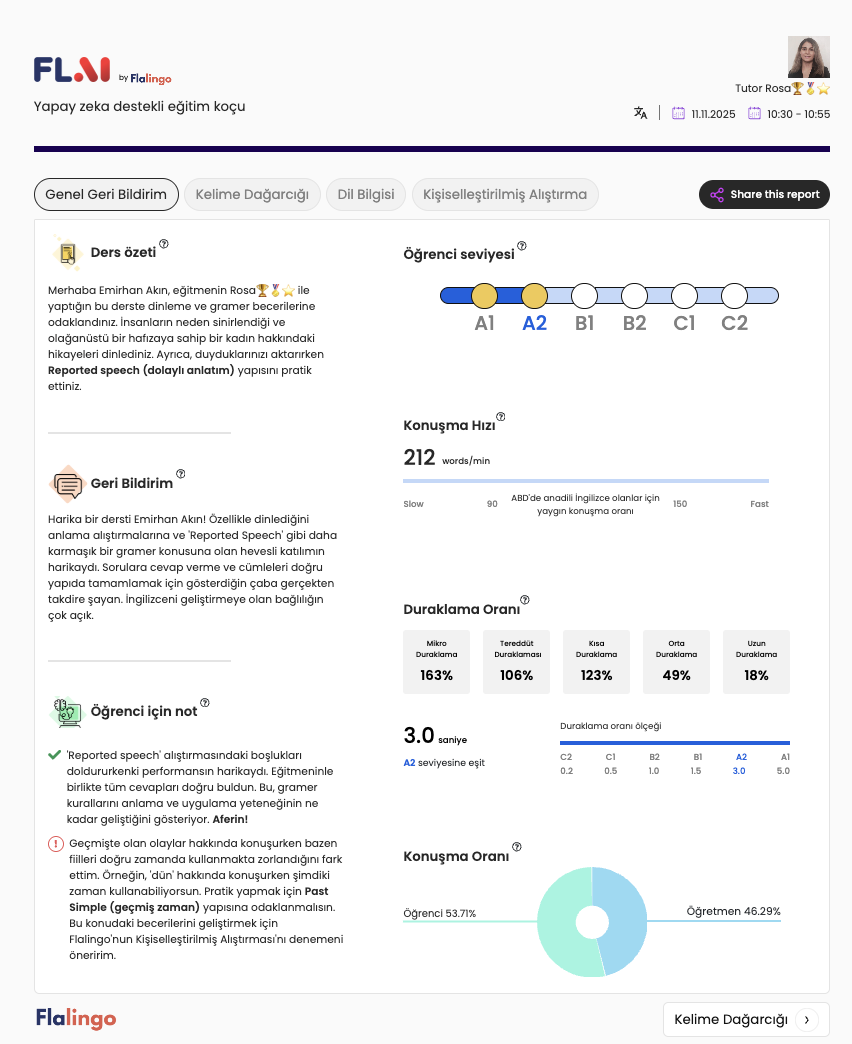
In conventional systems, a lesson is the end product — the service itself. In Flalingo, the lesson is just the beginning of a continuous feedback cycle. Every interaction feeds into FLAI — the AI coach that analyzes accuracy, fluency, and vocabulary metrics, generating a personalized learning roadmap for each student.
This design turns learning from reactive to proactive. FLAI identifies weaknesses, creates targeted exercises (Flomework), and prepares adaptive speaking scenarios for continuous improvement.
Flalingo doesn’t just teach English — it engineers learning efficiency.
5. Deep Dive into Flalingo’s Core Features
Flalingo’s learning ecosystem is built upon four tightly integrated pedagogical and technological pillars. Together, they transform what was once random and unstructured online practice into a data-driven, emotionally intelligent, and measurable learning experience.
5.1 One-on-One Lessons: Native and Professional Teachers
In many online platforms, being a native speaker is treated as a marketing credential. Yet, from an educational psychology standpoint, speaking English and teaching English are completely different competencies.
Flalingo’s recruitment policy emphasizes pedagogical expertise over nativeness. All instructors must hold internationally recognized teaching credentials such as CELTA, DELTA, TESOL, or TEFL, or possess a Bachelor’s degree in English Language Teaching.
This distinction is critical. Certified teachers know how to manage the Affective Filter, maintain students in the right zone of Comprehensible Input, and apply the Oxford University Press curriculum effectively. They understand when to challenge, when to scaffold, and how to transform nervousness into confidence.
Native vs. Professional Teacher Model
5.2 FLAI: Your Personal AI Coach
At the heart of Flalingo lies FLAI — the Flalingo Artificial Intelligence engine. FLAI is not a marketing gimmick; it is the analytical brain of the entire ecosystem. It performs what human teachers cannot do in real time: objective, large-scale language analytics.
How FLAI Works:
- 1) During the Lesson: FLAI listens to the conversation and applies Natural Language Processing (NLP) to convert speech into analyzable data.
- 2) Post-Lesson Analysis: The system evaluates performance based on CEFR standards across Accuracy, Fluency, and Lexical Resource.
- 3) Reporting: The AI generates a detailed progress report that pinpoints errors and pacing, and measures vocabulary range.
- 4) Action: FLAI creates personalized exercises (Flomework) and speaking simulations (FLAI Speaking) targeting specific weaknesses.) Action: FLAI creates personalized exercises (Flomework) and speaking simulations (FLAI Speaking) targeting specific weaknesses.
5.3 Curriculum and Materials: The Oxford University Press Advantage
Flalingo’s collaboration with Oxford University Press provides a structural backbone that most EdTech platforms lack. Every student follows a CEFR-aligned, four-skill curriculum (reading, writing, listening, speaking) validated by academic research.
Unlike platforms that rely on improvised PDFs or unverified content, Flalingo integrates OUP materials directly into its interface. This guarantees a tested learning path designed by one of the world’s most prestigious academic publishers.
5.4 Smart Match Algorithm
Online learning often suffers from decision fatigue — the anxiety of choosing from thousands of teachers. This raises Krashen’s Affective Filter and undermines consistency.
Flalingo’s Smart Match Algorithm uses a hybrid vector-matching system that compares student and teacher profiles across multiple variables:
- 1) Vectorization — student needs and teacher profiles are converted into numeric vectors.
- 2) Similarity — cosine similarity finds the closest matches.
- 3) Prioritization — hierarchical weighting (goal alignment > schedule > accent) refines the ranking.
- 4) Result — a shortlist of 20–30 teachers statistically most likely to yield success.
6. Dr. Sait Tuzel’s Experience: Step-by-Step Analysis
As an EdTech researcher, I tested the Flalingo platform for one full month with unrestricted access. My goal was to evaluate whether the entire ecosystem delivers what it promises: structured pedagogy, measurable data, and emotional continuity.
Step 1: The Trial Lesson
Matched via the Smart Match Algorithm, I experienced a diagnostic session rather than casual conversation. The teacher used an Oxford diagnostic framework integrated into the interface — an early sign of operational pedagogical consistency.
Step 2: Plan Selection and Booking
Testing different goals (IELTS vs Business English) produced different teacher pools, confirming goal alignment as the top matching factor. High teacher continuity reduced cognitive load and kept the Affective Filter low.
Step 3: During the Lesson
The interface is minimalist; Oxford content is fully integrated. The difficulty curve was calibrated — challenging yet achievable — consistent with Comprehensible Input theory.
Step 4: The FLAI Post-Lesson Analysis
About an hour after the class, I received the FLAI Report: accuracy, fluency, vocabulary diversity, and grammar issues — categorized by CEFR levels. Each detected weakness triggered targeted Flomework or FLAI Speaking tasks, forming a human–AI feedback loop.
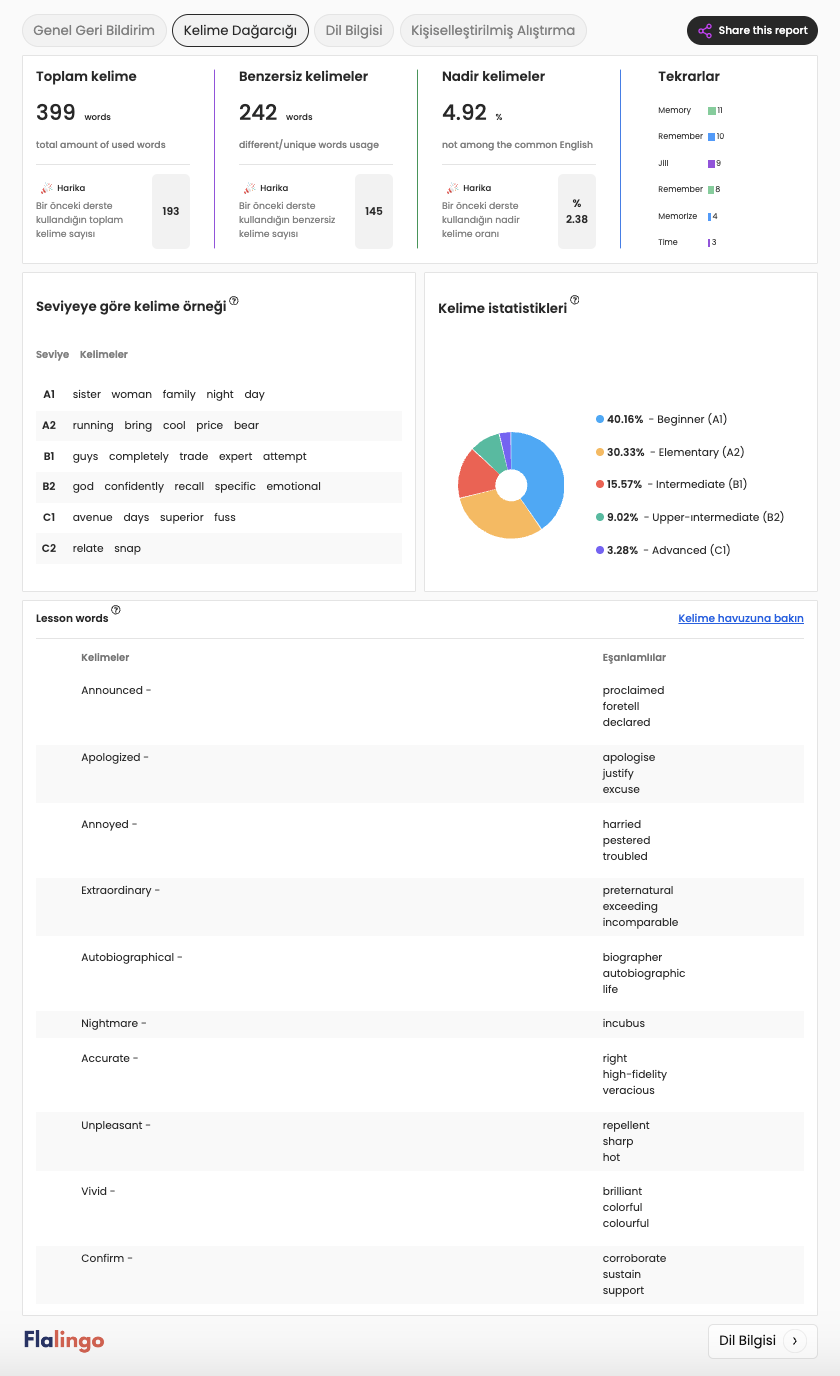
7. FLAI Report: Accuracy Example
8. Flalingo vs Competitors: Comparative Analysis
The market consists of three dominant models: (1) Hybrid Ecosystem (Flalingo), (2) Marketplace, and (3) Live-Class.
Flalingo is the only one engineered for measurable learning efficiency rather than mere availability.
Analytically, Flalingo unites pedagogical accountability with technological adaptability, turning outcomes into evidence rather than anecdotes. Smart Match and OUP integration reduce decision fatigue and cognitive load, while FLAI closes the feedback loop with quantifiable metrics.
9. Flalingo: Advantages and Disadvantages
10. Conclusion: The Future of Human–AI Collaboration
Flalingo redefines success by building a structured ecosystem where empathy, pedagogy, and artificial intelligence operate in a unified feedback loop. The system amplifies teacher expertise with AI precision, forming a closed-loop architecture that converts performance into progress.
This synthesis aligns Krashen’s Affective Filter with APA’s Deliberate Practice: humans lower anxiety and provide strategy; AI enforces targeted, evidence-based improvement.
11. Flalingo Performance Scorecard
Flalingo Performance Scorecard
12. Frequently Asked Questions (FAQ)
13. References
İlgini çekebilecek diğer içeriklerimiz

TEFL with CIEE: Your Gateway to Teaching English Around the World
Devamını oku

From TESOL to Teaching: How to Launch Your Online English Career with Flalingo
Devamını oku
Dr Sait Tuzel is an associate professor and educational technology researcher working in the fields of Artificial Intelligence Enhanced Education (AIED), media literacy and learning analytics. His work examines how AI can improve mindfulness in learning processes, critical thinking and equal opportunities in education.
Flalingo ile İngilizce

Flalingo ile İngilizce öğrenmek, birbiriyle entegre çalışan akıllı bir sistemle ilerlemektir.