
Flalingo vs Cambly: Which Online English Platform Is Right for You?
If you are weighing up two online English platforms, the choice usually comes down to one question: do you want quick speaking practice whenever the mood strikes, or a planned path that moves you from one level to the next? Cambly and Flalingo answer that question in very different ways, and both have earned a real following among adult learners.
Cambly built its name on instant access. You open the app, connect with a native English speaker over video, and start talking. Flalingo takes a more deliberate route. It pairs you with a certified teacher through a matching algorithm, builds your lessons on an Oxford University Press curriculum, and runs an AI coach over every session, so your progress is tracked and acted on. This guide walks through how each platform works, what they cost, the kind of teaching you can expect, and who each one genuinely suits.
Flalingo vs Cambly at a Glance
Here is the short version before we get into detail. The table sums up the practical differences most learners ask about.
How Does Cambly Work?
Cambly is an on-demand speaking platform. Its conversation-based method puts you in front of a native speaker from your first session, with the idea that you learn the language by using it. You pick topics that matter to you, talk through them, and pick up corrections along the way.
Access is the headline feature. Tutors are available around the clock, so a learner in Istanbul can practise at midnight and someone in São Paulo can squeeze in a session before work. You are not locked to a single teacher. You can browse profiles, sample different accents and backgrounds, and book whoever fits your schedule that day.
Plans run on a subscription model tied to minutes. You choose how many minutes per week you want and across how many days, then pay monthly. Cambly currently offers three adult tiers: Small Groups, Private+, and Cambly Pro. The higher tiers add private one-on-one lessons, recordings and transcripts, automated feedback, and access to Cambly Courses. Pro layers on hand-picked expert tutors who design a structured plan around your goals, which narrows the gap with curriculum-led platforms, though that structure is shaped by each individual tutor rather than a shared syllabus.
The minutes you buy are tied to your weekly plan and generally do not roll over if you skip a week, so the value depends on showing up consistently. The refund policy is also on the strict side, usually limited to pro-rated unused time, a complaint that surfaces often in learner reviews on Trustpilot.
Cambly in brief:
- Instant, around-the-clock access to native English speakers.
- Conversation-led sessions with no fixed syllabus.
- Three adult tiers: Small Groups, Private+, and Pro.
- Higher tiers add recordings, transcripts, and automated feedback.
- Minutes are tied to your weekly plan and usually expire if unused.
If you are torn between two on-demand marketplaces, it is worth seeing how Preply compares with Cambly before you decide, since the two are often shortlisted together.
How Does Flalingo Work?
Flalingo keeps the live one-on-one teaching that learners value, then builds a full system around it. The starting point is Flalingo's matching approach. Instead of asking you to browse profiles, its Smart Matching algorithm collects 18 data points at sign-up, covering your level, your goal, your available hours, your preferred accent, and even the teaching personality you respond to best. It then pairs you with the teachers most likely to suit you.
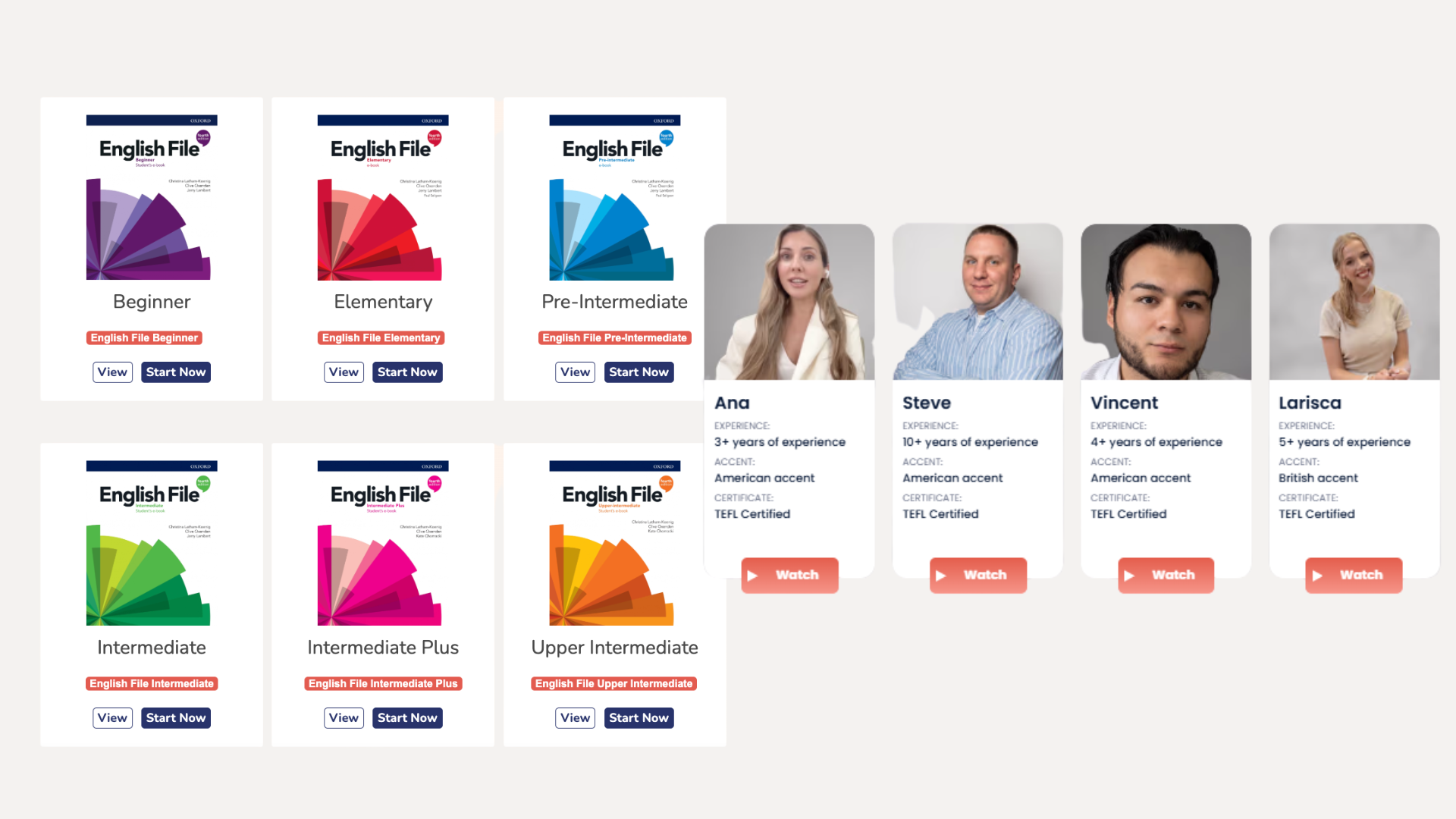
Lessons follow a real curriculum. Flalingo uses Oxford University Press materials mapped to the CEFR framework, so a complete beginner can start from scratch, and an upper-intermediate learner can push toward the next level with measurable checkpoints along the way. You can still book conversation sessions when you want them, but the backbone is a structured progression rather than an open chat.
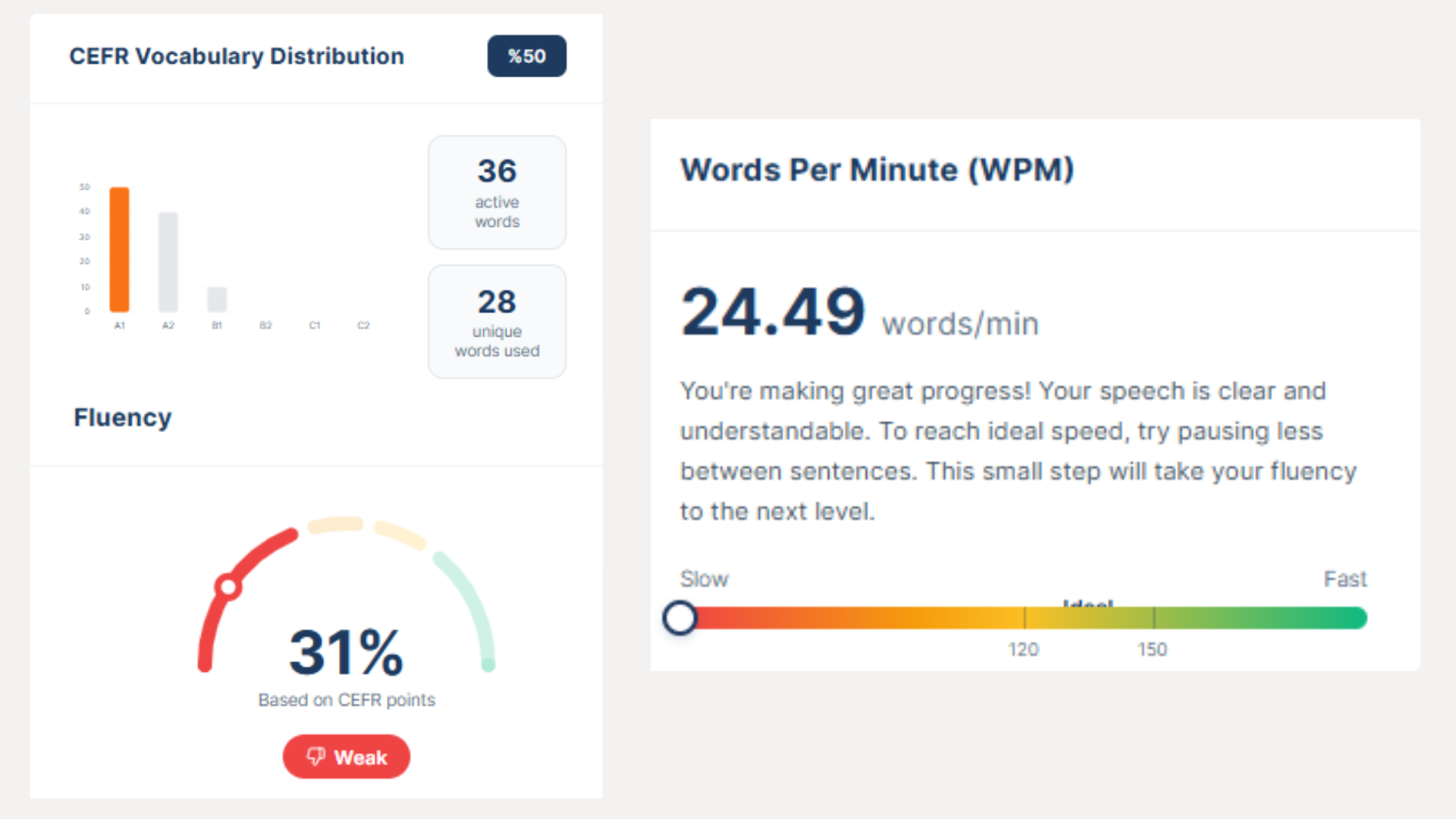
After each session, an AI coach called FLAI analyses the lesson. It transcribes the conversation, then scores it on three axes drawn from CEFR standards: accuracy (grammar and sentence structure), fluency (speaking pace, pauses, filler words), and lexical range (how varied your vocabulary is). You get a short report with specific corrections and a three-item action list. Your teacher gets guidance on what to target next. That feedback loop feeds two more tools: Flomework, which builds adaptive exercises from the exact mistakes you made, and FLAI Speaking, which gives you personalised speaking practice between live lessons.
Continuity is treated as a metric rather than an afterthought. Flalingo aims to keep you with the same teacher week after week, and reports that a learner has better than a 90 per cent chance of staying with their chosen teacher. That consistency lowers speaking anxiety and keeps the feedback coherent over time. Round-the-clock live support and a 30-day refund window round out the experience.
Getting started is low-commitment. You can take a free level assessment at start.flalingo.com before paying anything, so your very first lesson is already pitched at the right CEFR level rather than guessed. Between live lessons, demo.flalingo.com gives you 24/7 AI speaking practice, which means you keep talking on the days you do not have a teacher booked. Together, these turn Flalingo into something closer to a full learning loop than a booking app.
Flalingo in brief:
- Free level test at start.flalingo.com places you at the right CEFR level before you commit.
- Smart Matching pairs you with the right teacher using 18 data points, not a profile you pick blind.
- Oxford University Press curriculum, CEFR-aligned, takes you from your level to the next with measurable checkpoints.
- Certified teachers, CELTA or TEFL qualified, with roughly 1 in 73 applicants accepted.
- FLAI after every lesson scores accuracy, fluency, and vocabulary, then hands you a three-item action list.
- Flomework builds adaptive exercises from the exact mistakes you made in your lesson.
- FLAI Speaking and demo.flalingo.com give you personalised, 24/7 AI speaking practice between live sessions.
- Same-teacher continuity, with over 90 per cent of learners keeping their teacher, plus 24/7 live support and a 30-day refund window.
Teaching Philosophy: Structure vs Open Conversation
Cambly trusts the conversation. The bet is that enough real talk with native speakers, on topics you care about, will pull your English forward naturally. For confident learners who already have a foundation and mostly need reps and exposure, that bet often pays off. The looseness is the point: no syllabus to follow, no homework hanging over you, just talking.
Flalingo trusts the system. The conversation still happens, but it sits inside a planned arc with a curriculum, post-lesson analysis, targeted practice, and a consistent teacher who remembers where you left off. For learners who want to know they are actually moving and not just chatting pleasantly in circles, that structure is the value. It also tends to serve beginners far better, since open conversation can overwhelm someone who does not yet have the words to keep it going.
Flalingo vs Cambly: Pricing Compared
Prices were last checked in June 2026.
Teacher Quality: Native Speaker vs Certified Teacher
Cambly hires native English speakers and does not require a teaching qualification. There is no mandatory TEFL or CELTA certificate, nor is there a minimum. The upside is a huge, diverse pool of accents and personalities. However, a great conversation partner is not automatically a great teacher, and some users report tutors who could not explain why something was wrong. Cambly's TrustScore sits around 2.1 out of 5, weighed down partly by tutor-pay and support complaints, so it is best read as a signal about consistency rather than a verdict on every tutor.
Flalingo runs a curated pool. Roughly 1 applicant in 73 is accepted, after multi-stage interviews, sample-lesson assessments, and pedagogical and technical checks. Teachers carry recognised certifications such as CELTA or TEFL, and their performance is tracked continuously through student satisfaction, attendance, and FLAI's objective analysis, with under-performing teachers removed.
If you are comparing curated pools more broadly, it is worth seeing how Flalingo and Preply differ on tutor screening, since Preply runs a far larger but less filtered marketplace.
Who Is Cambly Best For?
- ✔ You are already intermediate or advanced and mainly want speaking reps and exposure.
- ✔ You value instant, around-the-clock access more than a fixed plan.
- ✔ You enjoy meeting many different native speakers and accents.
- ✔ You prefer relaxed conversation over homework and structured checkpoints.
- ✔ You can log in consistently each week, so minutes do not go to waste.
Who Is Flalingo Best For?
- ✔ You want a clear, measurable path from your current level to your goal.
- ✔ You want a certified teacher rather than hoping a conversation partner can teach.
- ✔ You like the idea of AI feedback and targeted practice after every lesson.
- ✔ You prefer keeping the same teacher so lessons build on each other.
- ✔ You are preparing for an exam such as IELTS or TOEFL and need focused, planned work.
- ✔ You like practising on your own between lessons with 24/7 AI speaking tools.
- ✔ You want round-the-clock support and a refund window that lowers the risk of trying something new.
If conversation-on-demand is your priority, you might also weigh how Cambly stacks up against italki, another platform built around flexible, learner-led speaking practice.
Flalingo vs Cambly: The Verdict
Cambly does one thing very well. If you want to open an app and talk to a native speaker within minutes, with no plan and no pressure, it is hard to beat for pure speaking practice. For a confident learner, topping up fluency, that is often enough.
Flalingo is built for learners who want the talking to add up to something. It keeps the live one-on-one teaching at the centre, then surrounds it with the pieces Cambly leaves out, such as Smart Matching to find the right teacher, an Oxford University Press curriculum to give your lessons direction, FLAI to turn every session into specific feedback, same-teacher continuity so nothing resets, and a 30-day refund window if it is not the right fit.
Put simply, choose Cambly for casual conversation on demand, and choose Flalingo when you want structure, qualified teaching, and progress you can actually track. If you would rather see both lined up against the wider field first, our guide to the best online English platforms puts the leading names side by side.
Get the structure Cambly doesn't offer.
İlgini çekebilecek diğer içeriklerimiz

Flexible Scheduling, Consistent Bookings, and Real Income: Teaching English on Flalingo
Devamını oku
Flalingo’s Advanced Course Tracking System that Sets It Apart
Devamını oku
Learning Experience Transformed by FLAI: Real-World Use Cases
Devamını oku
Joy Joel
My name is Joy. I am an online English teacher with five years of experience working with students of all ages. My teaching approach aims to build self-confidence and make the learning process productive through interactive, engaging and tailored support.
Flalingo ile İngilizce

Flalingo ile İngilizce öğrenmek, birbiriyle entegre çalışan akıllı bir sistemle ilerlemektir.