
The AI Revolution in Online Teaching: How Flalingo's FLAI Makes You a Better Instructor

Every lesson you teach generates data. Your student's hesitation before a conditional sentence, the gap between their intended meaning and their actual phrasing, the moment they finally nail a tricky vowel sound. All of it matters. And until recently, all of it disappeared the second your lesson ended.
That is the problem Flalingo's FLAI was built to solve. FLAI is an AI-powered teaching assistant that captures what happens during each live lesson and turns it into structured, actionable feedback for both the tutor and the student. It does not grade you. It does not judge your methods. It gives you a clearer picture of where your student stands, so your next lesson hits harder than the last one.
If you have ever wished for a second pair of eyes in the classroom, one that never gets tired and never forgets what happened three lessons ago, this is what FLAI offers.
Will AI Replace English Teachers?
No. AI will not replace English teachers. But tutors who understand how to work with AI will have a significant advantage over those who ignore it. That is the honest answer, and it deserves a longer conversation.
The anxiety is real, and dismissing it would be disrespectful. A University of Utah study presented at the TESOL Ecuador Conference surveyed educators on this question. The average concern score was 2.72 out of 5. But the researchers' conclusion was clear: human connection remains irreplaceable in language learning. Teachers bring empathy, cultural awareness, and the ability to read a student's body language. No algorithm replicates that.
Cambridge English put it plainly in their analysis. AI enhances English learning, but will not replace the teacher. The nuances of pronunciation coaching, the patience required when a student is on the verge of a breakthrough, and the ability to pivot a lesson because you notice your student had a rough day. These are human skills. AI handles data processing. Tutors handle people.
UNESCO reinforced this position in their article "Teachers Cannot Be Coded", arguing that the pedagogical relationship between teacher and student involves trust, emotional labour, and contextual judgment that technology simply cannot replicate.
Let AI amplify your teaching impact
Apply to become a Flalingo tutor.
The Debate: Where Do Reasonable People Disagree?
The disagreement is not really about whether AI replaces tutors. Most experts agree it does not. The real debate centres on how much autonomy AI should have in the learning process.
Flalingo's approach sits in the middle, and that is intentional. FLAI processes the data, generates the reports, and surfaces the patterns. The teacher decides what to do with all of it. The AI does not set your lesson plan. You do.
What Is FLAI and How Does It Work for Teachers?
FLAI is Flalingo's proprietary AI engine that analyses every live lesson using Automatic Speech Recognition (ASR) and Natural Language Processing (NLP). It listens to the lesson in real time, transcribes the dialogue, and then runs a multilayered linguistic analysis aligned with CEFR standards.
After each lesson, the AI generates two separate reports: one for the student and one for the instructor. The student report highlights errors with corrections and personalised improvement suggestions. The teacher's report identifies systematic patterns in the student's performance and recommends targeted teaching strategies for the next session.
Here is what a typical post-lesson workflow looks like with FLAI:
- You finish a 50-minute lesson and end on time (this is important for accurate reporting).
- Within minutes, FLAI processes the full session transcript.
- You receive a teacher-facing report with three key areas: accuracy issues, fluency metrics, and vocabulary analysis.
- You spend five minutes reviewing the report and adjust your next lesson plan accordingly.
FLAI gives you the "three things you need to know before your next lesson with this student." That kind of targeted preparation used to require extensive note-taking and memory. Now it is automated.
Here is a real scenario. You taught a B1 student on Monday. During the lesson, you covered second conditionals and noticed a few mistakes, but the conversation moved on. Wednesday morning, you open the FLAI report. It tells you: this student used the wrong tense in conditional clauses 9 times, their WPM dropped 15% whenever conditionals came up, and their vocabulary stayed within the A2 range during those segments. Now you know exactly what to do. You pull a targeted conditional exercise from the Oxford B1 materials and plan a focused drill before moving to new content. Without that report, you would have started Wednesday's lesson from scratch. With it, you walk in prepared.
FLAI does not replace the instructor. It sees what the teacher's eyes cannot catch in real time. After every lesson, it reports student progress data to both the teacher and the parent, guiding the instructor to make the next session more effective.
What Does the FLAI Report Measure?
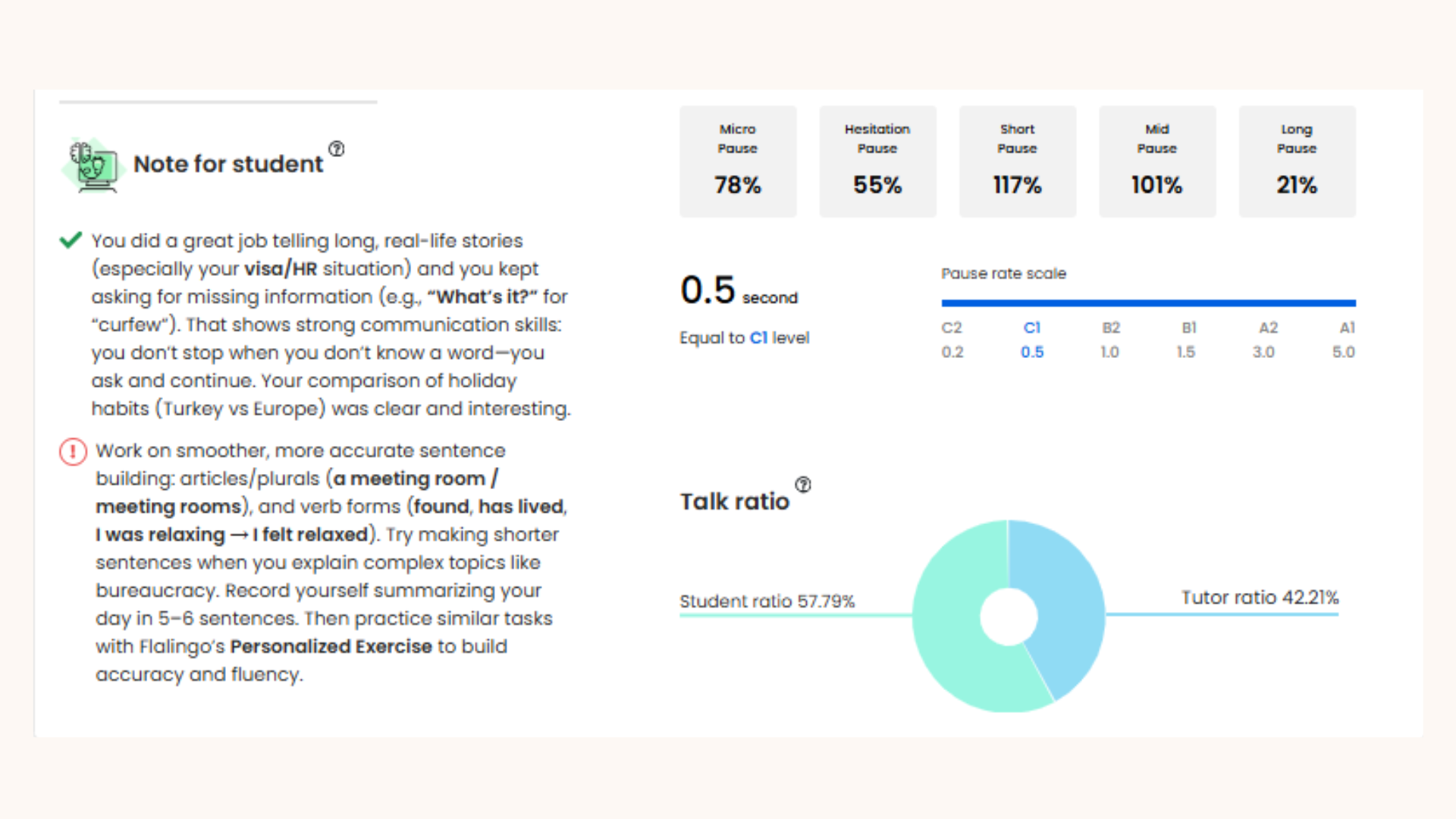
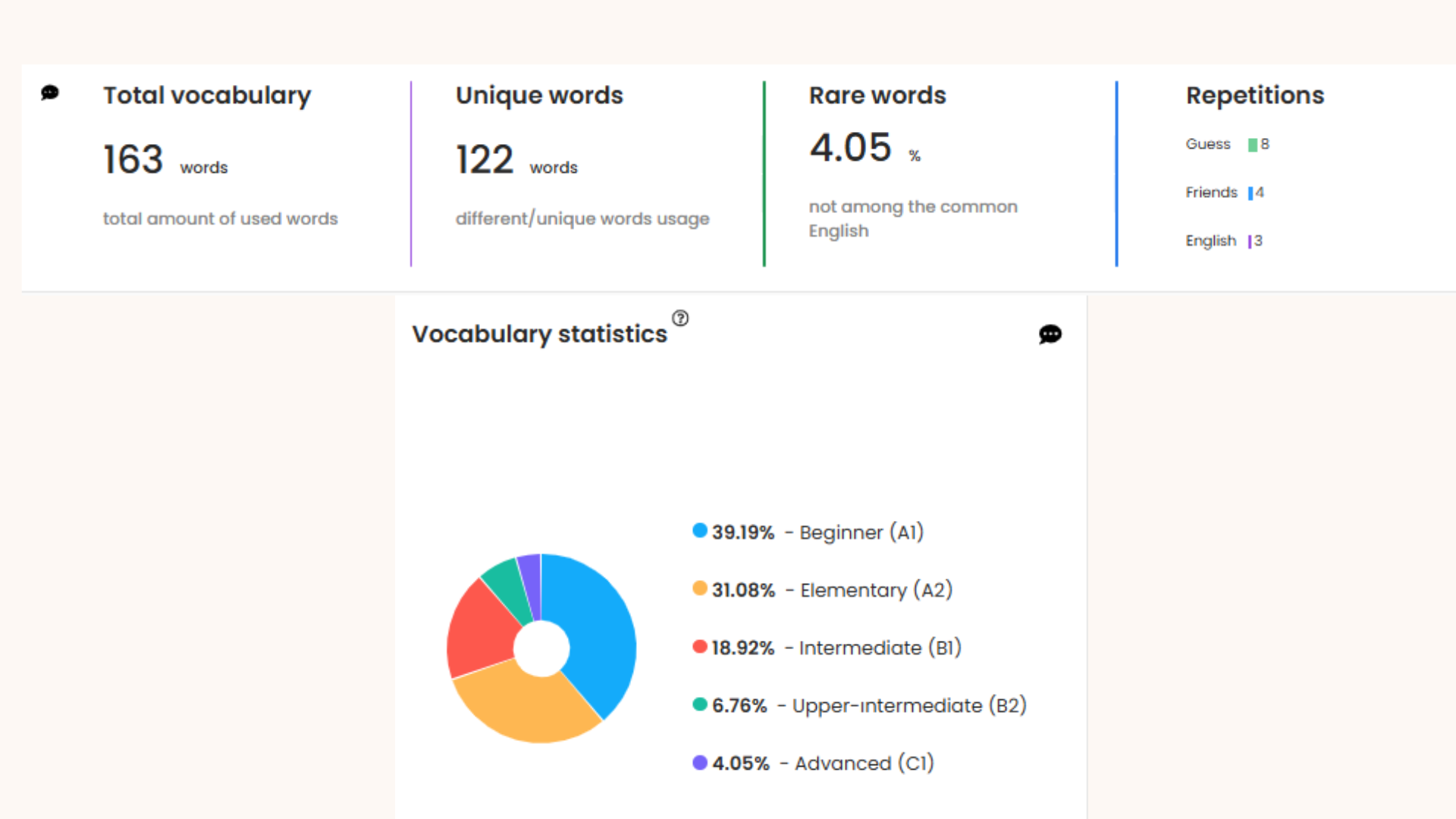
The report evaluates student performance across three primary axes, all aligned with the Common European Framework of Reference for Languages (CEFR). Here is a detailed breakdown of what each metric tracks and why it matters for your teaching:
How Does Shared Data Strengthen the Teacher-Student Relationship?
It builds trust. When both the tutor and the student see the same performance data, there is no ambiguity about where things stand. The student cannot wonder whether the teacher really understands their weaknesses, and the tutor does not have to guess whether the student took the feedback seriously.
On most online teaching platforms, feedback flows in one direction. The tutor says, "good job" or "work on your grammar," and the student nods. There is no shared reference point. FLAI changes that dynamic. After each lesson, both sides receive a report grounded in the same data. The student sees their accuracy rate, their fluency metrics, and their vocabulary distribution. The instructor sees the same numbers plus targeted intervention recommendations. This means your next lesson starts from a shared understanding rather than a blank slate.
Parents benefit from this transparency too. For younger learners, the reports give parents a concrete window into their child's progress. Instead of vague post-lesson check-ins, parents can review structured data on what their child practised and where they improved. That visibility keeps families engaged over the long term.
How Does Data-Driven Teaching Differ from Intuitive Teaching?
Data-driven tutoring does not mean cold, robotic instruction. It means having evidence to back up what your instincts are already telling you. Most experienced teachers can sense when a student is struggling, but FLAI puts specific numbers behind that feeling.
Consider this scenario: you have been teaching a B1 student for six weeks. You feel like their grammar is improving, but you are not sure. The report shows that their tense accuracy went from 62% in week one to 81% in week six. That is not just a feeling anymore. That is proof, and it is proof you can share with the student to boost their confidence.
The best approach is hybrid. You keep your teaching instincts, your ability to read the room, your warmth. The AI adds the data layer underneath. Together, they create something neither could achieve alone. A teacher community using AI data strengthens this model by sharing insights and collective experience. It allows educators to learn from each other while making data-driven decisions in the classroom.
How Does FLAI Connect with Flalingo's Other Tools?
FLAI does not operate in isolation. It is part of Flalingo's integrated tutoring ecosystem, and understanding how the pieces fit together helps you get the most out of the platform.
The Smart Match and AI systems work in tandem. Smart Match uses 18 data points to pair you with students who fit your expertise, whether that is kids, exam prep, business English, or general fluency. The AI then tracks how those students perform in your lessons, creating a feedback loop that refines future matches. The better the data, the better the match. The better the match, the better the outcomes.
Flalingo's curriculum is built on Oxford materials, and the FLAI tracks student progress against. When FLAI identifies that a student is underperforming at their CEFR level, the report references the specific Oxford content areas where reinforcement is needed. This means your lesson planning aligns with a globally trusted curriculum framework without requiring hours of prep work.
After AI analyses the lesson, Flalingo's Flomework system picks up where the report leaves off. It generates personalised homework based on the errors AI identified: fill-in-the-blank, matching, multiple-choice, and sentence reordering exercises. The student practices exactly what they struggled with, and you can see their homework performance before your next session.
Can Teachers Review Their Own Performance with FLAI?
Yes, and this is one of the most underrated features of the platform. Every lesson is recorded, and tutors can review their own sessions. Combined with the report, you can compare what FLAI flagged with your actual delivery. Did you spend too much time on a topic? Did you miss an error the student made? Did your pacing work? This kind of self-reflection used to require a mentor or supervisor sitting in on your lesson. FLAI makes it available for every session, on your own time.
What makes this powerful is the combination of recording and reporting. Say FLAI flags that your student's WPM dropped during the last 15 minutes. You pull up the recording, skip to that segment, and realise you introduced a new grammar concept too late when the student was already fatigued. Next time, you front-load the challenging material. Or FLAI notes that filler word usage spiked during a particular topic. You watch the recording and discover your prompts were too open-ended for the student's level. These are insights you would never catch in the moment, but the recording preserves them for later analysis.
How Can You Start Using FLAI on Flalingo?
FLAI is built into the Flalingo platform. No separate setup, subscription, or configuration required. Every teacher gets access to the reports from their first lesson. Here is what you need to know:
- End your lessons on time. The AI needs the session to conclude at the scheduled end time to generate an accurate report. Lessons that run over 50 minutes may not produce a report.
- If a student does not attend, stay on mute until the absence threshold. This prevents FLAI from generating an inaccurate report for a non-existent lesson.
- Check that your sessions are being recorded. If they are not, notify the support team immediately.
- Review your FLAI report before your next session with the same student. Five minutes of review can save twenty minutes of guesswork during the lesson.
Let AI amplify your teaching impact
Apply to become a Flalingo tutor.
FAQ
Will AI replace English teachers?
No. AI is a support tool, not a substitute for human educators. Research confirms that human connection, empathy, and contextual judgment remain essential in language teaching.
How does Flalingo FLAI work for teachers?
FLAI uses speech recognition and natural language processing to analyse every live lesson. After the session ends, it generates a teacher-facing report that covers student accuracy, fluency, and vocabulary, along with recommended teaching strategies for the next lesson. The report arrives automatically with no additional setup required.
Is Flalingo good for teachers who are new to AI?
Absolutely. FLAI is integrated directly into the platform, so you do not need any technical skills. The reports are written in plain language, and the Flalingo teacher community regularly shares tips on how to make the most of AI-powered insights.
Does FLAI track teacher performance or only student performance?
FLAI focuses primarily on student performance metrics. However, because lessons are recorded and teachers receive the same data, instructors can use the reports for self-reflection and professional growth. The AI does not evaluate or score tutors.
How does FLAI handle children's lessons?
FLAI includes a child safety module that monitors all lessons for potentially harmful content or behaviour. If anything concerning is detected, Flalingo's quality team is notified immediately. This runs automatically on every kids' session.
Can FLAI data help me get more students on Flalingo?
Indirectly, yes. The Smart Match algorithm takes lesson outcomes into account when recommending teachers to new students. Consistently strong FLAI data signals that your lessons produce results, which can improve your visibility on the platform.
İlgini çekebilecek diğer içeriklerimiz




Joy Joel
My name is Joy. I am an online English teacher with five years of experience working with students of all ages. My teaching approach aims to build self-confidence and make the learning process productive through interactive, engaging and tailored support.
Flalingo ile İngilizce

Flalingo ile İngilizce öğrenmek, birbiriyle entegre çalışan akıllı bir sistemle ilerlemektir.