
The Real Face of the English Learning Journey (FLAI Report)

1. Introduction: The Era of Personalized Learning
From the outside, learning a foreign language may seem like it's only about “speaking,” but behind the scenes lie thousands of details—from vocabulary depth to grammar reflexes, from speaking speed to pause duration. In traditional classrooms, it was impossible for instructors to identify each of these individual details and create a fully personalized roadmap for every student. But FLAI (Flalingo AI), developed by Flalingo, has changed the rules.
In this report, we focus not on assumptions but on actual lesson data analyzed by FLAI technology. FLAI is not merely an analysis tool; it is an intelligent system that identifies your language level, supports your weak areas, strengthens your strong ones, and provides you with a personalized learning plan.
Let’s take a closer look at the realities of the English learning journey through our dataset, randomly sampled from millions of lessons.
FLAI Summary
The vast majority of learners are concentrated at the B1 level. This means the basics are set, and the transition to fluency is where most learners gather.
At A1, the instructor is more active. From B1 to C1, student speaking time rises quickly, and at C1 it becomes almost equal.
As the level increases, speaking speed rises and long pauses decrease. At C1, pauses become part of a natural rhythm.
The most critical factor: consistent attendance. Learners who study steadily for 12 months or more progress much faster than those who use the platform for shorter periods.
2. Dataset: What Do Thousands of Lessons Tell Us?
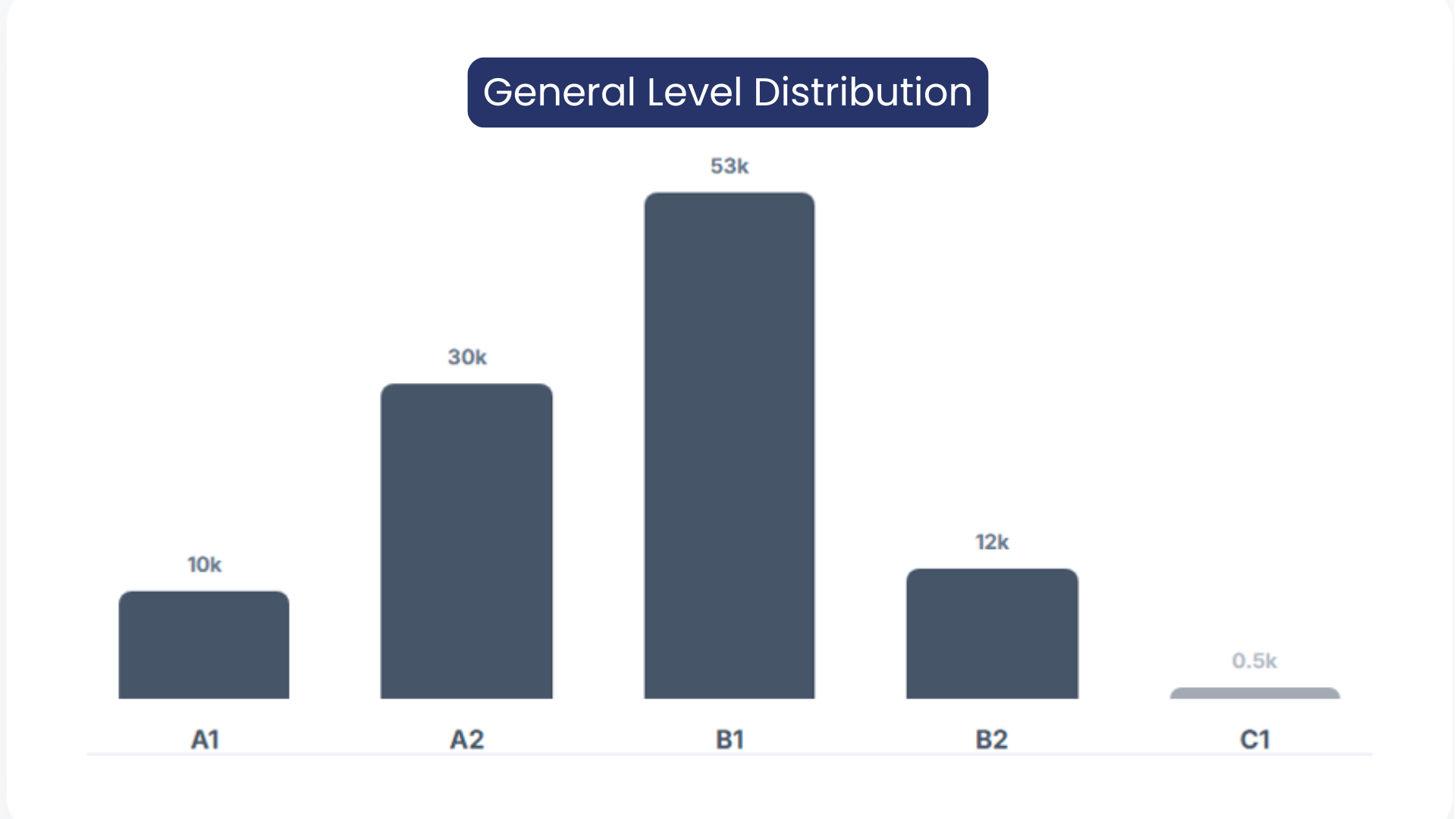
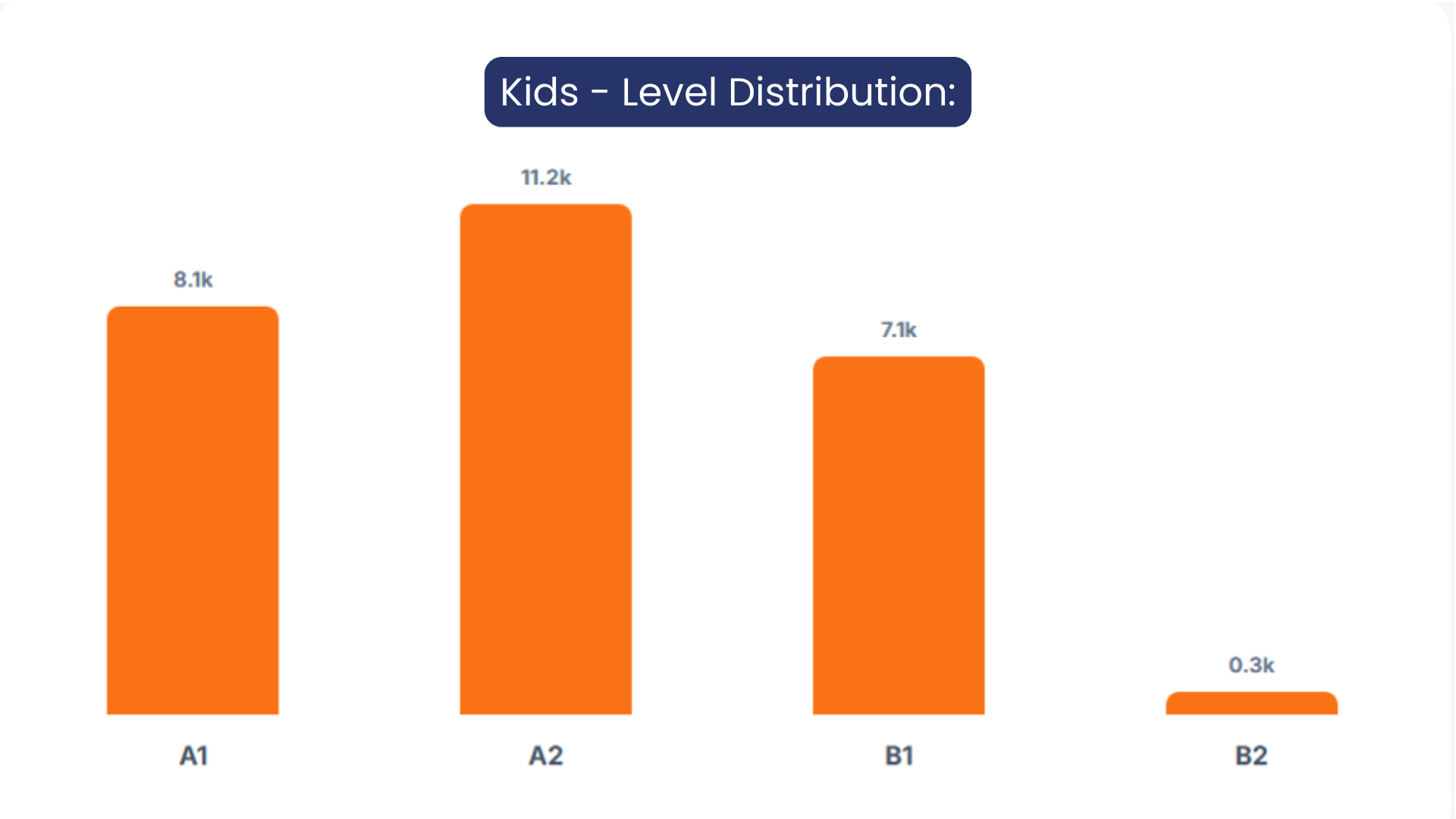
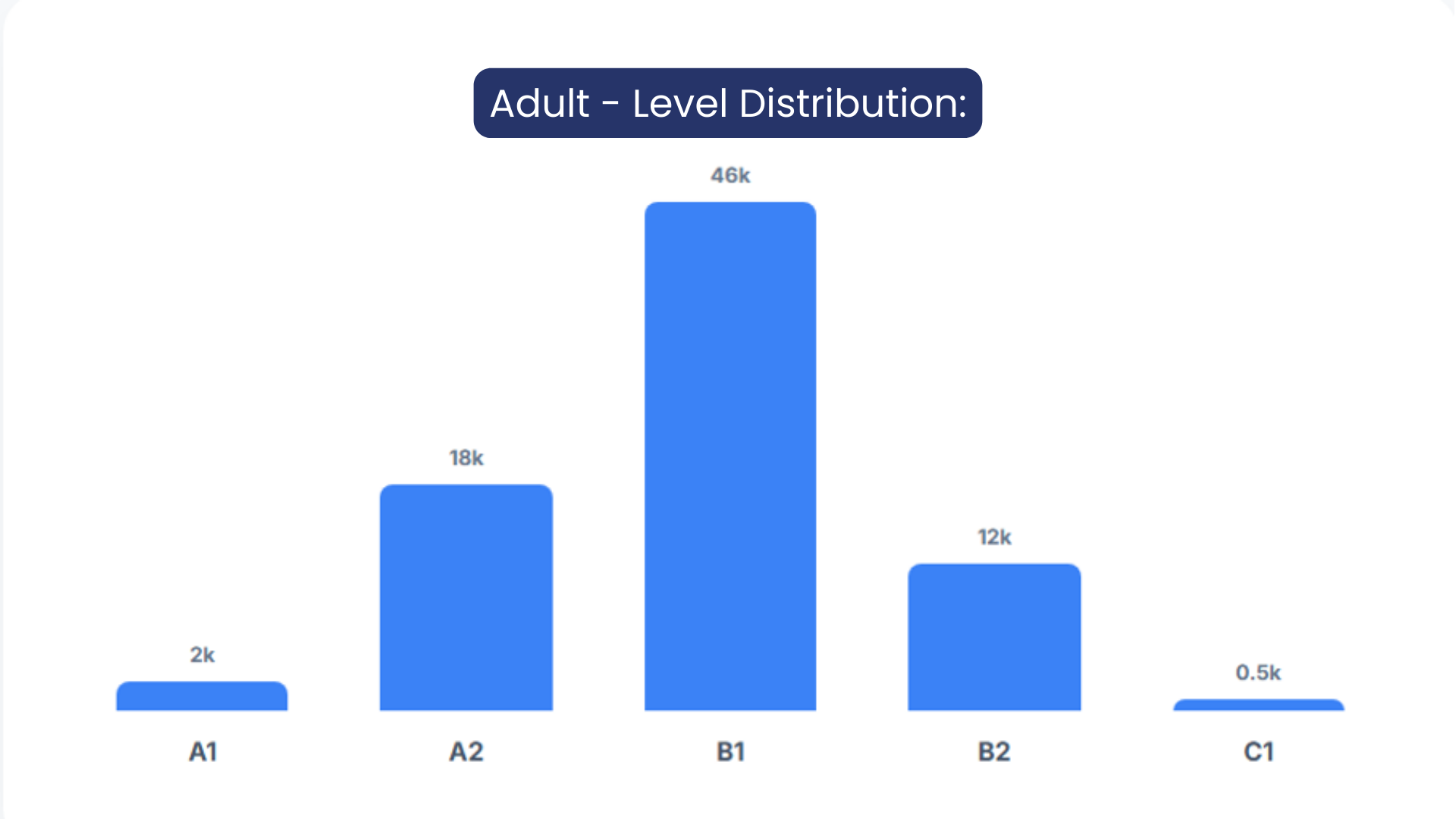
The foundation of this study is built on thousands of lesson reports and user data analyzed by the FLAI system. When we examine user profiles, a very clear picture emerges:
- Kids: Children who are just beginning their language journey naturally concentrate at the introductory and basic levels.
- Adults: Adults who pursue language learning for career or academic goals are largely clustered around what we describe as the “Intermediate Level.”
- Overall Picture: The majority of users on the platform fall within the intermediate range. This data shows that the largest group of language learners is standing at that critical threshold where they can say, “I’ve built the foundation, now it’s time to gain fluency.”
3. Findings: What the Reports Reveal
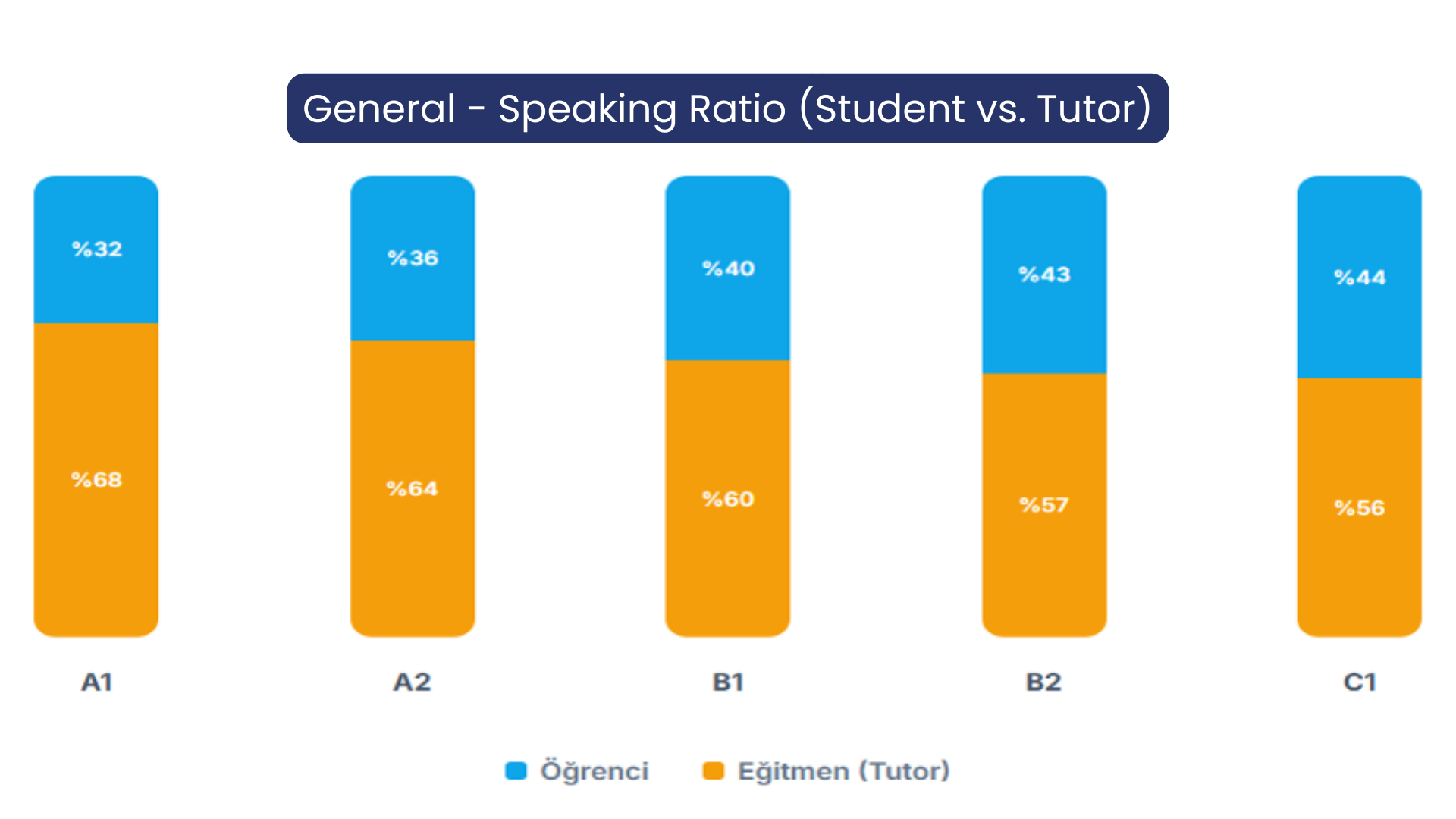
3.1. Speaking Behaviors: Who Holds the Microphone?
One of the biggest questions language learners have is: “Am I speaking enough during my lessons?”
FLAI optimizes lesson efficiency by recommending content suitable for your level. The analyses clearly show how this balance shifts as your proficiency increases:
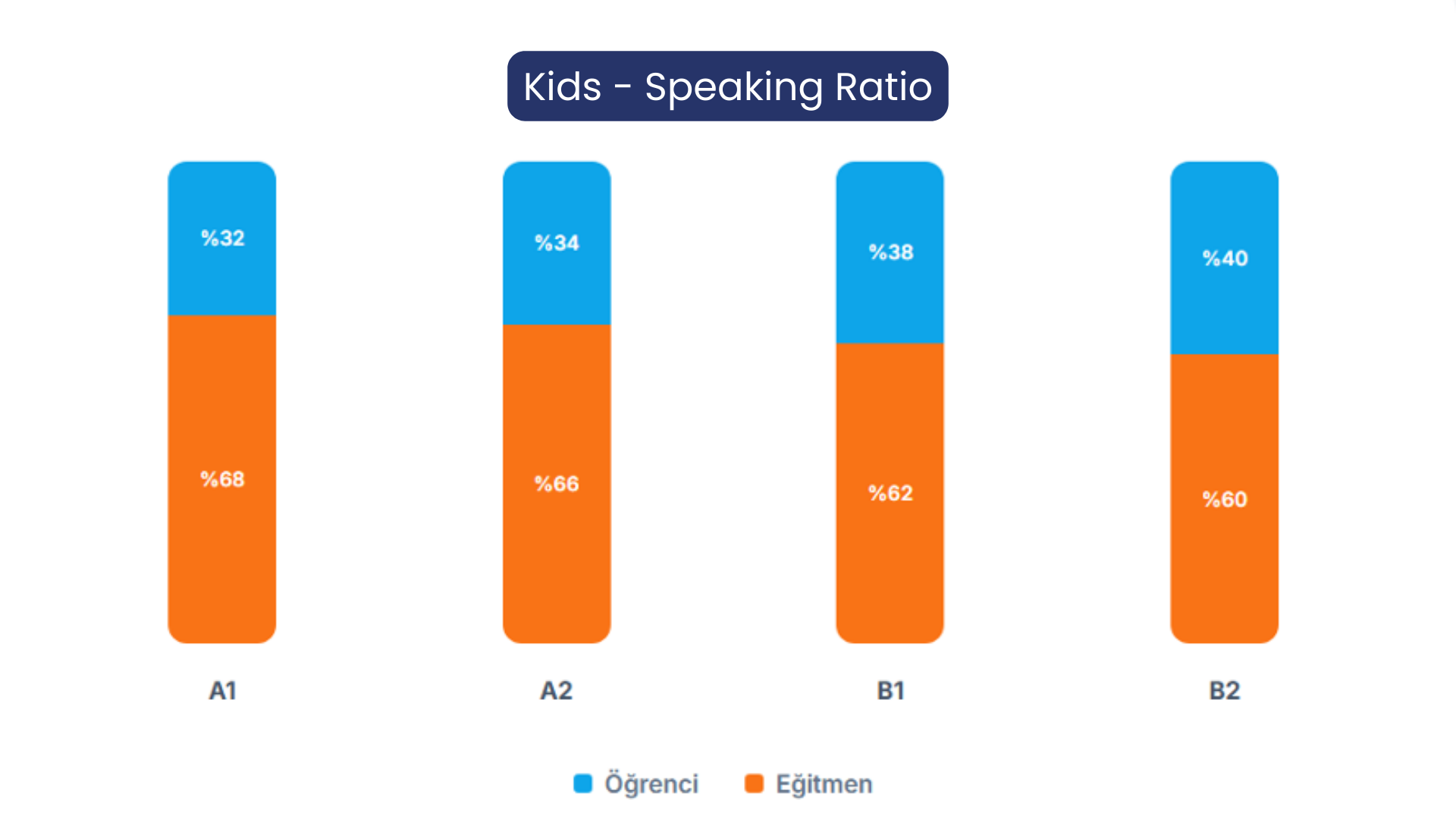
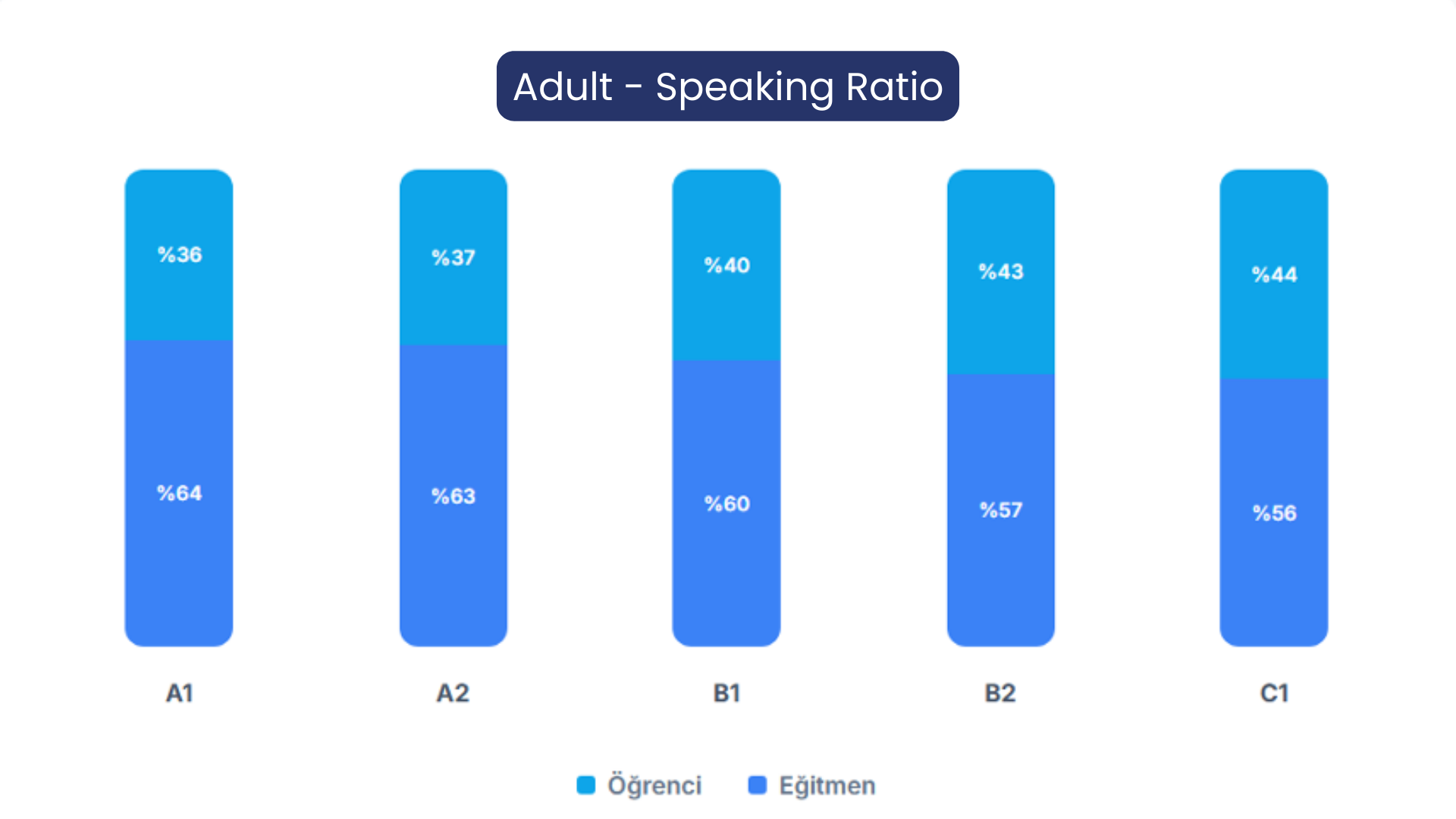
- A Levels (Instructor-Led): At the beginner stage, our instructors act almost like “pilots.” According to the data, at the A1 level the instructor speaks for most of the lesson, while the student remains more in the listening and responding role.
- B Levels (The Balance Shifts): As the level increases, the stage gradually shifts to the student. At B1 and B2, the student’s speaking rate rises noticeably. You’re no longer giving short answers you're starting to steer the conversation.
- C Levels (A Partnership Dynamic): At the advanced level (C1), the balance becomes almost equal. Student participation reaches nearly the same level as the instructor. At this stage, FLAI introduces not “taught” but rather “discussed” content, encouraging you to stay in the conversation for the maximum amount of time.
3.2. Speaking Pace and Adaptation: A Language Tango
One of the most human elements in our data is hidden within the “Speaking Pace” analysis. As learners’ speaking speed increases with their level, we also observe that instructors adapt to this change with remarkable precision.
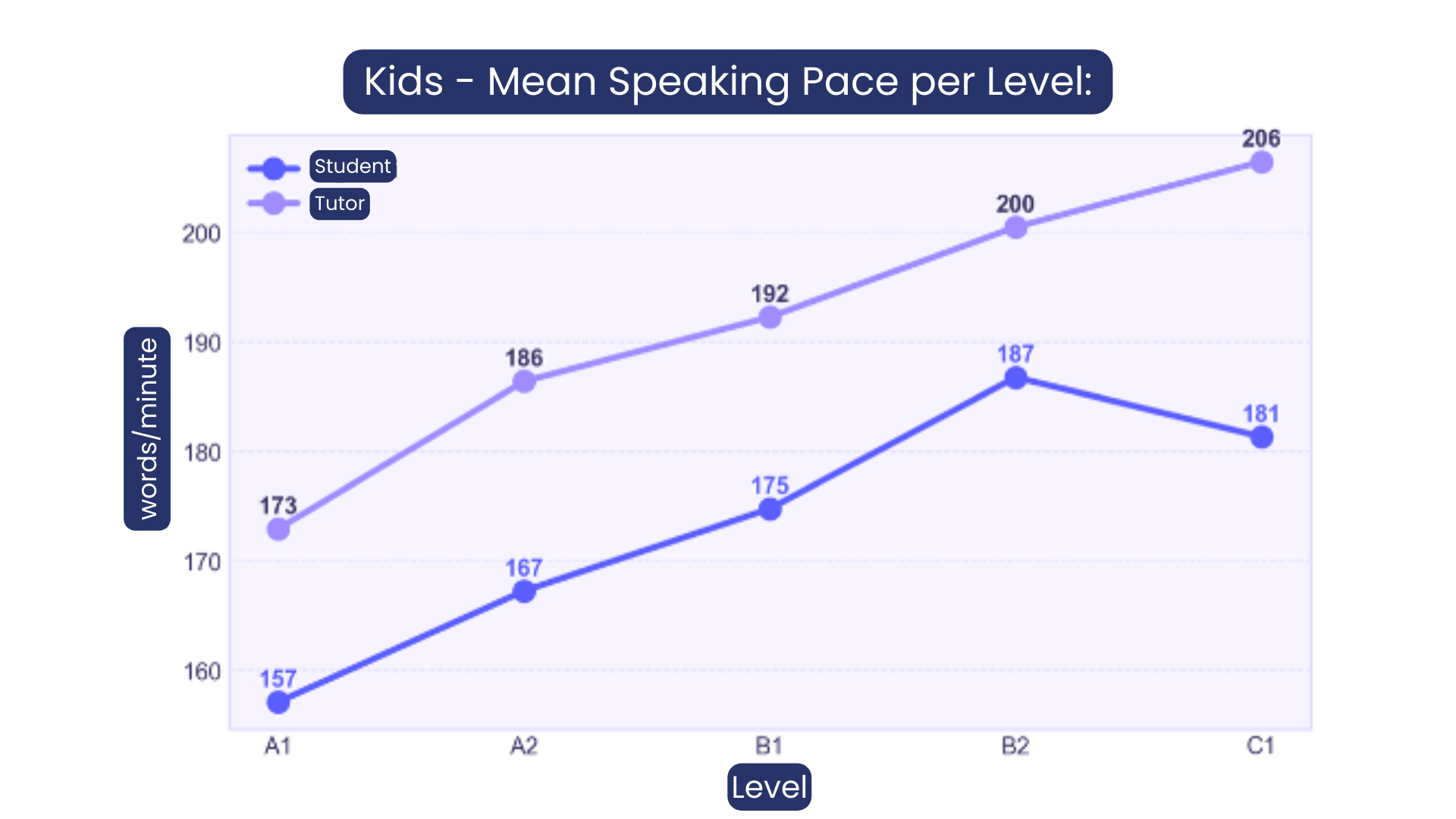
- Children: In children, this acceleration process progresses more steadily and along a smoother trajectory.
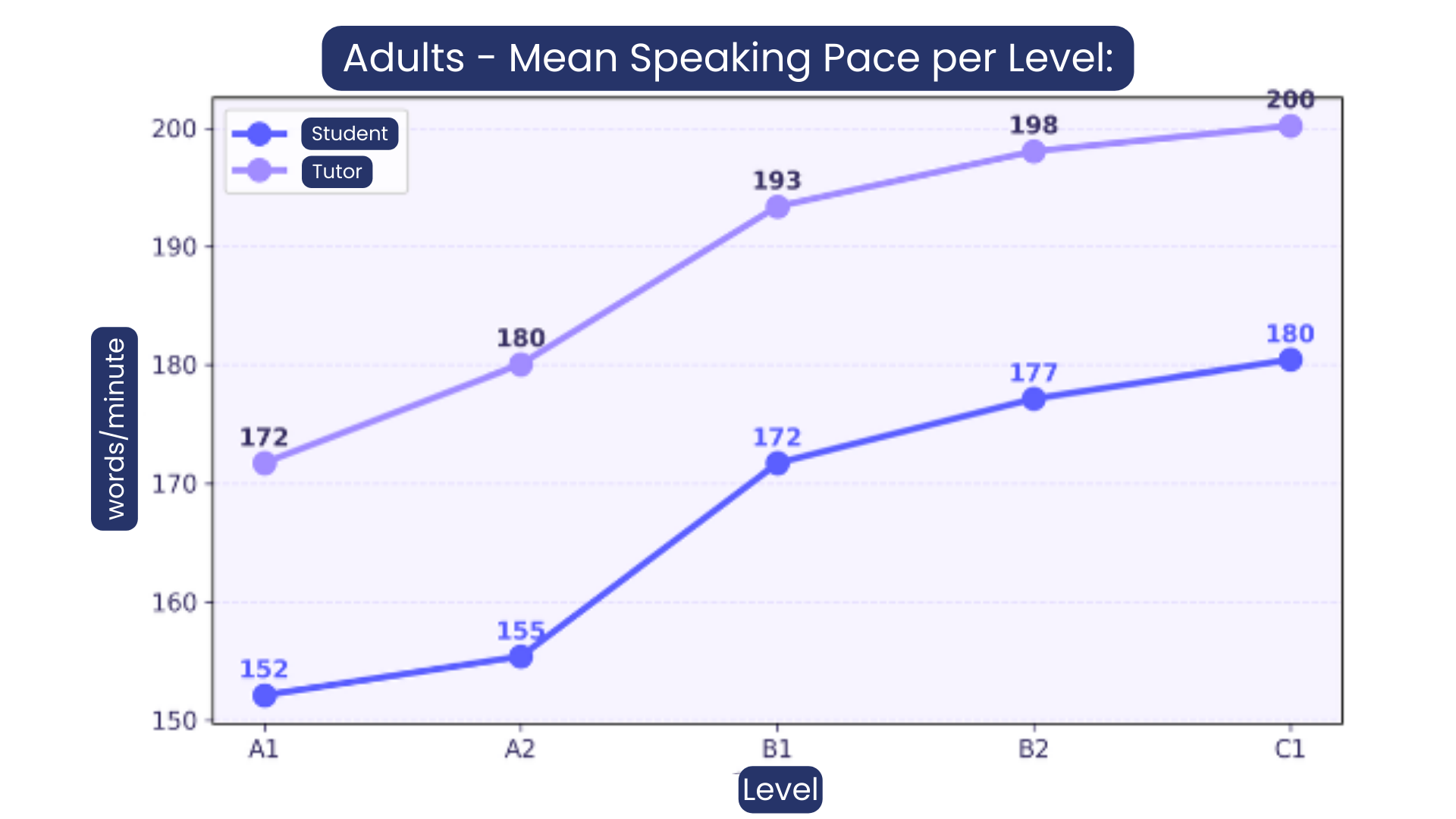
- Adults: Adult learners, who speak more slowly and deliberately at the beginner level, significantly increase their speaking pace as they advance. Instructors adapt to this pace as well, engaging in high-tempo conversations with advanced learners.
These findings clearly show that as you speed up, your instructor speeds up with you. Thanks to FLAI’s personalized matching, lessons that begin at a slower pace naturally evolve into fast, fluid conversations at advanced levels.
3.3. Pause Analysis: What Do Moments of Silence Really Mean?
The “uhh…”, “umm…” sounds or brief pauses that slip into our speech are essentially the brain’s version of a “Loading…” screen. FLAI’s analyses reveal that these moments of silence are not just empty gaps they are actually one of the most important indicators of the learning process.
Our data shows, quite surprisingly, how the quality of silence changes not just the amount through the journey from A1 to C1.
The Development Journey: Accessing Information Faster
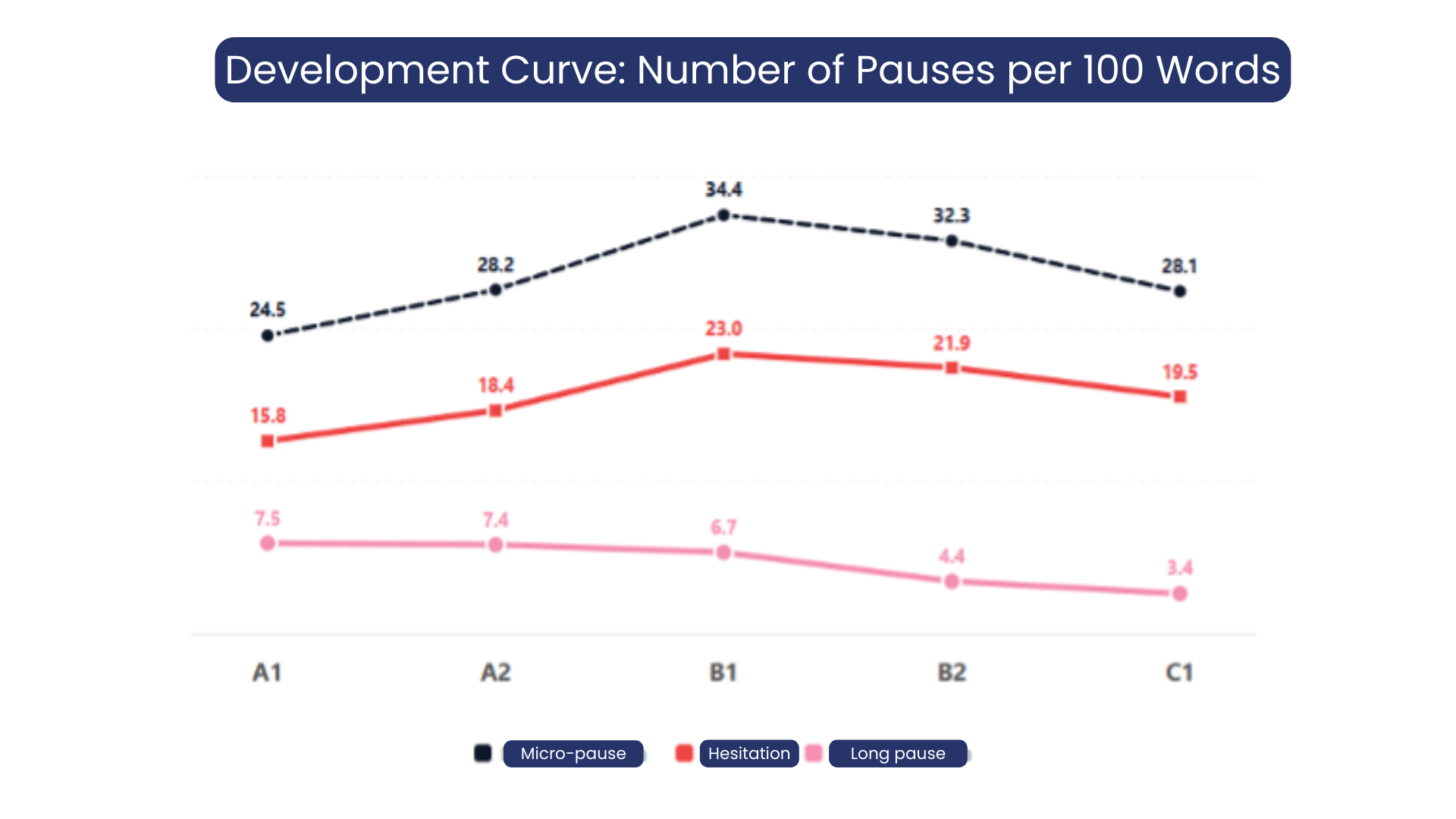
The clearest success story in our charts appears in the “Long Pauses” (Pink Line). At the A1 level, long pauses average 7.5 seconds per 100 words, but by the time a learner reaches C1, this drops to 3.4 seconds. This decrease is the strongest proof that your mind is no longer “searching” for English words and structures, but accessing them directly and reflexively.
However, progress is not always a downward line. As you can see in the “Hesitations” chart (Red Line the “umm, uhh” sounds), there is an increase when moving from A1 to B1 (from 15.8s → 23.0s). This isn’t a negative sign quite the opposite. It means the learner is taking more risks. At A1, sentences are simple. But at B1, students begin building longer, more complex sentence structures.
While the brain processes these more advanced structures, the “thinking gap” (hesitation) grows.
By B2 and C1, as these structures become familiar, hesitations decrease again—and fluency reaches its peak.
The Natural Rhythm of Speech: Micro Pauses
To understand how natural a conversation sounds, we look at “Micro Pauses” (Dark Navy Bars). These are the millisecond breaks we take to breathe or emphasize a point something we also do while speaking our native language.
In our overall distribution chart, Micro Pauses hold the largest share across all levels. The noticeable concentration at the B1 level represents the peak of the learner’s speaking effort. As proficiency increases (B2 and C1), long and uncomfortable silences are replaced by short, rhythmic, and naturally flowing pauses making speech clearer and more understandable.
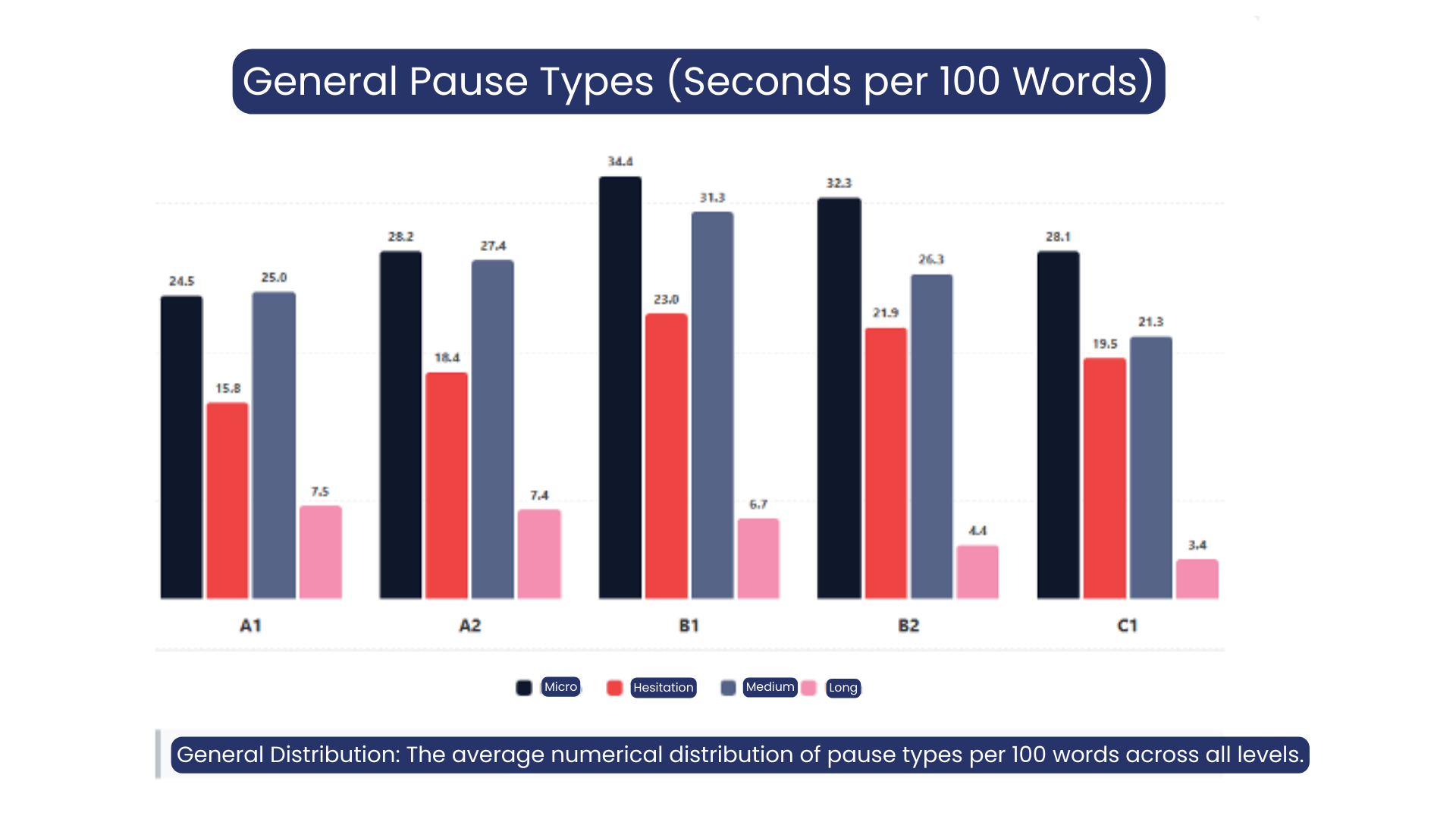
In summary, the “silence of not remembering a word” at the beginner stage gradually transforms into “pauses to organize your thoughts” at higher levels—turning your lessons from a slow-paced exchange into a fluent and natural conversation.
3.4. Vocabulary Diversity and Architecture: From Brick to Skyscraper
The words you use are the bricks of your language building. FLAI’s analyses reveal how the structure and variety of this material evolve as you move up through the levels.
1) Vocabulary Architecture
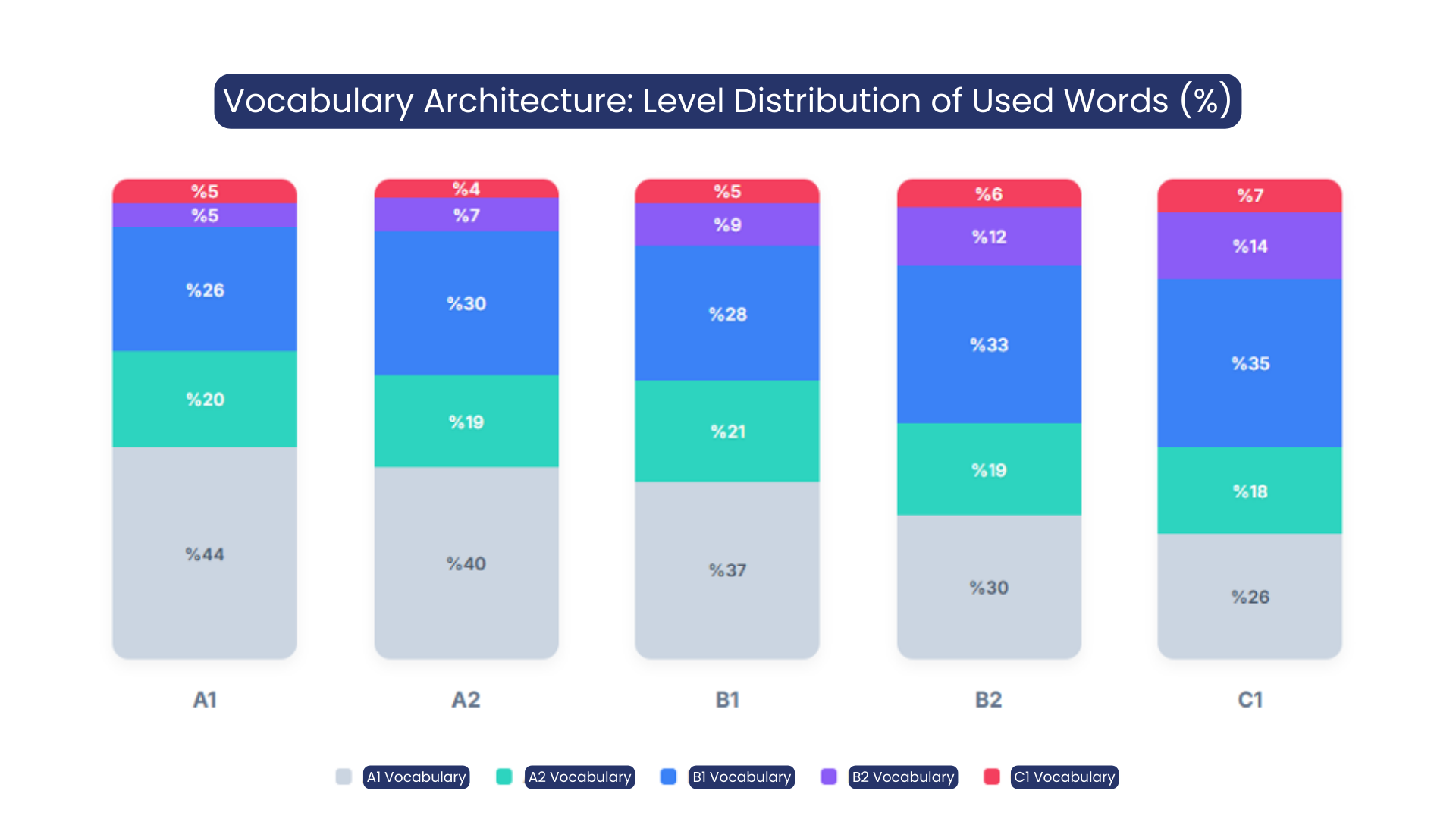
This chart shows the percentage of words students use during lessons, categorized by CEFR levels.
The results align perfectly with the natural progression of language acquisition.
A Levels (A1–A2) → Strong Dependence on Basic Vocabulary
- At A1, about 60–65% of the words used come from A-level vocabulary.
- At A2, this ratio decreases slightly, but basic words still make up the majority.
- Students at this stage communicate mostly through concrete objects, short words, and simple concepts.
B Levels (B1–B2) → Vocabulary Expands, Abstract Concepts Increase
- The share of A-level words drops significantly.
- B1–B2 vocabulary becomes dominant at around 30–35%.
- C-level words begin to appear for the first time, even if only in small amounts.
- At this stage, learners start moving beyond naming objects and begin using concepts and more abstract expressions.
C Levels (C1) → Advanced Vocabulary Usage
- Nearly half of the words used at this level come from B2–C1 vocabulary.
- A-level words decrease drastically.
- The majority now consists of abstract, academic, and conceptual vocabulary.
This clearly shows that C-level learners move beyond “everyday English” into academic and professional English.
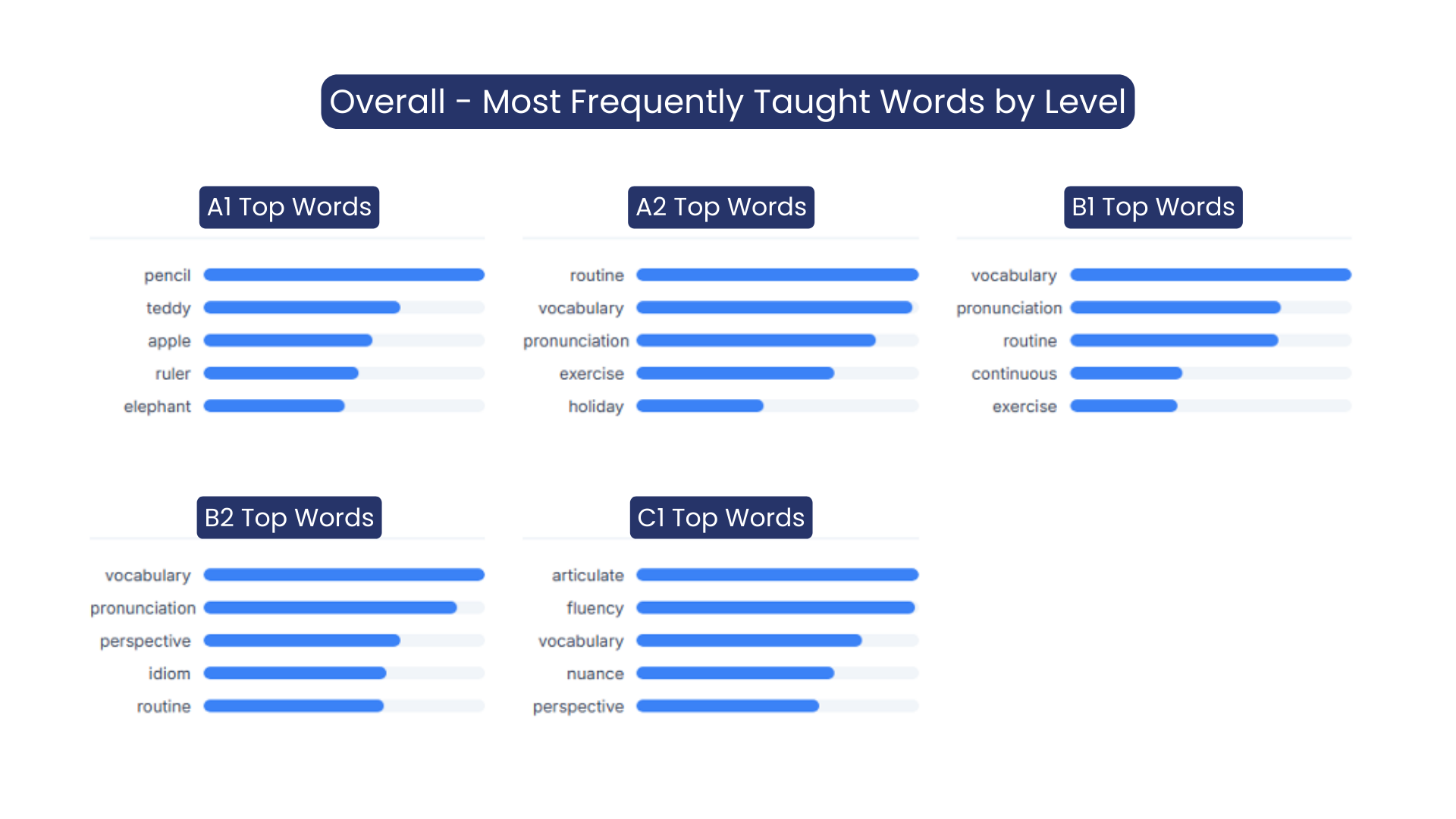
2) Overall (Adults + Kids) – Most Frequently Used Vocabulary by Level
The words you use are the bricks of your language building. But FLAI’s analyses reveal that the architecture of this building changes entirely depending on the age group and target audience. A child’s “vocabulary structure” and an adult’s “vocabulary structure” may belong to the same CEFR level, yet the materials words they’re built from can be completely different.
General Architecture (How Does the Structure Change?)
When we look at the “Vocabulary Architecture” chart that includes all users, we can clearly see how the proportions of vocabulary types shift as the level increases:
- Laying the Foundation (A1): At the beginning, nearly half (44%) of all words used come from the most basic level (A1).
- Transformation (B1–B2): By the time learners reach the intermediate stage, the proportion of basic words decreases, while more qualified and complex vocabulary (the blue and purple blocks) begins to make up over 60% of their language use.
- Peak (C1): At the advanced level, sentences start to be enriched with high-level, academic C-level vocabulary (the red block).
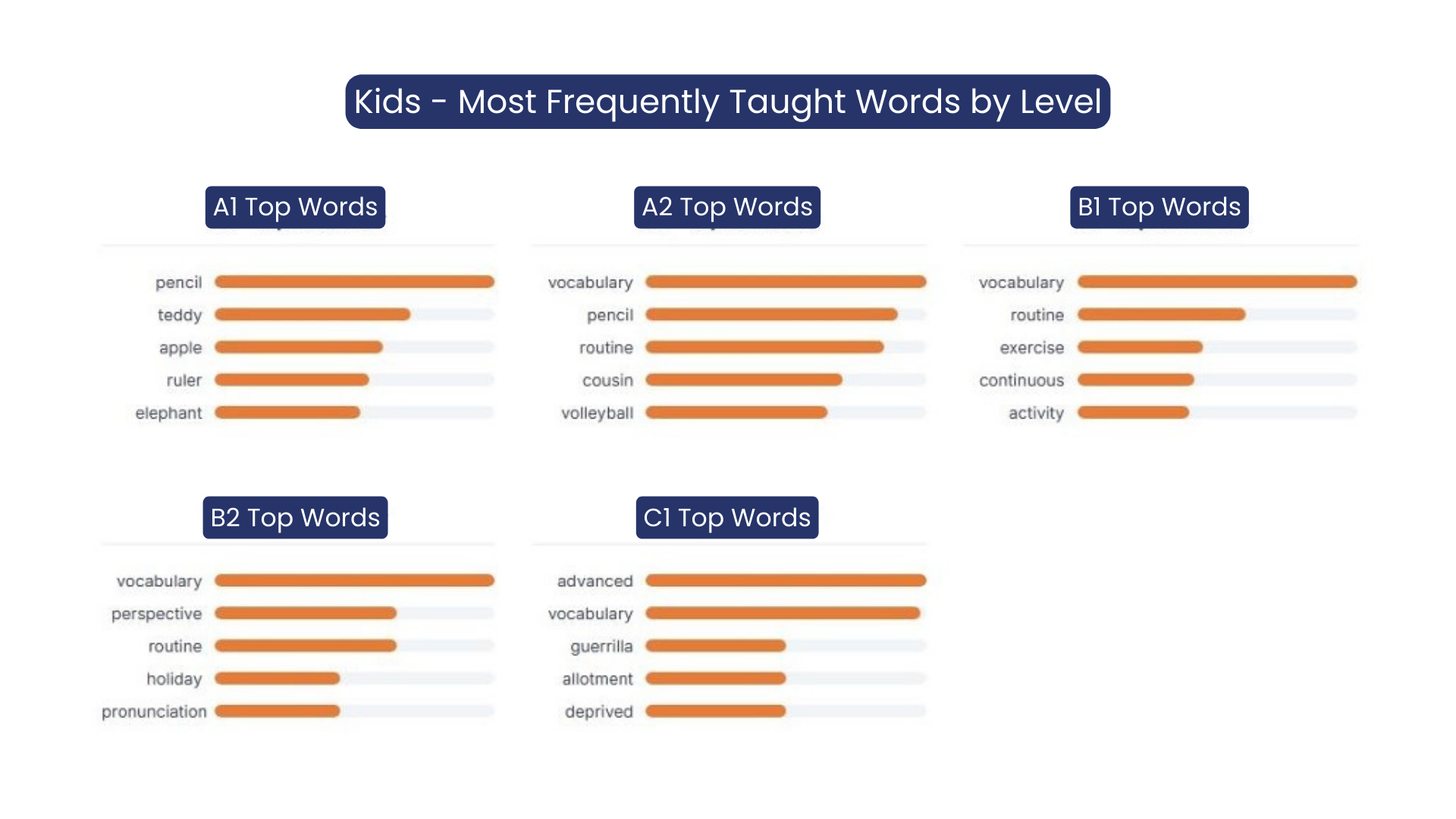
The lists of words most frequently learned by children reflect the way they perceive the world:
- A Levels (Play and School): At this stage, the top of the list includes concrete, tangible objects such as pencil, teddy, apple, and elephant. Children learn language through what they can see and touch.
- B and C Levels (Environment and Society): As they move into higher levels, instead of business-related terms like adults, they shift toward words that describe general culture and social life, such as community, various, and service. FLAI guides them through an “age-appropriate academic progression,” ensuring the complexity increases in a child-friendly way.
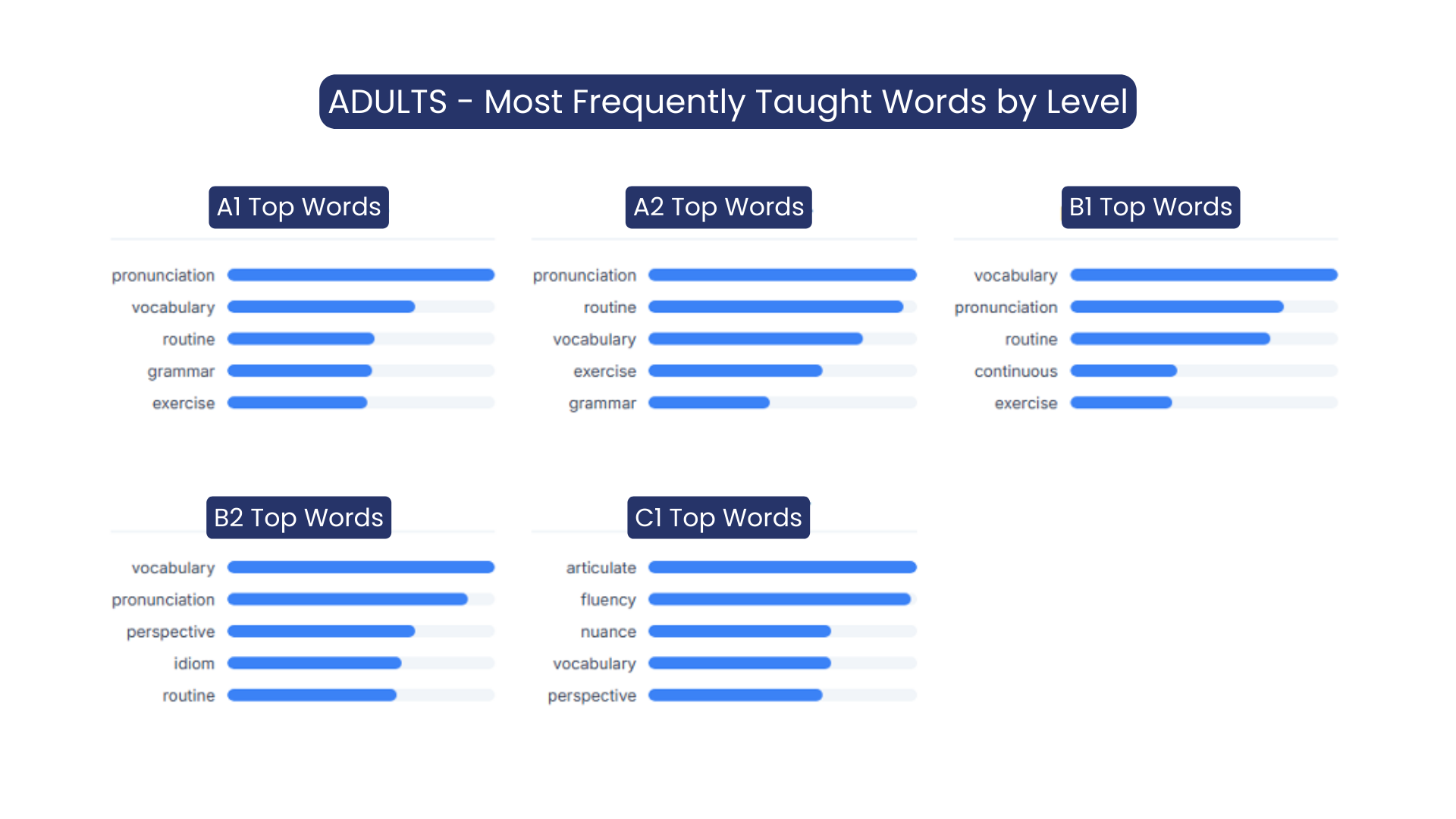
The World of Adults: From Functional to Abstract
The vocabulary journey of adults follows a much sharper and distinctly different path compared to children:
- A Levels (Meta-Learning): Even at the A1 level, adults tend to use functional words that describe the learning process itself such as pronunciation, routine, grammar instead of simple items like pencil.
- B and C Levels (Professional and Abstract): As the level rises, the gap widens significantly. At the C1 stage, adults’ vocabulary lists are dominated by highly abstract, professional, and academic words such as nuance, articulate, infrastructure, and fluency.
In summary: FLAI data proves that even though a C1-level child and a C1-level adult may know the same grammar rules, they actually speak two entirely different Englishes in terms of vocabulary. The system automatically personalizes the curriculum based on the needs of each age group.
3.5. Grammar Density: What Do We Focus On at Each Level?
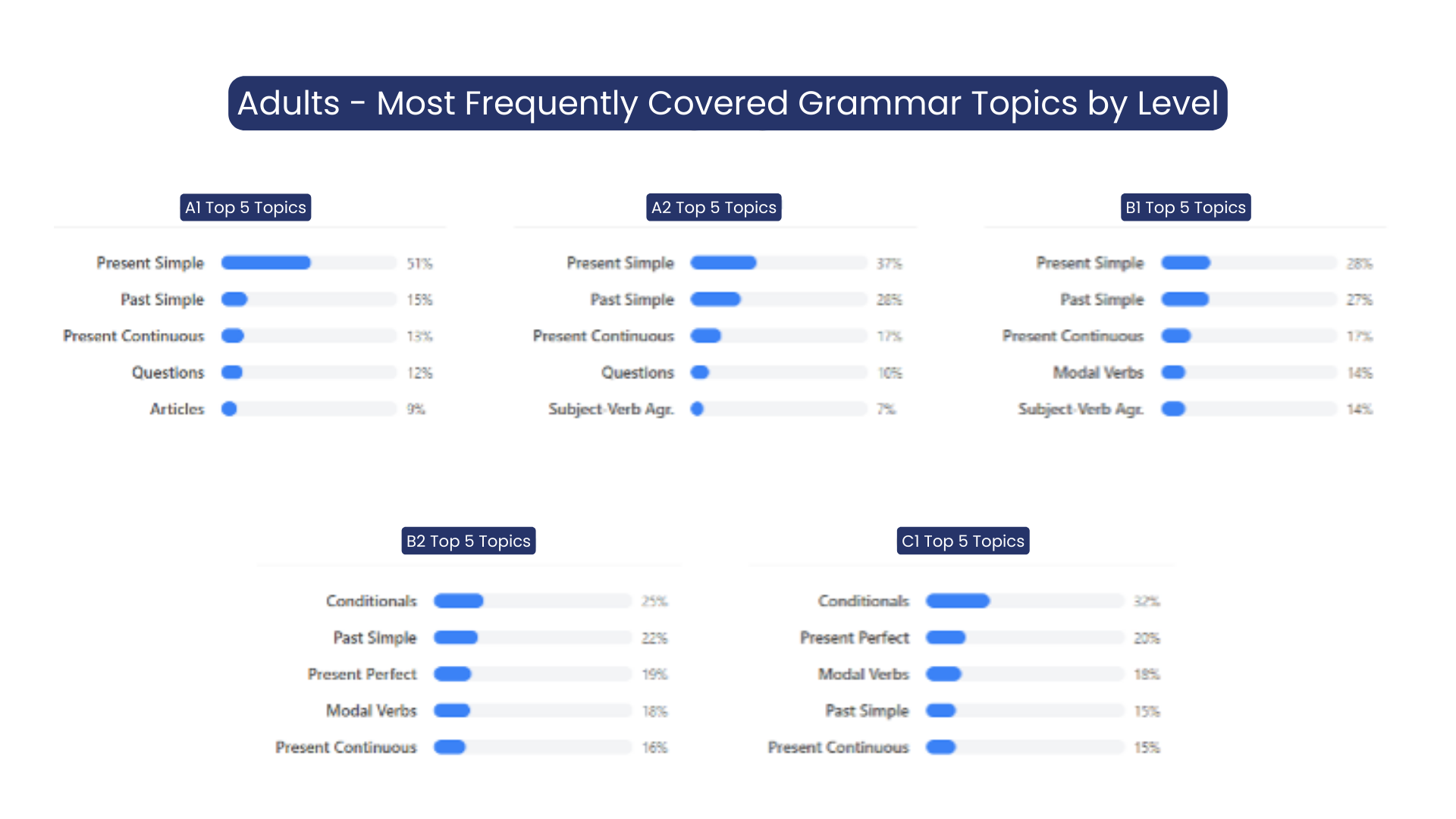
- Adults’ Path: Analytical and Functional The grammar progression for adults follows a much more technical and purpose-driven structure:
- Rapid Deepening: Starting from A2, adults move through grammar topics much faster. Basic structures that take longer for children are quickly replaced with “bridge tenses” such as Present Perfect.
- Complex Structures: In the B2 and C1 stages, adults work with topics like Conditionals and Passive Voice far more intensively than children. This reflects adults’ real-life needs—formality, probability expression, reporting language meaning FLAI prepares them early for business and academic communication.
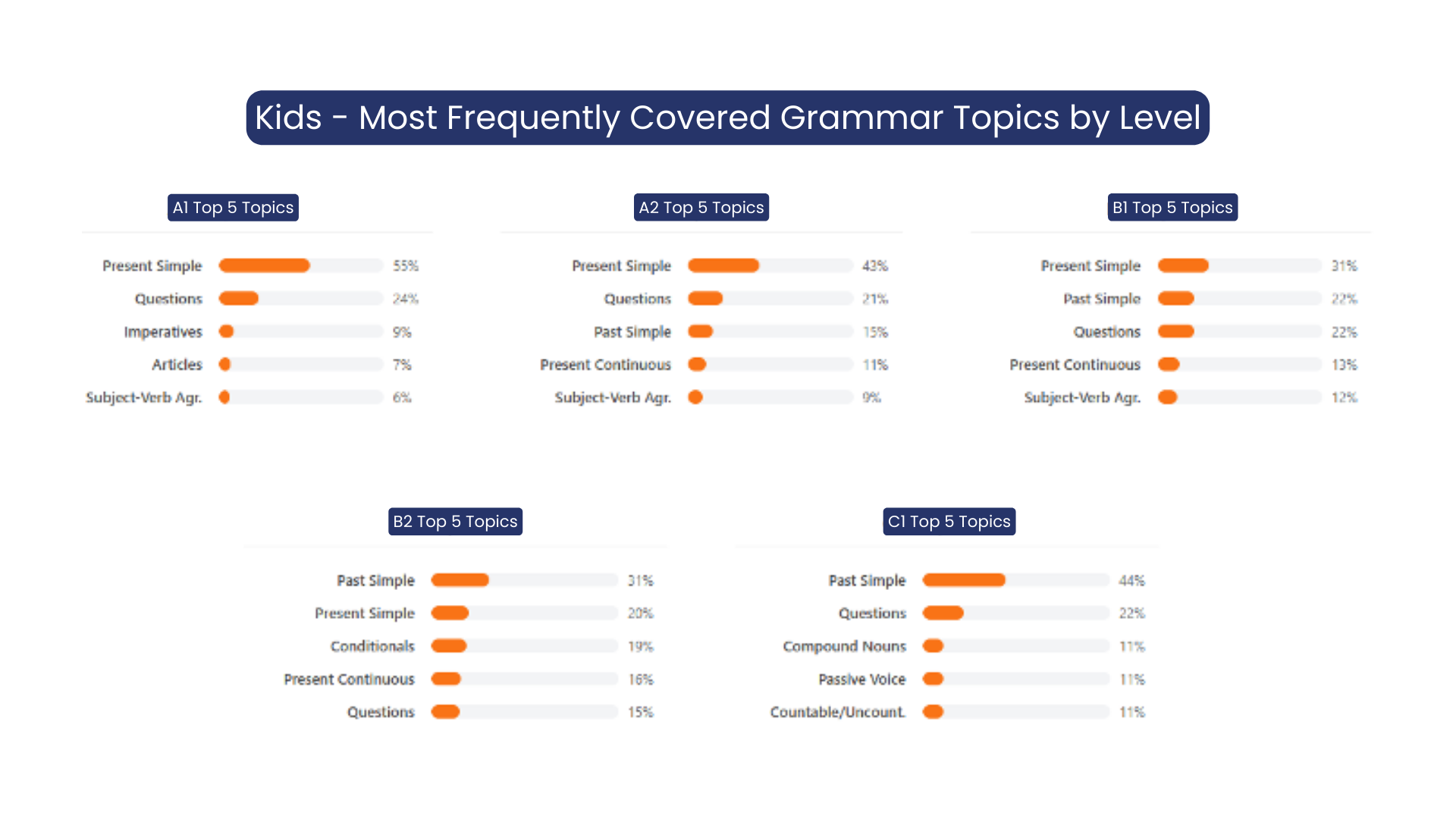
- Kids’ Path: Communication and Storytelling Focus Children’s grammar progression follows a more natural and communication-driven pattern—aligned with how they perceive the world:
- Question-Asking Skills: At A1 and A2, the “Questions” category is far more dominant for kids than adults. Children learn by asking questions, and FLAI places this natural curiosity at the heart of the grammar curriculum.
- Storytelling: As they enter the B levels, kids show a noticeable peak in Past Simple usage. For them, language isn’t a technical system it’s a tool for telling stories. Instead of complex structures like Passive Voice, active tenses that support narrative flow are prioritized.
3.6. Error Density: Don’t Fear Mistakes—The Data Says It’s Normal!
One of the biggest worries learners have is making mistakes. But our analysis proves that errors are simply a natural part of learning.
When we look at the “Errors per 100 Words” charts, we see a fantastic downward trend:
- A1–A2 Levels: Error rates are at their highest (around 3.0 per 100 words). Completely normal everything is new!
- B Levels: As learners reach intermediate stages, mistakes decrease noticeably and settle into a moderate range.
- C Levels: As fluency strengthens, error density drops to a minimum (even below 1.0).
FLAI’s data shows a simple truth: Progress = Practice + Mistakes.
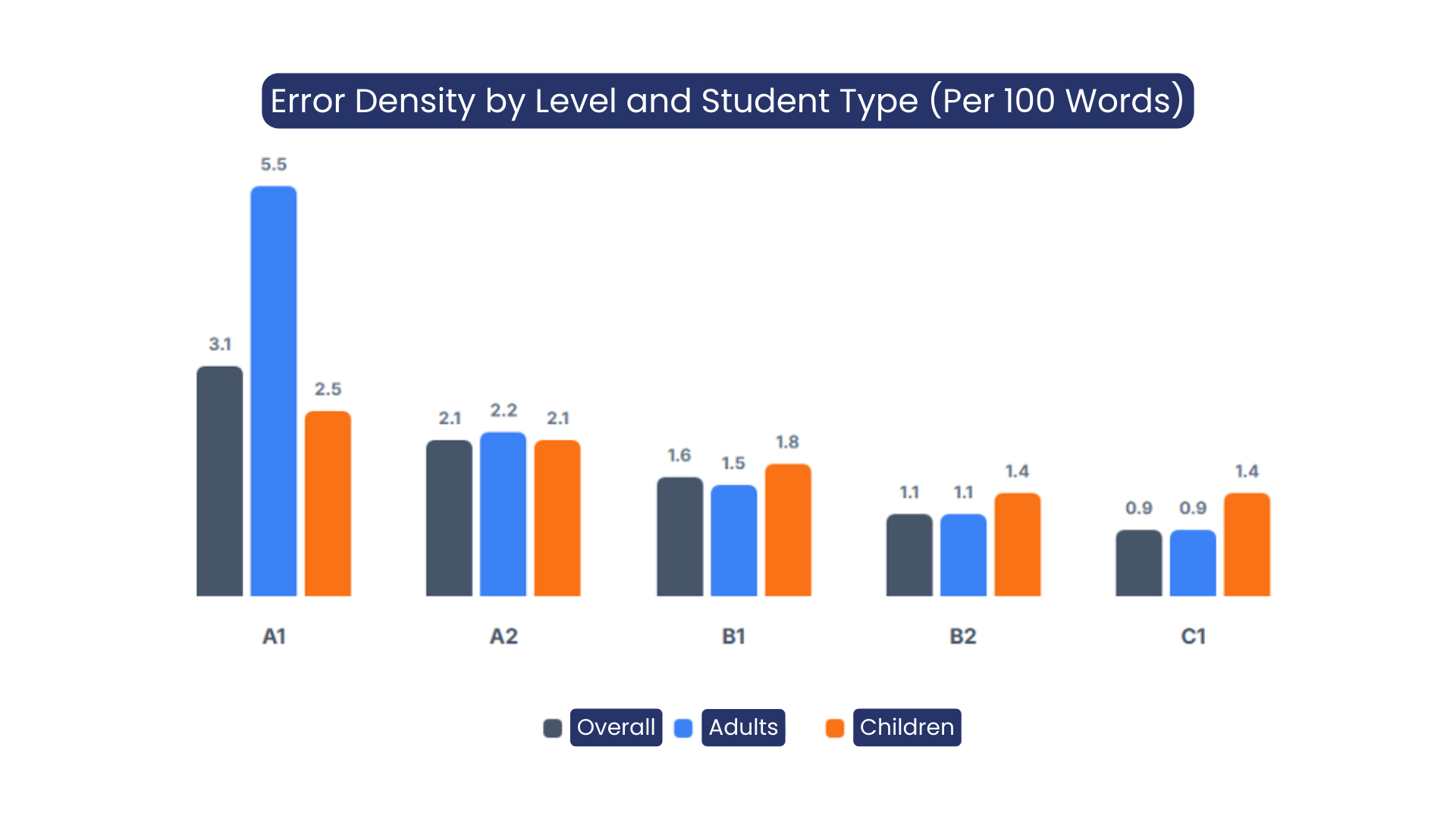
When we compare the KIDS and ADULTS charts side by side, we see that children’s error rates decrease in an almost perfectly linear pattern as their level increases. This data mathematically proves that confidence and accuracy grow steadily with each level advancement.
3.7. Level Transition Times and Progress Conversions
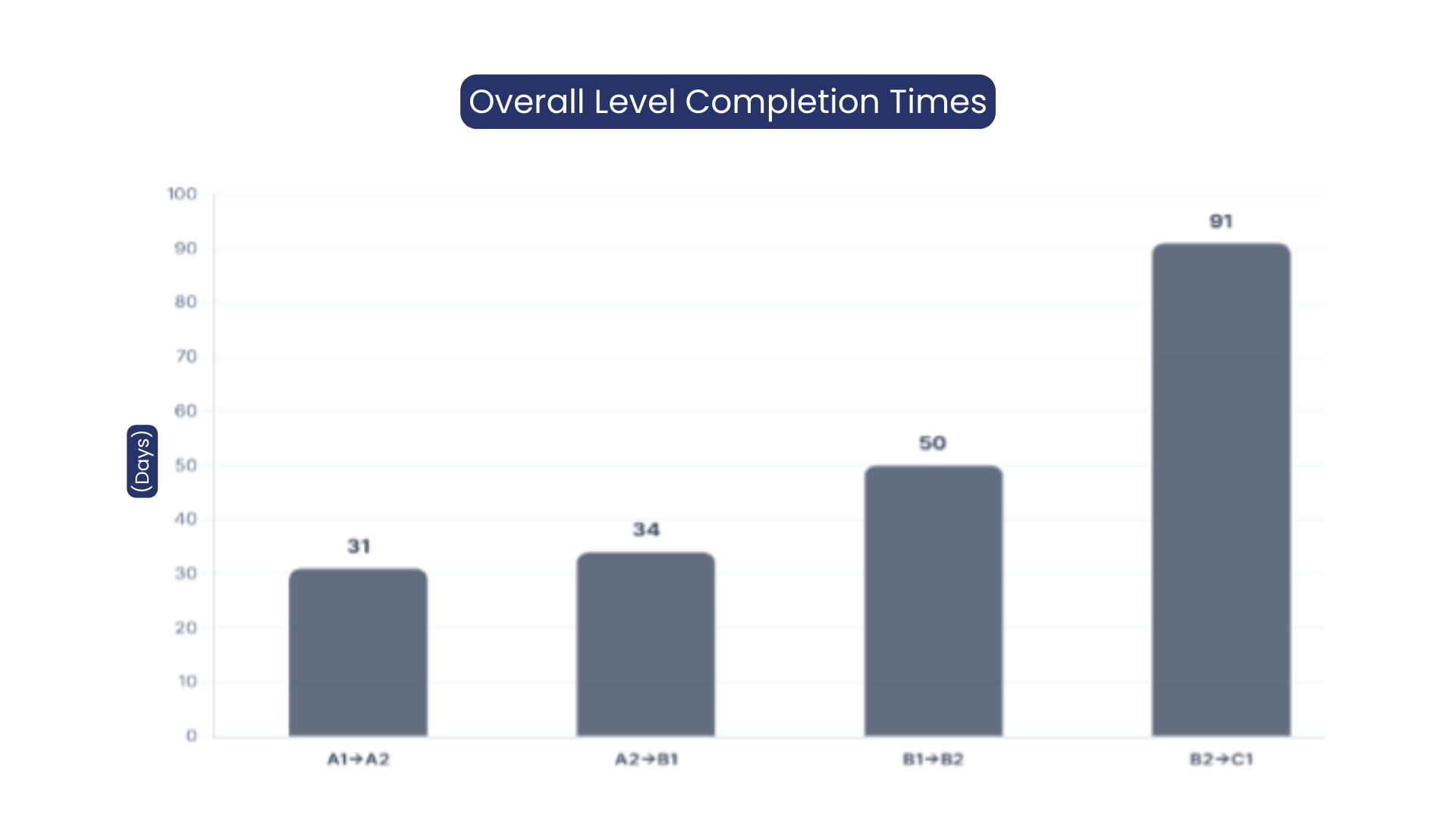
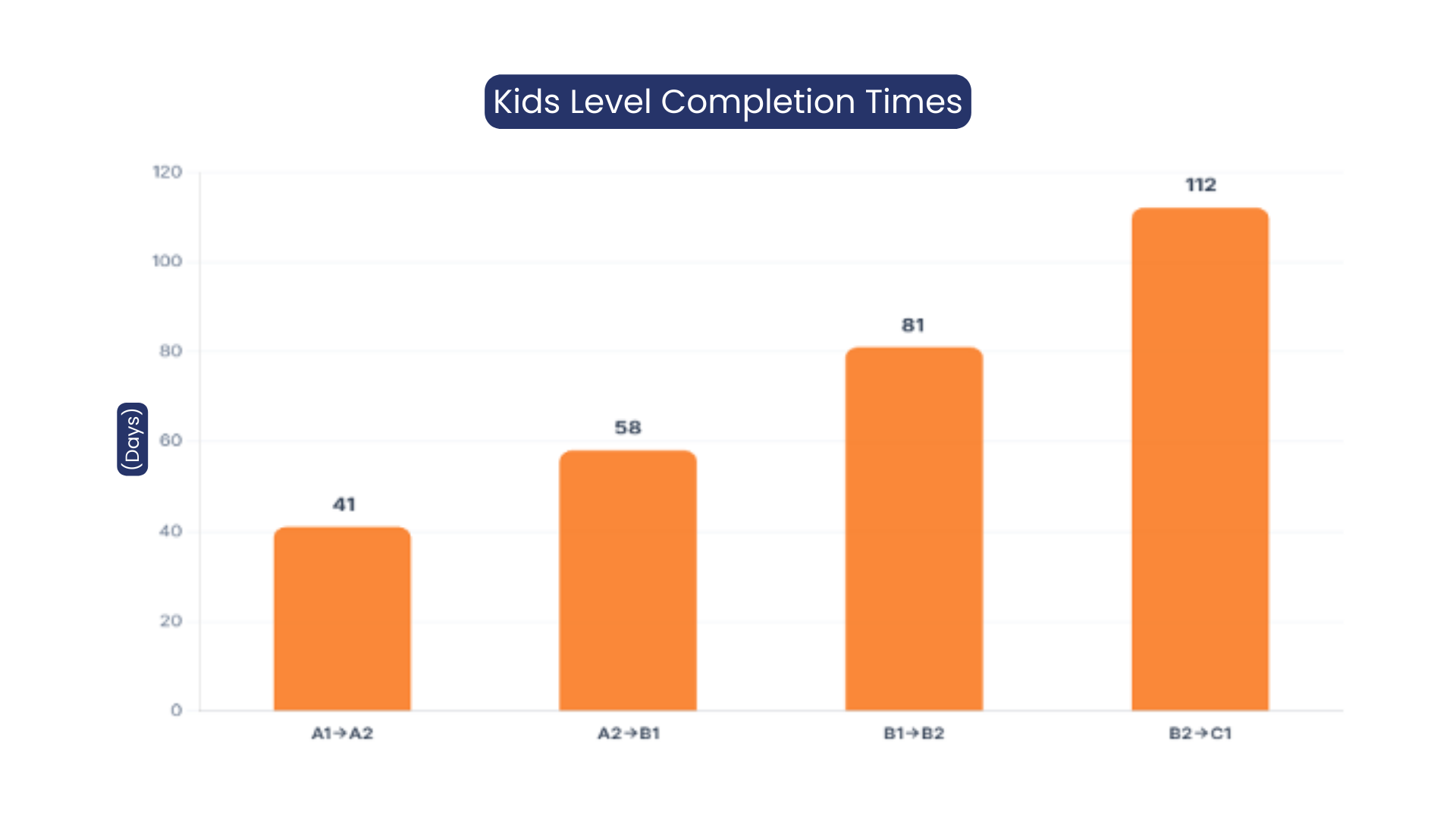
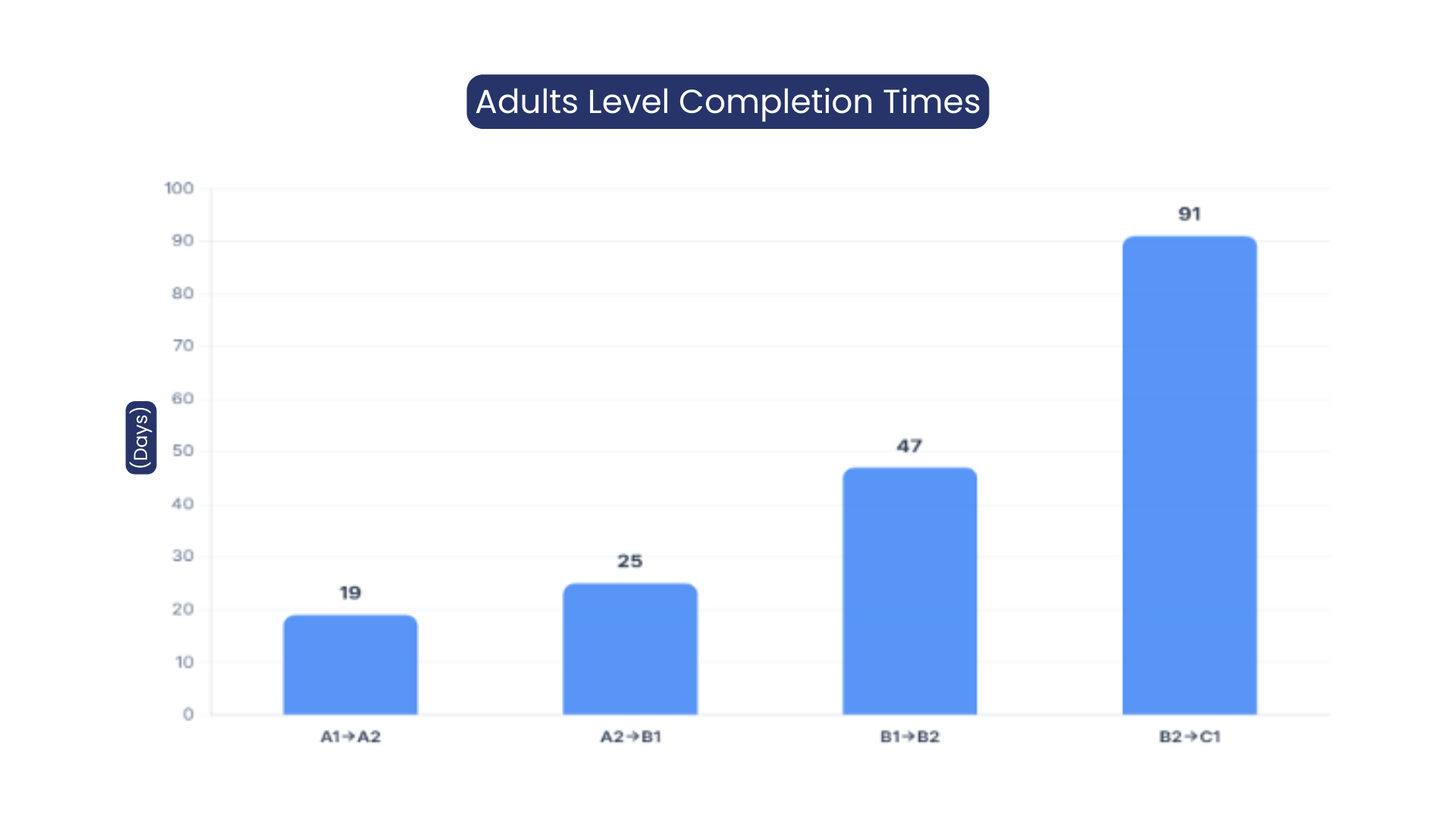
The answer to “How long does it take to learn English?” is also hidden in our data. Our analyses show that as learners move up the CEFR ladder, the time required to progress to the next level naturally increases.
Level-Up Durations
- Fast Progress at the Start (A1 → A2): Early transitions are quite quick—around 30–40 days on average.
- Slower at Higher Levels: As levels advance, the transition time increases significantly. For example, moving from B2 to C1 typically takes 90–110 days, simply because the grammar structures become more complex and the vocabulary range expands.
The Power of Time: 3-, 6- and 12-Month Transformation Analysis
Our progression data clearly shows that the biggest factor influencing student success is consistency:
- Month 3: Most learners haven’t made a huge level jump yet—they’re still in their adaptation phase.
- Month 6: A noticeable shift begins. The progress funnel starts to move.
- Month 12: This is where the magic happens. Students who stay consistent for a full year show remarkable transitions—for example, moving from a beginner level like A1 to intermediate or even upper levels such as B1–B2.
In short, the data says: Those who don’t give up, win.
Proficiency Levels of A1 Beginners After 3 / 6 / 12 Months
End of Month 3
End of Month 6
End of Month 12
From left to right: Month 3, Month 6, Month 12.
Proficiency Levels of A2 Beginners After 3 / 6 / 12 Months
End of Month 3
End of Month 6
End of Month 12
From left to right: Month 3, Month 6, Month 12.
Proficiency Levels of B1 Beginners After 3 / 6 / 12 Months
End of Month 3
End of Month 6
End of Month 12
From left to right: Month 3, Month 6, Month 12.
Level Advancement Success (%)
What percentage of students advanced at least 1 level?
Segment Success Rate (%)
4. Conclusion: The Power of Artificial Intelligence and the Human Touch
This report clearly demonstrates that Flalingo is not just a language-learning app—it is an AI-powered education coach driven by FLAI technology. After analyzing millions of data points, here’s what we uncovered:
- Speaking Ratio: As learners advance through the levels, their speaking time increases while the teacher gradually shifts into the role of active listener.
- Dynamic Speed Adjustment: Instructors consciously adapt their speaking pace based on the learner’s speed and proficiency.
- Vocabulary Growth: The number of unique words used rises in perfect correlation with CEFR levels.
- Structured Curriculum: Grammar topics aren’t random—they’re introduced systematically according to level requirements.
- Natural Development: Error rates decrease as levels go up, proving that real learning is taking place.
- The Reward of Consistency: Long-term learners (12 months or more) show significantly higher advancement rates compared to short-term participants.
In essence, AI-driven insights allow us to optimize teacher performance while tracking the learner’s journey down to the smallest detail.The Flai Report shows that personalized learning isn’t a luxury it’s the key to real success.
FLAI (Flalingo AI) — Frequently Asked Questions
What difference does FLAI technology make in learning English?
At which level do learners struggle the most?
How long does it take to move up to the next level?
Do adults and kids use different vocabulary at the same level?
How does making mistakes affect learning?
İlgini çekebilecek diğer içeriklerimiz

Flalingo vs ELSA Speak and Other AI English Apps: What's Missing from AI-Only Learning?
Devamını oku
Flalingo vs Cambly: Which Online English Platform Is Right for You?
Devamını oku
Mert Afacan is a results-oriented professional with in-depth expertise in business development, strategy and operational management. Throughout his career, he has led corporate growth processes by focusing on data analytics, process optimisation and market expansion strategies. Known for his ability to simplify complex problems with innovative solutions, Afacan brings a visionary perspective to his projects by closely following sectoral transformations. His approach, which combines discipline in strategic planning with operational speed, distinguishes him as a manager who makes a difference and creates value in the dynamic business world.
Flalingo ile İngilizce

Flalingo ile İngilizce öğrenmek, birbiriyle entegre çalışan akıllı bir sistemle ilerlemektir.