
本文へ移動
Flalingo

英語の練習

英語で食べ物の思い出を語るには(C1+上級プラス):感覚の語彙、食べる・飲む動詞、正直なディテール

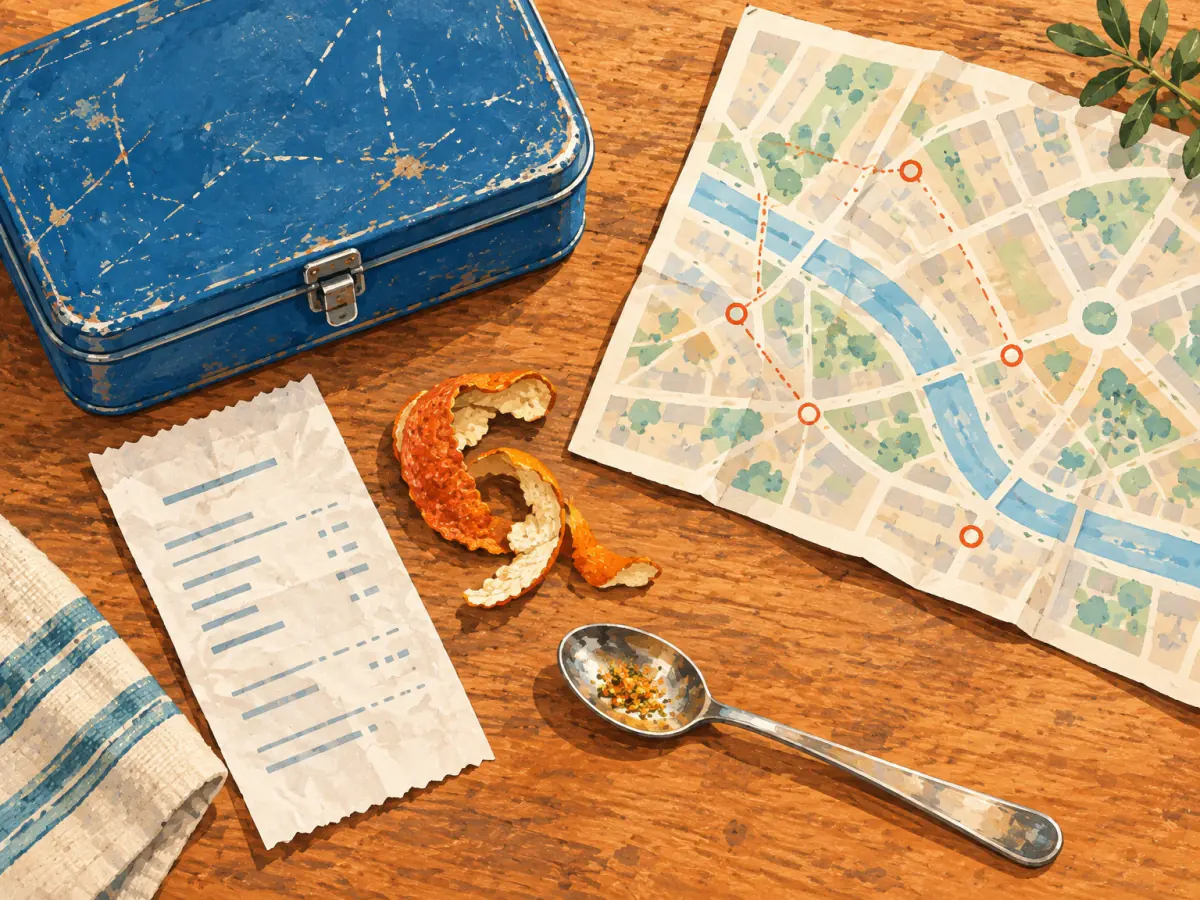
A blue lunch tin, receipt, citrus peel, spoon and marked map lie together on a desk.

C1+(上級プラス)レベルで、食べ物がよみがえらせた記憶を英語で語る方法:においと味を正確に表す語、食べる・飲む動詞、5つの短い母音、そして覚えていることと確かめられることを分ける方法を学びます。

食べ物の思い出を英語でうまく語るには、記憶のきっかけから始め、感覚を正確な語で表し、覚えていることと確かめられることを分けます。“whiff”は一瞬感じるかすかなにおい、“aroma”はたいてい心地よい香りで、“sip”“slurp”“guzzle”はそれぞれ違う飲み方です。鮮明だからといって正確とは限らないので、確信の度合いを示しましょう。“I suspect it was me that had changed.” このテーマはC1+(上級プラス)レベルで、正確で誠実に語りたい、流暢に話せる大人向けです。

この記事が向いている人

  • 英語は流暢でも、食べ物を“eat”“drink”“nice”“smell”など同じ数語でしか表現できない上級の大人。
  • 英語で話を語る人:雑談、面接、ポッドキャスト、オーラルヒストリーや家族の記録づくりなど。
  • 特に他の人が登場する話で、誇張せずに生き生きと語りたい人。
  • まだ早い場合:根拠で主張を支えることがまだ難しいなら、映画観光と管理費用を結びつけるC1のエッセイから始めましょう。
  • 簡単すぎる場合:正確な動詞や慎重な言い方がすでに自然に出るなら、対比の強勢で文化的な一般化を正す練習や、一人で働くことについてのバランスのよい意見に進みましょう。

サンプルページを開く

サンプルページを開く

単語カード

Personal · a taste of the past

Is there a dish that instantly brings back a particular place or person for you? What exactly do you remember about it?

Useful: ‘The moment I catch a whiff of…, I’m back in…’ · ‘If I had to recreate it, I’d start with…’ · ‘What I remember most vividly is…’

Personal · going back

Have you ever gone back to a food or a place from your past and found it was not as you remembered? What had changed, it or you?

Useful: ‘Had I known…, I might not have gone back.’ · ‘It tasted nothing like…’ · ‘I suspect it was me that had changed.’

会話

Gammon, cabbage, carrots, pineapple: the vowel in cat.

Herring, pepper, cherries, lettuce: the vowel in bed.

Sniff, dill, dribble, kipper: the vowel in sit.

Scoff, chopped, broccoli, porridge: in British English, the vowel in hot.

Guzzle, stuffed, mussels, Brussels sprouts: the vowel in cup.

After a w sound, the written a in swallow, quarrel, swapped, squabble, quarry and waddle sounds like the vowel in hot.

Sip becomes sipped, and hot becomes hotter: double the final consonant after one stressed short vowel before a vowel-initial ending.

文の形

Sensory meanings

  • sniff (noun or verb) — a short act of breathing in through the nose to detect a smell: “Owen gave the tin a cautious sniff before describing it.”
  • whiff — a slight smell that is noticed briefly: “A whiff of scorched peel escaped when Maya lifted the felt.”
  • aroma — a noticeable smell, often a pleasant one associated with food or drink: “The tea left a warm citrus aroma inside the tin.”

追加の練習

Eleven actions, not eleven synonyms

Mouth and throat actions

  • chew — bite food into pieces and move it around the mouth: “Chew the dried pear before judging its texture.”
  • lick — move the tongue over a surface: “Maya licked sauce from the tasting spoon.”
  • suck — keep something in the mouth and pull on it with the lips or tongue: “Owen sucked a mint during the journey.”
  • swallow — make food or drink pass down the throat: “She swallowed the capsule with water.”

Quantity, speed and attitude

  • devour — eat all of something quickly because of strong hunger: “After the night shift, Maya devoured the rice bowl.”
  • guzzle — informally and disapprovingly drink, or sometimes eat, a large amount quickly: “He guzzled two energy drinks during the briefing.”
  • scoff — informally and disapprovingly eat a lot very fast: “They scoffed the pastries before the guests arrived.”

Sound, size and rhythm

  • munch — eat steadily and often noisily, especially something crisp: “She munched raw carrots while editing.”
  • nibble — take small bites: “He nibbled a corner of the unfamiliar cheese.”
  • sip — drink a very small amount at a time: “Maya sipped the hot broth cautiously.”
  • slurp — make a loud noise while drinking: “Owen slurped the noodles and apologized.”

The blue lunch tin

A blue lunch tin, receipt, citrus peel, spoon and marked map lie together on a desk.

When sound archivist Owen opened a donated blue lunch tin, a faint aroma of scorched orange peel escaped from its lining. He held the tin beneath his nostrils—the two openings at the end of the nose through which a person breathes—and sniffed once more. The whiff made him picture his first radio job: a windowless studio, a nervous producer and a winter broadcast interrupted by a fire alarm. He was certain the producer had brought citrus cake that afternoon. The memory felt complete, down to the sugar on his fingers.

Instead of putting that recollection into the public catalogue, Maya asked him to test it. They sniffed the tin again, examined the hinge and found a bakery receipt trapped beneath the felt. Its date was six years later than Owen’s broadcast. A former owner then explained that she had carried smoked-orange tea in the tin during overnight bus shifts. The smell had not recovered Owen’s event; it had supplied vivid detail to a different event that already mattered to him.

At a tasting session the next day, a sharp sweet made Owen’s taste buds—the small structures on the tongue that detect flavours—react strongly. Lemon syrup began to dribble, or run in a thin stream, from the corner of his mouth. This intense sensation produced no confident story at all. The contrast persuaded him that intensity is not proof of accuracy. The archive now records sensory memories in two layers: the recollection itself and the independent evidence, if any, that supports it.

Sensory meanings

  • sniff (noun or verb) — a short act of breathing in through the nose to detect a smell: “Owen gave the tin a cautious sniff before describing it.”
  • whiff — a slight smell that is noticed briefly: “A whiff of scorched peel escaped when Maya lifted the felt.”
  • aroma — a noticeable smell, often a pleasant one associated with food or drink: “The tea left a warm citrus aroma inside the tin.”

Record a responsible sensory memory

A blue lunch tin, receipt, citrus peel, spoon and marked map lie together on a desk.
この単元を学ぶ
どの方法で学びますか?
アカウントをお持ちですか?

無料アカウントで1つの単元をずっと開いておけます。

においと味:正確な6つの語

記憶はにおいから始まることが多いので、正確な名前で呼びましょう。日本語にも「匂い」「臭い」「香り」の使い分けがあるように、英語もにおいの長さや快・不快で語が変わります。

  • “sniff”:鼻から短く息を吸い込むこと。動詞にも名詞にもなります。
  • “whiff”:一瞬感じるかすかなにおい。“I caught a whiff of smoke.”
  • “aroma”:食べ物や飲み物の、はっきりした、たいてい心地よい香り。“the aroma of fresh coffee” 不快なにおいには“odour”、ひどく強ければ“stench”を使います。
  • “nostrils”:鼻の穴。
  • “taste buds”:舌にある、味を感じ取る小さな器官(味蕾)。
  • “dribble”:多くは口から、細く垂れて流れること。“Lemon syrup dribbled from the corner of his mouth.”

“eat”と“drink”をもっと正確に

動詞ごとに量、速さ、音、態度が加わります。“guzzle”と“scoff”は批判的に響き、この意味の“scoff”は主にイギリス英語です。

  • 口の動き:“chew”(かむ)、“lick”(なめる)、“suck”(しゃぶる、吸う)、“swallow”(飲み込む)。
  • 空腹と速さ:“devour”(おなかがすいて一気に平らげる)、“guzzle”(大量にがぶがぶ飲む)、“scoff”(大量にがつがつ食べる)。“We scoffed the pastries before the guests arrived.”
  • 大きさと音:“nibble”(少しずつかじる)、“munch”(むしゃむしゃ、たいてい音を立てて食べる)、“sip”(ちびちび飲む)、“slurp”(音を立ててすする)。“He slurped his noodles and apologised.”
  • 食べ始め:“dig in”(「さあ、どうぞ」という勧めによく使う)と“tuck into”(勢いよく食べ始める)。
  • 食べ終わり:“eat up”(自分の分を全部食べる)、“polish off”(残りを平らげる)、“put away”(驚くほどたくさん食べる)、“wolf down”(がつがつかき込む)。
  • 食欲がないとき:“pick at”(少しずつつつく)と“toy with”(料理をいじり回す)。“She toyed with her pasta while she waited for the news.”

覚えているディテールと確かめられるディテール

強いにおいは一つの場面を丸ごとよみがえらせ、確信まで与えますが、強烈さは証拠ではありません。寄贈された弁当箱から焦げたオレンジの皮のにおいをかぎ、初めての職場で食べたケーキを「思い出した」アーキビストを想像してください。箱の中のレシートは、彼が思い出した日の6年後のものでした。においは本物でしたが、物語はそうではありませんでした。

記憶は層に分けて語りましょう。

  • きっかけは生き生きと:“What I remember most vividly is the steam on the windows.”
  • 信じていることは記憶として示す:“I’m fairly sure it was a Sunday, but I couldn’t swear to it.”
  • 確かめられること:写真、レシート、日付、ほかの人の話。
  • 変わったこと:“It tasted nothing like I remembered.”

過去に戻る表現と、その文法

表現をまるごと覚えましょう。

  • “The moment I catch a whiff of…, I’m back in…” “the moment”は“as soon as”、つまり「〜するとすぐに」の意味で、現在形が毎回繰り返す経験であることを示します。
  • “If I had to recreate it, I’d start with…” 想像上の課題について話す仮定法過去です。
  • “Had I known…, I might not have gone back.” 倒置した仮定法過去完了で、“Had I known”は“If I had known”、つまり「知っていたら」の意味です。
  • “I suspect it was me that had changed.” 焦点を食べ物から自分へ移す強調構文(分裂文)です。
自分に合った方法でこの単元を学ぶ

聞いてみよう:食べ物の単語にある5つの短い母音

各行の単語は同じ短い母音を持ち、重なった子音字がたいていその短い母音の目印になります。“dinner”と“diner”を比べてみましょう。“chopped”や“hotter”で子音を重ねるのも同じ理由です。日本語の母音は5つなので、“cat”と“cup”の母音がどちらも「ア」になりがちです。“cabbage”の最初の母音は「ア」と「エ」の中間で、口を大きく開けて出します。“hot”の行はイギリス英語の発音で、アメリカ英語ではもっと開いた母音になります。

Gammon, cabbage, carrots, pineapple: the vowel in cat.

Herring, pepper, cherries, lettuce: the vowel in bed.

Sniff, dill, dribble, kipper: the vowel in sit.

Scoff, chopped, broccoli, porridge: in British English, the vowel in hot.

Guzzle, stuffed, mussels, Brussels sprouts: the vowel in cup.

よくある間違い

語りの中で次の点を確認しましょう。

  • “It smells well.” “It smells good.”と言います。“smell well”は「嗅覚がよい」という意味です。
  • “an awful aroma” “aroma”はふつう心地よい香りなので、“an awful smell”と言います。
  • “I drank my soup.” 日本語ではスープを「飲む」と言いますが、スプーンを使うなら英語ではふつう“eat soup”か“have soup”です。
  • “choped”や“hoter”。子音を重ねて“chopped”“hotter”とします。
  • 鮮明なディテールを事実として語ること:“My aunt made it every Friday.” よりよい言い方:“I remember it as a Friday dish, but I may be mixing up two visits.”

1日15分の練習法

まず話し、直すのはあとにしましょう。

  • 3分:録音された5行を繰り返し、各行から1語ずつ選んで文を作ります。
  • 4分:昨日の食事を、この記事の動詞5つで描写します。“eat”と“drink”は使いません。
  • 4分:上の表現を2つ使って、自分の食べ物の思い出を録音します。
  • 4分:聞き返して、ディテールごとに「記憶」か「確認可能」かを書き込み、もう一度語ります。そのあと、この問いについて話し合いましょう。“Is a memory that is partly rebuilt or invented still true in any meaningful sense?”

次のステップ

同じ慎重さをほかの主張にも向けましょう。間違っている部分を正確に強調して文化的な一般化を正す、全体が増える中で下がる割合を説明する、一人で働くことについてバランスのよい意見を書く、といった練習がおすすめです。

よくある質問

“whiff”と“aroma”の違いは何ですか?

“whiff”は快・不快に関係なく、一瞬感じるかすかなにおいです。“aroma”ははっきりした、たいてい心地よい香りで、主に食べ物や飲み物から漂います。

“sip”“slurp”“guzzle”の違いは何ですか?

“sip”は少しずつ飲むこと、“slurp”は音を立てて飲むこと、“guzzle”は大量に急いで飲むことで、たいてい非難の気持ちを含みます。

誇張せずに英語で思い出を語るにはどうすればいいですか?

きっかけは生き生きと語り、“I’m fairly sure”や“I suspect”などで確信の度合いを示しましょう。そして、覚えていることと、写真やレシート、ほかの人が確かめられることを分けます。

この単元を学ぶ
どの方法で学びますか?
アカウントをお持ちですか?

無料アカウントで1つの単元をずっと開いておけます。

次は何をしましょうか?

Flaiで練習を続けよう

Flaiは、音声会話、訂正内容、レッスンレポートでスピーキング練習を支えるFlalingoのAIアプリです。

ライブの先生と学ぶ

Flalingoのレッスンでは、このような単元をライブの先生とマンツーマンで練習します。